Anmeldung in Germany 2026: How to actually get a Bürgeramt appointment in Berlin, Munich, Hamburg
Anmeldung in Germany 2026: how to actually get a Bürgeramt appointment in Berlin, Munich and Hamburg. Wait times, documents, fines, online route.

Table of contents
Last updated: May 2026
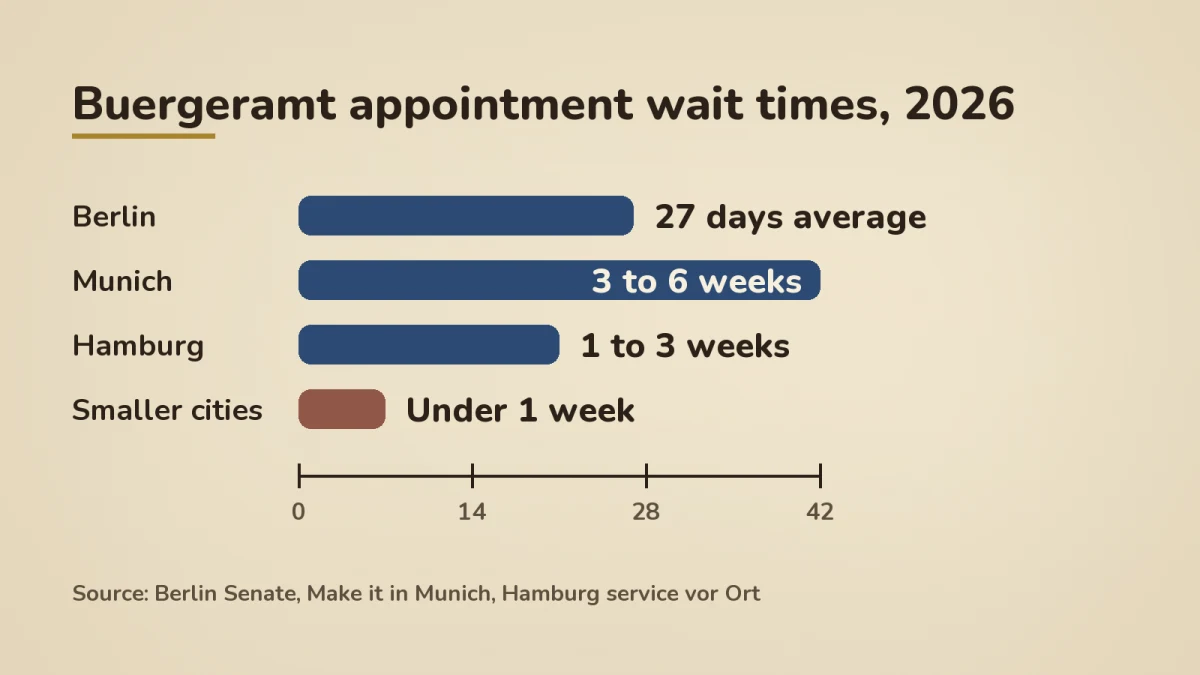
TL;DR: Anmeldung is the legal address registration every resident in Germany must complete within 14 days of moving in. The bottleneck is not the rule, it is the appointment. In 2026, Berlin runs on roughly a 27-day average wait, Munich on 3 to 6 weeks at the KVR Bürgerbüro, and Hamburg drops fresh slots twice a day at 7 a.m. and 10 a.m. via Hamburg Service vor Ort. Refresh tactics, off-district bookings, and (for EU citizens in Berlin) the new online route are how you actually get in.
If you have just landed, registered a new lease, or moved between Bundesländer, you have 14 days to file your Anmeldung. The clock is set by § 17 Abs. 1 of the Bundesmeldegesetz (BMG); miss it and the fine can climb to €1,000 in theory. In practice the real penalty is downstream: no tax ID, no permanent bank account, no SIM contract, no residence permit pickup, no salary processing. Everything in your first month in Germany routes through the Anmeldebestätigung sheet you walk out of the Bürgeramt with.
This guide is the /live/anmeldung playbook for 2026, focused on the three cities where the appointment crunch is real: Berlin, Munich, and Hamburg. Smaller cities (Cologne, Leipzig, Stuttgart, Frankfurt, smaller towns) move faster; the tactics below still help, but the wait is rarely the blocker. For the basic step-by-step framing aimed at first-time student arrivals, see our existing residence registration guide.
What Anmeldung is and why the 14-day clock is non-negotiable
Anmeldung is the act of telling the German state, via the local Einwohnermeldeamt (citizen registration office), that you live at a specific address. Until you file it, you do not legally exist in the system. The slip you walk out with, the Anmeldebestätigung, is the document everything else is keyed to.
Three rules to fix in your head:
- The 14-day clock starts the day you move into the residence, not the day you land in Germany. If you stay in temporary housing (an Airbnb, a friend's couch, a hotel) for the first three weeks, those days do not count against the deadline. The countdown begins when you have the keys to your actual lease and have moved in. Source: § 17 Abs. 1 BMG.
- The fine for late registration can reach €1,000 under § 54 BMG. Realistically, first-time arrivals who can show they tried to book an appointment (screenshots help) are usually waved through with no fine, sometimes a verbal warning. Repeat offenders or anyone caught lying about move-in date is treated less kindly.
- Your landlord must hand you a Wohnungsgeberbestätigung within 14 days of move-in. This is a one-page confirmation of residence (landlord name, your name, address, move-in date). The Bürgeramt will not register you without it. If your landlord refuses or stalls, that is itself a fineable offence under § 19 BMG. Print the form yourself, fill it in, and ask them to sign.
Once you have the Anmeldebestätigung, you can finally open a permanent German bank account, apply for or pick up your residence permit, get a postpaid SIM contract, receive your tax ID by post (4 to 6 weeks), and let your employer set the right Lohnsteuerklasse.
Berlin: how to actually get a Bürgeramt appointment in 2026
Berlin is the most-asked-about city for a reason. The capital ran 4 to 12 week waits between 2022 and 2024, peaked during the post-pandemic backlog, and has since clawed back. According to the Berlin Senate, the average appointment wait dropped to 27 days in July 2025, down from 33 days the year before, after staffing increases and process changes. By early 2026 that average is holding, with significant variance: some Bezirke release slots within 7 to 10 days, others stay closer to 35.
The booking portal is service.berlin.de (search for "Anmeldung einer Wohnung"). Slots open across all 12 Bezirke pooled, so you can book any office, regardless of where you live. This is the single most important Berlin tactic: do not search only your nearest Bürgeramt.
Berlin booking tactics that actually work
- Refresh aggressively in the morning. Cancellations and new slot releases concentrate between 7 a.m. and 11 a.m. local time. Set up a tab on
service.berlin.deand reload every few minutes. The system does not penalise refreshes. - Search every Bezirk, not just yours. A Bürgeramt slot in Spandau or Marzahn-Hellersdorf is just as valid as one in Mitte. The S-Bahn ride is a one-time cost; missing the 14-day window is a recurring one.
- Try Tuesdays and Wednesdays. Mondays clear weekend cancellations; Tue and Wed tend to have the deepest fresh-slot pool because Friday afternoons release the next-week schedule.
- Use a third-party slot watcher only if you accept the risk. Telegram bots and Twitter accounts that broadcast new Berlin slots exist; the official advice is not to use them, and the city occasionally rate-limits them. They work, but you may compete with hundreds of other watchers for the same release.
- Walk-in is essentially dead. Most Berlin Bürgerämter no longer accept walk-ins for Anmeldung. The few that do (rotates by Bezirk and season) require lining up at 6 a.m. for a same-day ticket. That is practical only if you are already past your 14 days and need a paper trail.
The new online Anmeldung route (EU citizens only, for now)
In late 2024, Berlin launched a fully online Anmeldung process. As of 2026 it works only if you meet all of these conditions: you are an EU/EEA/Swiss citizen, you have an activated eID on your national ID card, you have a BundID account at id.bund.de, and you are moving from one German address to another (not arriving from abroad for the first time).
That eliminates most non-EU readers of this guide. If you do qualify, the online flow takes 10 to 15 minutes and the digital Anmeldebestätigung lands in your BundID inbox within a couple of working days. Other German cities are piloting similar OZG-based flows; expect Hamburg and Munich to follow within 2026, but no firm public dates yet.
For non-EU arrivals, the in-person Bürgeramt appointment remains the only path.
Munich: the KVR Bürgerbüro and a 3-to-6-week typical wait
Munich runs Anmeldung through the Kreisverwaltungsreferat (KVR) Bürgerbüro, with several locations across the city. The booking system is at stadt.muenchen.de. Search for "Anmeldung Wohnsitz" or "Bürgerbüro Termin online". The official guidance from "Make it in Munich" puts typical wait times at 3 to 6 weeks, with periodic spikes around the September student arrival wave and the January/April relocation peaks.
Munich's quirks compared to Berlin:
- Slots release in batched windows. New appointment trays drop on weekday mornings, usually before 9 a.m. There is less random-time release than Berlin, which makes refresh less effective and pre-emptive booking (book an appointment for 5 weeks out the moment you sign your lease) more important.
- Document checks are stricter. Munich KVR staff will reject your Anmeldung on a missing landlord stamp, a wrong date format, or an unsigned Wohnungsgeberbestätigung more often than Berlin will. Bring originals plus copies of everything.
- Public-transport access matters. All Munich Bürgerbüros are S-Bahn or U-Bahn accessible, but the Ruppertstraße office (the largest) and Pasing-Bürgerbüro tend to have shorter waits than the Riem or Orleansplatz locations.
- Emergency walk-in for residence-permit issues only. The KVR Servicestelle für Zuwanderung und Einbürgerung at Ruppertstraße 19 handles emergencies for people whose residence permit is about to expire. It does not handle fresh Anmeldung walk-ins. Do not show up there expecting to register a new address without an appointment.
If you cannot land an appointment in time, the workaround is to book one as far out as the system allows (often 8 to 10 weeks), then refresh daily for an earlier cancellation. Cancellations cluster on Sunday evenings and Monday mornings as people rebook around the work week.
Hamburg: daily slot drops at 7 a.m. and 10 a.m.
Hamburg consolidated its citizen services into Hamburg Service vor Ort, which runs about 30 district offices across the city. The booking portal is on hamburg.com. The structural quirk that everyone needs to know: new appointments are released twice a day, at 7 a.m. and 10 a.m., and they cover same-day slots, the next 14 days, and several months ahead simultaneously.
Tactically that means:
- The 7 a.m. drop is the same-day pool. If you are already over your 14 days and need to register today, log in at 6:55 a.m. and refresh from 7:00 sharp. Slots get taken in 60 to 120 seconds in the central districts (Mitte, Eimsbüttel, Altona).
- The 10 a.m. drop is the planning pool. This release covers the upcoming two-week and forward-month windows. If you are still inside your 14-day window and want a normal appointment, this is the one to target.
- Search across all 30 offices, not just your home district. Hamburg's portal lets you filter by office; do not filter, take the first available slot anywhere on the U-Bahn or S-Bahn network.
- Walk-in is allowed at some offices for short queries, but Anmeldung is not on the walk-in list. You need a Termin.
Hamburg is generally faster than Berlin or Munich, with slots often available 1 to 3 weeks out outside peak relocation seasons. The double-drop schedule is the operational detail to internalise.
Documents the Bürgeramt actually checks
Bring all of the following. Originals plus one set of photocopies, in a plastic folder. Munich will check most strictly; Hamburg and Berlin are usually faster but no less thorough.
| Document | What it is | Common mistake |
|---|---|---|
| Passport or national ID | Your travel document, original | Bringing only a photocopy or a driving license |
| Anmeldungsformular | The registration form (downloadable from the city portal, also handed out at the office) | Filling it in pencil, missing signature, listing the wrong move-in date |
| Wohnungsgeberbestätigung | Landlord's confirmation of residence | Landlord forgot to date and sign it; address mismatch with lease |
| Lease (Mietvertrag) | Your signed rental contract | Not strictly required by law everywhere but strongly recommended; brings if your landlord is registered as a Hauptmieter and you are a Untermieter |
| Visa or residence permit | If applicable | Only if you already hold one; new arrivals do not need this for the first Anmeldung |
| Marriage or birth certificates | If registering a spouse or children | Apostilled and translated into German if foreign |
| Power of attorney | If a friend or relocation agent is registering for you | Original signature, copy of their ID; not all offices accept proxies for Anmeldung |
The Wohnungsgeberbestätigung is the document that fails most often. Two things to verify before your appointment: the landlord has signed and dated it, and the address on it matches the address on your lease character-for-character. A typo in "straße" vs "strasse" has rejected appointments.
What to do if you miss the 14-day deadline
Most first-time arrivals miss the 14-day window not because they ignored it but because they could not get an appointment. Do this:
- Book the earliest appointment you can find anywhere in the city, even if it is 6 weeks out.
- Screenshot the booking portal at the moment you book. This is your evidence that you tried.
- At the Bürgeramt appointment, lead with the screenshot. Say (in any combination of German and English): "I moved in on [date], I tried to book sooner, the earliest available was today. Can you register me as of my actual move-in date?" Most clerks will backdate the Anmeldung to your move-in date and waive the fine.
- If you are asked to pay a fine, it is typically €15 to €100 for genuine arrivals; €500 to €1,000 fines are reserved for fraud or repeat offences. Pay it on the spot, keep the receipt.
The thing that will hurt you, far more than a small fine, is missing the Anmeldung entirely or providing a fake address. Both are criminal offences and will tank any future visa, residence permit, or citizenship application. Get the slip, even late.
After Anmeldung: what you can finally do
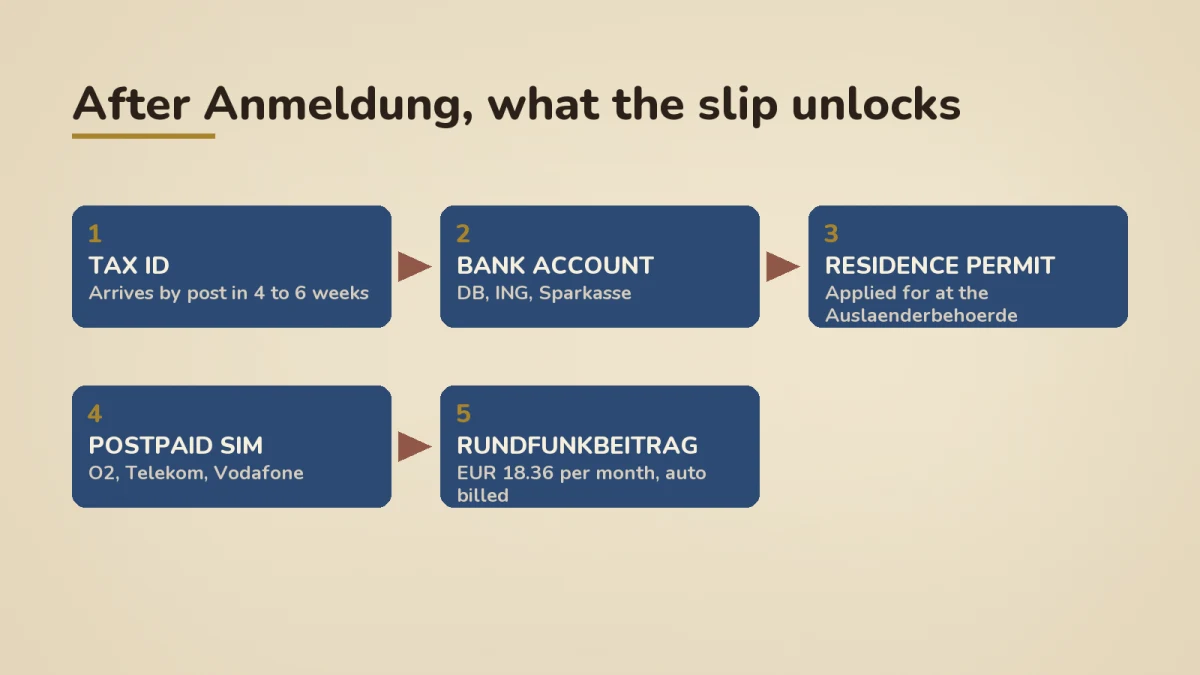
The Anmeldebestätigung is the key that opens a chain of dependencies. In rough order:
- Tax ID (Steueridentifikationsnummer) arrives by post in 4 to 6 weeks. Without it your employer cannot run payroll cleanly and will deduct emergency-rate tax (Steuerklasse 6) until they have it.
- Permanent bank account. Until Anmeldung you can use Wise, Revolut, or N26's online-only flow; for proper local accounts (DKB, Sparkasse, ING, Commerzbank) the Anmeldebestätigung is mandatory. The best German bank accounts for expats in 2026 comparison covers monthly fees, free ATMs, and English support across the major options.
- Residence permit (Aufenthaltstitel) appointment booking at the local Ausländerbehörde. Your study, work, or job-seeker visa is the entry document; the residence permit is what you need from Day 90 onward.
- Postpaid SIM contract from O2, Telekom, or Vodafone, which are typically 30 to 50 percent cheaper than the prepaid plans most arrivals use in their first month.
- Health insurance activation if you have not already started a public-insurance contract; private contracts can sometimes start before Anmeldung but require a confirmed address eventually.
- Rundfunkbeitrag registration. The €18.36 monthly broadcasting fee gets a letter in your name within weeks of Anmeldung. You cannot opt out unless you share a household with someone already paying.
Common mistakes that cost a return trip
- Showing up without the Wohnungsgeberbestätigung. This is the single biggest no-show. The form is on every city's website; print it before your appointment, get the landlord's signature in advance.
- Booking at the wrong office type. Berlin's Bürgeramt handles Anmeldung; the Ausländerbehörde does not. Munich KVR Bürgerbüro handles Anmeldung; the residence-permit section is a different building. Hamburg Service vor Ort handles Anmeldung; the Einwohner-Zentralamt does not for new arrivals.
- Forgetting to register all household members. If you move with a spouse and kids, every person needs to be on the form (and physically present at the appointment, in most cases). Some offices accept one adult registering everyone with a power of attorney; not all.
- Putting "moving in" date as the Anmeldung date. The form asks for your actual move-in date, which can be weeks before the appointment. Get this right or you risk being treated as late.
- Trying to register a Briefkasten-only address. Anmeldung must reflect your actual primary residence. Registering at a friend's flat where you do not live is fraud and routinely caught when residence permits are processed.
FAQ
Can I do my Anmeldung online if I am not an EU citizen?
Not in 2026, with the partial exception of inter-Bundesland moves where some pilot online flows exist for German residents already in the system. New arrivals from outside the EU still need the in-person Bürgeramt appointment. Hamburg and Munich are expected to extend their digital services in 2026, but no fully online route for non-EU first-time registrations is open as of May 2026.
What if my landlord refuses to give me the Wohnungsgeberbestätigung?
Refusing the form is itself a fineable offence under § 19 BMG (up to €1,000 for the landlord). In practice: print the form, fill it in for them, and explain politely that they are legally obliged to sign within 14 days. If they still refuse, file a written request via email so you have evidence, and contact your local tenant association (Mieterverein) for backup.
Can a friend register me with a power of attorney?
In some cities yes, in others no. Berlin Bürgerämter generally accept a notarised power of attorney plus a copy of the friend's ID. Munich KVR is stricter and usually requires the registrant to be present. Hamburg Service vor Ort sits between the two. Call the specific office before booking to confirm.
What happens if I move within the same city, do I need a new Anmeldung?
Yes. This is technically called Ummeldung (re-registration), but the form, the documents, and the 14-day deadline are identical. The same Bürgeramt portal handles both. If you move from one Bundesland to another, it is an Anmeldung at the new city plus an automatic Abmeldung from the old one (usually triggered by the new registration, no separate trip needed in most cases).
Is the €1,000 fine actually enforced?
Rarely at the maximum. First-time arrivals who can show they tried to book an appointment are typically not fined at all. Genuine 30-to-60-day overruns usually attract a €15 to €100 administrative fee. €500 plus fines are reserved for clear-cut bad faith: fraudulent address, repeat offences, refusing to register at all. The deeper risk is the chain effect: every later document (residence permit, citizenship, family reunion) draws on your Anmeldung history.
Do I need to deregister (Abmeldung) when I leave Germany?
Yes, if you are leaving the country permanently or moving abroad for more than six months. Abmeldung is free and can sometimes be done by post or email. It matters for tax residency, Rundfunkbeitrag termination, and any future return. If you only move within Germany you do not need a separate Abmeldung; the new Anmeldung handles it.
My address has a number suffix or unusual format. Will it cause issues?
Yes, more often than it should. Numbers like "12a" vs "12 A" vs "12-a" must match across your lease, your Wohnungsgeberbestätigung, and the form. If they do not match the clerk will reject the registration. Verify before the appointment; ask the landlord to issue a fresh Wohnungsgeberbestätigung if the address spelling is even slightly off.
Does Anmeldung give me any rights I do not already have?
It is the gateway, not the right. Anmeldung itself does not grant residency, work permission, or any benefit; those come from your visa, residence permit, or citizenship status. What it does is make every other German administrative process possible. Without it you are functionally outside the system: no tax ID, no permanent bank account, no SIM contract, no doctor's registration, no formal housing search records.
Where to next
- City-by-city visa support: see our residence permit guide for the next step after Anmeldung.
- For the bank account chain that activates the moment you have your Anmeldebestätigung, start with the German bank account guide.
- Settling your phone, internet, and contracts: the SIM card guide for new arrivals covers postpaid eligibility once you have a registered address.
- For the broader live-in-Germany pillar including health insurance, taxes, Schufa, and Rundfunkbeitrag, see
/live.
Continue reading
Living in Germany·7 min read
Residence Registration in Germany for International Students - A Step-by-Step Guide for Anmeldung
Learn how to complete your Residence Registration in Germany as an international student. This guide covers the necessary steps, documents, and tips for a successful registration.
Read articleLiving in Germany·12 min read
Living in Hamburg as an expat: Shipping, media, tech jobs, neighbourhoods
Hamburg expat guide for 2026: tech, aviation and media salaries, the neighbourhoods that actually work, real rent figures, and a first-month checklist.
Read articleLiving in Germany·8 min read
Student housing in Germany 2026: Real rents in 7 cities, dorm waiting lists, the PBSA option
Real 2026 rents in 7 German cities (Munich to Dresden), Studentenwerk dorm waiting lists, the PBSA option, and a search timeline that actually works.
Read articleReady to plan your Germany journey?
Explore our tools and resources to find the perfect university and program for your academic goals.