Best universities in Germany 2026: THE, QS, and what changed at TUM, LMU, Heidelberg
TUM, LMU and Heidelberg are again the only three German universities inside the global top 50 in THE 2026 and QS 2026. Here is what actually changed.

Table of contents
Last updated: May 2026
TL;DR: TUM, LMU and Heidelberg are again the only three German universities inside the global top 50 in the Times Higher Education 2026 ranking, at #27, #34 and #49. QS 2026 tells a slightly different story: TUM jumps to joint #22 globally (its strongest finish in years), while LMU sits at joint #58 and Heidelberg at #80. For most international applicants the practical question is not "is X the best", it is "does the programme I want exist there in English, with research that fits my field, in a city I can live in". Use rankings as a shortlist tool, never the decision.
International applicants writing to us in 2026 are still asking the same question: which German university is "the best"? The honest answer has not changed, but the numbers have. The Times Higher Education (THE) 2026 ranking, published in October 2025, places three German universities in the global top 50, with the Technical University of Munich at #27. The QS World University Rankings 2026, published in June 2025, push TUM up to joint #22, the highest QS rank a German university has held in over a decade. Both lists tell the same broad story: TUM, LMU and Heidelberg lead, with a wider top tier of research universities behind them.
This guide walks through what the two rankings actually say in 2026, where the German top tier sits globally, what changed at TUM, LMU and Heidelberg, and how to use rankings without letting them choose your university for you. If you are still narrowing your shortlist, our shortlisting universities for Master's in Germany and Public vs Private universities in Germany guides are the natural next reads, and our full universities directory lists every public institution with English-taught programmes.
Which are the best universities in Germany in 2026?
Across both major global rankings in 2026, the same three institutions sit at the top of Germany's table: TUM in Munich, LMU also in Munich, and Heidelberg in Baden-Württemberg. Behind them is a deep second tier of broad research universities (Charité Berlin, RWTH Aachen, KIT Karlsruhe, FU Berlin, Humboldt Berlin, TU Berlin) that all sit comfortably inside the global top 150.
Here is the 2026 picture, side by side.
| University | THE 2026 | QS 2026 | City |
|---|---|---|---|
| Technical University of Munich (TUM) | 27 | =22 | Munich |
| Ludwig-Maximilians-Universität (LMU) | 34 | =58 | Munich |
| Heidelberg University | 49 | 80 | Heidelberg |
| Charité Universitätsmedizin Berlin | top 150 | not ranked separately | Berlin |
| RWTH Aachen University | top 150 | =105 | Aachen |
| KIT, Karlsruhe Institute of Technology | top 150 | =98 | Karlsruhe |
| Freie Universität Berlin | top 150 | =88 | Berlin |
| Humboldt-Universität zu Berlin | top 150 | 130 | Berlin |
| Technische Universität Berlin (TU Berlin) | top 150 | 145 | Berlin |
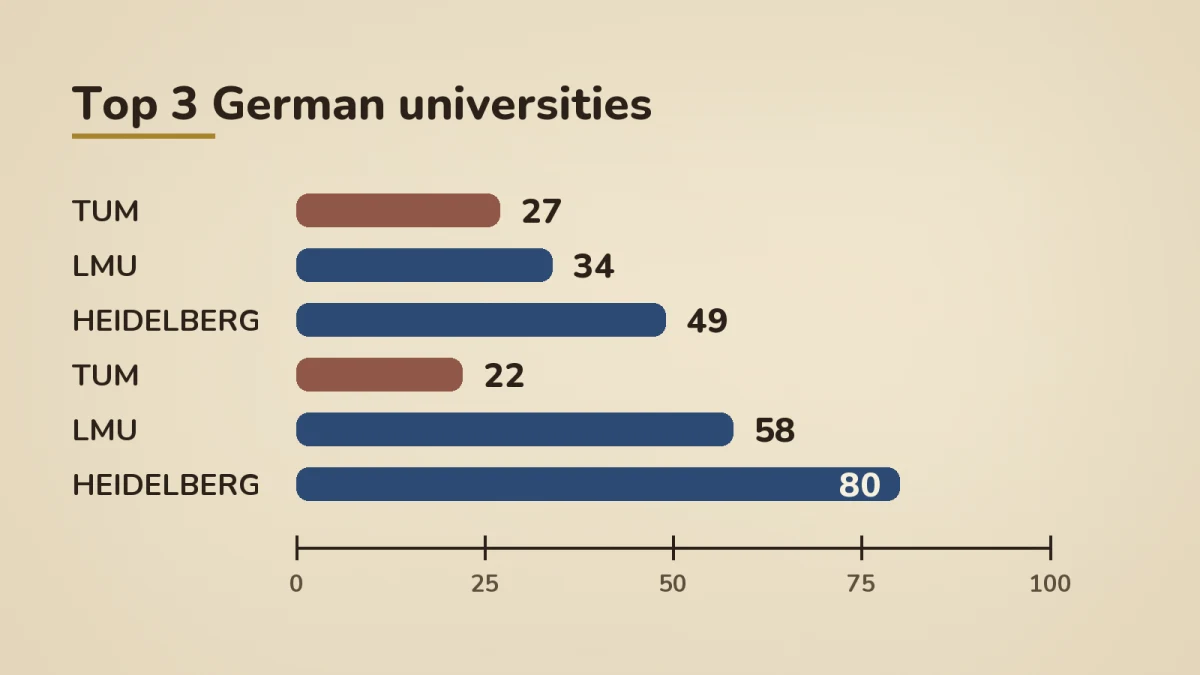
THE 2026 evaluated 2,191 universities across 115 countries on five pillars: teaching, research environment, research quality, international outlook and industry. Oxford retained #1 globally for the tenth consecutive year, with MIT second and Princeton tied with Cambridge in third. QS 2026 covers a similar set of institutions but weights employer reputation, citations per faculty, international research network, employment outcomes and sustainability differently, which is why the same German universities show up in different positions on the two lists.
What actually changed at TUM, LMU and Heidelberg
TUM moved up sharply on QS 2026
TUM's 2026 numbers tell the cleanest story. On QS, the university climbed from joint #28 in QS 2025 to joint #22 in QS 2026, its strongest position in over a decade. On THE, it sits at #27, broadly stable. Why the QS jump? Higher academic reputation scores, stronger employer reputation (TUM is consistently among the most-cited German universities in graduate hiring surveys), and improvements in QS's "international research network" pillar, which rewards cross-border co-authorship.
TUM's English-taught Master's portfolio in informatics, electrical and computer engineering, robotics, and management is one of the largest in continental Europe, and the Munich location keeps it close to BMW, Siemens, Airbus, Allianz, Microsoft DE and the wider Bavarian tech belt. If you are doing engineering or natural sciences and the rankings matter to your family or employer, TUM is the safest bet in Germany. Tuition for new non-EU students at TUM is usually €2,000 or €3,000 per semester (rising to 2,300 or 3,400 from winter semester 2027/28) for Bachelor's and €4,000 or €6,000 per semester (rising to 4,600 or 6,800 from winter semester 2027/28) for Master's programmes (the exact figure is on each programme page), with EU/EEA students paying only the standard semester contribution.
LMU is steady, with research strength leading the table
LMU sits at THE #34 and QS =#58, broadly stable on a multi-year view. LMU's strength is breadth: it ranks in the global top 50 for medicine, life sciences, humanities and physics, and it still graduates more Nobel laureates per decade than any other German university (44 across its history). For applicants in the humanities, social sciences, medicine and theoretical sciences, LMU is usually the better Munich pick over TUM.
The practical difference for an international applicant: LMU's English-taught programme list is shorter than TUM's. Most LMU Master's are taught in German, and even programmes labelled "international" often expect at least B2 German for seminars. Verify the language of instruction on each programme page before you apply, not after.
Heidelberg holds the top 50 line
Heidelberg University is #49 on THE 2026 and #80 on QS 2026, the same as it has been for several cycles. Founded in 1386 it is Germany's oldest university and its medical, life-sciences and humanities reputation is what carries the ranking. The QS faculty-to-student ratio score is among the strongest in Germany, which translates into smaller seminars and more direct supervisor contact than at TUM or LMU. If you are applying for a research-track Master's or a PhD in life sciences or medicine, Heidelberg deserves a closer look than its raw rank suggests.
How to read the rankings without letting them mislead you
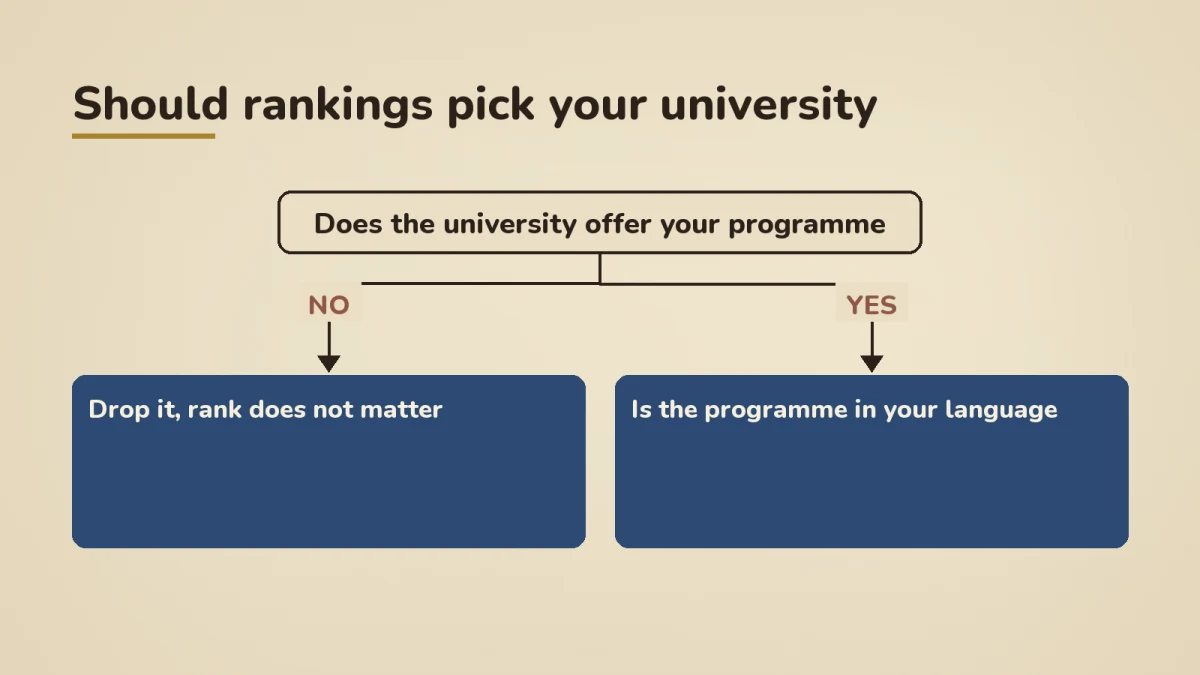
Before you anchor your shortlist on a single number, three honest caveats from the people who study these rankings.
First, the ranking publishers are commercial. Both THE and QS sell consultancy, advertising and analytics products to the universities they rank. United Nations University researchers and SPIEGEL have both flagged that universities which buy QS or THE products tend to move up over time. Treat the rankings as one signal, not the signal.
Second, the methodology weights research output far more than teaching quality. THE puts about 60 percent of its score on research-related metrics; QS puts 50 percent. A university can be a brilliant teaching school for international Master's students and still rank lower than a peer with stronger research throughput. The ranking is not measuring how good your specific programme is.
Third, German higher education is structurally flatter than US or UK higher education. The gap between TUM (#27) and, say, the University of Stuttgart (#251 to #300 band) is real, but it is much smaller than the gap between Harvard and a US state school at the same world rank. Almost every German public university accredits its degrees through the same federal Bologna framework, charges the same low fees, and gives the same full academic credit. Once you are inside the top 250 globally you are at a serious research institution.
The CHE (Centre for Higher Education) ranking, published by ZEIT in Germany, ranks programmes (not universities) on student-experience metrics like supervisor accessibility, employability, library quality and lab equipment. For programme-level fit it is a more useful read than THE or QS. Open the CHE ranking for your subject, then cross-check the top three CHE picks against your programme shortlist.
How to actually shortlist a German university for 2026 intake
A practical order of operations that works for almost every international applicant.
- Start with the field, not the university. Search our programme finder or DAAD's database by subject, language of instruction and degree type. Narrow to programmes that exist in English (or in your German level) and that admit international applicants without a Studienkolleg detour.
- Apply the rankings as a tie-breaker. From the list of programmes that match your subject, language and entry requirements, prefer the institutions ranked higher on either THE or QS, but only inside that already-fitting set. Do not flip the order.
- Check the CHE programme ranking for your specific subject. If a CHE-leading programme exists at a "lower-ranked" university (for example, computer science at TU Darmstadt or mechanical engineering at Stuttgart), that is often the smarter pick.
- Filter for city fit. Munich is wonderful but rents in 2026 are €1,374/month average for a private student studio. Berlin (€805), Leipzig and Dresden (€700-900) buy you more programme variety per euro. Our best cities to study in Germany for international students write-up walks through the trade-offs.
- Apply to 5 to 8 programmes, mixing competitive and less-competitive options. Each uni-assist application after the first is €30, so the spread is cheap insurance.
Common shortlisting mistakes
- Anchoring the entire decision on a single ranking number from a single year.
- Picking TUM or LMU because the rank is high, then discovering the programme you want is taught in German.
- Ignoring CHE in favour of THE / QS, then arriving in Germany surprised that supervisor access varies wildly between top-50 universities.
- Treating QS and THE as interchangeable. They use different methodologies and produce different orders. Use both, do not use just one.
- Skipping over Berlin's three big universities (FU, HU, TU Berlin) because each is "only" top-150 globally; in subject rankings two of them break top 50 in their fields.
FAQ
Which university is the best in Germany in 2026?
By both major global rankings, TUM in Munich. THE 2026 places it at #27 and QS 2026 at joint #22, ahead of LMU and Heidelberg. For non-engineering subjects, LMU and Heidelberg often rank higher in subject-specific tables.
Why does TUM rank higher on QS than on THE?
QS weights employer reputation and academic reputation surveys more heavily; TUM scores very strongly on both because of its industry links in Bavaria. THE weights research environment and citation impact more, where Oxford, Cambridge and US Ivy peers pull ahead.
How many German universities are in the global top 100?
Five on QS 2026 (TUM, LMU, Heidelberg, FU Berlin, KIT) and roughly seven on THE 2026 (the same five plus Charité Berlin and RWTH Aachen, depending on edition cut-offs). All Berlin universities and several others sit comfortably inside the top 150 to 200.
Are German universities free for international students?
Public universities in 15 of Germany's 16 federal states charge no tuition for international students at Bachelor's or Master's level. You pay only a semester contribution of €150 to €450, which usually includes a regional transport ticket. Baden-Württemberg charges non-EU students €1,500 per semester. In Bavaria, TUM charges new non-EU students tuition since the 2024/25 winter semester: usually €2,000 or €3,000 per semester (rising to 2,300 or 3,400 from winter semester 2027/28) for Bachelor's and €4,000 or €6,000 (rising to 4,600 or 6,800 from winter semester 2027/28) for Master's programmes. EU/EEA students continue to pay only the semester contribution.
Should I pick a top-ranked university or a top-ranked programme?
Pick the programme. CHE programme rankings, subject-specific QS rankings, and the actual course catalogue tell you more about your day-to-day study experience than the overall world rank. A CHE-leading programme at a top-150 university typically beats a mediocre programme at a top-50 university for international Master's outcomes.
How does Berlin compare to Munich for top universities?
Munich has the two highest-ranked universities (TUM and LMU). Berlin has three universities (FU, HU, TU Berlin) plus Charité all inside the global top 150, plus a much lower cost of living. Berlin gives you more programme variety and cheaper housing; Munich gives you the highest world ranks and the strongest tech industry adjacency.
Is the THE ranking or QS ranking more trustworthy?
Neither is objectively more accurate. Both are commercial publishers. Use them together (a university that ranks well on both is a stronger signal than one that ranks well on only one). Cross-check with CHE for the subject you actually plan to study.
Where to next
- Top 10 Public Universities in Germany: the full national table beyond the top three
- Public vs Private Universities in Germany: accreditation, fees, and recognition
- Shortlisting Universities for Master's in Germany: the full step-by-step decision framework
- TUM Tuition Fees for International Students: the new Bavarian fee structure in detail
- Universities directory: every public institution with English-taught programmes, filterable by city and subject
Continue reading
Top Universities·14 min read
Germany and the QS World Ranking
Which German universities rank highest in QS World Rankings 2025? Get a detailed breakdown of rankings, methodology, and what it means for international student
Read articleTop Universities·12 min read
Top 10 Universities for Master's in Chemical Engineering in Germany
Looking to study Master's in Chemical Engineering in Germany? Discover the top 10 universities renowned for their exceptional programs, state-of-the-art facilities, and outstanding research opportunities.
Read articleTop Universities·6 min read
Top German Universities for Graduate Employability in 2025: Ranked by Employers
Top German Universities for Graduate Employability in 2025: Ranked by Employers
Read articleReady to plan your Germany journey?
Explore our tools and resources to find the perfect university and program for your academic goals.