On this page
What TUM actually costs an international student
The tuition figures from TUM's own pages, the semester fee everyone still pays, who is exempt, and an honest first-year total.
At a glance
The Technical University of Munich charges tuition to students from outside the EU and EEA. Per TUM's own fee page, Master's programmes usually cost 4,000 or 6,000 EUR per semester and bachelor's programmes usually cost 2,000 or 3,000 EUR, charged since the winter semester 2024/25. On top of that everyone pays the student union fee, which is 97.00 EUR per semester in Munich, Garching, Weihenstephan and Heilbronn for summer semester 2026. So a non-EU Master's student pays roughly 8,000 to 12,000 EUR a year in tuition before living costs.
- Master's tuition per semester
- 4,000 or 6,000 EUR
- Bachelor's tuition per semester
- 2,000 or 3,000 EUR
- Charged since
- Winter semester 2024/25
- Waiver scholarships
- Full tuition, merit or need
- Main winter deadline
- 31 May
The tuition figures, from TUM
TUM introduced tuition for students from third countries, meaning outside the EU and the European Economic Area, from the winter semester 2024/25. The legal authority came from the Bavarian Higher Education Innovation Act, in force since 2023, which lets Bavarian universities charge non-EU students; TUM was the first to use it. Per TUM’s own tuition page, checked 27 July 2026:
| Level | Tuition per semester | Tuition per year |
|---|---|---|
| Bachelor’s degree programmes | usually 2,000 or 3,000 EUR | 4,000 or 6,000 EUR |
| Master’s degree programmes | usually 4,000 or 6,000 EUR | 8,000 or 12,000 EUR |
Note the word "usually" in TUM’s own wording. The amount is set per programme, so two Master’s programmes at the same university can differ by 2,000 EUR a semester. Do not budget from a range. Open the specific programme page on tum.de and read its number.
This matters more than it sounds. Over a two-year Master’s, the difference between the 4,000 and the 6,000 band is 8,000 EUR. That is not a rounding error, and it is decided by which programme you apply to.
These rates rise from the winter semester 2027/28. Per the same TUM tuition page, checked 8 October 2026, the new rates for non-EU students are 4,600 or 6,800 EUR for Master’s programmes and 2,300 or 3,400 EUR for bachelor’s programmes, replacing the rates above. Students already enrolled before the increase keep the rate that applied when they started, until they finish that programme. If you start in winter 2027/28 or later, budget from the new figures.
The semester fee, which nobody is exempt from
Tuition is not the only compulsory payment. Every enrolled student pays the student union fee each semester, and TUM states plainly that it must be paid in addition to the tuition fees.
Per TUM’s study fees page, checked 27 July 2026, the student union fee for summer semester 2026 is:
| Campus | Fee per semester |
|---|---|
| Munich, Garching, Weihenstephan | 97.00 EUR |
| Heilbronn | 97.00 EUR |
| Straubing | 82.00 EUR |
By German standards that is low. Across the 2,655 Master’s programmes in our catalogue the median semester contribution is 300 EUR, and the middle half sits between about 104 and 379 EUR. TUM’s 97 EUR is at the bottom end, because Bavaria’s student union fees do not include the semester transport ticket that inflates the figure at many other universities.
There is also an application fee. Our catalogue records 75 EUR for 70 of TUM’s 101 Master’s programmes, with 30 charging nothing. That is paid once per application, before you know whether you have a place.
Who does not pay tuition at TUM
The tuition applies to third-country nationals in bachelor’s and master’s degree programmes. Per TUM’s tuition page, checked 27 July 2026, you are not required to pay if any of these apply:
- You are from an EU or EEA country, or an equivalent state
- You were already enrolled at TUM before winter semester 2024/25 in the same programme
- You are pursuing a doctoral degree
- You are on an exchange programme, visiting student status, or enrolled in a Studienkolleg
- You are in a state examination programme or a non-degree programme
- You obtained your higher education entrance qualification within the German education system
- You completed a bachelor’s degree at TUM or another German university before starting the Master’s
- You have an established domestic connection under Section 8 of the BAföG
Three of these are worth reading twice. Doctoral students do not pay. If your plan is research, a PhD in Germany is a different financial situation entirely, and it is often funded. The exemption for students already enrolled before winter 2024/25 does not transfer between programmes, so switching programme can start the fee. And the Studienkolleg exemption only covers the Studienkolleg itself. TUM states that attending a Studienkolleg does not exempt you from tuition in the bachelor’s degree that follows, because its final examination does not count as a German higher education entrance qualification.
The completed-degree exemption has a hard deadline. To use it you must provide proof of your German bachelor’s degree no later than the enrollment deadline, which is five weeks after the start of lectures. TUM does not grant retroactive exemptions or refunds after that.
Waiver scholarships, waivers and the study grant
TUM runs three different instruments, and they are easy to mix up. Per its scholarships and waivers page, checked 27 July 2026:
- Waiver scholarships cover the full tuition, and merit is a real route. High-achieving Master’s applicants can be awarded one for their first two semesters based on academic performance in their previous degree, proven with an official ranking certificate from that institution, and it is renewable. A second version covers students from the third semester onwards who show outstanding performance at TUM. A third covers applicants who cannot pay due to financial hardship, and that one runs for the standard duration of the degree.
- Waivers and exemptions cover hardship cases. Grounds include caring for your own children or dependent family members, special personal or social circumstances such as displacement by war or unforeseen financial hardship, a documented disability that significantly affects your studies, asylum seeker status from countries with a protection rate above 50%, and leave of absence.
- The TUM scholarship for international students is separate money, not tuition relief. Recipients receive a one-time grant of between 500 and 1,800 EUR per semester and may reapply each semester. TUM states it is independent of the waiver scholarships, exemptions and waivers, so do not budget it against the fee.
The practical reading: if your grades in your bachelor’s put you near the top of your cohort, get the ranking certificate and apply for the waiver scholarship, because the best case is not a discount but the whole tuition covered. The number of scholarships is limited, so none of this is a figure to build your budget on.
The honest first-year total, and what TUM asks of you
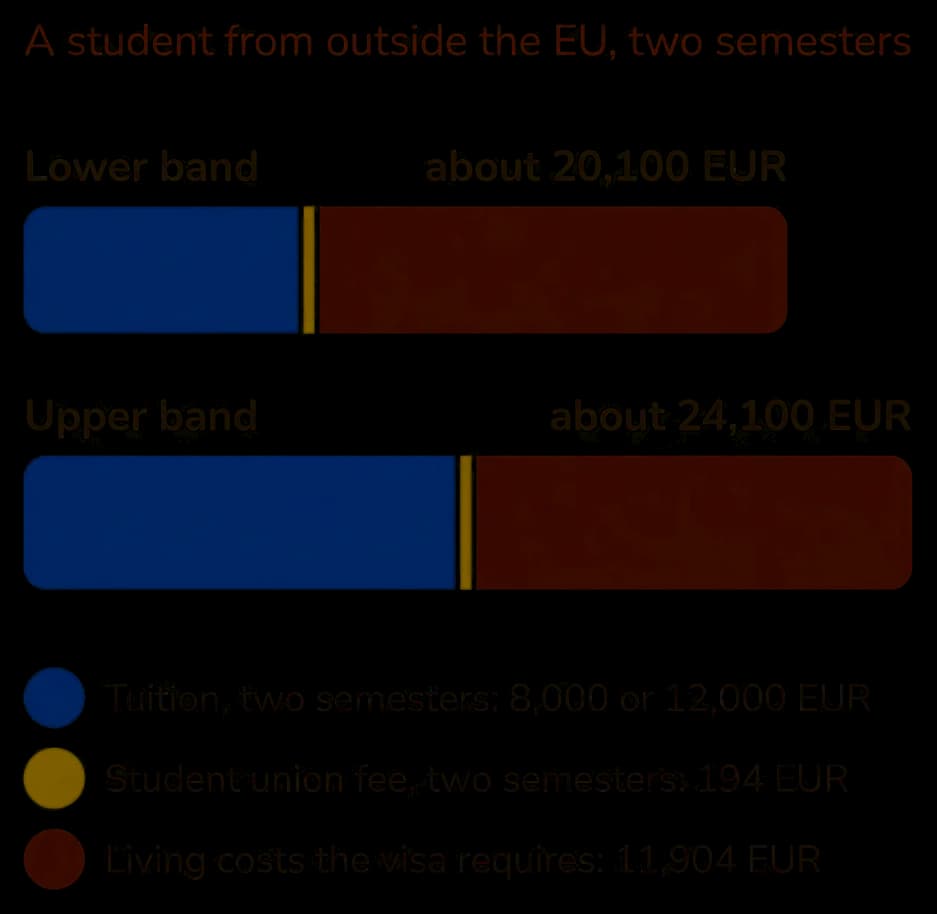
Tuition is only part of what leaving India for Munich costs. Here is the arithmetic, using only the figures cited on this page.
| Item | Lower band | Upper band |
|---|---|---|
| Tuition, two semesters | 8,000 EUR | 12,000 EUR |
| Student union fee, two semesters | 194 EUR | 194 EUR |
| Living costs, as required for the visa | 11,904 EUR | 11,904 EUR |
| First year total | about 20,100 EUR | about 24,100 EUR |
These totals use the current tuition rates. If you start in winter 2027/28 or later, two semesters of tuition become 9,200 or 13,600 EUR, so add 1,200 or 1,600 EUR to the totals.
The living cost line is not a guess. Per the German Missions in India student visa checklist, last updated September 2024 and checked 27 July 2026, you must show funds for your first year of study, currently 11,904 EUR, with confirmation that no more than 992 EUR per month can be withdrawn. Munich is one of Germany’s most expensive cities, so treat that as the visa minimum rather than a realistic budget. Our cost of living estimator and blocked account calculator work out your own figure.
What our catalogue shows about TUM
From our own data on active, published Master’s programmes, queried 27 July 2026:
- 101 Master’s programmes at TUM Munich, plus one at TUM Asia in Singapore.
- 66 are taught in English, 20 in German, 8 bilingual and 7 in either language.
- 91 of the 101 close on 31 May for the winter intake, which is six weeks earlier than the 15 July date most applicants have in mind. Miss it and you wait.
- 42 also take a summer intake, most of them closing on 30 November.
- 41 require an APS certificate at the point of application, which is the step Indian applicants should start first.
- 38 have restricted admission, where places are limited and applicants are compared against each other.
- 13 of the 101 are recorded in our catalogue as charging no tuition. Where our record and TUM’s own fee page disagree, TUM’s page is the one that decides, so confirm on the programme page before you budget.
Browse them all on the TUM university page.
Is TUM worth paying for when 1,694 programmes are free
This is the real question and it deserves a straight answer. 1,694 of the 2,655 Master’s programmes in our catalogue charge no tuition at all, and every one of those is at a public university. TUM is a public university that chose to charge non-EU students. So paying 8,000 to 12,000 EUR a year is a decision, not an unavoidable cost of studying in Germany.
It can be the right decision. TUM is one of the strongest technical universities in Europe, it sits in a city with a dense industrial and technology employer base, and the 18-month post-study job search permit is the same wherever you graduate from. What it is not is the only route, and anyone telling you that a paid programme at a ranked university is required to work in Germany is selling something. Compare against the free options in our course catalogue before you commit.
Where these figures come from
All fee figures are quoted from TUM’s own pages and were checked on 27 July 2026. Fees are set per programme and change between semesters, so the programme page on tum.de is always the final word. Programme counts, deadlines and application fees come from our own catalogue of active, published Master’s programmes, queried the same day.
Related tools
Cost of living estimator
Your own Munich budget
Blocked account calculator
What the visa needs
Next steps
Frequently asked questions

Compare TUM against the free alternatives
Tell us your degree and subject. We will show you which programmes you qualify for, what each one charges, and where the free options are.