Blocked Account Germany 2026: How much you need, providers compared, application steps
How much money you need in a 2026 German Sperrkonto, which providers are still operational, and the step-by-step application timeline before your visa appointment.

Table of contents
Last updated: May 2026
TL;DR: For a 2026 German student visa you need EUR 11,904 in a blocked account (Sperrkonto), which releases EUR 992 per month after you arrive. Open the account online with Expatrio (EUR 119 setup), Fintiba (fastest, instant Opening Confirmation), or Deutsche Bank (slower, in-person). Coracle's own site currently lists its opening fee as "coming soon", so check coracle.de directly before paying anyone selling a Coracle account. Use the blocked account calculator to see how the wire transfer, fees, and monthly stipend actually flow.
The blocked account, called a Sperrkonto in German, is the single most checked piece of paperwork in your visa file. Without it, the embassy will not even start the substantive review. With it, your visa case becomes routine. This post walks through the 2026 amount, who needs one, which providers are still operational, what each charges, and the order in which to do everything so the wire transfer lands in time.
If you are still building your full visa-day file, the proof of financial resources guide covers the alternatives (scholarship letters, Verpflichtungserklärung, parental sponsorship). This post focuses on the blocked-account route, which is what most non-EU students use.
How much do you need in your blocked account for 2026?
EUR 11,904 for the year, equivalent to EUR 992 per month. That figure is set by the Auswärtiges Amt (Federal Foreign Office) in line with the BAföG living-cost rate, and it has been unchanged since 2024. Expatrio, Fintiba, and the embassy each list the same amount. The next change will be announced when BAföG rates next move.
A few facts that get asked every week:
- The amount applies regardless of which German city you plan to live in. Munich and Heidelberg are more expensive than Leipzig, but the visa minimum is uniform.
- It applies for one year of stay. If your residence permit, once issued, is for two years, you do not need to deposit EUR 23,808. Embassies require funds for the first year only; you top up later.
- The Sperrkonto is fully refundable to you. After you arrive, EUR 992 is released to your German current account every month. Nothing is forfeited unless you abandon the account without closing it.
- The same EUR 11,904 figure is required for the Job Seeker Visa and for some Chancenkarte (Opportunity Card) routes, not just the student visa. If you are coming on a different track, see the visa types guide for which one applies to you.
What is a Sperrkonto, and why does Germany require one?
A blocked account is a German bank account that holds your living-cost funds in escrow until you land in Germany. The bank legally restricts withdrawals to a fixed monthly amount (EUR 992 in 2026) so the embassy knows you cannot spend the full EUR 11,904 on the day you collect the visa. It is a financial guarantee, not a deposit you lose.
The mechanism exists because German student visas are not granted on the assumption you will work. International students can work 140 full days or 280 half days per year, but the visa file must show you can survive without a job. The Sperrkonto is how Germany verifies this without asking your parents to attend the embassy.
The account is opened in your name, the wire transfer goes from your home account into it, and the provider sends an Opening Confirmation (Eröffnungsbestätigung) to you and to the embassy. This single PDF is what the consular officer is looking for in your visa file.
Who needs a blocked account, and who can skip it?
You need a Sperrkonto if you are a non-EU student or job-seeker applying for a long-stay national visa. EU and EEA citizens do not need one because they enter Germany on freedom-of-movement rules.
You can replace the blocked account with one of the following, if you have it cleanly documented:
| Alternative proof | When it works | Catch |
|---|---|---|
| Scholarship letter (DAAD, university, government) | Scholarship covers EUR 992/month or more for the visa duration | Letter must name the monthly amount, currency, start and end date |
| Verpflichtungserklärung (formal sponsorship from a German resident) | Sponsor signs at their local Ausländerbehörde and proves income | Sponsor income test is strict; failed sponsorships waste 4 to 8 weeks |
| Parental income statement plus bank guarantee | Some embassies still accept this for Bachelor's applicants | Inconsistent across embassies; check with your consulate before relying on it |
| Salary contract (Ausbildung, paid Werkstudent role with confirmed offer) | Monthly salary covers EUR 992 with margin | Mostly used for Ausbildung trainees, not Master's students |
If none of those apply cleanly, open a blocked account. It is the path the embassy is most familiar with, and most embassies process Sperrkonto-backed visas faster than alternative-proof cases.
Blocked account providers in 2026: who is still operational
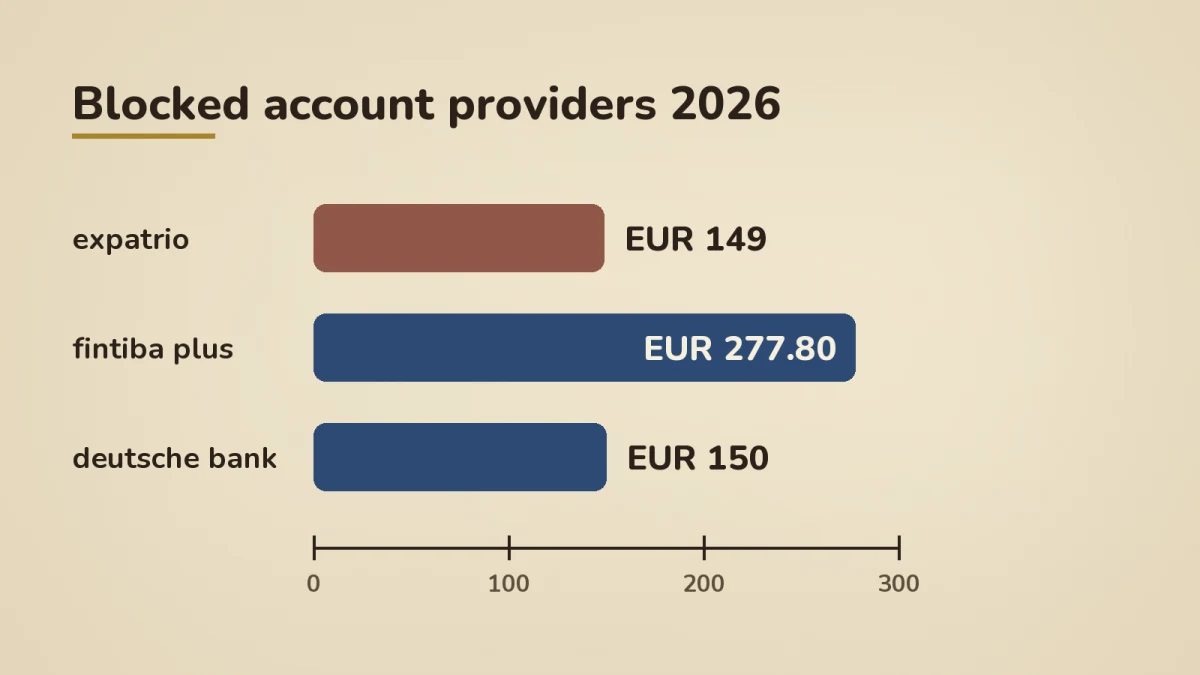
Three providers are accepting new student applications in 2026: Expatrio, Fintiba, and Deutsche Bank. Coracle's own site currently lists its opening fee as "coming soon"; if a third-party agent in your home country quotes you a Coracle setup, check coracle.de directly first.
Here is what the active providers actually charge and how fast they move.
| Provider | Setup fee | Monthly fee | Opening Confirmation | Best for |
|---|---|---|---|---|
| Expatrio | EUR 119 | EUR 9 | Within 24 hours after wire arrives | Compare current fees on expatrio.com |
| Fintiba | EUR 159 (Basic and Plus) | EUR 9.90 | Instant on KYC completion, no wait for wire | Fastest paperwork; visa appointment booked tight |
| Deutsche Bank | EUR 150 (postal) or EUR 0 (in-person at branch in Germany) | EUR 0 | 4 to 8 weeks (postal) | Already a Deutsche Bank customer in your home country; otherwise too slow |
A few things the table does not capture:
- Expatrio charges EUR 119 setup plus EUR 9 a month (check expatrio.com for current fees). You complete KYC online via video call, wire the EUR 11,904 plus the setup fee, and the Opening Confirmation lands in your inbox the next business day. The bank partner is Aion Bank in Belgium.
- Fintiba wins on speed. Its blocked-account fees are EUR 159 setup plus EUR 9.90 a month on both Basic and Plus, and the Plus plan bundles compulsory health insurance for the visa, which saves the round-trip of buying insurance separately. KYC and Opening Confirmation are instant on completion. Bank partner is Sutor Bank in Hamburg.
- Deutsche Bank is the legacy postal option. You download forms, get them notarized at the German embassy or honorary consulate in your home country, and mail them in. It takes 4 to 8 weeks before the account is open, so this only makes sense if your visa appointment is months away. The advantage is no monthly fee.
For most applicants in 2026, Expatrio or Fintiba is the right choice. The decision between them comes down to whether you also need health insurance bundled (Fintiba Plus) and how tight your visa-appointment timeline is. Compare with our existing Expatrio review and Fintiba review for the long-form breakdown.
Step-by-step: how to open a blocked account in 2026
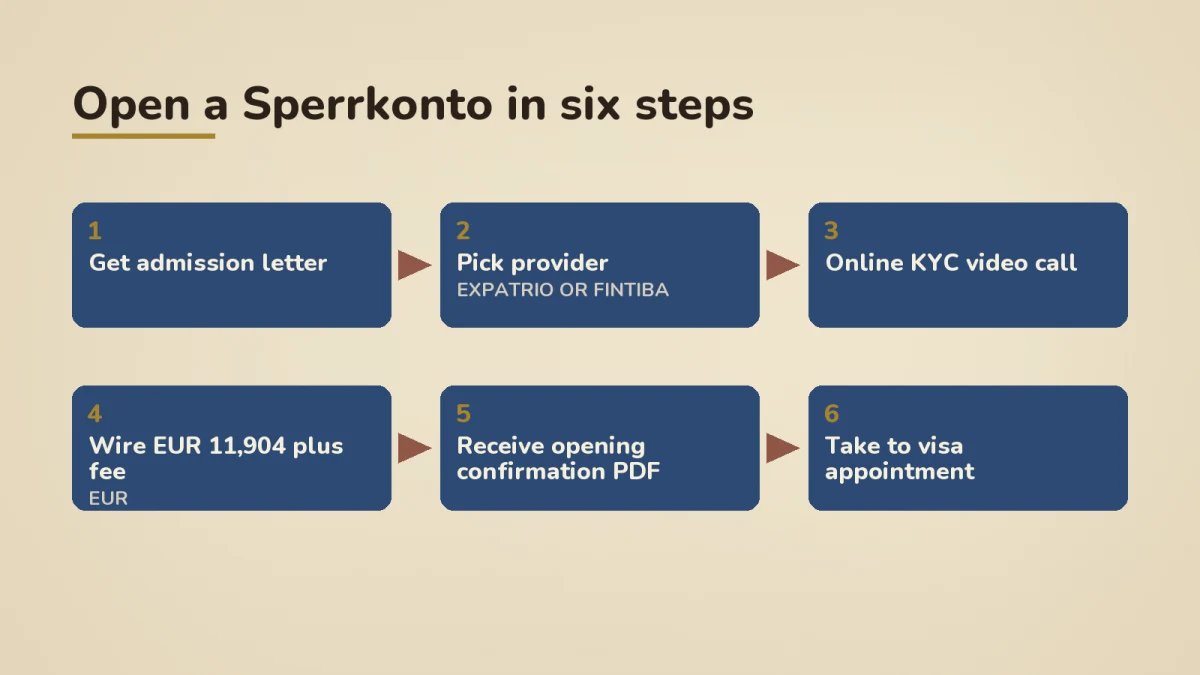
The process takes 1 to 7 days end to end with Expatrio or Fintiba, and 4 to 8 weeks with Deutsche Bank. Run through these steps in order:
- Get your university admission letter or conditional offer. Providers do not require this for KYC, but the embassy does, so do not start the wire until your admission is in hand.
- Pick a provider. Expatrio (EUR 119 setup plus EUR 9 a month), Fintiba for speed, Deutsche Bank only if your appointment is at least two months away.
- Complete the online application. This includes a video KYC call (passport in hand, plain background, English or German). Both Expatrio and Fintiba support most non-EU passports including Indian, Pakistani, Bangladeshi, Nigerian, Iranian, Turkish, Brazilian, and Vietnamese.
- Wire EUR 11,904 plus the setup fee from your home bank. Use SWIFT transfer in EUR. Indian applicants need an A2 form and an LRS declaration via your bank for the outward remittance. The wire usually settles in 2 to 5 working days; check your bank's cut-off times.
- Receive the Opening Confirmation (Eröffnungsbestätigung). This is the PDF the embassy needs. Print two copies for the appointment.
- Add the Opening Confirmation to your visa file. Submit at the embassy along with your admission letter, passport, photos, motivation letter, APS certificate (Indian, Chinese and Vietnamese applicants), insurance proof, and visa fee.
- After arrival in Germany, open a current account. N26, DKB, ING, and the local Sparkasse are common choices; see the German bank account guide for the trade-offs.
- Activate the Sperrkonto release. With Expatrio and Fintiba, you log in, link your German current account IBAN, and the EUR 992 monthly transfer starts on a fixed date each month.
The wire transfer is the step that goes wrong most often. Triple-check the IBAN and the BIC on the provider's instructions; one wrong digit and the EUR 11,904 sits in correspondence-bank purgatory for two weeks while you call your bank in tears.
After arrival: activating, monthly transfers, closing the account
Once you land in Germany, the Sperrkonto is no longer the embassy's concern. It becomes your monthly cashflow. Here is what changes:
- You complete the Anmeldung at your local Bürgeramt within 14 days of moving into your room. The registration certificate (Meldebescheinigung) is what the bank needs to fully activate your German current account. If your appointment is delayed, see the Anmeldung guide for the workaround letter most landlords will sign.
- You link your German IBAN to the Sperrkonto in the provider portal. The first EUR 992 transfer typically lands within 2 to 4 working days.
- You can top up the Sperrkonto from inside Germany if you want a buffer beyond EUR 11,904. Wires from your German current account land same-day. Most students do not bother; once you start working part-time, the monthly EUR 992 is the floor, not the ceiling.
- You close the Sperrkonto when your residence permit is renewed for a non-blocked-account ground, for example after switching to a job-seeker permit or a Blue Card. The remaining balance is wired to your German current account. Closure is free with all three providers.
If you abandon the account (stop logging in, change phone number, do not respond to KYC re-verification), the funds stay there but the provider charges idle fees. Close it properly when you no longer need it.
Common mistakes to avoid
- Paying an Indian or Pakistani agent for "guaranteed Coracle approval". Coracle's own site currently lists its opening fee as "coming soon". Check coracle.de directly before paying anyone who sells a Coracle setup.
- Wiring funds before you have your university admission letter. If admission falls through, getting the EUR 11,904 back takes 4 to 8 weeks and you pay the wire fee twice.
- Wiring less than the full EUR 11,904 plus the setup fee. The Opening Confirmation is only issued when the full amount lands. If you wire EUR 11,900 because you misread the figure, the provider holds the funds until you top up.
- Submitting an Opening Confirmation older than three months at the visa appointment. Some embassies treat older confirmations as expired. Time the wire to land 4 to 8 weeks before your appointment, not 6 months before.
- Using a Wise or Revolut account as proof of funds. Multi-currency neobank accounts are not Sperrkonto and embassies will not accept them. The account must be specifically labelled as a blocked account by a German-licensed institution.
- Mixing up Sperrkonto and current account. The Sperrkonto holds the visa funds. The current account is what your salary, rent, and groceries flow through. You need both, and you cannot use one for the other.
Frequently Asked Questions
Can I open a blocked account before I get my admission letter?
Yes, technically. Providers will run KYC and accept the wire without an admission letter. But if your admission falls through, you will need to refund the EUR 11,904 back to your home account, which takes 4 to 8 weeks. The safer order is admission first, blocked account second.
Is EUR 11,904 enough to live on for a year in Germany?
In Munich, Hamburg, or Frankfurt, no. In Leipzig, Dresden, or smaller university cities, yes, with no margin for travel or emergencies. The figure is a visa minimum, not a budget recommendation. Most students top up with parental support, scholarship money, or a Werkstudent job during the year. The cost of living guide breaks down what each city actually costs.
What if I have a partial scholarship?
You can combine a scholarship with a smaller blocked account. If your DAAD or university scholarship pays EUR 500 per month, you only need to deposit EUR 5,904 in the Sperrkonto (12 x EUR 492). The scholarship letter must specify the monthly amount and duration, and you submit both the letter and the smaller Sperrkonto Opening Confirmation at the visa appointment. Check with your consulate; some prefer the full EUR 11,904 deposit even when a scholarship exists.
How long does the wire transfer take from India?
From an Indian bank, 2 to 5 working days for the SWIFT to land in Expatrio or Fintiba. You will need an A2 form, your LRS declaration (you have a USD 250,000 annual limit per individual), and the provider's IBAN and BIC. ICICI, HDFC, SBI, and Axis Bank all process Sperrkonto wires routinely; ask for the "outward remittance for education" pathway, not the personal-purpose one.
Can I close the blocked account early if I leave Germany?
Yes. Closure is free with Expatrio, Fintiba, and Deutsche Bank. The remaining balance is wired back to either your German current account or your home-country account. Allow 2 to 4 weeks for cross-border closure. If you are mid-semester, do not close the Sperrkonto unless you are also surrendering your residence permit; the embassy can revoke a permit if the funding ground disappears.
Do I need a blocked account if I get a Job Seeker Visa?
Yes. The Job Seeker Visa requires the same EUR 11,904 in a Sperrkonto for the 6-month search period. Once you sign an employment contract and convert to a residence permit, you can close the account and use your salary as the funding ground.
Are there providers other than Expatrio, Fintiba, and Deutsche Bank?
A few smaller players exist (Coracle is one; its site currently lists the opening fee as "coming soon"). Sutor Bank is the underlying bank behind Fintiba but does not accept direct student applications. Most embassies are most familiar with Expatrio and Fintiba documents and process them faster than less-common providers. Stick to one of the three names in the table above.
Is the EUR 11,904 figure going to change in 2027?
Likely yes. The amount tracks the BAföG living-cost rate, which the Federal government re-indexes every 2 to 3 years. The next BAföG adjustment is expected in late 2026 or early 2027. We will update this post when the Auswärtiges Amt confirms the new figure.
Where to next
Use the blocked account calculator to model the wire transfer, FX cost, and monthly release schedule with real numbers. If you are still in the application phase, the proof of financial resources guide compares the Sperrkonto route against scholarships and sponsorship letters in more depth. Once you arrive, the German bank account guide walks through choosing N26, DKB, ING, or a Sparkasse for your day-to-day current account.
Continue reading
Financial Planning·11 min read
Blocked Account Activation for Studying in Germany
Learn how to navigate the challenges in Blocked Account Activation. Discover the banks and services offering Blocked Account Activation, and follow our step-by-step guide to initiate the process in Germany.
Read articleFinancial Planning·13 min read
Proof of Financial Resources for Studying in Germany
Planning your education in Germany? This guide breaks down how to prove your financial resources for studying in Germany, including blocked accounts, parental support, and more to help you secure your student visa.
Read articleFinancial Planning·11 min read
Cost of Living in Germany for International Students
Get a detailed breakdown of cost of living in Germany for international students, including tuition, accommodation, and transportation. Tips to save and plan your finances!
Read articleReady to plan your Germany journey?
Explore our tools and resources to find the perfect university and program for your academic goals.