DAAD scholarships 2026/27: Every open programme, deadline, and funding amount
Every open DAAD scholarship for the 2026/27 academic year: programmes, deadlines, monthly stipend amounts (EUR 934 Master's, EUR 1,300 PhD), eligibility, and how to apply.

Table of contents
Last updated: May 2026
TL;DR: The DAAD runs roughly a dozen funded programmes for the 2026/27 academic year. Monthly stipends are EUR 992 for Master's students and EUR 1,400 for PhD candidates, plus health insurance, travel allowance, and a tuition waiver where applicable. The biggest deadline for general Master's funding closes on 31 October each year; subject-specific tracks have earlier or later windows.
The DAAD (Deutscher Akademischer Austauschdienst) is the German government's academic exchange service and the single largest funder of international students in Germany. The 2026 federal cabinet kept DAAD institutional funding flat year-on-year, so every major programme listed below is open for the 2026/27 cycle. If you are planning a Master's degree in Germany, DAAD funding is the most realistic first stop before private foundations or education loans.
This guide covers every open programme, who it is for, what it pays, and when the deadline lands.
What is the DAAD scholarship and who can apply
The DAAD funds individual scholarships, structured Master's programmes, research grants, and short-term internships. Most programmes are open to non-EU citizens. A few (notably Helmut-Schmidt and the EPOS development track) are restricted to applicants from the DAAD's "developing country" list.
For the wider funding picture, see our scholarships in Germany guide and the broader financing higher education walkthrough.
The four core eligibility checks DAAD applies to most Master's tracks:
- A first university degree (Bachelor's) completed within the last six years at the time of application.
- At least two years of relevant professional work experience for development-track programmes (EPOS).
- Language proof: B2 German for German-taught programmes, IELTS 6.0 or equivalent for English-taught programmes.
- A motivation letter linking the planned study in Germany to your home country's needs (development-track) or to a coherent academic career path (general Master's).
Open programmes for 2026/27 with deadlines
The DAAD does not publish a single master deadline. Each programme has its own application window. Numbers below are confirmed from the official DAAD New York deadline announcement and the DAAD scholarship database.
| Programme | Audience | Funding period | Deadline (for 2026/27 intake) |
|---|---|---|---|
| Study Scholarship: Master's in All Academic Disciplines | Master's, any field | 10 to 24 months | 31 October 2025 |
| Study Scholarship: Architecture | Master's, architecture | 12 to 24 months | 24 September 2025 |
| Study Scholarship: Music | Master's, music | 10 to 24 months | 25 September 2025 |
| Study Scholarship: Fine Art, Design, Visual Communication, Film | Master's, art and film | 12 to 24 months | 10 November 2025 |
| Study Scholarship: Performing Arts | Master's, performing arts | 12 to 24 months | 10 November 2025 |
| EPOS: Development-Related Postgraduate Courses | Master's and PhD, development context | 12 to 42 months | Varies by course (typically Aug to Nov 2025) |
| Research Grants in Germany | PhD candidates and Postdocs | 7 to 36 months | 31 October 2025 |
| University Summer Course Grant | German learners | 1 month | 30 October 2025 |
| RISE Germany | Bachelor's, science and engineering | About 2 to 3 months (summer) | 30 November 2025 |
| RISE Professional | Graduate level, science and engineering | About 2 to 3 months (summer) | 30 November 2025 |
| Helmut-Schmidt Programme | Master's, governance and policy | 24 months | Mid-2026 (rolling annual cycle) |
The 31 October deadline for general Master's funding is the one most international applicants will target. Subject-specific tracks run on their own calendars, so check each programme page in the DAAD scholarship database before you finalise your plan.
How much DAAD pays
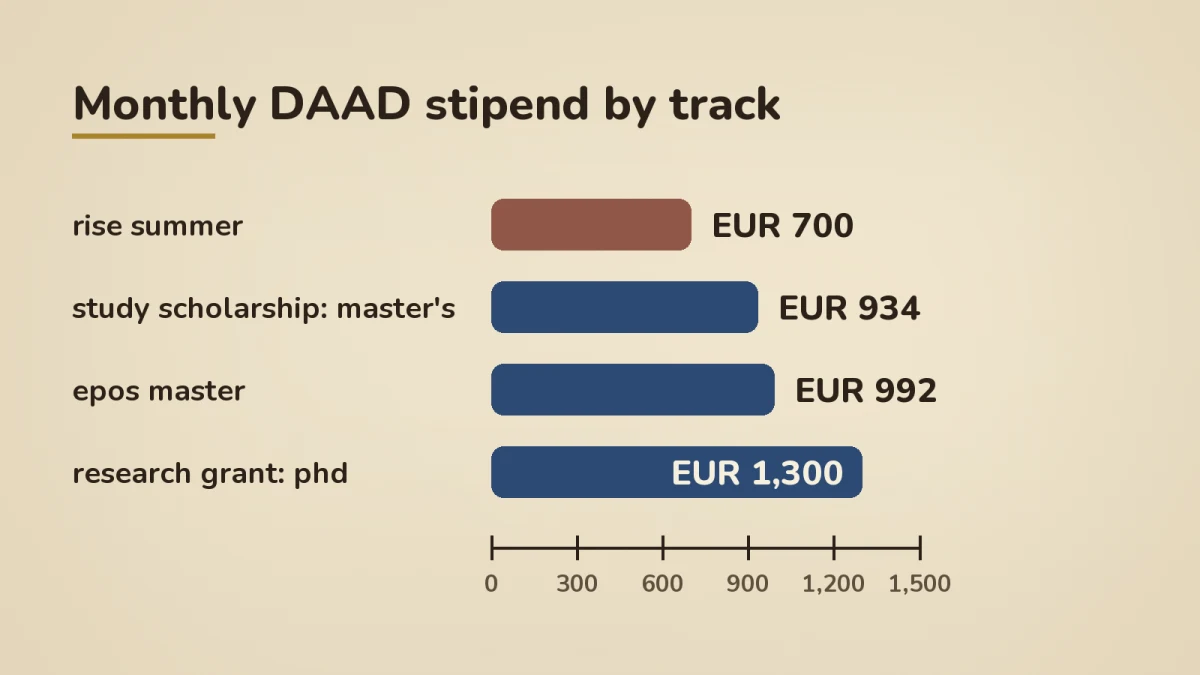
The headline figure for a Master's student is EUR 992 per month under the standard Study Scholarship. PhD candidates on a Research Grant receive EUR 1,400 per month. The exact figure for any specific course is in that course's funding factsheet on the DAAD database.
Beyond the monthly stipend, every full DAAD scholarship typically covers:
- Health, accident, and personal liability insurance.
- A one-time travel allowance to and from Germany (the amount depends on the home country).
- A monthly study and research allowance for materials.
- A tuition fee subsidy of up to EUR 500 per semester where the host university charges fees (relevant in Baden-Wuerttemberg and a handful of private programmes).
- Optional German language course funding (a 2 to 6 month intensive course before the programme starts) for non-German-taught Master's tracks.
- A family allowance and rent subsidy if you bring a spouse or children for stays of six months or longer.
A typical first-year Master's scholar sees about EUR 12,000 to 14,000 in stipend payments alone, with another EUR 1,500 to 2,500 in non-stipend benefits. For comparison to baseline living costs, our cost of living for international students sets the EUR 992 monthly figure used by German immigration as the reference point.
What the DAAD looks for in a strong application
The technical bar (degree, GPA converted to the German 1.0 to 5.0 scale, language) only gets you into the pool. The selection committee then weighs three documents heavily:
- Statement of motivation (one to three pages): the reason for choosing Germany, the specific programme, and the link to your career trajectory. Generic essays get filtered out.
- CV with all relevant work, research, and volunteer experience: for EPOS, the two-year professional experience requirement is non-negotiable.
- Two academic references: ideally from professors who supervised significant research or thesis work, not large-class instructors.
Programme-specific add-ons: a research proposal (1,500 to 3,000 words) for Research Grants and Helmut-Schmidt, a portfolio for art, music, design, and performing arts tracks, and an admission letter (or proof of application) from the host German university for the general Master's Study Scholarship.
Common mistakes that get applications rejected
- Applying without a host university plan. DAAD funds the person, not a generic "study in Germany" wish. List at least one specific Master's programme at a named German university.
- Submitting through the wrong portal. Most DAAD scholarships use portal.daad.de. EPOS development-track programmes route through each host university's own application system.
- Missing the language proof window. TestDaF and DSH reports take weeks. IELTS reports arrive in about 13 days. Order tests at least two months before the deadline.
- Vague motivation letters. A development-track applicant who cannot name a specific challenge in their home country rarely makes shortlist.
- Six-year rule slip. The Bachelor's degree must be no more than six years old at the application deadline.
FAQ
How competitive is the DAAD scholarship for Master's?
Acceptance rates published by DAAD regional offices range from 10 to 25 percent, depending on the programme and country quota. The general Study Scholarship is more competitive than EPOS development-track programmes from underrepresented countries, but EPOS demands two years of professional experience that disqualifies most fresh graduates.
Can I apply for DAAD before getting a university admission?
Yes for the general Study Scholarship: you submit the DAAD application before or in parallel with university applications, and you list your top three preferred programmes. Final scholarship confirmation is conditional on receiving an admission offer. EPOS works differently: you apply directly to the host university's funded programme, which decides scholarship and admission together.
Does DAAD cover tuition fees in Baden-Wuerttemberg?
The standard Study Scholarship contributes up to EUR 500 per semester toward tuition, which fully covers the EUR 1,500 per semester non-EU charge in Baden-Wuerttemberg, often with a partial waiver from the host university for DAAD scholars. Confirm with the university before assuming full cover.
Can I work part-time on a DAAD scholarship?
DAAD scholars can work up to 140 full days or 280 half days per year, the same rule that applies to all international students. The DAAD does not deduct earnings from the stipend, but very high earnings (over EUR 7,000 per year) can affect tax treatment.
Is the DAAD scholarship taxable?
DAAD scholarship stipends are tax-free under section 3 number 44 of the German Income Tax Act, provided the scholar's primary purpose is research or study, not employment.
Do I need German language for English-taught programmes?
No. About 85 percent of internationally targeted DAAD scholarships are open to English-taught Master's programmes and accept IELTS 6.0 or TOEFL iBT 80 as language proof. The optional 2 to 6 month German pre-programme course is funded if you choose to take it.
Where to next
- Scholarships in Germany for international students: the wider hub including Erasmus, Deutschlandstipendium, and foundation funding.
- Financing higher education in Germany: how DAAD slots into a full funding stack alongside loans and blocked accounts.
- Education loan options for Master's in Germany: the fallback when scholarship funding does not cover the full cost.
- Cost of living for international students: the EUR 992 baseline and city-by-city breakdown.
Continue reading
Financial Planning·8 min read
Tuition fees for Bachelor's in Germany
Find out all you need to know about tuition fees for Bachelor's in Germany! This guide covers everything from free public university options to living costs and financial aid tips.
Read articleFinancial Planning·14 min read
Bachelor's Degree Scholarships in Germany for International Students
Looking for bachelor's degree scholarships in Germany? Our funding guide has got you covered! Explore top scholarship programs available in Germany
Read articleFinancial Planning·8 min read
BAföG for international students in Germany 2026: Who qualifies, how much, and the start-up grant
BAföG eligibility for international students in 2026: residence-permit rules, monthly rates around EUR 992, the EUR 1,000 Studienstarthilfe, and how to apply.
Read articleReady to plan your Germany journey?
Explore our tools and resources to find the perfect university and program for your academic goals.