BAföG for international students in Germany 2026: Who qualifies, how much, and the start-up grant
BAföG eligibility for international students in 2026: residence-permit rules, monthly rates around EUR 992, the EUR 1,000 Studienstarthilfe, and how to apply.

Table of contents
Last updated: September 2026
TL;DR: Most international students in Germany on a §16b student visa are NOT eligible for BAföG. The grant is reserved for EU/EEA citizens with deep ties to Germany, refugees, long-resident third-country nationals, or students whose parents have worked in Germany for years. If you do qualify, the maximum monthly rate sits around EUR 992, half is a grant and half is an interest-free loan, and a one-time EUR 1,000 Studienstarthilfe is now available to low-income first-semester students.
BAföG (Bundesausbildungsförderungsgesetz) is Germany's federal student aid scheme. For German nationals from low-income families, it pays a monthly stipend that is half grant, half interest-free loan, capped repayment at EUR 10,000. For Bachelor's students from abroad, the rules are very different, and most readers of this blog are not eligible. This guide explains exactly when an international student qualifies, how much BAföG actually pays in 2026, and what the new EUR 1,000 start-up grant adds. If BAföG turns out to be a no, the Study pillar lists the scholarships and education loan routes that fill the gap.
Can international students get BAföG in 2026?
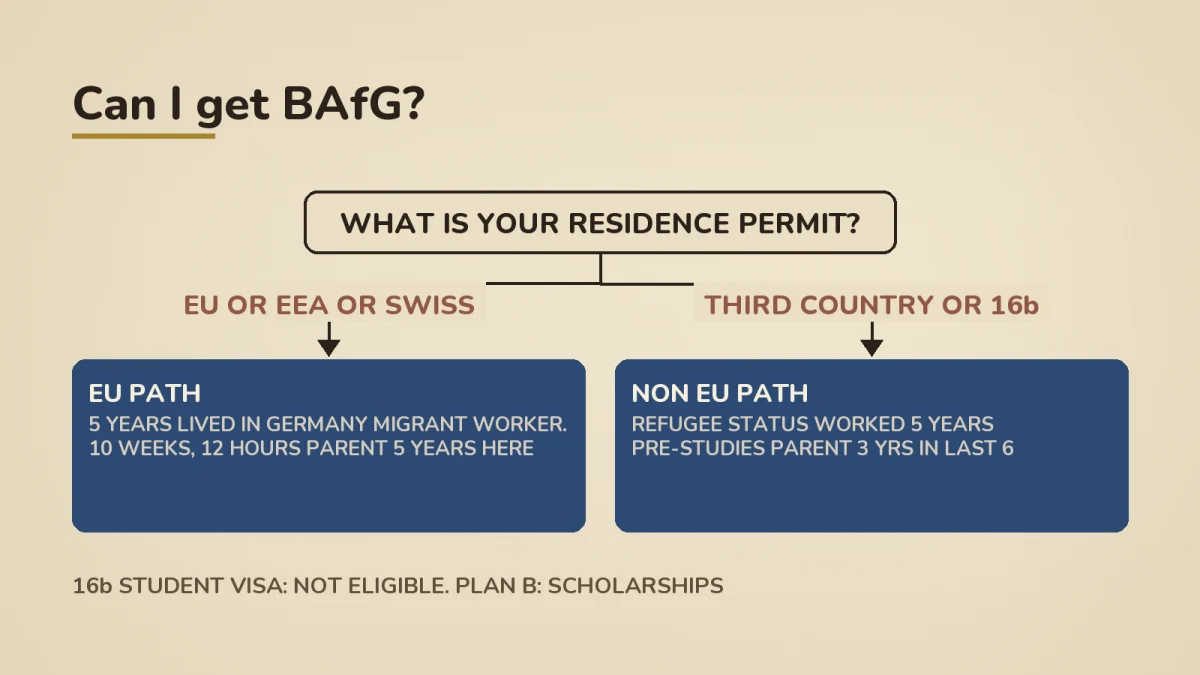
The short answer: only some, and almost never on a fresh student visa.
A §16b residence permit (the standard "student visa" issued at a German consulate before you arrive) explicitly excludes the holder from BAföG. The German Studierendenwerk system states this in plain text. If you came to Germany solely to study and your residence permit is §16b, the application will be rejected. This is the single most important fact international students miss when they read about BAföG online.
International students who can apply fall into two groups. EU, EEA (Norway, Iceland, Liechtenstein), and Swiss citizens have one set of paths. Everyone else (third-country nationals) has a different set, and the bar is higher.
Who qualifies among EU, EEA, and Swiss citizens
Eligibility opens through any one of these routes:
- Five years of legal residence in Germany before starting studies, OR
- A parent has lived legally in Germany for at least five years, OR
- Migrant worker status: you have been employed in Germany for at least 12 hours per week for at least 10 weeks before applying, you maintain employment during your studies, and you keep freedom-of-movement rights, OR
- Prior employment for 6 months in Germany before starting studies, where the work content is related to your degree.
The migrant worker route is the most common for EU students who finish a job in Germany and roll into a degree. The 10-week threshold is short. Once granted, BAföG continues as long as the qualifying status holds.
Who qualifies among third-country nationals
For non-EU students the bar is set high enough that fresh arrivals on a study visa are filtered out:
- Recognised asylum status or refugee status (this is the most common qualifying route for third-country nationals).
- Five years of prior employment in Germany before starting studies (vocational training does not count toward this).
- A parent who has been legally employed in Germany for at least three of the last six years.
- Tolerated foreigner status (Duldung) with at least 15 months of uninterrupted legal, permitted, or tolerated stay in Germany.
- §104c AufenthaltsG residence right (transitional path for long-tolerated residents). BAföG funding under this route is capped at 18 months.
Ukrainian students with a §24 AufenthG residence title are eligible, including during the period when only a Fiktionsbescheinigung (fictitious certificate) has been issued, with a 6-month renewable window.
How much BAföG pays in 2026
The maximum monthly BAföG for a student living away from parents and on the public statutory health and long-term care insurance scheme is around EUR 992. This is the all-in figure that includes the basic needs rate plus health and long-term care insurance contributions and a housing supplement.
For students under 25 living away from parents, the basic needs rate after the most recent reform sits around EUR 855 per month before insurance and housing add-ons. Students who live with their parents receive significantly less, around EUR 534 per month, because the housing portion is reduced.
What you actually receive depends on your own income, your parents' income, and any partner's income. The income exemption thresholds were raised by 5 percent in the most recent reform, which means more applicants clear the means test, but most still receive only a partial rate. A full max-rate payment is the exception, not the rule.
| Living situation | Approximate 2026 monthly rate |
|---|---|
| Living with parents | up to EUR 534 |
| Living away from parents (under 25) | up to EUR 855 base needs |
| Living away, under 25, with full insurance and housing supplement | up to EUR 992 |
Half of every euro paid is a grant (you keep it). The other half is an interest-free state loan. The total loan repayment is capped at EUR 10,000 regardless of how many semesters you funded. Repayment starts 5 years after the end of the maximum funding period, with a minimum monthly instalment of EUR 130. Recipients who repay early can apply for a partial discount.
The EUR 1,000 Studienstarthilfe start-up grant
The 2024 reform introduced a one-time start-up grant for first-semester students from low-income households. It is a separate scheme from monthly BAföG, paid as a single lump sum at the start of studies, and it is a pure grant with no repayment obligation.
To qualify you must be enrolling at a German higher education institution as a first-semester student and your household must be receiving an income-tested social benefit (BAföG itself, Bürgergeld, Wohngeld, child supplement, or asylum-seeker benefits). The start-up grant is independent of monthly BAföG eligibility. You can receive the EUR 1,000 even if you are not on monthly BAföG, provided the household-benefit test is met. International students from third countries on a §16b student visa generally do not meet the test because they are not eligible for the listed benefits.
How to apply
Applications run through the BAföG-Amt at your local Studierendenwerk (the student services office at your university). The standard submission is online via bafoeg-digital.de or through the relevant Land's portal. You will need:
- Form 1: the main application with personal details and study programme.
- Form 3: filled out by each parent (income declarations).
- Enrolment certificate (Immatrikulationsbescheinigung) from your university.
- Proof of identity and residence permit showing the eligible status (the §16b student visa will not pass this filter).
- Bank statements and tax assessments for the relevant period.
Process the application as early as possible. BAföG pays from the month of application, not retroactively, so a delay costs you a month of support per month delayed. Decisions take 6 to 10 weeks during the autumn-winter peak.
Common mistakes international students make
- Assuming a student visa qualifies. It does not. §16b is the explicit BAföG exclusion.
- Applying without a residence-permit type that opens the eligibility door. The application will be rejected and the time spent on it will not have moved you closer to funds.
- Confusing BAföG with the Studienstarthilfe. They are separate schemes with separate eligibility tests. You can receive one without the other.
- Skipping the income disclosure. Both your income and your parents' income need full documentation. Missing or incomplete income forms are the single biggest reason for processing delays.
- Treating BAföG as the only option. For students who do not qualify, scholarships, education loans, and structured part-time work cover the same ground.
FAQ
Can I get BAföG on a §16b student visa?
No. A §16b residence permit (the standard pre-arrival study visa) is the explicit BAföG exclusion clause. You must hold a different residence-permit type that opens eligibility.
How much does BAföG pay per month in 2026?
Up to about EUR 992 per month for a student under 25 living away from parents, with health and long-term care insurance contributions and the housing supplement included. Most recipients get less because the means test reduces the rate based on family income.
Is BAföG a grant or a loan?
Both. Half the money paid is a non-repayable grant. The other half is an interest-free state loan. Total loan repayment is capped at EUR 10,000 across the entire study period.
When do I have to repay BAföG?
Five years after the end of your maximum funding period. The minimum monthly instalment is EUR 130. The total cap is EUR 10,000. Early-repayment discounts are available.
What is the EUR 1,000 Studienstarthilfe?
A one-time, no-repayment start-up grant for first-semester students whose households receive an income-tested social benefit. It is separate from monthly BAföG and is paid once at the start of studies.
Can a Ukrainian student get BAföG?
Yes, with a §24 AufenthG residence title (the temporary protection status). Even a Fiktionsbescheinigung can support a 6-month renewable application.
Does part-time work affect my BAföG?
Yes. Earnings above EUR 603 per month (2026 mini-job ceiling) reduce the monthly BAföG rate. Within the mini-job ceiling there is no reduction.
Where to next
Continue reading
Financial Planning·8 min read
Tuition fees for Bachelor's in Germany
Find out all you need to know about tuition fees for Bachelor's in Germany! This guide covers everything from free public university options to living costs and financial aid tips.
Read articleFinancial Planning·14 min read
Bachelor's Degree Scholarships in Germany for International Students
Looking for bachelor's degree scholarships in Germany? Our funding guide has got you covered! Explore top scholarship programs available in Germany
Read articleFinancial Planning·8 min read
Elterngeld for expats 2026: Rates, income cap, and how to plan parental leave
How Elterngeld works for expat parents in Germany in 2026: replacement rates, the EUR 175,000 income cap, ElterngeldPlus, and planning tips.
Read articleReady to plan your Germany journey?
Explore our tools and resources to find the perfect university and program for your academic goals.