Elterngeld for expats 2026: Rates, income cap, and how to plan parental leave
How Elterngeld works for expat parents in Germany in 2026: replacement rates, the EUR 175,000 income cap, ElterngeldPlus, and planning tips.

Table of contents
Last updated: May 2026
TL;DR: Elterngeld replaces 65% of your pre-birth net income, capped at €1,800 a month, for up to 12 months (or 14 if both parents share). For babies born from 1 April 2025 onward, parents lose the benefit entirely if their joint taxable income (zvE) in the year before birth crossed €175,000. ElterngeldPlus doubles the duration at half the rate. Most expats with a residence permit that allows work qualify; permits issued purely for study or job search do not.
For expats planning a baby in Germany, Elterngeld is the biggest cash benefit you will get from the state in your first year as a parent. It is paid by the federal government, sits separately from Kindergeld (the flat monthly child benefit on top), and the rules changed twice in two years. Here is the version that applies in 2026.
How much Elterngeld pays in 2026
Basiselterngeld replaces a share of the income you lost during parental leave. The headline rate is 65% of your "Elterngeld-Netto" (your pre-birth net income with a few deductions added back). The minimum is €300 a month; the maximum is €1,800 a month, hit once your Elterngeld-Netto crosses roughly €2,770.
Modifiers on top:
- Geringverdienerbonus. Below €1,240 of Elterngeld-Netto, the rate climbs above 65% on a sliding scale, up to 100% at very low pre-birth incomes.
- Geschwisterbonus. An older child under 3 (or two under 6) adds a 10% sibling bonus, with a €75 minimum extra per month for Basiselterngeld.
- Mehrlingszuschlag. Twins, triplets, and beyond add €300 per extra child for Basiselterngeld, or €150 for ElterngeldPlus.
The income cap that locks higher earners out
This is the rule expats most often miss. Since 1 April 2025, parents whose zu versteuerndes Einkommen (zvE) in the calendar year before the birth crossed €175,000 receive zero Elterngeld. The cap applies to single parents and couples equally; for couples filing jointly, it is the combined zvE.
zvE is not the same as gross salary. It is the figure on your final tax assessment (Steuerbescheid) after deducting Sonderausgaben, Vorsorgeaufwendungen, individual allowances, and outsized burdens. A couple with about €207,000 in combined gross salary will often land near €175,000 zvE, give or take their deductions. The Bundesfamilienministerium publishes worked examples on its official Elterngeld page.
A quick history of the cap:
| Birth date | zvE limit (couples) | zvE limit (single parents) |
|---|---|---|
| Up to 31 March 2024 | €300,000 | €250,000 |
| 1 April 2024 to 31 March 2025 | €200,000 | €200,000 |
| From 1 April 2025 | €175,000 | €175,000 |
For a 2026 birth, the €175,000 limit decides whether you get anything at all. If you are close to it, the timing of bonuses, equity vests, or year-end deductions in the prior calendar year can be the difference between full Elterngeld and none.
Basiselterngeld, ElterngeldPlus, and partner months
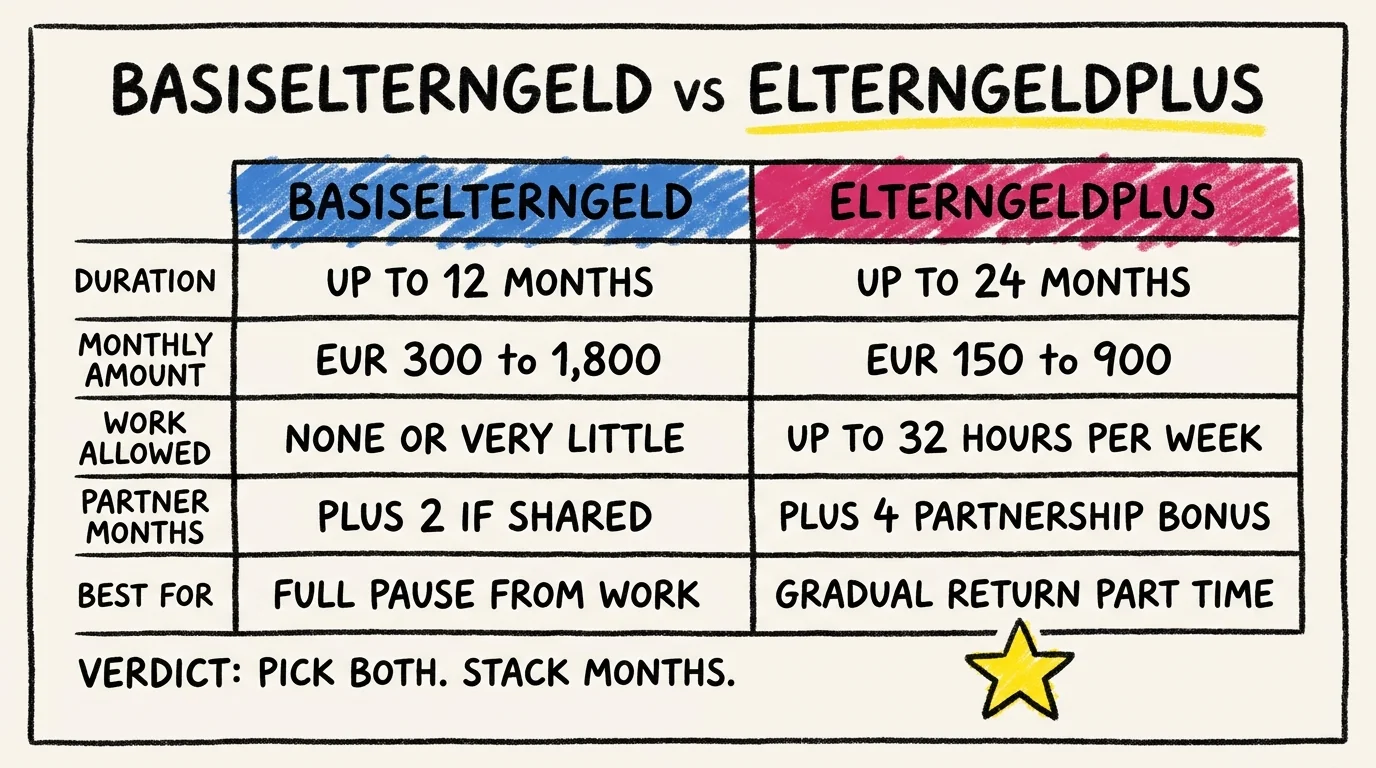
You don't have to take the benefit in one block. There are three flavours.
- Basiselterngeld. Up to 12 months at the full rate, claimed by one parent. If both parents take at least 2 months each, you get 2 extra "partner months", for a total of 14 across the household. Single parents get the full 14 months alone.
- ElterngeldPlus. Half the monthly amount, doubled duration. One Basiselterngeld month converts to two Plus months. Plus is designed to bridge a part-time return to work, since you can earn up to 32 hours a week without losing the benefit, with the payment recalculated against what you earn.
- Partnerschaftsbonus. Four extra Plus months on top, available to each parent, if both work between 24 and 32 hours a week for four consecutive months and care for the child during that time.
For births from 1 April 2024, both parents can take Basiselterngeld at the same time only for one month within the first twelve months of the child's life. Premature babies (more than 6 weeks early), multiple births, and parents of children with disabilities are exempt and can take parallel Basiselterngeld as before.
Who qualifies as a non-EU expat
Citizenship alone does not decide eligibility; your residence permit does. The short version:
- EU, EEA, Swiss citizens: eligible once living in Germany with the child.
- Settlement permit (Niederlassungserlaubnis) or EU long-term residence: eligible.
- EU Blue Card, ICT card, residence permit for skilled employment (§§ 18a, 18b AufenthG), researcher permits: eligible. See our EU Blue Card guide.
- Family reunion permits that allow work: eligible. The family reunion visa usually carries work rights; check the back of your card.
- Pure study permits (§ 16a AufenthG), language-course permits, post-study job-search permits, Chancenkarte during the search phase: not eligible.
You also need to live in Germany with the child and work no more than 32 hours per week during the months you claim.
How to plan: tax class, timing, application
Three levers move the needle for most expats.
- Tax class. Elterngeld is calculated on net income, so the tax class you held before maternity leave matters. The parent who will claim Elterngeld should sit in Steuerklasse III (the lower-tax class for couples) for at least 7 months before maternity leave starts. Switching closer to the birth date will not be respected. See our Germany tax basics for how to switch.
- Reference period. For employees, the 12 calendar months before maternity leave are the reference. For the self-employed, it is the calendar year before birth, the same year used to test the €175,000 cap. Self-employed parents close to the cap may want to bring forward deductible spending into that year.
- Application window. Submit the application to your local Elterngeldstelle after the birth, ideally within the first 3 months. Elterngeld is only paid retroactively for 3 months, so a late application directly costs you money. Documents needed: birth certificate, ID, residence permit, proof of income, employer confirmation of parental leave dates, health insurance certificate, and the state application form.
You also have to notify your employer of Elternzeit (the unpaid leave) at least 7 weeks before it starts, in writing. Elternzeit and Elterngeld are separate: Elternzeit can run up to 3 years, while Elterngeld only pays for the months above.
Common mistakes expats make
- Counting gross salary against the cap instead of zvE, then panicking unnecessarily.
- Switching to Steuerklasse III less than 7 months before the leave starts and finding the change does not apply to the calculation.
- Missing the 3-month retroactive limit by submitting the application too late after birth.
- Forgetting to share parent months when only one parent takes leave, and losing the 2 partner-month bonus.
- Assuming a student visa or job-seeker visa qualifies. It does not.
- Letting bonuses, RSU vests, or restricted stock push the prior-year zvE above €175,000 right when a baby is due, with no plan to spread the income.
FAQ
Does Elterngeld count as taxable income in Germany?
Elterngeld itself is tax-free, but it raises your effective tax rate via the Progressionsvorbehalt: the rest of your taxable income for the year is taxed at a higher bracket. File a tax return for the year you receive it, even if you were not required to file before.
Can both parents take Elterngeld at the same time?
For births from 1 April 2024, parallel Basiselterngeld is limited to one month within the first 12 months of the child's life. ElterngeldPlus can run in parallel for longer, and the Partnerschaftsbonus is built on shared part-time work. Twins, premature babies, and children with disabilities are exempt from the parallel limit.
Is the €175,000 cap calculated per person or per couple?
Per couple if you file together. Per person for single parents. Either way, the benchmark is the zvE for the calendar year before birth.
What happens if I work part-time during Elterngeld months?
Up to 32 hours per week is allowed without losing the benefit, but the amount is recalculated against what you earn. Over 32 hours and you lose the benefit for that month.
Can I get Elterngeld if I am self-employed?
Yes. The calculation uses your profit (Gewinn) from the calendar year before birth as reported on your tax return. The €175,000 cap applies to your zvE as for everyone else.
Do I keep my health insurance during Elterngeld?
If you are publicly insured (gesetzlich krankenversichert) and on Elternzeit without paid work, you usually stay covered free of charge. Privately insured parents continue paying their full premium. See our insurance overview for context.
Where to next
Continue reading
Financial Planning·13 min read
ELSTER and German tax filing for expats: When you must file, how to claim back, what changed in 2026
Working in Germany and unsure about taxes? When ELSTER filing is mandatory, the 2026 changes, and how expats reclaim around 1,000 euro on average.
Read articleFinancial Planning·9 min read
Kindergeld for expats in Germany 2026: who qualifies and how to claim
Kindergeld is Germany's monthly child benefit, paid by the Familienkasse to almost any parent legally living here. The 2026 rate is 259 euros per child.
Read articleFinancial Planning·13 min read
Blocked Account Germany 2026: How much you need, providers compared, application steps
How much money you need in a 2026 German Sperrkonto, which providers are still operational, and the step-by-step application timeline before your visa appointment.
Read articleReady to plan your Germany journey?
Explore our tools and resources to find the perfect university and program for your academic goals.