ELSTER and German tax filing for expats: When you must file, how to claim back, what changed in 2026
Working in Germany and unsure about taxes? When ELSTER filing is mandatory, the 2026 changes, and how expats reclaim around 1,000 euro on average.

Table of contents
Last updated: May 2026
TL;DR: If you live and work in Germany, you may not be required to file a tax return, but most expats are. Filing through ELSTER (the official free portal) takes a couple of hours and the average refund is around 1,000 euro. From July 2026 a new "MeinELSTER+" one-click flow auto-fills most of it for you.
If you moved to Germany on a Blue Card, a Skilled Worker visa, or as a Werkstudent who is now full-time, the German tax system probably looks like a wall. Half the rules are in legal German; the other half assume you have lived here for a decade. This guide cuts that down to the parts that actually matter to expats: when you are legally required to file, when you should file even if you do not have to, and what changed for the 2025 tax year you are filing in 2026.
We will not cover the student-only mini-job and Werkstudent edge cases here. If that is your situation, read paying taxes in Germany as an international student instead. This post is for working professionals and settled expats. The pillar overview lives at taxes in Germany.
Who must file a German tax return in 2026
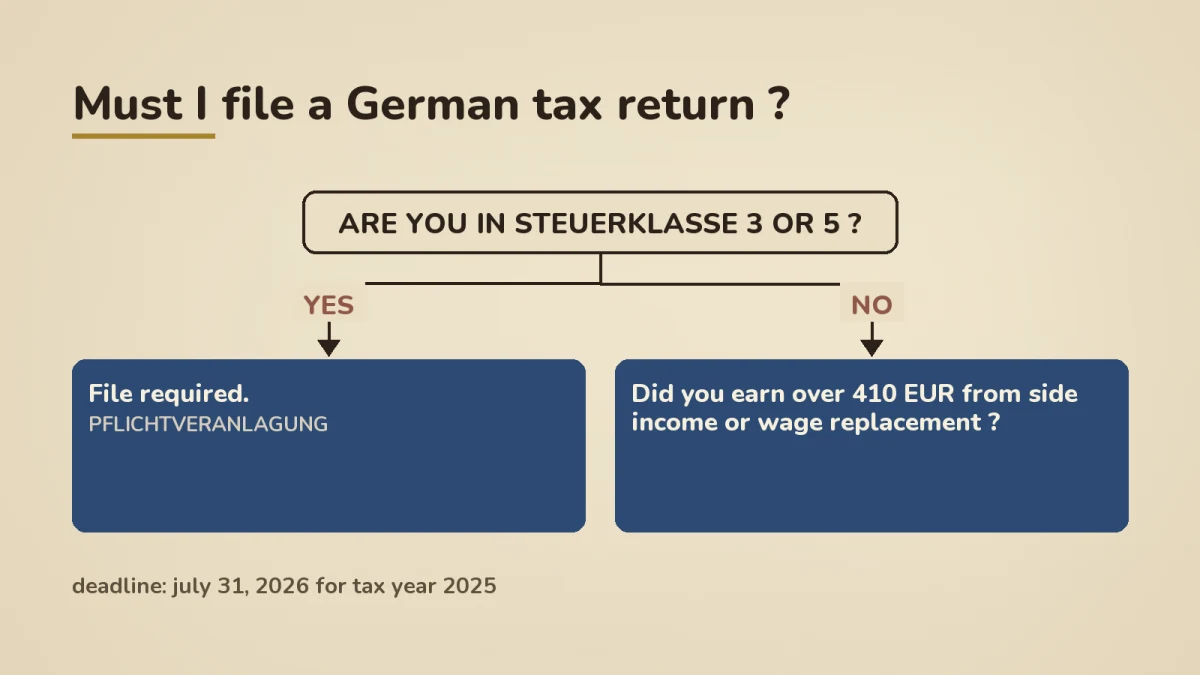
Most German employees never need to file. Your employer withholds Lohnsteuer every month, Solidarity surcharge is mostly gone for normal earners, and the Finanzamt is satisfied. You are off the hook unless one of the trigger conditions below applies. These are called Pflichtveranlagung cases (mandatory filing).
You must file a return for tax year 2025 (deadline 31 July 2026) if any of these are true:
- You are in tax class III/V or in tax class IV with the Faktorverfahren (most married couples where both work).
- You earned more than 410 euro from a side job, freelance work, or self-employment that was not taxed at source.
- You received more than 410 euro of wage replacement benefits like Arbeitslosengeld, Krankengeld, Elterngeld, Mutterschaftsgeld, or Kurzarbeitergeld in the year. These are tax-free but raise the rate applied to the rest of your income (Progressionsvorbehalt).
- You worked for two or more employers in the same calendar year (without an Abrufverfahren registered).
- You claimed a Freibetrag on your payroll record during the year (for example a commute deduction added monthly to reduce withholding).
- You sold property, shares not subject to Abgeltungsteuer at source, or other capital assets.
- You moved out of Germany mid-year and had German income that year. Most expats leaving Germany hit this rule.
- You moved into Germany mid-year. Income from before you became tax-resident counts toward the rate calculation even though it is not taxed in Germany.
- You are married to a non-EU spouse who has not had the Ehegattensplitting election filed.
Outside of these triggers you can skip filing. But you almost certainly should not.
Who should file voluntarily, and why almost everyone benefits
Voluntary filing (Antragsveranlagung) is the path for employees who are not legally required to file but want their money back. The average refund for German tax filers is around 1,000 euro for the 2025 tax year, according to the Federal Statistical Office. That is real money for two hours of paperwork.
The deduction categories that most often trigger a refund are:
- Werbungskosten above the 1,230 euro lump sum: commute, professional training, German classes, work tools, second-home tax for a Wochenendpendler.
- Doppelte Haushaltsführung if you keep a flat in your home country and another in Germany while working here.
- Umzugskosten: relocation expenses including the move itself, househunting trips, broker fees, double rent during transition.
- Sonderausgaben above 36 euro: church tax, Riester contributions, donations, school fees for a German-recognised school.
- Außergewöhnliche Belastungen: medical bills, dental work, glasses, therapy not covered by insurance, above the zumutbare Belastung threshold.
The voluntary window is four years backward. In 2026 you can still file for 2022, 2023, 2024, and 2025. After that the right is lost. If you have been in Germany since 2022 and never filed, you have four refunds waiting.
What changed for the 2025 tax year you are filing in 2026
Three changes matter for filers this year.
Grundfreibetrag rises to 12,348 euro
The basic personal allowance increases to 12,348 euro for single filers and 24,696 euro for married couples filing jointly. This is the slice of income on which you pay zero income tax. Up by 252 euro from the 2025 level. For a normal earner this saves roughly 50 to 70 euro in 2026 versus 2025 at the same gross salary, according to the Bundesfinanzministerium.
If your annual taxable income is below 12,348 euro you owe nothing and the rest of the article is moot. File anyway to claim back any Lohnsteuer your employer withheld during onboarding months.
MeinELSTER+ one-click filing launches in 2026
This is the biggest practical change in years. The Federal Ministry of Finance and the Bavarian Landesamt für Steuern launched the MeinELSTER+ smartphone app on 31 March 2026 with a feature called okElster. From July 2026 it rolls out to most simple-case taxpayers (single income source, no self-employment, no rental income, no foreign assets).
If you qualify, the Finanzamt sends you a pre-filled return based on data they already hold (your Lohnsteuerbescheinigung, your Krankenkasse contributions, pension contributions, child benefit payments). You open the app, tap once to confirm, get a Vorschau on the expected refund, and submit. No PIN ceremony, no Mantelbogen, no separate Anlage forms.
The catch: pre-filling means you only get the deductions the Finanzamt knows about. Werbungskosten beyond the 1,230 euro lump sum, donations, medical bills, and home office days still need to be added manually. For most expats the manual additions are where the refund hides, so the one-click flow is a starting point not a finishing line.
Home office Pauschale stays at 6 euro per day, capped at 1,260 euro
The Homeoffice-Pauschale is unchanged in 2026: 6 euro per qualifying work-from-home day, up to 210 days per year, maximum 1,260 euro. It counts inside Werbungskosten and only helps if your total Werbungskosten exceeds the 1,230 euro lump sum. Practically that means you need either a long commute or other Werbungskosten on top to claim it.
Pendlerpauschale rates
For the commute deduction, the current rate is 0.38 euro for every full kilometre of one-way distance. You count the working days you actually commuted, not 365.
Filing through ELSTER: step by step
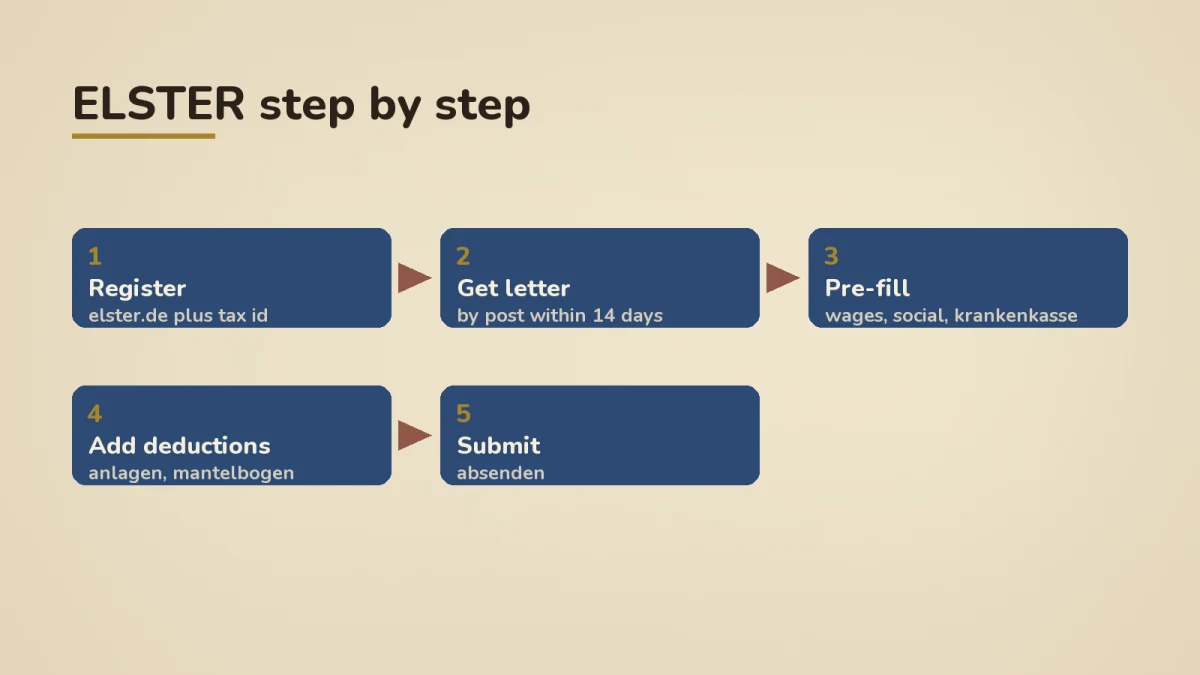
ELSTER is the official portal of the German tax authorities, run by the Bayerisches Landesamt für Steuern on behalf of all 16 federal states. It is free. There is no premium tier. Third-party services (Taxfix, Wundertax, Smartsteuer, SteuerGo) sit on top of ELSTER and add a friendlier interface; they charge 30 to 60 euro and are worth it if your German tax vocabulary is weak.
If you want to do it yourself directly through ELSTER:
- Register at elster.de with your Steueridentifikationsnummer (the 11-digit ID you got after your Anmeldung). You will receive an activation letter by post within 14 days. Plan for this lag; it is the single most common reason expats miss the deadline.
- Download your certificate file after activation and store it somewhere safe. This is your login key. Losing it means restarting the registration cycle.
- Pull your pre-filled data through Belegabruf. ELSTER will populate the wage data, social security, and Krankenkasse contributions from the Finanzamt's records.
- Add your Werbungskosten manually in Anlage N (employees) or Anlage S (self-employed): commute distances, work tools, training, language courses, home office days, work-related travel.
- Add Sonderausgaben in the Mantelbogen: church tax (already on your payslip), Riester or Rürup contributions, donations with receipts.
- Add Außergewöhnliche Belastungen if you had unreimbursed medical, dental, or therapy bills.
- Review the Vorschau ELSTER shows your estimated tax assessment before you submit. Numbers that look wrong usually mean a missed Anlage. Fix and re-preview.
- Submit electronically. No paper, no signature ceremony, no Finanzamt visit.
The Finanzamt typically processes a return in 6 to 12 weeks. Refunds land directly in the bank account you provided. If you do not have a German account yet, see opening a German bank account first; foreign accounts work but slow the refund.
Deductions expats commonly miss
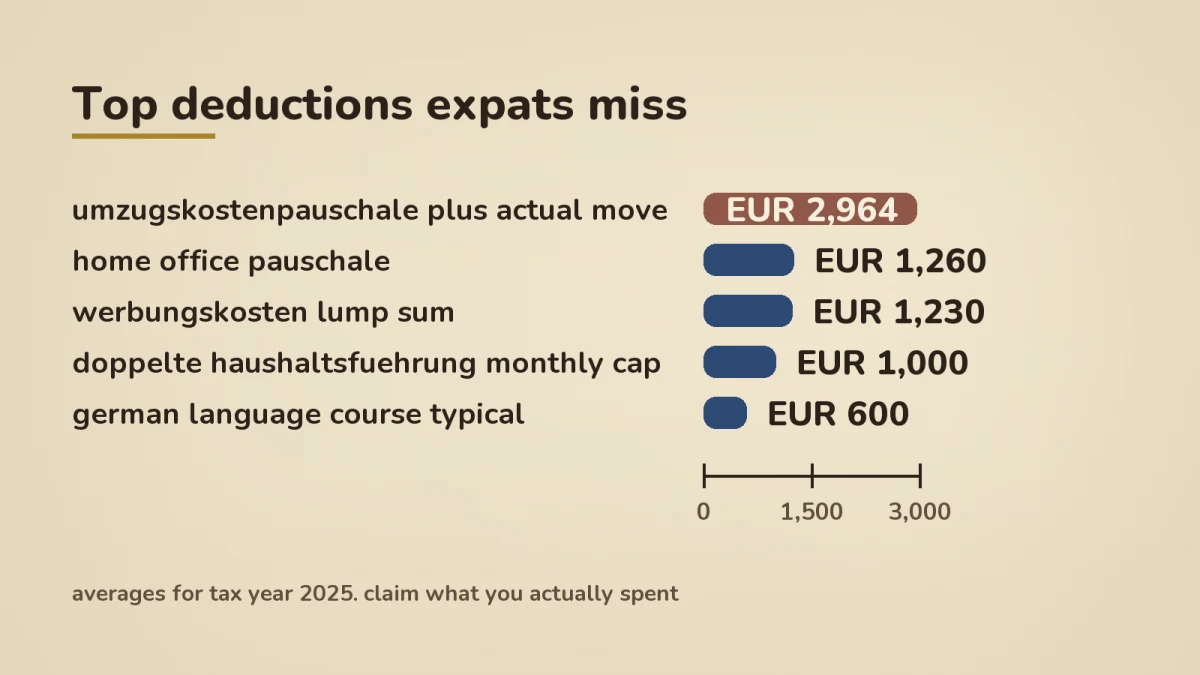
These are the deductions that most often turn a small refund into a meaningful one. Each one is real, each one is documented in the Einkommensteuergesetz, and each one is routinely missed by expats filing for the first time.
- Umzugskostenpauschale: if your move was work-related (you took a job or were transferred), you can claim a flat allowance currently set at 964 euro for a single person plus actual costs for the move itself. A relocation flight from India, Pakistan, or the US plus the moving company invoice routinely add up to 2,000 to 4,000 euro of deductible expense.
- Doppelte Haushaltsführung: if you kept a residence in your home country during your first year in Germany while your German home was the work location, you can deduct rent on the German place (capped at 1,000 euro per month) plus weekly travel home plus telephone costs.
- German language courses: Volkshochschule Goethe-Institut, telc, ÖSD, or any other accredited German course is fully deductible as Werbungskosten if you can argue it improves your job prospects. For most expat working professionals this is trivial to argue.
- Beratungskosten: any tax software fee, Lohnsteuerhilfeverein membership, or Steuerberater fee for the previous year is itself deductible the next year.
- Job application costs: travel to interviews, postage, certified copies, online job board subscriptions, all deductible if they relate to securing your current or next employment.
If you are uncertain whether something qualifies, claim it and let the Finanzamt push back. They will. They are reasonable about it. The worst case is they remove it from your assessment.
Common mistakes that cost expats money
- Filing late and skipping voluntary returns. The four-year voluntary window closes silently. People reach year five and lose the refund.
- Skipping the Steuerklasse change after marriage. A non-working or lower-earning spouse plus a higher-earning partner usually wants III/V, not IV/IV. The change is free at the Finanzamt and saves money every payday.
- Letting the employer pick the wrong wage tax software default. New hires often get tax class I auto-assigned even when they are married. Check your first payslip.
- Filing on paper. You do not have to. Paper returns get processed last and refunds take longer.
- Trusting Google translate for the Mantelbogen. Use a third-party tool with English UI like Taxfix, Wundertax, or SteuerGo if your German tax vocabulary is weak. The 30 to 60 euro fee is itself deductible next year.
- Not registering for ELSTER until June. The activation letter takes up to 14 days by post. If you start in mid-July you will miss the 31 July deadline. Start in March.
FAQ
Do I have to file a German tax return if I left Germany mid-year?
Yes. Anyone who had German taxable income during the year and left Germany mid-year is in Pflichtveranlagung. The deadline is the same: 31 July of the following year. If you left in 2025, you file for 2025 by 31 July 2026.
Can I file in English?
ELSTER is German-only. Third-party services offer English interfaces (Taxfix, Wundertax, SteuerGo, Smartsteuer). You can also hire an English-speaking Steuerberater; expect 200 to 600 euro for a simple expat return.
What is the deadline if I use a Steuerberater?
If a Steuerberater files for you, the deadline for tax year 2025 extends to 28 February 2027. This is the standard extended deadline for represented filers.
How long does it take to get my refund?
Six to twelve weeks after submission, in most cases. Coastal Finanzämter and Berlin Finanzamt für Körperschaften tend to be slower. Refunds are paid by SEPA transfer to the IBAN you supply on the return.
Do I owe German tax on income from my home country?
If you are tax-resident in Germany (you have a Wohnsitz here or stayed more than 183 days), Germany taxes your worldwide income. Double Taxation Agreements with most countries (India, Pakistan, US, UK) prevent the same income being taxed twice; foreign tax paid is credited against German tax owed. The mechanics are in Anlage AUS.
Can I claim back the Solidaritätszuschlag I paid in 2025?
The Soli was abolished for the bottom 90 percent of earners in 2021. If you earned above the threshold (roughly 100,000 euro single, 200,000 euro joint) you still paid it. There is no separate refund procedure; it is just baked into the assessment.
What happens if I miss the deadline?
The Finanzamt sends a reminder, then a Verspätungszuschlag (late-filing penalty) of 0.25 percent of the assessed tax per started month, minimum 25 euro per month. If you are owed a refund, late filing costs you only the time-value of money. If you owe tax, it adds up fast.
Should I use Taxfix, Wundertax, SteuerGo, or ELSTER directly?
If you are comfortable in German and have a simple return (single employer, standard deductions), use ELSTER directly. If your German is weak or you have multiple Anlagen (rental income, foreign income, freelance), use a third-party tool with English UI. The 30 to 60 euro fee is deductible next year.
Where to next
- Cost of living in Germany for the budget context the tax savings sit inside.
- EU Blue Card guide if your tax class III election is tied to your immigration status.
- German bank account guide if you do not have a German IBAN yet for the refund.
- The pillar page at /live/taxes for the broader German tax system overview.
If you want a person to walk you through the return, our team includes Steuerberater partners who handle expat returns end-to-end. Reach out via the consultation form and ask for tax filing support.
Continue reading
Financial Planning·9 min read
Income tax in Germany 2026 for international students and expats: New tax-free allowance
Germany's basic tax-free allowance rose to EUR 12,348 for 2026. What changed, how the brackets work, and what students and expats need to file.
Read articleFinancial Planning·8 min read
BAföG for international students in Germany 2026: Who qualifies, how much, and the start-up grant
BAföG eligibility for international students in 2026: residence-permit rules, monthly rates around EUR 992, the EUR 1,000 Studienstarthilfe, and how to apply.
Read articleFinancial Planning·8 min read
Tuition fees for Bachelor's in Germany
Find out all you need to know about tuition fees for Bachelor's in Germany! This guide covers everything from free public university options to living costs and financial aid tips.
Read articleReady to plan your Germany journey?
Explore our tools and resources to find the perfect university and program for your academic goals.