€50,000 salary in Germany: Where it goes the furthest (Munich vs Berlin vs Leipzig)
A €50,000 salary in Germany is roughly €2,695 net per month. See exactly what that buys in Munich, Berlin, and Leipzig in 2026.

Table of contents
Last updated: May 2026
TL;DR: A €50,000 gross salary in Germany works out to roughly €2,695 net per month for a single person on Steuerklasse 1 (no church tax). What that money buys depends almost entirely on the city. In Munich, rent eats more than half your take-home and you have around €500 left after the basics. In Berlin you keep about €1,000. In Leipzig the same salary leaves close to €1,500 free. The spreadsheet, not the skyline, picks the winner.
So you have a €50,000 offer in Germany. Before you sign, the question that decides your year is not the gross figure on the contract. It is the city the contract names. Use the salary calculator to confirm the net for your tax class, then read on for what those euros actually buy once rent, groceries, and a Deutschland-Ticket come out. For broader context, our cost of living guide and the best cities to live and work in Germany cover the supporting picture.
This post is for the working-professional reader who has a number on the table and three cities in the mix: Munich, Berlin, Leipzig. We compare the same salary across all three and end with the hidden-gem cities that beat all three on disposable income.
What €50,000 actually means after tax in Germany
A €50,000 gross annual salary on Steuerklasse 1 (single, no children, no church tax, statutory health insurance) leaves roughly €32,300 in net pay across the year. That is about €2,695 per month in your account after income tax, solidarity surcharge where it still applies, and the four social contributions: pension, unemployment, health, and long-term care.
The wedge between gross and net in Germany is large by international standards. On €50,000 you keep about 64.7% of the gross figure. That ratio shifts with tax class, church membership, and which Bundesland you live in for church tax purposes, but the headline net is the right anchor for a single professional. Couples on Steuerklassen 3 / 5 keep more of one income, and adding a child changes the calculation again. Our broader taxes in Germany guide explains how the brackets work.
Two side notes that matter when you compare offers:
- Brutto vs Netto on job ads. German job adverts almost always quote gross (brutto). When recruiters say €50,000 they mean before tax. Always compute the net before negotiating.
- Bonuses are taxed as a lump. A €5,000 sign-on bonus does not move you to a higher bracket permanently, but the month it lands is taxed at the rate of an annualised projection. The deduction looks scary on the payslip; the year-end tax return reconciles it.
How rent eats your salary, city by city
Rent is the single biggest variable. Same gross, same job, three different stories.
| City | Warm rent (2-room, 60-70 sqm) | % of net (€2,695) |
|---|---|---|
| Munich | €1,500 to €1,600 | 56% to 59% |
| Stuttgart | €1,150 to €1,250 | 43% to 46% |
| Hamburg | €1,100 to €1,200 | 41% to 45% |
| Frankfurt | €1,100 to €1,250 | 41% to 46% |
| Berlin | €1,050 to €1,150 | 39% to 43% |
| Düsseldorf | €950 to €1,050 | 35% to 39% |
| Leipzig | €650 to €750 | 24% to 28% |
| Dresden | €600 to €700 | 22% to 26% |
Sources: LohnTastik 2026, Investropa, Numbeo (warm-rent figures include heating; cold-rent listings on Immowelt look lower but rarely tell the full monthly story).
The IW Köln Kurzbericht 93/2025 frames the same picture differently: Munich's general price level sits 24% above the German national average. Eight of the country's ten most expensive districts cluster in Bavaria, Baden-Württemberg, around Frankfurt, and Hamburg. Eastern districts in Vogtland and Görlitz sit roughly 10% below the national average. The split is not a stereotype, it is in the data.
The full monthly budget:
Munich, Berlin, Leipzig
Once you add the rest of the basics, the picture sharpens. Here is the same single professional, same €2,695 net, three cities. Numbers reflect a comfortable but not extravagant lifestyle: warm 2-room rent, normal groceries, the Deutschland-Ticket at €63 per month (raised from €58 in January 2026), eating out four times a month, a gym subscription, and miscellaneous.
| Expense | Munich | Berlin | Leipzig |
|---|---|---|---|
| Warm rent (2-room) | €1,550 | €1,100 | €700 |
| Groceries | €350 | €300 | €270 |
| Transport (Deutschland-Ticket) | €63 | €63 | €63 |
| Dining out (4 visits) | €120 | €100 | €80 |
| Gym + miscellaneous | €105 | €95 | €85 |
| Total spend | €2,188 | €1,658 | €1,198 |
| Left after basics | €507 | €1,037 | €1,497 |
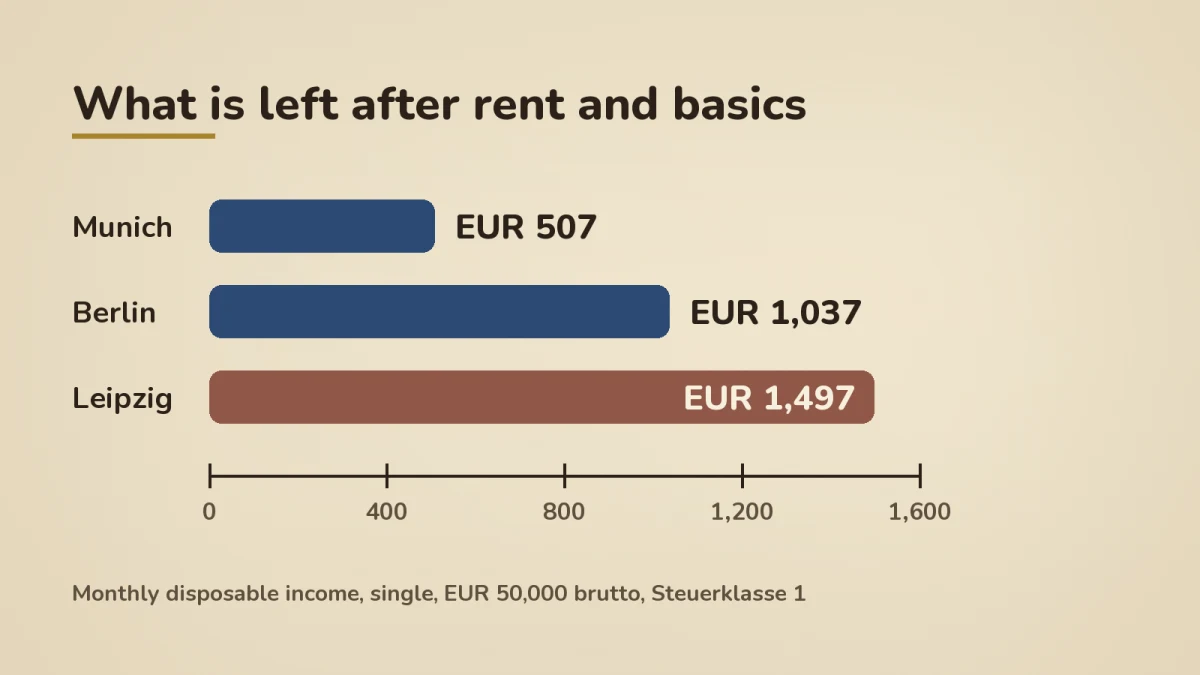
On a €50,000 contract, Leipzig leaves you roughly three times the disposable income of Munich. Berlin sits squarely in the middle. The difference is not lifestyle, it is geography.
That €1,497 in Leipzig is what funds the rest of life: travel, savings, retirement contributions beyond the statutory minimum, the dentist visit your private insurance does not fully cover, the wedding gift for a friend in Cologne, the flight home. €507 in Munich funds none of that comfortably. You can absolutely live a fine life in Munich on €50,000 if you treat it as a city to start in and grow out of, but it is rarely the city to compound savings in at this salary band.
Hidden gem cities the spreadsheet actually rewards
Beyond Berlin and Leipzig, four cities consistently beat the big metros on the salary-to-rent ratio without sacrificing job market quality:
- Erlangen, Bavaria. Siemens HQ. Average commute around 8.8 minutes (one of the shortest in Germany). Rent in the €700 to €850 range for a 2-room. The catch: the local labour market is concentrated in Siemens, university medicine, and Schaeffler-adjacent industry. If your skill set fits, this is a smart bet on cost-of-living plus salary.
- Chemnitz, Saxony. Around €5.30 per sqm cold rent in 2025 to 2026 versus Munich's €22 to €23 per sqm. Roughly four times cheaper per square metre. Chemnitz held the European Capital of Culture title in 2025 and the after-effect is a more interesting cultural and food scene than the city was known for. Smaller job market, but cost differential is extreme.
- Jena, Thuringia. Carl Zeiss and Schott headquartered here. University town energy, optics and biotech industry, prices that look like 2015 western Germany. €700 to €900 covers most 2-room rentals.
- Leipzig itself. "The new Berlin" is a tired phrase but the data still holds. Tech jobs (Spreadshirt, Porsche IT, Kühne+Nagel digital), a developed startup scene, rents that have risen since 2022 but remain less than half of Munich's. If you want a 500K+ city without the Munich price tag, Leipzig is the obvious answer.
The general rule for the spreadsheet-driven mover: pick a Saxony, Thuringia, or Saxony-Anhalt city if you can tolerate the smaller employer pool, or a second-tier western city like Erlangen, Münster, Bonn, or Aachen if you want stronger English-speaking job options at a 30 to 40% rent discount versus Munich.
What changes if you have a family
For singles, the salary maths is mostly about rent. For a family, Kita fees (state-subsidised daycare costs) flip the picture in some surprising ways.
Free or near-free Kita places (state-funded, parents pay food only):
- Berlin (fully free since 2018)
- Hamburg (5 hours per day free)
- Hessen (6 hours per day free from age three)
- Brandenburg, Lower Saxony, and Bremen (income-scaled, often zero for moderate earners)
Expensive Kita states:
- Bavaria: roughly €3,600 to €4,800 per child per year
- Baden-Württemberg: roughly €3,600 to €5,000 per child per year
- Saarland and parts of Saxony also charge
A two-child family in Berlin saves up to €5,000 per year on Kita versus the same family in Bavaria. Stack that with €600 cheaper monthly rent and the €50,000-in-Munich case looks worse for families than it does for singles. The Berlin and Leipzig advantage compounds.
If you are bringing children into Germany, also read our piece on bringing your parents to Germany for the family-reunification angle, and the EU Blue Card guide if a Blue Card is the visa pathway.
Property prices: the long-term picture
If your €50,000 is a starting salary and you plan to grow into ownership, where you live now affects when you can buy. Q1 2026 condo prices per square metre, plus what 60 sqm costs in years of net salary:
| City | €/sqm (Q1 2026) | 60 sqm purchase | Years of net (€32.3k) |
|---|---|---|---|
| Munich | €8,138 | €488,000 | 15.1 |
| Hamburg | €5,200 | €312,000 | 9.7 |
| Berlin | €4,850 | €291,000 | 9.0 |
| Leipzig | €2,553 | €153,000 | 4.7 |
| Dresden | €2,400 | €144,000 | 4.5 |
Sources: Immowelt, ImmoPortal Q1 2026.
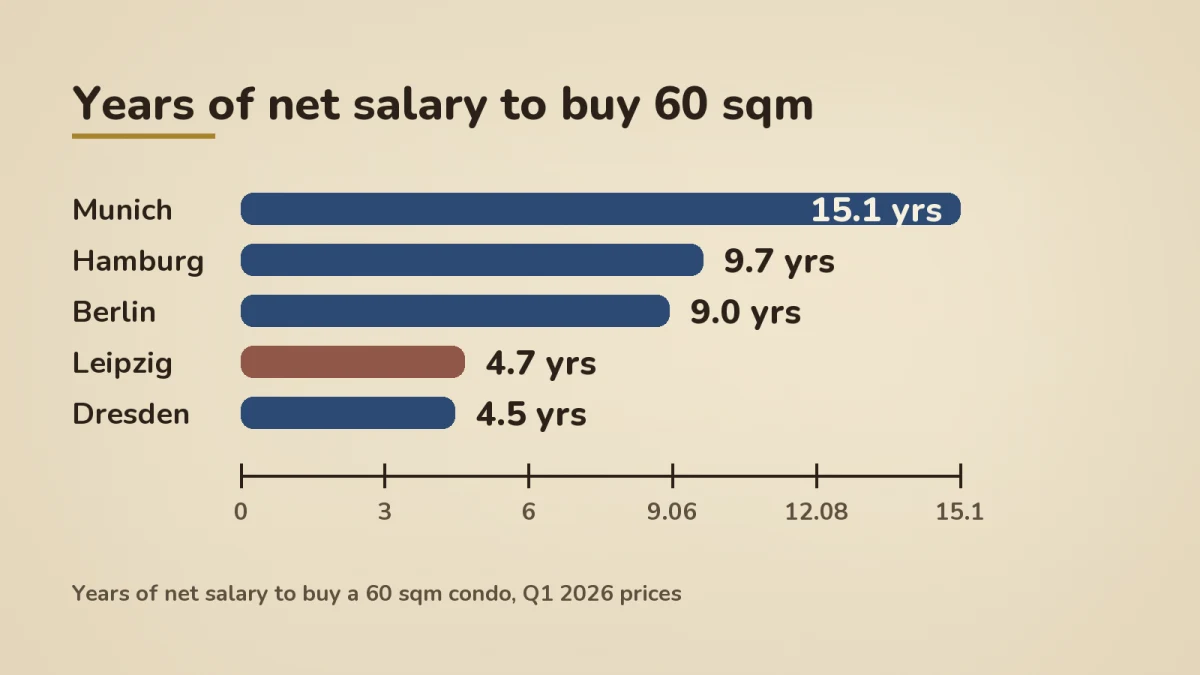
Two important caveats. First, the "years of net" figure is a back-of-envelope ratio, not a mortgage calculation; German banks typically lend up to 40% of net for total housing costs and require 10 to 30% down. Second, a 60 sqm flat is often too small for a family, so the real Munich number for a family-sized 90 sqm is closer to €730,000.
Common mistakes when picking your German city
- Optimising on gross salary alone. A €60,000 Munich offer often delivers less disposable income than a €50,000 Leipzig offer. Always compute the net, then subtract rent, before comparing.
- Ignoring the warm-rent vs cold-rent gap. Listings advertise cold rent (kalt). Heating, building maintenance, and water (Nebenkosten) typically add €150 to €350 per month in 2026. A €900 cold listing is a €1,150 monthly outflow.
- Underestimating the visa-tied employer constraint. If your residence permit is tied to a specific role, a city move requires either a new offer or a visa amendment. Plan the city around the offer that anchors your visa.
- Treating Berlin as cheap. Berlin used to be Germany's cheap big city. It no longer is. 2026 warm rents in central districts now match Hamburg. Cheap-Berlin nostalgia leads to under-budgeting.
- Forgetting regional car insurance classes. The same car and driver costs €200+ more per year in Offenbach, parts of Berlin, or parts of Bavaria than in Brandenburg or Schleswig-Holstein (Allianz Regionalklasse 2026). Trivial individually, real over a decade.
Frequently asked questions
What is €50,000 gross in net per month for a single person in Germany?
For Steuerklasse 1, no church tax, statutory health insurance, the 2026 net works out to approximately €2,695 per month (€32,337 per year). The exact figure depends on your insurance provider's additional contribution rate (Zusatzbeitrag) and your federal state.
Is €50,000 a good salary in Germany in 2026?
It is around the German full-time median for an early-to-mid career professional, especially outside the largest metros. It is comfortable in Leipzig, Dresden, Chemnitz, Jena, and most second-tier cities. It is tight in Munich and only adequate in Frankfurt, Stuttgart, and Hamburg. The median full-time gross in Germany sits in the high €40,000s, so €50,000 is at or slightly above the typical worker.
Why is Munich so expensive compared to Leipzig?
Munich combines the headquarters of BMW, Allianz, Siemens, Munich Re, and a tech and life-sciences hub with constrained housing supply (limited buildable land, strict zoning, Bavarian conservatism on density). Leipzig has roughly the population of Munich's outer ring with one quarter of the headquarters footprint, no land constraint, and a much later rent inflation cycle. The rent ratio reflects job density per square kilometre.
How much rent should I budget on a €50,000 salary?
The conventional 30%-of-net rule gives you a ceiling of roughly €810 warm. Munich at €1,500 warm is 56% of net, well over the rule. Berlin at €1,100 is 41%. Leipzig at €700 is 26% and the only one of the three that fits the rule comfortably. If you must rent above 30% of net (Munich and Frankfurt usually force this), cut grocery, dining, and discretionary spend hard or commute from a cheaper suburb.
Are eastern German cities like Leipzig and Dresden actually cheaper, or is that outdated?
Yes, still cheaper as of 2026. The rent gap has narrowed from "60% cheaper" in 2018 to roughly "45 to 55% cheaper" today versus Munich, but the gap is real and large. Property prices remain about a third of Munich's. Wages also lag by about 12 to 15% in some sectors, so check the local pay band for your role; a senior software engineer offer in Leipzig is unlikely to match a Munich offer to the euro.
Where in Germany is €50,000 the most disposable income?
On the headline single-renter math, Leipzig, Dresden, Chemnitz, Jena, and Erlangen sit at the top. Of these, only Leipzig and Erlangen have job markets large enough to let most working-professional readers actually take an offer. Chemnitz and Jena work brilliantly for specialised fields (heritage industry in Chemnitz, optics and biotech in Jena).
Should I take a Munich offer at €60,000 or a Leipzig offer at €50,000?
Run the numbers. €60,000 in Munich is roughly €3,150 net minus €1,550 rent and €600 basics, leaving around €1,000 free. €50,000 in Leipzig is €2,695 net minus €700 rent and €500 basics, leaving close to €1,500 free. Leipzig wins on disposable income at a 20% lower gross. Munich wins if the role itself is a step up (responsibility, network, future-employer signal). Career trajectory beats current cash flow when you are early.
How does the Deutschland-Ticket factor into city choice?
The Deutschland-Ticket at €63 per month covers all regional public transport across Germany. It does not change inter-city economics directly, but it lets you live in a cheaper Speckgürtel (commuter belt) town and still reach a major-city job. A Munich offer with a base in Augsburg or Ingolstadt becomes financially viable when you treat the €63 ticket as the full transport line. From January 2027 the ticket price will be calculated by an annual cost-tracking formula, so expect further small annual rises.
Where to go next
- Run your own numbers with the salary calculator for your exact gross and tax class.
- Cross-check city costs in the cost of living guide and the best cities to live and work ranking.
- Drill into the Munich case with our district-by-district Munich cost of living 2026 guide, the full deep dive on rent bands, transport, groceries, and three real expat budgets.
- Confirm tax class basics in our taxes in Germany explainer.
The €50,000 line is not the end of your decision. It is the start. The city is what compounds.
Continue reading
Financial Planning·8 min read
BAföG for international students in Germany 2026: Who qualifies, how much, and the start-up grant
BAföG eligibility for international students in 2026: residence-permit rules, monthly rates around EUR 992, the EUR 1,000 Studienstarthilfe, and how to apply.
Read articleFinancial Planning·8 min read
Tuition fees for Bachelor's in Germany
Find out all you need to know about tuition fees for Bachelor's in Germany! This guide covers everything from free public university options to living costs and financial aid tips.
Read articleFinancial Planning·14 min read
Bachelor's Degree Scholarships in Germany for International Students
Looking for bachelor's degree scholarships in Germany? Our funding guide has got you covered! Explore top scholarship programs available in Germany
Read articleReady to plan your Germany journey?
Explore our tools and resources to find the perfect university and program for your academic goals.