Heating costs in Germany winter 2025/26: what your Nebenkosten Nachzahlung will look like and how to dispute it
What a 2025/26 Nebenkosten Nachzahlung looks like in Germany, why heating bills jumped, and how to dispute under §556 BGB within 12 months.

Table of contents
Last updated: August 2026
TL;DR: The Nebenkosten Nachzahlung landing in German letterboxes this summer is bigger than last year because gas heating rose roughly 13% per square metre and district heating jumped 27% in the 2025 billing cycle. You have 12 months from the day you receive the bill to file a written Widerspruch under §556 BGB, and roughly half of all bills contain a calculation error worth challenging.
If you live in a rented flat in Germany and just opened a four-figure Nebenkosten Nachzahlung, you are not alone. The 2025 billing year is the first since the energy crisis where most landlords pass through the full price spike, and the bills are arriving in batches between June and December 2026.
This guide explains what a typical Nachzahlung looks like for winter 2025/26, why it is higher than the one you got in 2024, and the exact steps to dispute it. For the bigger settling-in picture, our /live hub covers the rest of household admin, and our cost of living guide has the monthly budget context.
What a Nebenkosten Nachzahlung actually is
Nebenkosten are the running costs your landlord passes through on top of your Kaltmiete: heating, hot water, building electricity, water, lift, garden, Hausmeister, sometimes Internet. You pay a monthly Vorauszahlung all year. After the billing period closes, the landlord reconciles actual spending against advances paid and sends the Heiz und Betriebskostenabrechnung. If you underpaid, the difference is the Nachzahlung, due within 30 days of the bill landing.
Heizkosten and Warmwasser usually make up 60 to 70% of the total Nebenkosten in winter-heated flats, so when energy prices move, the Nachzahlung moves with them.
How big is the bill this year
The 2025 billing year ended badly for tenants. The Heizspiegel 2025 from co2online and the Minol heating cost statistics published in April 2026 both show meaningful jumps, with district heating leading the pack.
For a typical 95 sqm two-person flat in a 10-unit apartment building, annual costs for heating plus hot water now look roughly like this:
| Heating type | Annual cost (95 sqm flat) | Cost per sqm | Year-on-year |
|---|---|---|---|
| Natural gas | around EUR 1,718 | EUR 18.08 | up roughly 13% |
| District heating (Fernwärme) | around EUR 1,705 | EUR 17.94 | up roughly 27% |
| Heating oil | around EUR 1,466 | EUR 15.43 | down slightly |
| Heat pump | around EUR 887 | EUR 9.33 | up roughly 5% |
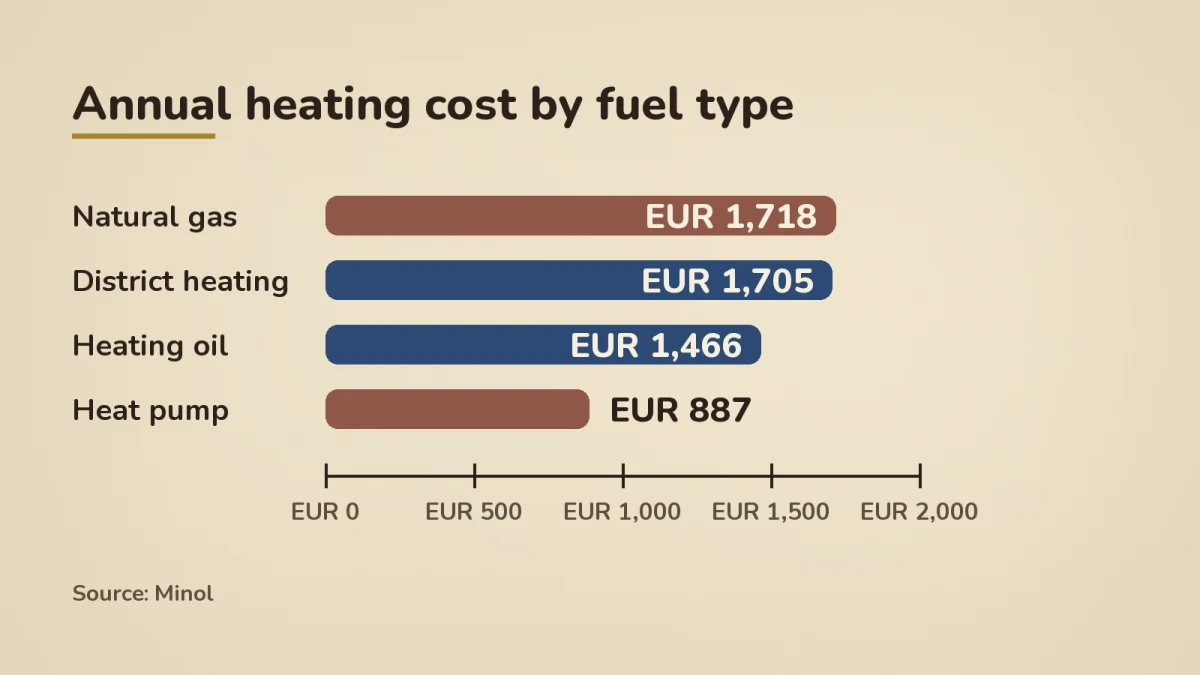
Numbers from Minol's 2025/2026 statistics. co2online's parallel Heizspiegel reports the same direction: gas and district heating households are the worst hit.
The reason district heating spiked so hard while the headline gas price moved less is that Fernwärme contracts use formulas tied to energy indices with a lag of up to 15 months. The 2022 to 2023 wholesale peak is only now flowing through to end-customer bills.
Why your bill is bigger than last year
Three forces stacked in 2025 to push Nachzahlungen up.
The CO2 levy keeps climbing. The national Brennstoffemissionshandelsgesetz price was set at EUR 55 per tonne for 2025 and is moving to a market-based corridor of EUR 55 to 65 in 2026. That alone adds roughly 1.3 to 1.6 cents per kWh of natural gas before VAT.
Energy crisis pricing finally arrived in district heating. Fernwärme tariffs are formula-driven with long lags, so 2022 and 2023 wholesale prices are only now hitting customer bills. If you live in Hamburg, Berlin, Munich, or any large city served by a Stadtwerke Wärmenetz, this is the single biggest driver.
A cold January 2025. Heating-degree-days were notably higher than 2024, so households genuinely consumed more energy. You are paying both higher prices and higher volumes.
How to read the bill before you pay
A Heizkostenabrechnung is legally required to show the billing period, your apartment's share key (Verteilerschlüssel), individual consumption split into heating and hot water, the total building cost broken down by category, your Vorauszahlung, the resulting Nachzahlung or Guthaben, the legal basis (Heizkostenverordnung), and the meter readings at start and end of period. If any of these is missing, the bill is formally invalid and you do not have to pay until corrected. The ADAC and Verbraucherzentrale both publish free check-lists.
How to dispute a Nebenkosten Nachzahlung
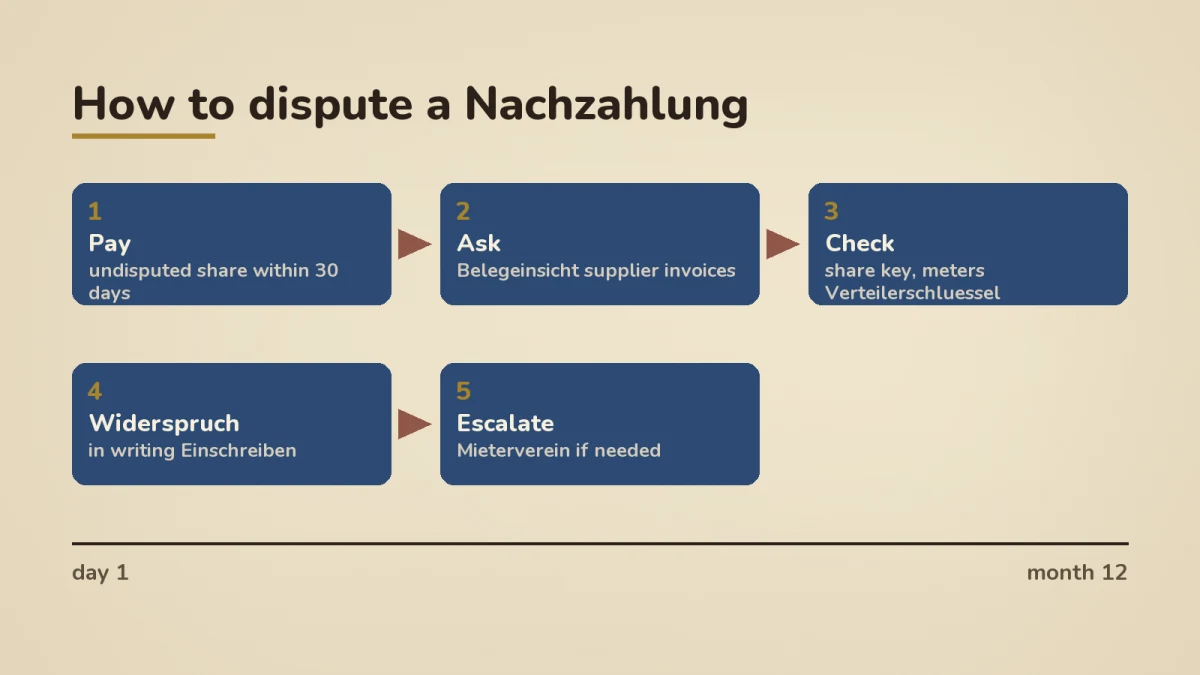
The legal framework is §556 Abs. 3 BGB. Two deadlines matter, and they cut both ways.
- The landlord's deadline. The bill must reach you within 12 months of the end of the billing period. If your billing period ran 1 January to 31 December 2025, the bill must be in your hands by 31 December 2026. If it arrives later and the landlord cannot prove the delay was not their fault, you do not owe the Nachzahlung at all. A Guthaben in your favour still has to be paid out regardless of timing.
- Your deadline. You have 12 months from the day the bill reaches you to file a written, substantive Widerspruch. Verbal complaints do not count. After the 12 months expire, the bill is binding unless formally invalid.
A workable process:
- Pay the undisputed share within 30 days. Paying does not waive your right to dispute, and it stops Mahngebühren and SCHUFA entries.
- Demand the underlying receipts. You have a statutory Belegeinsicht right. Ask the landlord in writing to inspect the supplier invoices, meter-reading protocol, and cost-distribution calculation. Most disputes resolve here because errors become visible.
- Run the obvious checks. Did the share key change without notice? Are you charged for items not in your contract (Internet, building insurance not pre-agreed)? Does the consumption number match your meter readings? Is hot water billed by consumption (it must be, by law, where metering is feasible)?
- File a written Widerspruch. A registered letter (Einschreiben mit Rückschein) or PDF email with specific objections and a corrected figure. Verbraucherzentrale publishes a free template you can adapt.
- Escalate if needed. Mieterverein membership costs around EUR 80 to 100 per year and includes legal review of any Nebenkostenabrechnung. Mineko, Wittmann, and Mietercheck do paid one-off audits for EUR 30 to 80. Court is the last resort.
Roughly half of all Heizkostenabrechnungen audited by Mieterverein and Mineko contain at least one error, so the Belegeinsicht request alone is often worth the effort.
Common mistakes that cost tenants money
- Paying without checking the math. A 30-day pay deadline is not a verification deadline. Pay if you must, audit at your pace within 12 months.
- Disputing verbally. Phone calls and WhatsApp messages do not stop the clock. Only written, dated, substantive objections do.
- Missing the share-key change. If the building added or removed apartments and your Verteilerschlüssel shifted, your share of fixed costs changes. Compare against last year's bill.
- Ignoring the Belegeinsicht. Many tenants challenge on gut feel without asking for invoices. The numbers usually win, not opinions.
- Skipping insurance. A good household insurance policy does not cover Nebenkosten directly, but Rechtsschutzversicherung covers the legal cost of a Mietstreit if it goes to court.
FAQ
Q1:
I just got a EUR 1,800 Nachzahlung. Is that normal for a winter 2025/26 bill?
A: For a 95 sqm flat heated by gas or district heating in a building with average efficiency, yes, that range is consistent with the 2025 Heizspiegel. If your flat is under 80 sqm or the building is post-2010 construction, the figure is high and worth auditing.
Q2:
Can I refuse to pay if I think the bill is wrong?
A: You can pay only the undisputed amount and lodge a Widerspruch on the rest, but pay the undisputed portion within 30 days to avoid Mahngebühren and SCHUFA reports. Paying does not waive your right to dispute within 12 months.
Q3:
My landlord sent the bill 14 months after the billing period ended. Do I owe?
A: Probably not, under §556 Abs. 3 BGB. If the landlord cannot prove the delay was outside their control, you do not owe a Nachzahlung. A Guthaben in your favour still has to be paid out regardless.
Q4:
How long do I have to dispute the Nebenkostenabrechnung?
A: 12 months from the day the bill reaches you. The objection must be in writing and substantive, naming the specific items contested. After 12 months, the bill is binding unless formally invalid.
Q5:
Should I switch flat or switch heating type?
A: Heating type is the biggest lever. A 95 sqm flat with a heat pump averaged EUR 887 in 2025, less than half the cost of the same flat heated by gas. When you next move, ask the landlord which Heizungsart the building uses and check the building's last Energieausweis. Building age matters more than landlord identity for total Nebenkosten.
Q6:
Does my Vorauszahlung automatically rise next year?
A: The landlord can adjust your Vorauszahlung after each Abrechnung up to a reasonable amount based on the prior year's actual costs. If they raise it more aggressively, you can request the calculation. You cannot refuse the increase outright, but you can challenge an unreasonable one.
Where to next
The Nebenkosten cycle repeats every year, so the audit habit is worth building once and reusing. Read our cost of living guide to right-size next year's monthly budget, the finance management tips for life in Germany for the broader money picture, and our best cities to live and work in Germany overview if a city move is on the table. Pillar reading on the rest of household admin lives at /live.
Continue reading
Living in Germany·9 min read
Buying a car in Germany as a new arrival: Registration, insurance, TÜV, financing
Practical guide to buying a car in Germany as a new arrival in 2026: Anmeldung first, eVB insurance, Zulassung at the Kfz office, TÜV and financing options.
Read articleLiving in Germany·19 min read
Public vs Private Health Insurance in Germany: PKV vs GKV Head-to-Head with Real Numbers
Public vs private health insurance in Germany compared with 2026 numbers. JAEG, BBG, GKV monthly cost, PKV premiums, family math, and the age 55 lock-in.
Read articleLiving in Germany·15 min read
Schufa in Germany explained: How to build credit as a new arrival, and the myths to ignore
Schufa is Germany's main credit file. Here is how it actually starts, the new 2026 score model, and how to build it from zero as an expat.
Read articleReady to plan your Germany journey?
Explore our tools and resources to find the perfect university and program for your academic goals.