Renter's, liability, legal insurance in Germany: Which ones expats actually need
Haftpflicht, Hausrat and Rechtsschutz explained for expats in Germany: what each covers, what it costs in 2026, and the buying order that actually makes sense.

Table of contents
Last updated: May 2026
TL;DR: Personal liability insurance (Haftpflichtversicherung) is the one almost every expat in Germany should buy on day one. Contents insurance (Hausratversicherung) is worth it once you own things worth replacing. Legal insurance (Rechtsschutzversicherung) only earns its keep if you have specific risks (rental disputes, employment contracts, a car). The order matters, and so does timing.
You have probably been told you need "renter's, liability, and legal insurance" in Germany. That is mostly correct, but the English bundling hides which one is genuinely essential and which two are situational. This post sorts them by what international residents actually need, in what order, and what each costs in 2026. For the broader picture (health, dental, disability), see our must-have insurance overview and the Live in Germany pillar.
A terminology note: Germany does not have an exact equivalent of the US "renter's insurance." What Americans call renter's insurance is split into two German policies: Haftpflichtversicherung (your liability for damage you cause) and Hausratversicherung (your belongings inside the apartment). The building itself is the landlord's policy (Wohngebäudeversicherung), not yours.
The three policies, ranked by priority
If you can only buy one, buy Haftpflichtversicherung. If you can buy two, add Hausratversicherung once you have furniture, electronics, or anything you would not want to replace from savings. Legal insurance is the third tier and only pays off in specific situations.
| Policy | What it covers | Typical cost | Priority for most expats |
|---|---|---|---|
| Haftpflichtversicherung (personal liability) | Damage you cause to other people or their property | EUR 60 to 150 per year | Buy on day one |
| Hausratversicherung (contents) | Your belongings inside the apartment (fire, theft, water) | EUR 40 to 180 per year | Buy once your stuff is worth replacing |
| Rechtsschutzversicherung (legal) | Lawyer fees and court costs in covered disputes | EUR 180 to 420 per year | Only if you have specific risks |
Haftpflichtversicherung: the one expats actually need
Personal liability insurance is the policy roughly 85 percent of German households carry. It pays out when you accidentally cause damage to someone else, and the financial exposure without it is uncapped under German civil law. The classic example is a kitchen fire that spreads to neighbours, or a burst washing-machine hose that floods the flat below. Without Haftpflicht, you personally owe the damages, often six figures.
Coverage is broad: bodily injury, property damage, and accidental damage to your rented apartment (a hole in a tile, a stained parquet floor). Most landlords expect tenants to carry it.
Costs in 2026 sit roughly between EUR 60 and EUR 150 per year for a single person; family policies are similar. Stiftung Warentest pegs a good policy at around EUR 70 to EUR 140 a year. When comparing, check for:
- Coverage sum of at least EUR 10 million for personal injury and property damage. EUR 50 million is often only a few euros more.
- Schlüsselverlust (key loss): replacing a master-key system runs into thousands.
- Mietsachschäden (damage to rented property): the line that makes the policy useful in your own flat.
- Forderungsausfalldeckung (failed-claims cover): your policy steps in if someone uninsured causes damage to you.
- Gefälligkeitsschäden (favors): covers damage while helping a friend move.
Students: your parents' policy from home almost never covers you in Germany. Get your own; it is too cheap to skip.
Hausratversicherung: when contents insurance pays off
Hausratversicherung covers your personal belongings inside the apartment against fire, water damage from pipes, theft after a break-in, vandalism, and storm damage. It does not cover the apartment structure (landlord's policy) and does not cover damage you cause (that is Haftpflicht).
Whether it is worth buying depends on what you own. If you arrived with two suitcases and a laptop, the math rarely works out: EUR 80 a year for five years is EUR 400 to insure roughly EUR 1,500 of stuff. Once you have furniture, a bike, kitchen appliances, and electronics, the math flips. The German rule of thumb is to insure contents at roughly EUR 650 per square metre.
Costs in 2026 start around EUR 3 to EUR 5 per month for basic coverage in low-risk areas and climb to EUR 15 in big cities. Glass breakage and bicycle theft are optional add-ons; in city centres a bicycle clause is worth EUR 20 to EUR 40 per year if you ride daily.
Practical rule: buy Hausratversicherung the same month you buy a sofa, a TV, or a high-end bike, whichever comes first.
Rechtsschutzversicherung: the conditional third policy
Legal insurance covers lawyer fees, court costs, and expert opinions in disputes. The math: a one-hour lawyer consultation costs around EUR 250 to EUR 300, and a full court case can run several thousand. A year of Rechtsschutzversicherung starts at roughly EUR 110 (basic, single module) and reaches EUR 420 for a family with all modules.
The catch is the waiting period. Most policies have a three-month wait before you can claim, and the dispute must arise after the policy starts. You cannot buy legal insurance on Monday for a problem that started last month.
Common modules to mix and match:
- Privatrechtsschutz (private): consumer disputes, online purchases, holiday claims.
- Berufsrechtsschutz (work): wrongful termination, salary disputes, contract issues. Highest-value module for most expats.
- Verkehrsrechtsschutz (traffic): driving offences, accidents, insurance disputes. Worth it if you drive.
- Mietrechtsschutz (tenancy): deposit disputes, evictions, rent-increase fights, Nebenkosten Nachzahlung disputes. Worth it in high-pressure rental markets.
Legal insurance pays off if you have a real risk profile: a contested work contract, a slow landlord, a car. If yours is "office job, share-flat, no car," skip it the first year and reassess.
How to decide what to buy
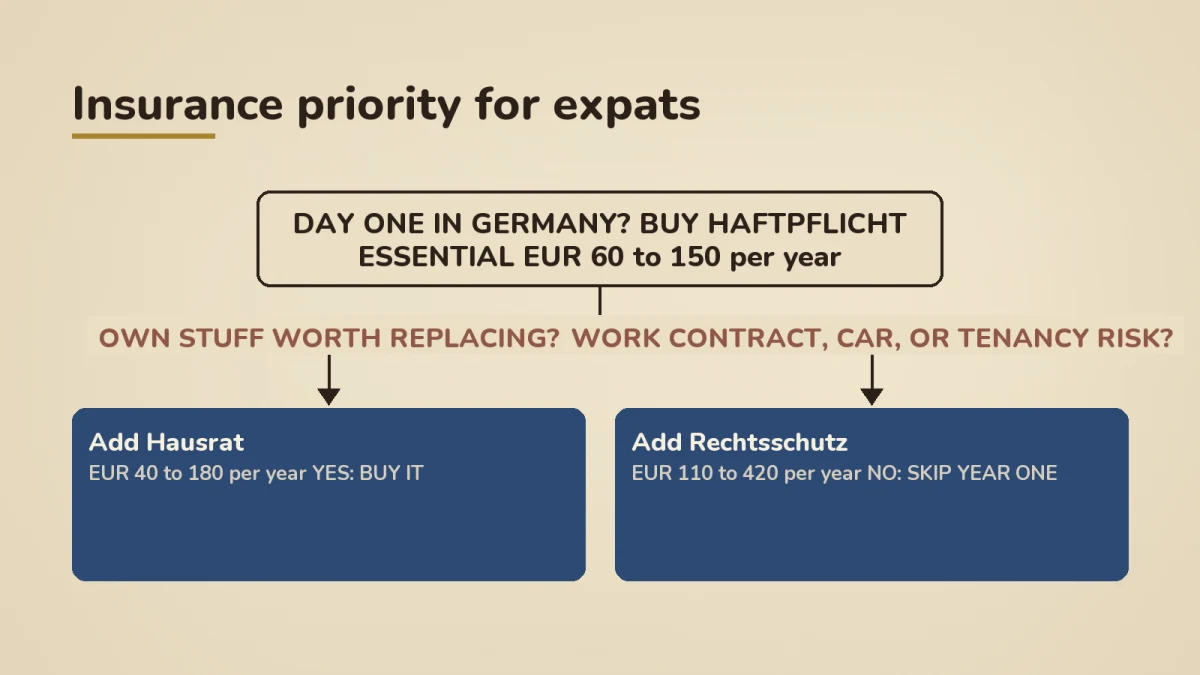
Run through this check before you start comparing policies:
- Day one in Germany: buy Haftpflichtversicherung. Single policy, EUR 10 million coverage, standard add-ons. Done in 15 minutes online.
- Once your stuff is worth more than your emergency fund: add Hausratversicherung at roughly EUR 650 per square metre of apartment. Add a bike clause if you ride daily in a city.
- If any of these apply, look at Rechtsschutzversicherung: contested work situation, you drive regularly, a tenancy contract you are not comfortable with, or ongoing disputes likely to need a lawyer. Otherwise wait.
Keep the policies separate unless a bundle is genuinely cheaper; "kombi" discounts are often smaller than they appear.
Common mistakes
- Skipping Haftpflicht because "I'm careful." The point is not how careful you are; it is what happens if one accident exposes you to a six-figure claim.
- Over-insuring contents on day one. New arrivals often buy Hausratversicherung at EUR 50,000 of coverage when they own EUR 5,000 of things.
- Buying legal insurance after a problem starts. The waiting period plus the cause-after-start rule means retroactive coverage does not exist.
- Assuming health insurance covers liability. It does not. Your TK or AOK card pays your medical bills; if you injure someone, that is Haftpflicht territory.
- Letting the agent pick the coverage sum. Always specify EUR 10 million or higher for Haftpflicht. Some agents quote EUR 3 million by default; the savings are negligible and the gap is not.
FAQ
Is Haftpflichtversicherung mandatory in Germany?
Not by federal law, but it is mandatory in most rental contracts. Some landlords ask for proof before handing over keys. Either way, it is the single most cost-effective insurance you can buy in Germany.
Does my parents' liability insurance from back home cover me in Germany?
Almost never. Liability policies are jurisdiction-specific. The simpler path is your own German policy at EUR 60 a year.
What is the difference between Hausratversicherung and "renter's insurance"?
Hausratversicherung covers belongings inside the apartment. US renter's insurance bundles contents plus tenant liability. In Germany the two are split: Hausrat for things, Haftpflicht for damage you cause.
How long does it take to get insured?
Most German insurers issue a policy online within 24 hours. You can usually show the confirmation email to a landlord immediately.
Can I cancel anytime?
Standard policies run a year and auto-renew, with cancellation typically due three months before the renewal date. Several providers offer monthly-cancellable plans for a small premium, useful if you are not sure how long you will stay.
Do I need legal insurance for the visa or residence permit process?
No. Rechtsschutzversicherung covers civil disputes, not administrative procedures with the Auslaenderbehoerde.
Should I buy in English or German?
Either works. Insurtech providers (Feather, Getsafe) sell in English. Traditional providers (HUK24, Allianz, Cosmos Direkt) sell in German. Prices are similar; pick by language comfort.
Where to next
Continue reading
Financial Planning·8 min read
BAföG for international students in Germany 2026: Who qualifies, how much, and the start-up grant
BAföG eligibility for international students in 2026: residence-permit rules, monthly rates around EUR 992, the EUR 1,000 Studienstarthilfe, and how to apply.
Read articleFinancial Planning·8 min read
Tuition fees for Bachelor's in Germany
Find out all you need to know about tuition fees for Bachelor's in Germany! This guide covers everything from free public university options to living costs and financial aid tips.
Read articleFinancial Planning·14 min read
Bachelor's Degree Scholarships in Germany for International Students
Looking for bachelor's degree scholarships in Germany? Our funding guide has got you covered! Explore top scholarship programs available in Germany
Read articleReady to plan your Germany journey?
Explore our tools and resources to find the perfect university and program for your academic goals.