Buying a car in Germany as a new arrival: Registration, insurance, TÜV, financing
Practical guide to buying a car in Germany as a new arrival in 2026: Anmeldung first, eVB insurance, Zulassung at the Kfz office, TÜV and financing options.

Table of contents
Last updated: May 2026
TL;DR: You can own a car in Germany as a new arrival, but you need an Anmeldung first, then an eVB insurance number, then a Zulassung at the Kfz registration office. Plan for around EUR 1,200 to EUR 2,400 per year in running costs even on a cheap used car. Skip a car for the first six months if you live anywhere with U-Bahn, S-Bahn, or a regional train.
A car is the most expensive non-housing decision you make in your first year in Germany. Insurance treats you like a beginner regardless of your home-country record, parking is rare and expensive in big cities, and the bureaucracy needs you to be settled before you can register anything. This guide walks the four moving parts that catch new arrivals out: registration, insurance, the TÜV inspection, and how to pay for the car in the first place. For the broader settling-in picture, see our Living in Germany pillar, and for the running-budget context read our cost of living guide.
Do you actually need a car?
In Berlin, Munich, Hamburg, Frankfurt, Cologne, and Stuttgart, the answer for the first six to twelve months is usually no. The Deutschlandticket gives you unlimited regional and city transport for EUR 63 per month in 2026, every city has decent night buses, and parking permits in Munich and Berlin run EUR 240 to EUR 480 for two years on top of street-parking time limits. A car genuinely earns its keep in three cases: you live in a small Bundesland town with one bus per hour, you commute to a Werk on the edge of the city, or you have kids and need to do a weekly Aldi run. Otherwise, rent through a car-sharing service like ShareNow, Miles, or Sixt share for the first months.
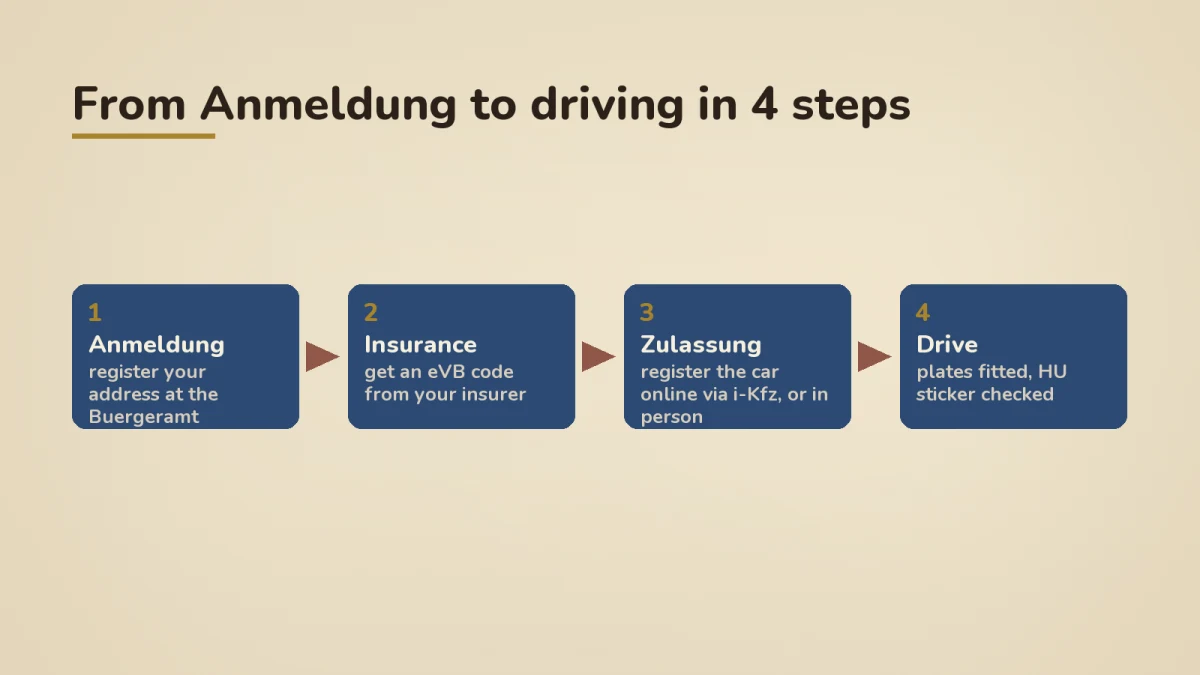
If you do need one, the order of operations is fixed. You cannot skip ahead.
What it actually costs to own a car here
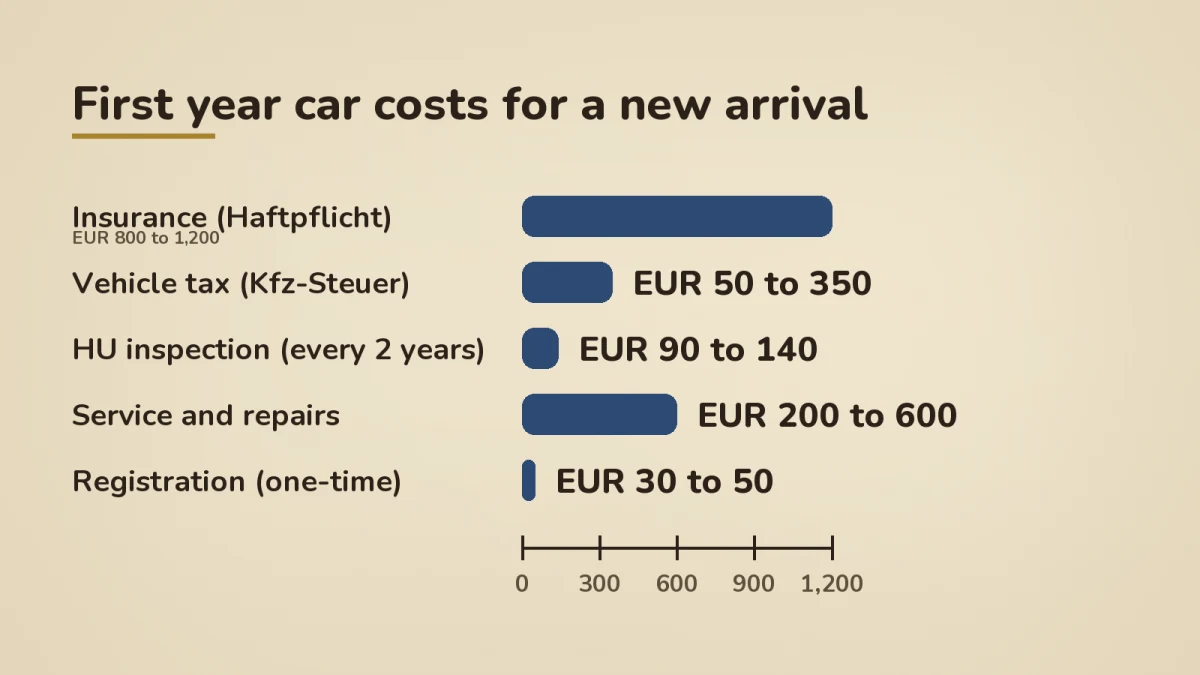
Insurance is the cost most new arrivals underestimate. Without a German Schadenfreiheitsklasse (no-claims class), insurers default you to SF0 or SF1, which means a 100 to 230 percent multiplier on the base premium. A 1.4-litre Volkswagen Polo that costs a long-time German driver EUR 350 a year on Haftpflicht alone can cost a new arrival EUR 800 to EUR 1,200 in their first year on exactly the same policy.
The other recurring costs add up fast: Kfz-Steuer (vehicle tax) of EUR 50 to EUR 350 per year depending on engine and CO2, an HU inspection every two years at EUR 90 to EUR 140, fuel that sits around EUR 1.70 to EUR 1.90 per litre, and routine service at EUR 200 to EUR 600 a year for an older used car. Pure electric cars are still vehicle-tax exempt through 31 December 2030.
Step 1:
Buy the car (new, dealer-used, or private)
Three routes, very different risk profiles.
New from a dealer (Neuwagen). Cleanest path: full warranty (Gewährleistung), financing baked in, plates done by the dealer, drive away. Most expensive option but you skip every used-car landmine.
Used from a dealer (gebrauchter Händlerwagen). Dealer must give you a one-year statutory warranty (Sachmängelhaftung) on the car's condition at handover, except for clearly listed defects. Slight mark-up over a private buy but the warranty is real legal protection.
Used from a private seller (privat). Cheapest route, zero warranty. Every private contract reads "gekauft wie gesehen" (sold as seen) and German courts uphold that. You take the car as is. Use the free ADAC purchase contract template, ask for the full Scheckheft (service book), check the last HU certificate is recent, and bring a German friend or a TÜV pre-purchase check (around EUR 130) if the car is older than five years.
Watch the documents at handover. You need both Fahrzeugschein (Zulassungsbescheinigung Teil I, the registration certificate that lives in the car) and Fahrzeugbrief (Teil II, the title document the bank holds while you finance). No Teil II, no transfer, no exceptions.
Step 2:
Get insurance and an eVB number
You cannot register a car without proof of insurance. The proof is a seven-digit eVB code (elektronische Versicherungsbestätigung) that the insurer sends you by email or in their portal once you sign up. You bring that code to the Zulassungsstelle.
Three coverage tiers:
- Kfz-Haftpflicht (third-party liability). Mandatory by law. Covers damage you do to others. Minimum legal cover is EUR 7.5 million for personal injury; most policies offer EUR 50 to EUR 100 million.
- Teilkasko (partial comprehensive). Adds theft, fire, glass, storm, hail, animal collisions. Adds EUR 100 to EUR 300 per year. Worth it on any car you would not happily replace from cash savings.
- Vollkasko (full comprehensive). Adds your own at-fault collisions and vandalism. Adds EUR 300 to EUR 800+ per year on top of Haftpflicht. Lenders require it on financed cars; on a EUR 3,000 used Polo it is overkill.
The hack for new arrivals: ask your home-country insurer for a written certificate of your no-claims years (in English, with year-by-year breakdown). Several German insurers, including HUK24, Allianz, and CosmosDirekt, will recognise foreign no-claims history and slot you into a higher SF class than the default SF0 or SF1. This single document can drop your first-year premium by 30 to 50 percent.
Step 3:
Register at the Zulassungsstelle
Two paths in 2026, depending on whether you have a German digital ID.
In-person. Book a Termin at your local Kfz-Zulassungsstelle (most book up two to four weeks ahead in Berlin, Munich, and Hamburg; smaller cities are faster). Bring: passport plus residence permit, your most recent Anmeldung, the eVB code, the seller's Fahrzeugbrief and Fahrzeugschein, the last HU certificate, your IBAN for the SEPA mandate (Kfz-Steuer is direct-debited), and the licence plates (you can pre-buy them at any Schilderdienst near the office for EUR 20 to EUR 30). Fee at the counter: EUR 30 to EUR 50.
Online via i-Kfz. Since September 2023, the i-Kfz portal lets you register, re-register, or de-register fully online, with results delivered by post in two to three working days. You need an activated German eID on your residence permit or German ID card, an AusweisApp, the eVB code, and the seller's documents with their security codes scratched off. Fee is around EUR 13 to EUR 25, cheaper than in-person, and you save the Termin wait. Berlin, Munich, Hamburg, Cologne, and Frankfurt all support i-Kfz Stage 4 in 2026.
Step 4:
TÜV and the HU inspection
TÜV is the brand most people use as a verb, but the actual inspection is the Hauptuntersuchung (HU), and you can do it at TÜV, Dekra, GTÜ, or KÜS. The rules are simple:
- New cars need their first HU after 3 years, then every 2 years.
- Used cars need an HU every 2 years from the date of the last sticker on the rear plate.
- The Abgasuntersuchung (emissions check, AU) is part of the HU since 2010, no longer separate.
- Cost in 2026: EUR 90 to EUR 140 depending on station and fuel type. Diesels are slightly more.
- If the car fails, you have one month to fix the listed defects and re-test for a reduced fee. After that, you pay full price again.
If you buy a used car that has less than 12 months of HU left on the sticker, negotiate the cost of a fresh inspection into the price.
Financing options for new arrivals
Three real options, ranked by accessibility:
- Pay cash for a EUR 2,000 to EUR 6,000 used car. Skips Schufa entirely. Recommended for the first 12 to 18 months while you build a German credit history.
- Dealer financing through a captive bank (VW Bank, BMW Bank, Mercedes-Benz Bank, Hyundai Capital). Captive banks are more flexible than retail banks for new residents because they want the car sale. Usually requires three to six months of German payslips and an indefinite or 12-month-plus contract.
- Direct bank loan from your everyday bank. Hardest path. Most German banks need 12 months of Schufa history and a permanent contract before they will write a Kfz-Kredit at competitive rates.
Leasing as a new arrival is rarely a good deal: setup fees, mandatory Vollkasko, and harsh end-of-lease damage assessments. Skip it for now.
Common mistakes new arrivals make
- Registering before having an Anmeldung. The Zulassungsstelle will turn you away.
- Buying privately without checking if the seller's name on the Fahrzeugbrief matches their ID.
- Forgetting the eVB code is single-use per registration. If you swap insurers between getting the code and reaching the counter, you need a new one.
- Letting the HU sticker expire. You get a EUR 15 fine after two months overdue, EUR 25 after four months, EUR 60 plus one Flensburg point after eight months.
- Cancelling the SEPA mandate for Kfz-Steuer. The Hauptzollamt deregisters your car if a payment fails twice.
FAQ
Can I drive in Germany with my home-country licence?
Most non-EU licences are valid for 6 months from your Anmeldung date, after which you must convert. EU and EEA licences stay valid until expiry. The conversion process varies by country; we cover it in detail in our German driving licence conversion guide.
How long does the whole process take from buying to driving?
If you have your Anmeldung and eID ready: 1 to 2 days online via i-Kfz, or about 1 week if you wait for a Zulassungsstelle Termin. Add 3 to 5 working days if you are buying a new car and the dealer is doing the paperwork.
What is the cheapest way to insure a car as a new arrival?
A small petrol car (under 1.4 litres), Haftpflicht only, paid annually instead of monthly, with proof of foreign no-claims years submitted upfront. Get quotes from HUK24, CosmosDirekt, and DA Direkt as a baseline before buying any branded policy.
Do I need German bank account to register a car?
Yes, for the Kfz-Steuer SEPA direct debit. A free N26 or DKB account works. The Zulassungsstelle will not accept cash for the recurring tax, only the one-time registration fee.
Is ADAC membership worth it?
Yes for most new arrivals. EUR 60 to EUR 85 per year covers roadside assistance across Europe, free pre-purchase used-car checks at any ADAC centre, free legal contract templates, and discounted maintenance partners. The breakdown cover alone pays for itself the first time you need it.
Can I import my car from outside the EU?
Technically yes, practically rarely worth it. You pay 10 percent customs duty plus 19 percent import VAT on the car's residual value, plus a full TÜV individual approval (Einzelabnahme) at EUR 200 to EUR 800 if your model is not on the German type list. For cars worth under EUR 15,000, just sell at home and buy locally.
Where to next
- Cost of living in Germany guide for the wider monthly-budget picture.
- Insurance every expat in Germany needs once Haftpflicht is sorted.
- Driving licence conversion in 2026 if your home-country licence is about to expire its grace period.
- Living in Germany pillar for the full new-arrival roadmap.
Continue reading
Living in Germany·15 min read
Schufa in Germany explained: How to build credit as a new arrival, and the myths to ignore
Schufa is Germany's main credit file. Here is how it actually starts, the new 2026 score model, and how to build it from zero as an expat.
Read articleLiving in Germany·19 min read
Public vs Private Health Insurance in Germany: PKV vs GKV Head-to-Head with Real Numbers
Public vs private health insurance in Germany compared with 2026 numbers. JAEG, BBG, GKV monthly cost, PKV premiums, family math, and the age 55 lock-in.
Read articleLiving in Germany·9 min read
Finding Temporary Accommodation in Germany for Initial Days or Short Period
Are you a student looking for temporary accommodation in Germany? Check out our guide on student halls, youth hostels, and private accommodations for short-term stays. Compare the advantages and disadvantages of each option and find the best fit for your needs.
Read articleReady to plan your Germany journey?
Explore our tools and resources to find the perfect university and program for your academic goals.