Converting your driving licence to a German Führerschein: Country-by-country rules in 2026
EU and EEA licences are valid in Germany until they expire. Non-EU licences need conversion within six months. Country rules for 2026.

Table of contents
Last updated: May 2026
TL;DR: EU and EEA licences are valid in Germany until they expire, no test needed. Non-EU licences are valid for six months after you register your residence; after that you must convert. How hard the conversion is depends on which country issued your licence: Anlage 11 countries (UK, Switzerland, Japan, South Korea, most US states, all Canadian provinces, and around 20 others) get a paperwork-only swap. Everyone else, including India, Pakistan, China, Bangladesh, Sri Lanka, and Nepal, has to clear the German theory and practical exam through a Fahrschule.
Germany takes its Führerschein seriously. The country runs one of Europe's strictest driving-licence regimes, and the rules for converting a foreign licence are written down to the country and US-state level in Anlage 11 of the Fahrerlaubnis-Verordnung. This guide walks through the actual rules in 2026, the deadlines, the country-by-country split, the documents you need, and what each path costs.
If you have not yet registered your address, do that first. The clock on your foreign-licence validity only starts when you register, and the local Führerscheinstelle will not book your appointment without proof of Anmeldung.
Who needs to convert and by when
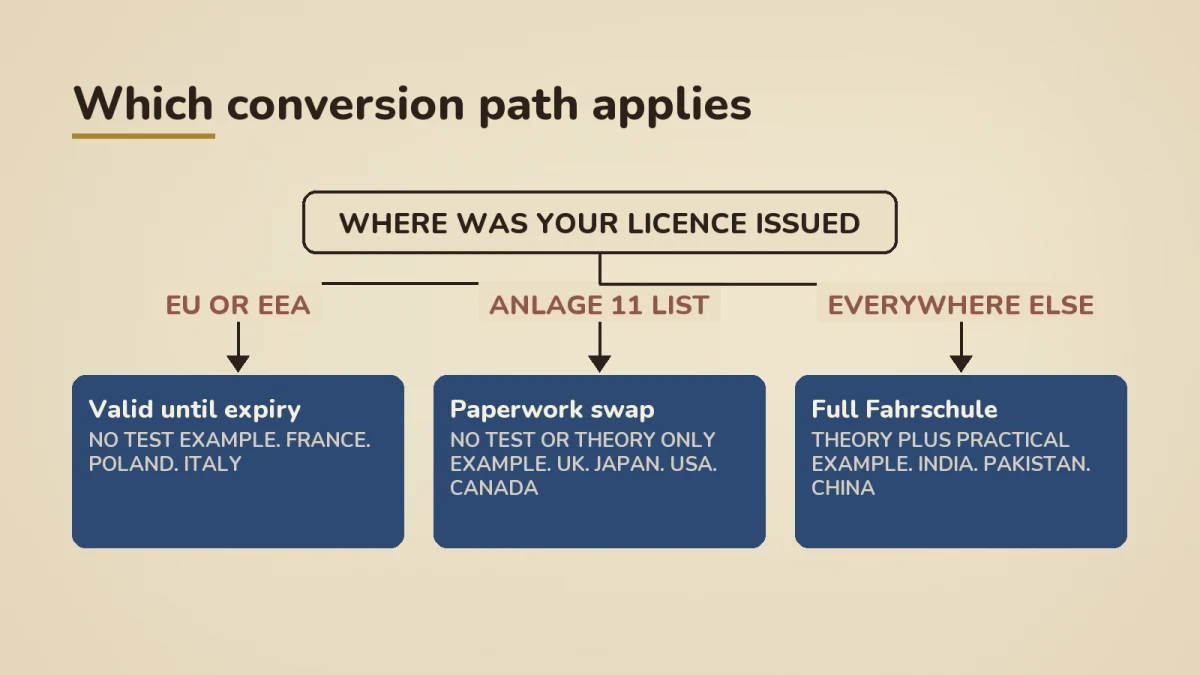
Your situation falls into one of three buckets.
EU or EEA licence holders. If your licence was issued in another EU country, Iceland, Liechtenstein, Norway, or Switzerland, you can keep driving on it in Germany until it expires. No six-month deadline, no conversion exam. When the card expires you exchange it at the Führerscheinstelle for around 37.50 to 43 EUR.
Non-EU licence, planning to stay under six months. Tourists, short-term interns, and visiting researchers can drive on a valid foreign licence for 185 days after taking up ordinary residence. If your licence is not in German, English, French, Italian, or Spanish, carry an International Driving Permit or a sworn translation alongside it.
Non-EU licence, planning to stay longer than six months. This is the group this guide is written for. You have 185 days from your Anmeldung date to convert. After that, driving on the foreign card becomes Fahren ohne Fahrerlaubnis under §21 StVG, a criminal offence, not a traffic ticket. The German term for the swap is Umschreibung, and how simple it is depends entirely on which agreement Germany has with your issuing country.
Anlage 11: the listed countries with no driving test
Germany maintains an official list (Anlage 11 to §31 FeV) of countries whose driving licences it recognises as broadly equivalent to its own. If you hold a category B (car) licence from one of these countries and you held it for at least 185 days while ordinarily resident in the issuing country, you swap it for a German licence with no theory test and no practical test.
The countries currently on the full no-test list (category B):
| Region | Countries with full Anlage 11 recognition (no theory, no practical) |
|---|---|
| Europe | Andorra, Bosnia and Herzegovina (A1, A and B), Gibraltar, Guernsey, Isle of Man, Jersey, Monaco, Montenegro, North Macedonia, San Marino, Serbia, Switzerland, Ukraine (A1, A, B, BE and truck and bus classes), United Kingdom |
| Recently added | Albania (licences issued from 24 January 2017), Kosovo (licences issued from 1 March 2018) |
| Asia and Pacific | Japan, Republic of Korea (B only), Singapore, Taiwan (B and BE only), New Zealand |
| Americas | All Canadian provinces and territories (Alberta, British Columbia, Manitoba, New Brunswick, Newfoundland, Northwest Territories, Nova Scotia, Ontario, Prince Edward Island, Québec, Saskatchewan, Yukon) |
| Africa | Namibia (must have held licence for at least 2 years before applying), South Africa |
| Australasia | All Australian states and territories (ACT, NSW, NT, Queensland, SA, Tasmania, Victoria, WA) |
| Middle East | Israel (B only) |
| Other | French Polynesia, New Caledonia |
Source: BMJV Anlage 11 FeV, updated through 2026.
A few notes that catch people out. The UK switched columns after Brexit but stayed on the full no-test list, so a UK photocard licence still converts paperwork-only. Switzerland is on the list despite being neither in the EU nor the EEA, because of a separate bilateral agreement. Albania and Kosovo are recent additions, and only licences issued after the dates above qualify; older Albanian and Kosovar cards still need the full exam.
Anlage 11 with a theory test: most US states get partial recognition
The United States is split state by state. Most states give you a paperwork-only swap. A handful, mostly in the south and east, require you to pass the German theory test (Theorieprüfung) before the swap is granted.
| US states with full no-test conversion | US states with theory test required |
|---|---|
| Alabama, Arizona, Arkansas, Colorado, Delaware, Idaho, Illinois, Iowa, Kansas, Kentucky, Louisiana, Maryland, Massachusetts, Michigan, New Mexico, Ohio, Oklahoma, Pennsylvania, Puerto Rico, South Carolina, South Dakota, Texas, Utah, Virginia, Washington State, West Virginia, Wisconsin, Wyoming | Connecticut, District of Columbia, Florida, Indiana, Minnesota, Mississippi, Missouri, Nebraska, North Carolina, Oregon, Tennessee |
If your state is in the right column, you book the theory test through the local Fahrschule, study the German road rules in English (most schools offer English material now), and pass before the Führerscheinstelle issues your German card. The practical road test is still waived. Moldova is the inverse case: practical exam required, no theory.
Everything else:
India, Pakistan, China, and the full Fahrschule path
If your country is not in Anlage 11, the conversion is not really a conversion. You enrol in a German driving school (Fahrschule), pass the theory exam, complete the mandatory minimum lessons (special-purpose drives on Autobahn, at night, on rural roads), and pass the practical exam. This is the same path a German 18-year-old takes from scratch.
Countries on this path include India, Pakistan, Bangladesh, Sri Lanka, Nepal, China, Vietnam, Thailand, Indonesia, the Philippines, most of Africa outside Namibia and South Africa, most of South America, Russia, Belarus, and most of the Middle East outside Israel.
The cost is the cost. A full Fahrschule package, theory and practical exam included, runs 2,600 to 3,640 EUR in 2026 according to school operator surveys, with Berlin and Munich at the top of that range and Saxony at the bottom. Plan a minimum of three months from enrolment to issued card. The practical-exam pass rate for first-time candidates sits around 62 percent nationally, so factor in the cost of a re-take if you fail (around 200 to 350 EUR per attempt).
A small advantage: many Fahrschulen offer a "Umschreibung" intensive course aimed at experienced foreign drivers, condensing the lesson hours and skipping the basics. If you have actual driving experience, ask for the Crashkurs für ausländische Führerscheine rather than the standard 18-year-old curriculum.
The conversion process, step by step
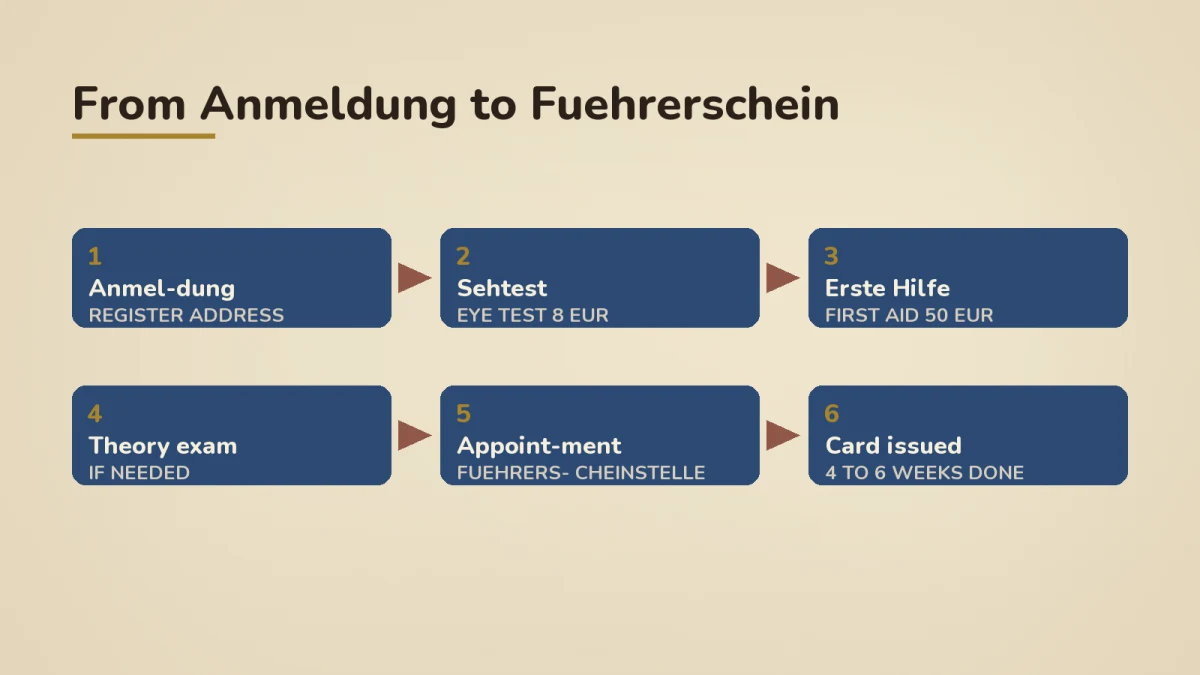
Whatever your country, the office workflow is the same. Allow four to six weeks from application to card.
- Register your address (Anmeldung). Without a Meldebescheinigung the Führerscheinstelle will not even open a file. Most cities run their slot system through the Bürgeramt; book as early as you can.
- Book an appointment with the Führerscheinstelle. Each city has its own booking portal. Berlin uses berlin.de's slot system, Munich uses muenchen.de, Hamburg uses lbv-termine.de. Wait times in 2026 run two to eight weeks depending on city.
- Get your foreign licence translated. If your licence is not in German, English, French, Italian, or Spanish, you need a translation by a sworn interpreter (vereidigter Dolmetscher). Cost: 30 to 80 EUR.
- Get a sight test certificate (Sehtest). Any optician (Fielmann, Apollo, your local Brille shop) will do it for around 6 to 8 EUR.
- Take a first-aid course (Erste-Hilfe-Kurs). Nine 45-minute units, around 35 to 50 EUR. Mandatory for anyone going through Fahrschule, optional but often requested for Anlage 11 swaps.
- Get a biometric passport photo (35x45mm, not older than one year, around 10 to 15 EUR).
- If your country requires the theory test or full Fahrschule path, complete that before the appointment. The Führerscheinstelle issues the German card only after they receive the test pass confirmation from the Fahrschule.
- Surrender your foreign licence at the appointment. German law requires it; you cannot keep both. The original is sent back to the issuing country.
- Pay the fee (37.50 to 74.40 EUR, set under the GebOSt fee schedule).
- Collect the German card four to six weeks later.
Documents to bring to the appointment
| Document | Detail |
|---|---|
| Valid passport or eAT | Must be the original, plus a copy. |
| Anmeldebescheinigung | Proof of registered address in Germany. |
| Foreign driving licence | The original. With sworn translation if not in German, English, French, Italian, or Spanish. |
| Biometric passport photo | 35x45mm, not older than 1 year. |
| Sehtest certificate | Not older than 2 years. |
| Erste-Hilfe-Kurs certificate | First-aid course. Often requested even for Anlage 11 swaps. |
| Proof of 185-day residence | In the country that issued the licence, at the time it was issued. Tourist licences (e.g. obtained on a 4-week US holiday) do not qualify. |
| Theory exam certificate | Only if your country requires the theory test under Anlage 11. |
| Fahrschule completion certificate | Only if your country requires full Fahrschule. |
| Fee | 37.50 to 74.40 EUR depending on city and licence class. |
Common mistakes that cost time
- Driving past the six-month mark. The 185-day clock starts on your Anmeldung date, not on your visa or your arrival flight. Police random checks happen, and an expired-foreign-licence offence costs you a criminal record, not a fine.
- Booking the Führerscheinstelle before Anmeldung. They will not process the application without it. Sequence matters.
- Assuming an International Driving Permit is enough long-term. An IDP is not a German licence; it just translates your foreign one for the first six months.
- Letting your foreign licence expire mid-conversion. Your foreign card must be valid on the day you submit the application. If it expires while you are setting up the appointment, you cannot use the Anlage 11 path; you have to start a new German licence from scratch.
- Forgetting class C and D require medical reports. Truck and bus categories need an ophthalmological certificate (not older than 2 years) and a general medical certificate (not older than 1 year). The car category B does not.
- Not factoring the Fahrschule timeline if you are on the long path. Plan three months minimum, six in some cities, before you book the Führerscheinstelle slot.
Where to next
- For the registration step that gates this whole process, read Anmeldung in Germany: how international students register their address.
- For everyday driving and where you actually need a car, see the best cities in Germany to live and work in 2026.
- For the car insurance you have to buy before you can register a vehicle, read must-have insurance in Germany for expats and students.
FAQ
Do I need to convert my licence if I only stay one year?
Yes, if the year crosses the 185-day mark. The grace period is six months from your Anmeldung, regardless of how long you intend to stay.
Can I keep my foreign licence as a back-up?
No. German law requires you to surrender the original card on conversion. The Führerscheinstelle sends it back to the issuing authority. Scan it before the appointment if you want a record.
Does an International Driving Permit help?
Only for the first six months. An IDP does not extend the deadline; it just translates your home licence so German police can read it.
What if my country requires the full Fahrschule path?
Budget 2,600 to 3,640 EUR and three to six months. Ask the Fahrschule for the Crashkurs für ausländische Führerscheine if you have actual driving experience. The theory exam is offered in English in most German cities, so language is rarely the blocker.
How long until I get the actual card?
Four to six weeks from a clean application. Some cities issue a temporary paper licence (Ersatzführerschein) at the appointment so you can keep driving in the meantime; others make you wait for the card.
Does the German licence have a renewal date?
Newly issued German licences are valid for 15 years for category B, after which you renew the physical card. The driving entitlement itself does not expire. Renewal is paperwork-only as long as no medical issues are flagged.
Continue reading
Living in Germany·9 min read
Buying a car in Germany as a new arrival: Registration, insurance, TÜV, financing
Practical guide to buying a car in Germany as a new arrival in 2026: Anmeldung first, eVB insurance, Zulassung at the Kfz office, TÜV and financing options.
Read articleLiving in Germany·19 min read
Public vs Private Health Insurance in Germany: PKV vs GKV Head-to-Head with Real Numbers
Public vs private health insurance in Germany compared with 2026 numbers. JAEG, BBG, GKV monthly cost, PKV premiums, family math, and the age 55 lock-in.
Read articleLiving in Germany·15 min read
Schufa in Germany explained: How to build credit as a new arrival, and the myths to ignore
Schufa is Germany's main credit file. Here is how it actually starts, the new 2026 score model, and how to build it from zero as an expat.
Read articleReady to plan your Germany journey?
Explore our tools and resources to find the perfect university and program for your academic goals.