Public vs Private Health Insurance in Germany: PKV vs GKV Head-to-Head with Real Numbers
Public vs private health insurance in Germany compared with 2026 numbers. JAEG, BBG, GKV monthly cost, PKV premiums, family math, and the age 55 lock-in.

Table of contents
Last updated: May 2026
TL;DR: GKV (public) is income-based and capped at €1,261/month childless in 2026. PKV (private) is age and risk-based and starts around €170 to €380/month for healthy under-40s above the €77,400 JAEG threshold. PKV usually wins for high-earning singles and self-employed; GKV almost always wins for families with one earner. Switching back from PKV to GKV is nearly impossible after 55, so the choice you make in your 30s is effectively a 30-year bet.
Most expats arriving in Germany inherit a default. Their employer signs them up to a public sickness fund on day one, the salary slip starts deducting around 21% of gross, and the question of whether private health insurance would be cheaper or better never gets asked. For people earning under the €77,400 salary threshold (JAEG 2026) that default is actually the law, you cannot choose. But for working professionals above the threshold, freelancers, self-employed founders, and civil servants, the choice between the public system (Gesetzliche Krankenversicherung, GKV) and private health insurance (Private Krankenversicherung, PKV) is real, financially material, and difficult to reverse.
This post is the head-to-head: real 2026 numbers, the lifecycle traps that calculators miss, and a decision tree you can actually use. We also publish a side-by-side health insurance provider comparison for the question of WHICH GKV fund to pick, and a broader insurance overview for expats covering liability, household, and disability cover that goes alongside health.
Public (GKV) vs private (PKV): the short answer
GKV is income-based. Your contribution is a flat percentage of your gross salary up to a cap. In 2026, the rate stacks to 17.5% for health insurance plus 3.6% to 4.2% for long-term care insurance (Pflegeversicherung), so 21.1% with kids or 21.7% childless of your gross. Above the contribution ceiling (Beitragsbemessungsgrenze, €69,750/year or €5,812.50/month in 2026), the bill stops climbing and freezes at the maximum. Employees split it 50/50 with the employer; freelancers pay the whole thing themselves.
PKV is age and risk-based. Premium is priced on your age at entry, your health status when you sign, and the coverage tier you pick. A healthy 32-year-old IT engineer in Berlin pays €280 to €380/month gross. The same package for a 50-year-old with high blood pressure and a back issue could be €700 or more. Income is not in the formula at all.
The 30-second filter:
- Earning under €77,400/year: you have no choice, GKV.
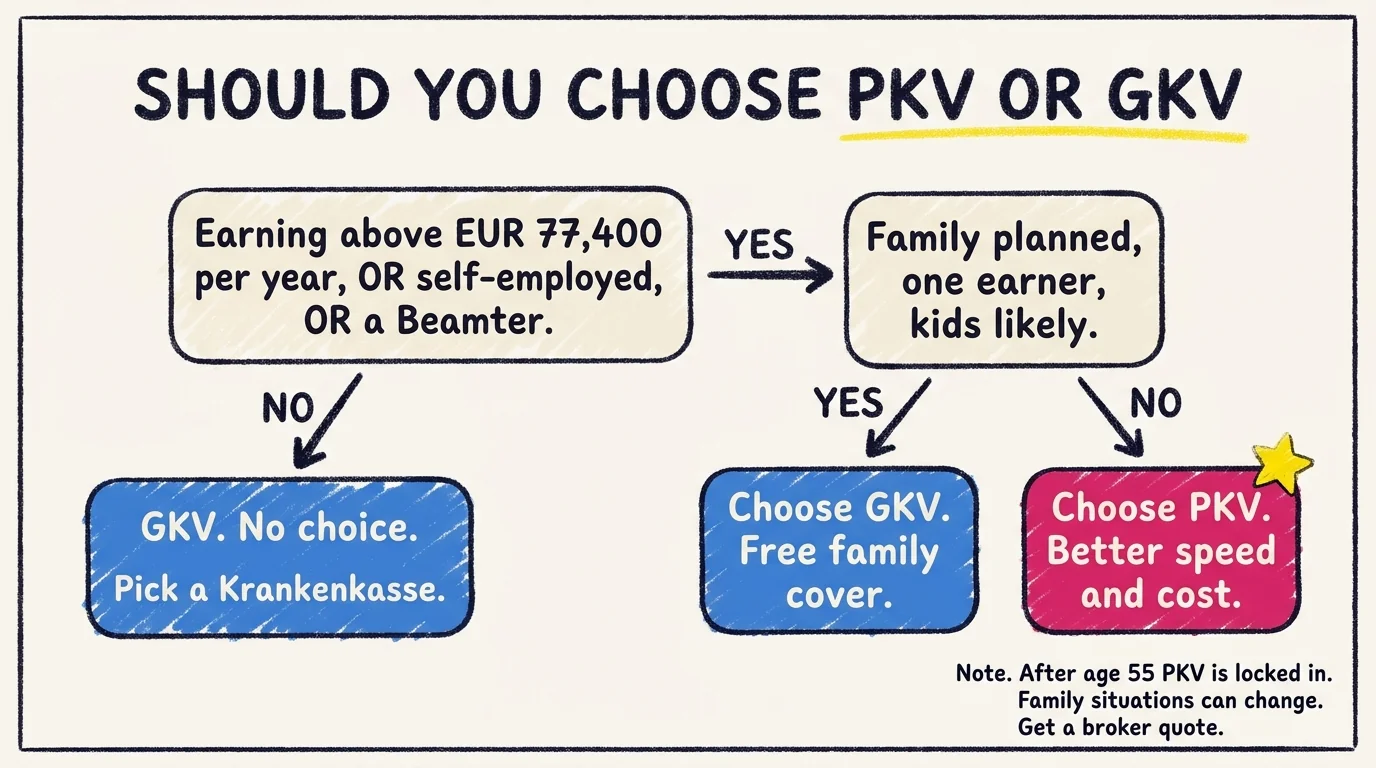
- Earning over €77,400/year, single, healthy, mid-30s, plan to leave Germany within 10 years: PKV is usually cheaper and gives faster appointments.
- Earning over €77,400/year, planning a family on one income, planning to retire in Germany: GKV almost always wins on lifetime cost once kids and old age enter the maths.
- Self-employed at any meaningful income: PKV is materially cheaper because there is no employer to share the GKV bill with.
The rest of this post is the long version with the actual numbers.
Who can choose private health insurance in Germany?
Four groups can opt out of GKV in 2026:
- Employees earning above the JAEG (Jahresarbeitsentgeltgrenze). For 2026 the threshold is €77,400 gross per year (€6,450/month). You must earn above this for a full calendar year, and the employer has to confirm next year's salary will also be above it. Source: §6 Abs. 6 SGB V.
- Self-employed people and freelancers. No income test. The day you register a Gewerbe or sign a freelance contract, you can choose either system.
- Civil servants (Beamte). The German state subsidises (Beihilfe) 50% to 80% of medical costs and the rest is topped up with PKV. Most Beamte go private.
- Students under specific routes. Most international students must enrol in mandatory public health insurance with TK, AOK, Barmer, or DAK at around €130/month. Private student plans (Mawista, Care Concept) only count during the application phase or for students over 30 who got opted out. The PKV vs GKV question for students is largely solved by the law: see our healthcare guide for international students.
Everyone else, including expats earning between €40,000 and €77,400, is locked into GKV until their salary crosses the threshold.
What GKV actually costs in 2026 (the real numbers)
The percentages are fixed by federal law, but most expats lose track of which percentage applies to which slice of their salary. The 2026 numbers:
| Item | 2026 figure | Set by |
|---|---|---|
| General health insurance rate | 14.6% | §241 SGB V (federal law, fixed) |
| Average Zusatzbeitrag (supplementary) | 2.9% | Federal Ministry of Health, set each Nov for following year |
| All-in health insurance rate | ~17.5% | Sum of base + average Zusatzbeitrag |
| Pflegeversicherung (with kids) | 3.6% | §55 SGB XI |
| Pflegeversicherung (childless from age 23) | 4.2% | Includes 0.6% Kinderlosenzuschlag |
| Beitragsbemessungsgrenze (BBG, contribution cap) | €69,750/year, €5,812.50/month | Federal regulation, autumn each year |
| Jahresarbeitsentgeltgrenze (JAEG, opt-out threshold) | €77,400/year, €6,450/month | Federal regulation |
| Höchstbeitrag (max monthly bill, childless) | €1,261/month total | At the BBG cap |
| Höchstbeitrag with kids | €1,226/month total | At the BBG cap |
| Employee share at the cap (childless) | €648/month | Employer pays the rest |
| Employee share at the cap (with kids) | €613/month | Employer pays the rest |
| Self-employed Mindestbemessung (minimum basis) | €1,318.33/month | §240 SGB V |
| Self-employed monthly floor | €281 to €320/month | Depends on fund's Zusatzbeitrag |
Two numbers worth memorising:
The BBG (€69,750) is the cap on what gets assessed for GKV. Income above this is invisible to the calculation.
The JAEG (€77,400) is the eligibility threshold to leave GKV for PKV. They are different numbers, set in the same federal regulation, doing different jobs. Most expats blur the two and end up confused about which one matters for their decision.
The Höchstbeitrag escalator
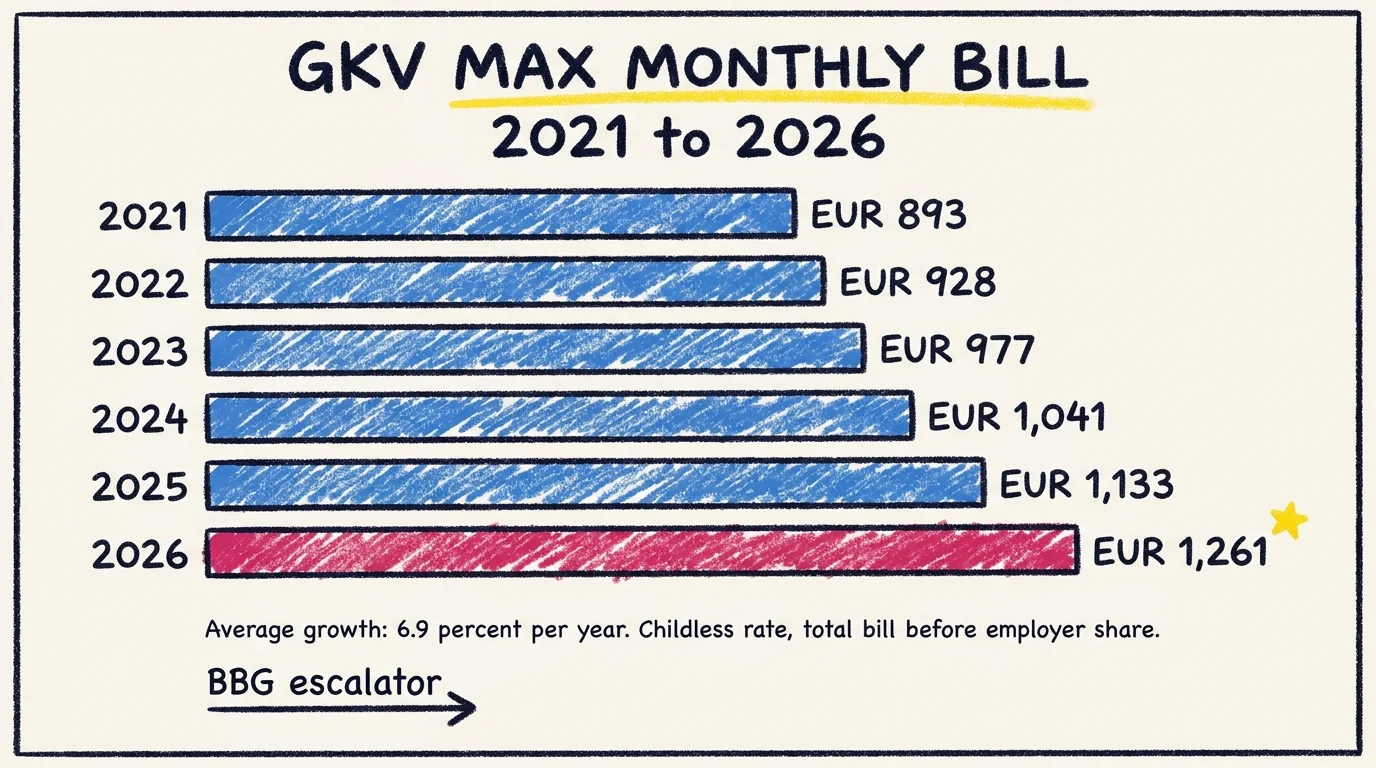
Once your salary is durably above the BBG, your GKV bill stops being income-sensitive. It is fixed at the maximum, and it grows on its own schedule. Between 2021 and 2026, the GKV maximum monthly contribution climbed from €893 to €1,261, an average of 6.9% per year. That is more than double general wage growth.
For someone earning €100,000 or €120,000, this is a structural problem. You cannot opt out of the BBG escalator while staying in GKV, and you cannot reduce the bill by working less hard since the cap is income-blind once you cross it.
The self-employed problem
For a freelancer earning €60,000/year, GKV costs roughly €1,085/month all-in (no employer share). The same €60,000 as a salaried employee would mean €478 employee share and €478 employer share. That €600/month gap is the single biggest structural reason PKV is materially cheaper for self-employed earners at meaningful incomes. Without an employer to share the bill, the GKV percentage runs up fast as income climbs, while PKV stays flat against income.
What PKV actually costs in 2026
PKV premiums are quoted as gross monthly figures, and for employees the employer reimburses up to 50% (capped at the average GKV employer share for the year, around €475/month in 2026). Typical 2026 ranges for healthy applicants on standard mid-tier coverage:
| Profile | PKV gross premium | After employer share (employee) |
|---|---|---|
| Under 30, employee | €350 to €500/month | €170 to €250/month |
| 30 to 39, employee, no pre-existing conditions | €500 to €750/month | €250 to €380/month |
| 35 to 40, employee | €600 to €860/month | €300 to €430/month |
| 40, employee earning €90,000 | ~€960/month | ~€485/month |
| Freelancer, age 30, basic outpatient | n/a | €450/month with €1,000 deductible |
| Freelancer, age 35 to 40 | n/a | €500 to €700/month |
These are typical mid-tier ranges, real quotes vary by insurer and selected coverage modules. The single biggest variable is your age at entry: a 30-year-old who locks in a tariff today pays differently to a 45-year-old signing the same tariff this year, and the gap compounds for life.
Three structural points about PKV pricing that calculators do not show:
- The 10% Altersrückstellung surcharge. Until you turn 61, every PKV premium includes an extra 10% that funds an actuarial reserve (Altersrückstellung) used to dampen premium growth in old age. At 61 the surcharge falls away, dropping the gross premium meaningfully. The reserve also feeds back into the premium each year you are insured, which is why long-tenured PKV customers see slower premium inflation than freshly-priced new joiners.
- Premiums grow with medical inflation, not with age. A common myth says PKV premiums "double in retirement." They grow, but the driver is general medical-cost inflation across the insurer's risk pool, not your individual ageing. Two levers reduce the late-life jump: the Altersrückstellung mentioned above, and the optional Beitragsentlastungstarif (BET) you can buy in your 30s and 40s.
- Pre-existing conditions are priced individually. Apply with controlled hypertension, well-managed asthma, or a history of back pain, and most insurers add a Risikozuschlag (risk surcharge) of 10% to 30% to the base premium. Some conditions trigger an outright decline. PKV underwriting is medical-form-driven; honesty matters because misrepresentation lets the insurer void the contract years later.
PKV vs GKV head-to-head (the decision table)
The side-by-side that calculators rarely show in one frame:
| Factor | GKV (public) | PKV (private) | Verdict |
|---|---|---|---|
| Cost basis | % of income, capped at BBG | Age + risk + coverage tier, fixed at entry | GKV cheaper when income is low; PKV cheaper at high income or self-employed |
| 2026 monthly cost, single 30-yo at €90,000 | €648 employee share + employer | €280 to €380 employee share + employer | PKV by ~€300 to €370/month |
| Family of four, one earner at €90,000 | €648 employee share covers everyone | €280 + €280 partner + €120 per child = €800/month employee share | GKV by far |
| Self-employed at €60,000/year | €1,085/month full bill | €450 to €600/month full bill | PKV by €500/month |
| Speed to specialist appointment | 2 to 8 weeks typical | Often within days | PKV |
| Single hospital room | Multi-bed standard | Single or twin private | PKV |
| Choice of doctor in hospital | Treating physician of the day | Chefarzt (head of department) | PKV |
| Dental coverage | Basic only, ~50% on crowns | Up to 90% to 100% on crowns and implants | PKV |
| Family coverage | Spouse and kids free if no income | Each family member separate paid policy | GKV |
| Pregnancy and maternity | Mutterschutzgeld + full GKV during leave | Premium continues, must be funded; some Mutterschutz benefits | GKV usually |
| Old-age cost trajectory | Höchstbeitrag escalator runs ~6.9%/yr | Altersrückstellung dampens; surcharge drops at 61 | Tied; depends on PKV tariff age + KVdR eligibility |
| Ability to switch back | Open to anyone meeting eligibility | Effectively impossible after age 55 | GKV |
| English-language customer service | TK and Barmer have decent English; AOK varies | Better in PKV (ottonova fully English; ARAG decent) | PKV |
| Pre-existing conditions | Accepted automatically, no underwriting | Surcharges or rejections common | GKV |
For most singles and DINK couples earning above the JAEG, PKV wins on the maths. For most one-earner families, GKV wins on family coverage. The decision changes if circumstances change, but the contract you sign is hard to unwind.
When private is worth it, when public is worth it
PKV typically wins for:
- Singles or DINK couples earning above €77,400, in their 20s and 30s, no chronic conditions
- Self-employed people earning €40,000+ with no employer to share the bill
- Civil servants (Beihilfe makes the maths almost automatic)
- People planning to leave Germany within 10 years and not return
- High earners over €120,000 where the GKV Höchstbeitrag is climbing at 6.9%/year regardless of what you do
GKV typically wins for:
- Families with one main earner and a non-working or low-earning partner
- Families planning multiple children
- Anyone with a chronic condition, mental-health history, or developmental note PKV would surcharge or decline
- Anyone planning to retire in Germany who arrived after age 35 (the 9/10 rule is hard to meet)
- Anyone who values administrative simplicity over premium savings
Two filters most people miss:
The 10-year rule. If there is a meaningful chance you go back home (or to a third country) within 10 years, PKV is the rational pick. PKV does not "follow" you in any useful way once you leave the German tax base, but the savings during your German years compound. GKV in this scenario means paying full Höchstbeitrag for years and getting no carry-over benefit.
The retirement maths. If you arrived in Germany after 35 and plan to retire here, you may not satisfy the 9/10 Vorversicherungszeit rule (§5 Abs. 1 Nr. 11 SGB V) for KVdR (statutory pensioner insurance). Without KVdR, you fall into voluntary GKV in retirement, where capital gains, rental income, and private pensions all get assessed. A pension near the BBG can mean paying the full €1,226 to €1,261/month Höchstbeitrag from your retirement income. PKV in retirement is often less ugly than people assume because of the Altersrückstellung and the 10% surcharge dropping at 61.
The trap: switching back from PKV to GKV
This is the single most consequential rule in the German health system, and the one most expats underestimate.
Once you are in PKV, switching back to GKV requires meeting one of these conditions:
- Your income drops below the JAEG and you are under 55
- You become an employee (with employment income) and you are under 55
- You become unemployed and qualify for ALG I
- You join a spouse's family insurance (Familienversicherung) and you have no income above the threshold
After age 55, the law (§6 Abs. 3a SGB V) effectively closes all of these doors. Returning to GKV becomes practically impossible. You stay in PKV for life.
What this means in practice: a 35-year-old who picks PKV for the immediate savings is committing to that choice for at least 20 years before the lock-in starts, and probably for life. The decision is reversible only at significant cost (income drop, change of employment status) and only inside the under-55 window.
The post on switching back from PKV to GKV goes through every loophole, but the short version is: assume you will not switch back. Make the PKV decision as if it is permanent.
Family math (the silent killer)
The biggest single argument for GKV that PKV brokers underplay: GKV's Familienversicherung insures a non-working or low-income spouse and all dependent children for free, as long as they earn below €556/month (2026 limit, mini-job threshold).
In PKV, every family member needs their own paid policy:
- Non-working spouse: €350 to €600/month depending on age and tariff
- Each child: €100 to €200/month for child-specific tariffs
A typical family of four (one earner above JAEG, partner not working, two children) on PKV pays around €800/month employee share versus the GKV employee share of €648/month covering all four.
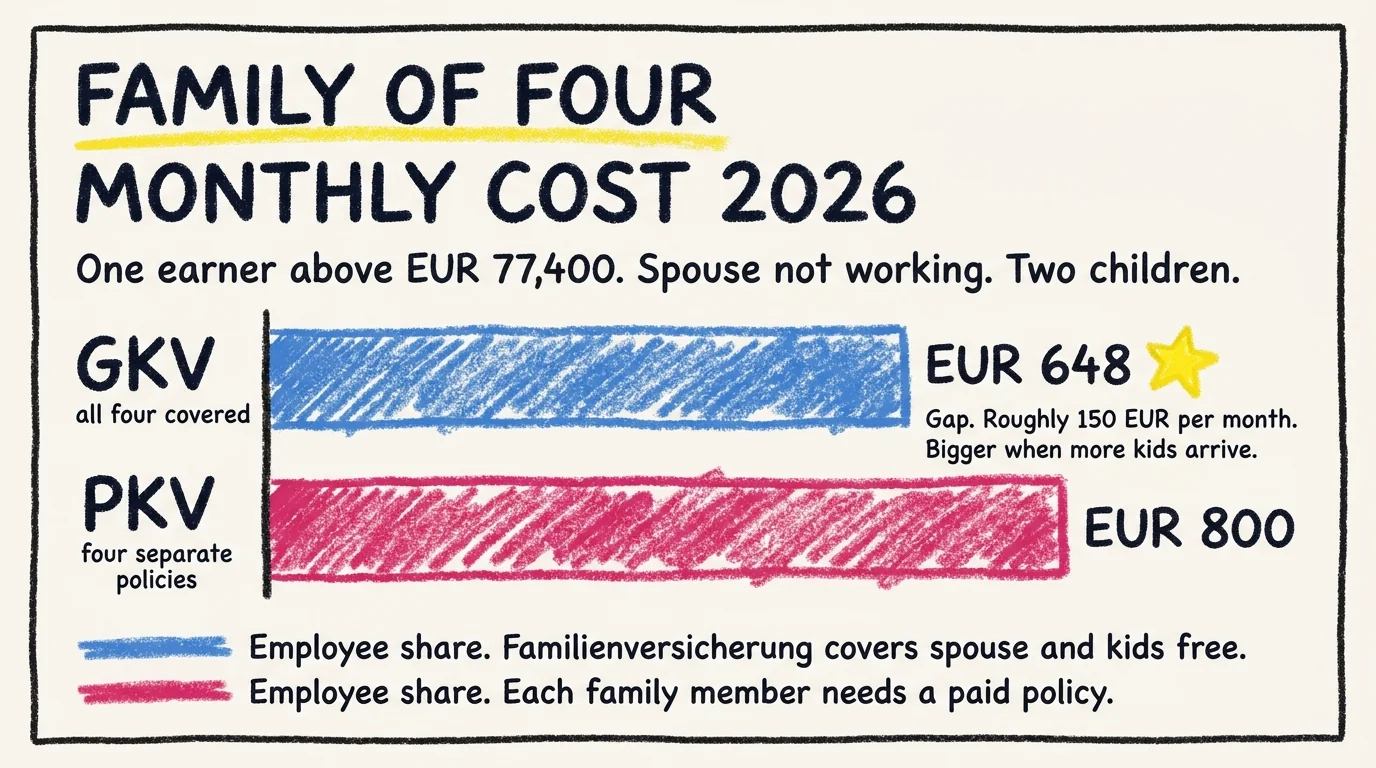
If the non-working partner re-enters work part-time and earns above €556/month, they lose Familienversicherung in GKV and need their own contribution there too, at which point the maths gets closer. But for the typical one-earner family with kids, GKV is roughly 30% to 50% cheaper over the family's working years, and that gap usually outweighs the PKV's better appointment speed and dental coverage.
This is why most German broker guidance lands on: single high earners go PKV, families go GKV. The exception is when both parents earn well above the JAEG and the kids can be insured on the lower-premium parent's PKV tariff at €100 to €150 each, in which case PKV becomes competitive again.
Common mistakes
- Picking PKV based on the gross premium without subtracting the employer share. Always compare your net monthly cost (employee share for both PKV and GKV) over a 10 to 20 year horizon, not the headline premium.
- Picking GKV based on cost alone when you are a healthy 30-year-old self-employed founder. The €600/month gap compounds; for self-employed earners, PKV is structurally cheaper and the Altersrückstellung partly addresses retirement risk.
- Going for the cheapest PKV tariff (no Altersrückstellung, high deductible) to win on month-1 cost. These tariffs become unaffordable at 60 and you cannot escape them. Mid-tier with full Altersrückstellung and a manageable deductible is the safer pick.
- Not factoring family planning. A PKV decision at 28 looks brilliant until child #1 arrives at 32 and the family bill explodes.
- Forgetting the 9/10 rule. A late-arriving expat (35+) who picks PKV at 38 may face a much harder retirement situation than a German colleague who started GKV at 22 and has the KVdR years stacked up.
- Filling out the PKV health questionnaire optimistically. Misrepresentation lets the insurer void the contract years later, including refusing to pay claims. Be accurate even when it hurts the premium.
- **Assuming "private always means better." ** GKV's TK or Barmer cover excellent care for routine medicine. Where PKV pulls clearly ahead is dental, single hospital rooms, faster specialist access, and Chefarzt treatment. If those do not matter to you, the premium gap is hard to justify on care quality alone.
FAQ
Is private health insurance cheaper than public in Germany?
Often yes for healthy single high earners under 40, almost always yes for self-employed people earning above €40,000, and almost never for families with one earner above the JAEG. The honest answer is: it depends on your income, family situation, age, and health status. A 30-year-old single IT engineer earning €90,000 saves roughly €300 to €370/month going PKV. A 35-year-old single parent of two on the same income pays €150 to €200/month more in PKV.
What is the salary threshold for private health insurance in Germany 2026?
The Jahresarbeitsentgeltgrenze (JAEG) for 2026 is €77,400 per year or €6,450 per month gross. You must earn above this for a full calendar year, with employer confirmation that next year's salary will also be above it. Bonuses, 13th-month pay, and recurring allowances count toward the threshold; expense reimbursements do not.
Can I switch from private back to public health insurance in Germany?
Only under specific conditions, and effectively never after age 55. Under 55, you can return if your income drops below the JAEG, you become unemployed and qualify for ALG I, you join a spouse's Familienversicherung with no income above €556/month, or you take a salaried job that puts you below the threshold. After 55, the law closes these routes (§6 Abs. 3a SGB V). The 5 years before turning 55 are the only window most adults have to engineer a return.
Why is the GKV maximum monthly contribution rising so fast?
The Beitragsbemessungsgrenze (BBG), which sets the cap on assessable income, is updated each autumn by federal regulation and tracks general wage growth. Recently it has run ahead of average wage growth, climbing about 6.9% per year on average between 2021 and 2026. The Höchstbeitrag (maximum monthly bill) climbs in lockstep with the BBG, regardless of what individual high earners do.
What does PKV cost in retirement?
It depends on the tariff. A standard mid-tier PKV policy taken out in your 30s typically costs €700 to €1,100/month gross at age 65, dropping by 10% when the Altersrückstellung surcharge falls away at 61. Compared to GKV in retirement (where pension, capital, and rental income all get assessed and a high pension can mean €1,200+/month), PKV is often comparable or slightly better, if you picked a tariff with full Altersrückstellung and did not strip benefits to chase a low entry premium.
Is it worth taking PKV if I might leave Germany in a few years?
Often yes. PKV gives you faster appointments and lower monthly cost during your German years, and the premium savings compound. The Altersrückstellung you build up is forfeited when you leave (PKV is a German contract, not portable), but for under-40s leaving within 10 years, the cumulative savings usually exceed what the Altersrückstellung would have been worth. The exception: if you have any chronic condition, GKV is almost always better because the underwriting risk does not exist.
Do international students need PKV or GKV?
Almost always GKV. International students up to age 30 (sometimes 33) are required to enrol in a public sickness fund (TK, Barmer, AOK, DAK) at around €130/month. Private student plans like Mawista or Care Concept exist but mostly cover the application phase or students above 30 who got opted out of GKV. See our healthcare guide for international students for the full breakdown.
How does Pflegeversicherung interact with PKV?
If you go private for health insurance, you also go private for long-term care insurance. Private Pflegepflichtversicherung is mandatory alongside PKV, and the rates are similar to GKV's: roughly 3.6% with kids or 4.2% childless, calculated on a similar basis. The childless surcharge (Kinderlosenzuschlag) of 0.6% applies in both systems and is paid entirely by the employee.
Where to next
If you have decided GKV is right for you, our side-by-side comparison of the major German health insurance providers walks through TK, AOK, Barmer, and DAK on Zusatzbeitrag, English service quality, and bonus programmes. Our healthcare system guide is the broader overview of how the German medical system actually works. The insurance overview for expats covers the other policies (liability, household, disability) that should sit alongside health.
If you are weighing PKV, the right next step is two or three quotes from licensed German brokers. Get the exact same coverage tier quoted across insurers (otherwise the premium comparison is meaningless), and ask the broker to show the projected premium at age 65 with and without the optional Beitragsentlastungstarif. Decisions made on the entry premium alone tend to age badly.
Continue reading
Living in Germany·14 min read
Public health insurance Germany 2026: what changed and how to pick a Krankenkasse
What changed in German public health insurance for 2026: average Zusatzbeitrag is now 2.9 percent, income ceiling moved up, and how to compare Kassen.
Read articleLiving in Germany·15 min read
Rundfunkbeitrag explained: why every German household pays it and how students legally skip it
Germany's broadcasting fee in 2026: who pays, who is exempt, how to apply for the Befreiung, and what happens if you ignore the bill.
Read articleLiving in Germany·16 min read
Anmeldung in Germany 2026: How to actually get a Bürgeramt appointment in Berlin, Munich, Hamburg
Anmeldung in Germany 2026: how to actually get a Bürgeramt appointment in Berlin, Munich and Hamburg. Wait times, documents, fines, online route.
Read articleReady to plan your Germany journey?
Explore our tools and resources to find the perfect university and program for your academic goals.