Rundfunkbeitrag explained: why every German household pays it and how students legally skip it
Germany's broadcasting fee in 2026: who pays, who is exempt, how to apply for the Befreiung, and what happens if you ignore the bill.

Table of contents
Last updated: June 2026
TL;DR: The Rundfunkbeitrag is Germany's mandatory broadcasting fee. Every household pays €18.36 a month in 2026, regardless of who lives there or whether you own a TV. Only one fee per flat, even if you live in a WG with five roommates. Students on BAföG who do not live with their parents can apply for an exemption; everyone else can skip it only through specific exemption categories or by sharing one fee across a whole household. Here is exactly how it works, who can legally avoid it, and how to apply.
You will get the letter within a few weeks of registering your address at the Bürgeramt. White envelope, ARD ZDF Deutschlandradio Beitragsservice in the corner, a contributor number and a request for €55.08. Welcome to the Rundfunkbeitrag, the broadcasting fee that funds Germany's public radio and TV stations and that almost every adult in this country pays whether they want to or not.
This is a Live in Germany explainer for newcomers and long-term expats who want a clean answer to three questions: do I have to pay this, can I get out of it legally, and what happens if I ignore the letter. We have covered the residence registration process and things that get expats fined in Germany elsewhere. The Rundfunkbeitrag connects to both, because the fee is triggered by your Anmeldung and ignoring it is one of the cheapest ways to land yourself a Schufa entry.
What is the Rundfunkbeitrag and who collects it?
The Rundfunkbeitrag is Germany's per-household contribution to public broadcasting. It funds the ARD network, ZDF, and Deutschlandradio. It replaced the older GEZ fee in 2013, which was a per-device licence (one fee per TV, one per radio, one per car radio) that nobody could enforce in the streaming era. The current model charges every Wohnung (residential unit) a single contribution, no matter how many people live there or how many devices they own.
The legal basis is the Rundfunkbeitragsstaatsvertrag, a treaty between Germany's 16 federal states. Collection is handled by the Beitragsservice, jointly run by the public broadcasters and headquartered in Cologne. They are the people who send the letters, set up direct debits, and chase late payments. The website is rundfunkbeitrag.de.
The fee is not a tax in the legal sense. It is a contribution (Beitrag) tied to dwelling occupancy. Constitutionally, the German Federal Constitutional Court has upheld this model multiple times. You cannot opt out by claiming you do not watch TV, do not own a radio, or only stream Netflix. The ruling logic is that public broadcasting serves society as a whole, so the obligation attaches to the dwelling, not to your media consumption.
How much is the Rundfunkbeitrag in 2026?
| Billing period | Amount |
|---|---|
| Monthly | €18.36 |
| Quarterly (default) | €55.08 |
| Half-yearly | €110.16 |
| Annual | €220.32 |
The monthly rate of €18.36 has been frozen since 2021. In late 2024, the 16 state premiers blocked a recommendation by the KEF (the independent commission that proposes the fee level) to raise it to €18.94. The freeze runs through the end of 2026. The KEF has since proposed a smaller increase to €18.64 starting January 2027, which still needs ratification by the state parliaments. Plan your budget around €18.36 for now and assume a small bump in 2027.
Quarterly is the default billing cycle. The Beitragsservice prefers SEPA direct debit (Lastschrift) and will set the next withdrawal for the middle of the quarter. If you choose bank transfer (Überweisung), you are responsible for sending the money on time, and since June 2025 the Beitragsservice has stopped sending regular invoice reminders. Instead, you receive one annual letter, the Einmalzahlungsaufforderung, that lists the four payment deadlines for the year. Miss them and you start the late-payment chain.
Who has to pay (and the WG rule that trips up newcomers)
The rule is simple but counter-intuitive: one fee per Wohnung, not per person. A Wohnung is any structurally separate residential unit, defined by its own front door and an address with a name on the bell.
That means:
- You live alone in a one-bedroom flat. You pay one fee. €18.36/month.
- You are a married couple in a two-bedroom flat. You pay one fee, not two. Designate one of you as the contribution payer.
- You live in a four-person WG sharing one kitchen and one bathroom. You pay one fee for the whole flat. Split €18.36 four ways = €4.59 each.
- You live in a student dorm with your own room behind your own door. Officially, a self-contained dorm room counts as its own Wohnung and pays one fee. In practice, many Studentenwerk dorms are exempt or invoiced collectively; check with your specific Studentenwerk.
- You own a holiday flat in addition to your main residence. As of June 2020, you only pay one fee for your primary residence; second homes are exempt if you can prove the primary fee is being paid.
The WG rule is the most common source of confusion for international students. The Beitragsservice will write to every newly registered adult and ask them to either pay or prove that someone else in the same flat is already paying. This is normal. Reply with your roommate's contribution number and the issue closes within a few weeks.
Who can legally skip the Rundfunkbeitrag
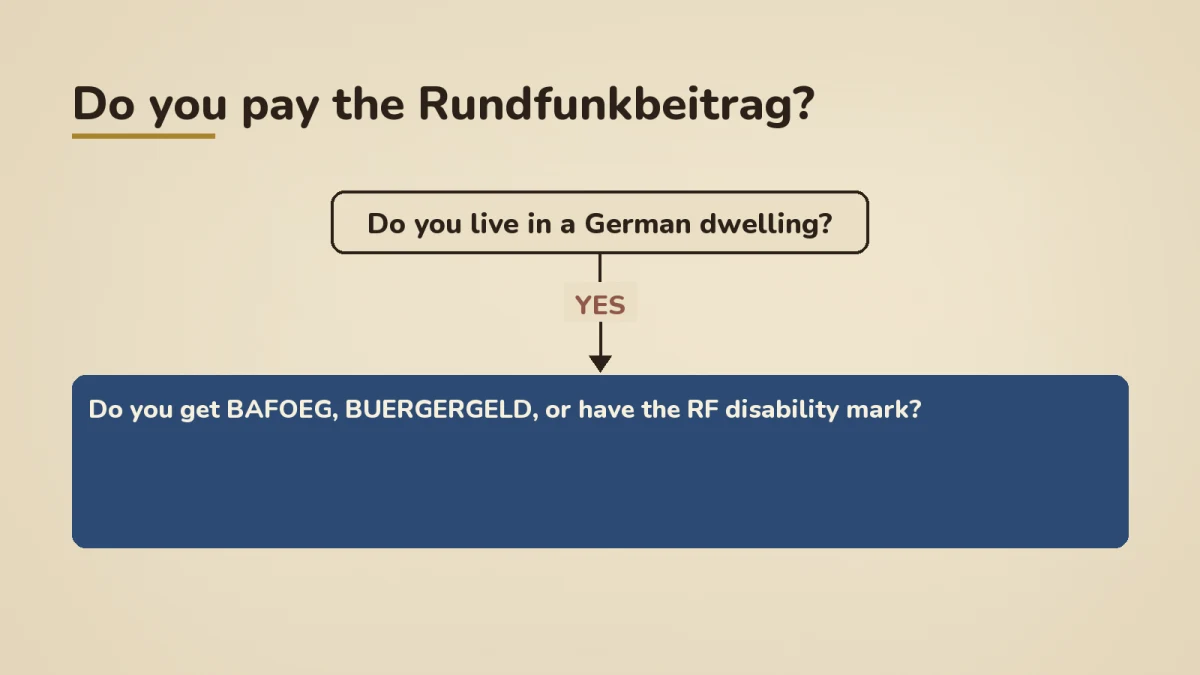
There are real exemptions, and they are tighter than most newcomers expect. The Beitragsservice will not waive the fee because you are a foreigner, because you do not speak German, because you only stream content, or because you do not believe in public broadcasting. The exemptions are specific to financial hardship or disability. The current categories in 2026:
- BAföG recipients who do not live with their parents. If you receive BAföG (Germany's federal student financial aid) and you live in your own flat or in a WG away from home, you can apply for full exemption. The exemption also covers a spouse or registered partner, but not other flatmates.
- Bürgergeld recipients. People receiving the German basic-income benefit (formerly known as Hartz IV) qualify. Show the Bescheid (decision letter) from your Jobcenter.
- Grundsicherung im Alter und bei Erwerbsminderung. The means-tested old-age and reduced-capacity benefit qualifies.
- Asylum seekers receiving AsylbLG benefits. Recipients of basic benefits under the Asylbewerberleistungsgesetz are exempt.
- People with disabilities (RF mark on the disability ID). A blue ID card showing the RF mark grants a one-third reduction in the fee, not a full waiver. The full waiver applies only to people who are blind, severely vision-impaired with a GdB of 60 or more, or deaf. The reduced rate is currently €6.12/month.
- People who simply cannot afford the fee (Härtefall). A small minority qualify under the hardship clause. You need to show that your income, after deducting the standard Bürgergeld rate, is less than the fee itself. This route is rarely successful.
International students arriving on a regular student visa, working professionals on a Blue Card, and most expats do not qualify for any of these. If you are sharing a WG with a German student who is BAföG-exempt, that helps the household: the whole flat can be exempt if every adult resident qualifies separately. If only one person qualifies, the others still owe one fee for the dwelling.
How to apply for an exemption (Befreiung)
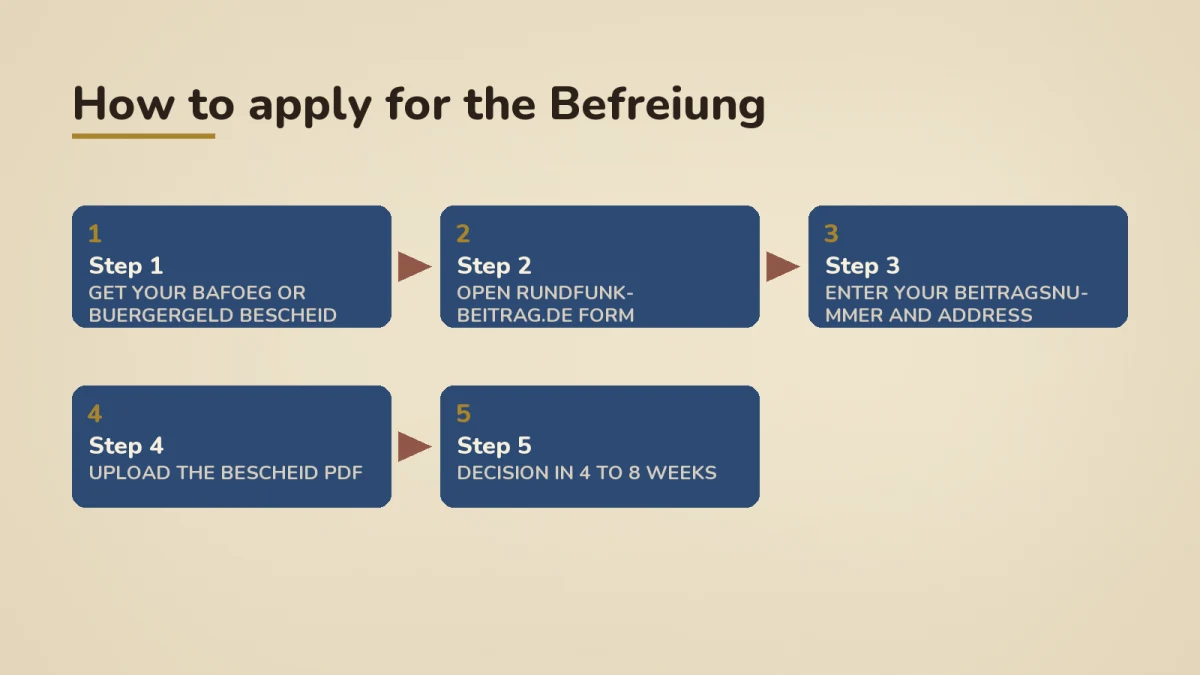
The application is online and free. It takes 10 to 15 minutes if you have your documents ready.
- Collect your proof. For BAföG, the most recent BAföG-Bescheid (decision letter from your university's BAföG-Amt). For Bürgergeld, the current Jobcenter Bescheid. For disability, a copy of your Schwerbehindertenausweis showing the RF mark.
- Open the form. Go to rundfunkbeitrag.de, choose Bürgerinnen und Bürger, then Befreiung beantragen. The form is in German; have a translator tab open if you need one.
- Fill in your data. Your contribution number (Beitragsnummer) from the welcome letter, your address, the exemption category, and the start date you want exemption from.
- Upload the Bescheid. PDF or photo, both sides, no more than 5 MB. Make sure your name and the issuing date are visible.
- Submit and wait. You receive a written decision within four to eight weeks. Until then, keep paying as usual. If approved, the Beitragsservice refunds anything you paid for the exempt period.
The exemption runs for the same period as the underlying benefit. BAföG decisions are usually annual, so you reapply once a year with the new BAföG-Bescheid. The Beitragsservice writes to remind you about three months before the current exemption expires. Miss the renewal and the fee snaps back; you have to apply retroactively with proof, which is annoying but fixable.
How to share one fee in a WG
If you live in a shared flat where nobody qualifies for an exemption, the household still only owes one fee. The procedure is straightforward:
- Designate one Beitragszahler. The roommate with the longest tenancy or the one who receives the first letter is the obvious choice.
- The other roommates write a short statement. A one-line letter or email to the Beitragsservice with their contribution number, name, address, and the contribution number of the designated payer. The official term is "Mitbewohner-Bestätigung" or "Gemeinsame Wohnung".
- The Beitragsservice closes the secondary accounts. Within a few weeks, every other resident is taken off the rolls for that flat and only the designated payer is billed.
- Settle the split internally. Most WGs add €4 to €5 per person to the monthly Nebenkosten or transfer it to one PayPal/Bunq pool. The Rundfunkbeitrag is one of the easier shared bills because the amount never moves between billing cycles.
If anyone leaves the WG, the leaver should send a deregistration to the Beitragsservice citing the move; the new arrival sends in their Anmeldung confirmation if they want to be added as a co-resident. This keeps the records clean and avoids one of you getting a duplicate letter six months later.
What happens if you ignore the letter
The Beitragsservice does not give up. The escalation chain is mechanical and lands on every contributor who stops paying:
- Reminder (Mahnung). Sent after the first missed quarter. Includes a small late fee.
- Final warning (zweite Mahnung). Sent after the second missed quarter. Tone gets sharper. Late fees grow.
- Vollstreckungsanordnung (enforcement order). Issued at around six months overdue. The unpaid fee plus penalties (Säumniszuschlag of 1% of the overdue amount, at least €8) becomes enforceable. After six months of non-payment, you have committed an Ordnungswidrigkeit, an administrative offence punishable by additional fines.
- Court execution (Gerichtsvollzieher). A bailiff can attach your bank account or wages directly. This step is rare for first-time offenders but standard for repeat avoiders.
- Schufa entry. The Beitragsservice can report enforced debts to Germany's main credit bureau. A Rundfunkbeitrag-related Schufa entry can block you from renting flats, opening certain bank accounts, and getting consumer credit for years.
For most newcomers the chain stops at step 1 or 2 once you set up the direct debit. But the Schufa risk is real, and we have seen students with otherwise clean records pick up enforcement entries from a forgotten broadcasting bill. If you receive a Mahnung, deal with it the same week. Either pay, set up Lastschrift, or apply for the exemption you actually qualify for.
When you leave Germany: how to stop paying
The fee follows the dwelling, so the day you give up your German address you stop owing it. Two steps:
- Abmeldung at the Bürgeramt. Deregister your residence on or shortly after your move-out date. The Bürgeramt issues an Abmeldebestätigung as proof.
- Notify the Beitragsservice. Online form on rundfunkbeitrag.de under Abmeldung. Upload the Abmeldebestätigung. Specify the last day you were resident at the German address.
If you have already prepaid for the current quarter, the Beitragsservice refunds the unused portion to your account. If you owe back-payments, you should clear them before leaving; an unpaid balance can follow you internationally if it is sent to a collection agency, and a Schufa entry will outlast your visa.
People moving within Germany do not deregister with the Beitragsservice; they update their address. The Anmeldung at the new town's Bürgeramt automatically forwards your data through the residents' register, but it is faster to send the Beitragsservice your new address directly.
Common mistakes to avoid
- Ignoring the first letter because it looks like a scam. It is not a scam; it is a legally binding bill from a quasi-public body. Open it and respond.
- Both partners in a couple paying separately. Only one fee per flat. Designate one payer and have the other send the Mitbewohner statement.
- Assuming "I don't watch TV" makes you exempt. It does not. The fee is per-dwelling. Tell the Beitragsservice you don't own a TV and they will keep billing you.
- Forgetting to deregister when you leave Germany. A forgotten Rundfunkbeitrag account can quietly accrue €220+ a year of debt that lands on your Schufa file the next time you return.
- Not renewing the BAföG exemption every year. Exemptions run for the BAföG period only. Renew with the new Bescheid; otherwise the fee restarts automatically.
- Paying through random bank transfers without the Beitragsnummer. The Beitragsservice cannot match payments without your contribution number in the reference field. Either use direct debit or include the number in every transfer.
Where the broadcasting fee fits in your monthly budget
For most expats, the Rundfunkbeitrag is one of those background fixed costs you set up once and forget. €18.36 a month sits next to your public health insurance premium, GEZ-style internet contract, and electricity bill in the predictable-monthly column. It is small enough that we usually recommend setting up the SEPA direct debit on day one, filing the welcome letter, and never thinking about it again. If you are eligible for a BAföG exemption, the 15 minutes to apply pays back €220 every year.
For a wider monthly cost picture for international students and working professionals in Germany, see our cost-of-living breakdown. For other unwritten rules that catch newcomers off guard, the five things that quietly get expats fined covers Anmeldung, Sunday quiet hours, and recycling alongside the broadcasting fee.
FAQ
Do I still pay the Rundfunkbeitrag if I do not own a TV?
Yes. The fee attaches to your dwelling, not to your devices. It does not matter whether you own a TV, a radio, or only stream content. Every Wohnung in Germany pays the same €18.36 a month in 2026.
I live in a WG with three roommates. Does each of us pay separately?
No. Only one fee per flat, regardless of how many people live there. Designate one Beitragszahler, have the others send a Mitbewohner-Bestätigung to the Beitragsservice with the designated payer's contribution number, and split the €18.36 internally.
Are international students automatically exempt?
No. International students pay the same fee as everyone else unless they receive BAföG and do not live with their parents. BAföG recipients who do not live with their parents can apply for an exemption; non-BAföG students on regular study visas are not exempt.
What is the fine if I never pay the Rundfunkbeitrag?
After about six months of non-payment, the unpaid balance plus a Säumniszuschlag (1% of the overdue amount, at least €8) becomes enforceable. Continued non-payment can trigger a court bailiff, wage or account garnishment, and a Schufa entry that affects rental and credit applications for several years.
How do I deregister when I leave Germany permanently?
Two steps. First, do your Abmeldung at the Bürgeramt (residents' registration office) before or shortly after your move-out date. Second, fill out the Abmeldung form for the Rundfunkbeitrag on rundfunkbeitrag.de and upload your Abmeldebestätigung. Any prepaid amount for the period after your move-out date is refunded.
Will the Rundfunkbeitrag change in 2027?
Likely yes. The KEF has recommended raising the fee to €18.64 a month from January 2027, which still needs ratification by the 16 state parliaments. The current €18.36 freeze runs through the end of 2026.
Can I cancel my Rundfunkbeitrag because I disagree with public broadcasting?
No. The fee is mandatory under the Rundfunkbeitragsstaatsvertrag and has been upheld by the German Federal Constitutional Court. The only legal ways out are exemption (BAföG, Bürgergeld, certain disabilities) or moving out of your German dwelling.
What is the difference between the Rundfunkbeitrag and a Netflix subscription?
The Rundfunkbeitrag funds public broadcasters (ARD, ZDF, Deutschlandradio) that are required by law to provide news, education, and cultural programming independent of advertising and commercial pressure. Netflix is a private streaming subscription. Paying for one does not waive the other, and vice versa.
Where to next
- Residence registration (Anmeldung) for international students. The trigger event that puts you on the Beitragsservice's radar.
- Five things that get expats fined in Germany. The unwritten rules every newcomer needs to know in their first month.
- Cost of living in Germany for international students. Where the broadcasting fee sits in your monthly budget.
- Paying taxes in Germany as an international student. For the bigger picture on what newcomers owe to the German state.
- The Live in Germany pillar collects every settling-in guide we publish, from Schufa to health insurance to driving licences.
Continue reading
Living in Germany·15 min read
Schufa in Germany explained: How to build credit as a new arrival, and the myths to ignore
Schufa is Germany's main credit file. Here is how it actually starts, the new 2026 score model, and how to build it from zero as an expat.
Read articleLiving in Germany·19 min read
Public vs Private Health Insurance in Germany: PKV vs GKV Head-to-Head with Real Numbers
Public vs private health insurance in Germany compared with 2026 numbers. JAEG, BBG, GKV monthly cost, PKV premiums, family math, and the age 55 lock-in.
Read articleLiving in Germany·13 min read
Deutschlandticket 2026: monthly cost explained, semester-ticket rules, who really saves
The Deutschlandticket is Germany's nationwide flat-rate transit pass. What it costs in 2026, how the semester ticket works, and who really saves.
Read articleReady to plan your Germany journey?
Explore our tools and resources to find the perfect university and program for your academic goals.