How long do you actually wait for a doctor in Germany? Specialist appointment data for international patients
Average wait for a specialist in Germany is 42 days for GKV patients. See wait times by specialty, GKV vs private gap, and how 116117 helps.

Table of contents
Last updated: May 2026
TL;DR: Patients in Germany's statutory health insurance (GKV) wait an average of 42 days for a specialist appointment, up from 33 days in 2019. By specialty the spread is wide: dermatology, cardiology, and neurology are slowest, while ENT, urology, and gynecology are fastest. You can skip a chunk of the queue by calling Terminservicestelle 116117, which by law must place you with a specialist within 4 weeks (1 week if urgent).
If you have just moved to Germany, the first thing that surprises you about the healthcare system is not the cost. The cost is mostly handled by your statutory health insurance fund. The thing that catches you off guard is the wait. Want to see a dermatologist? Six weeks. Cardiologist? Nine weeks if you live outside a big city. A friend with private insurance got the same appointment next Tuesday.
This post lays out what actual 2024 data says about specialist wait times in Germany, where the international-patient angle differs, and the four legal levers you can pull to get seen faster. It is part of our health insurance pillar, and pairs with our broader healthcare in Germany guide for internationals.
How long do you actually wait for a specialist in Germany?
The headline number from a 2024 Federal Ministry of Health survey of GKV-insured patients: 42 days average wait time for a specialist appointment. That is the figure the Ministry submitted in its 2026 reply to a Bundestag inquiry from Die Linke. In 2019, the same survey put the number at 33 days. So Germany has added about a third to its specialist wait in five years.
A more granular 2025 study published in Deutsches Ärzteblatt International (AOK Rheinland and Hamburg, 3,205 surveyed patients) breaks the same population three ways:
- 40.3 percent got a specialist appointment within 1 week
- 21.3 percent waited between 1 and 3 weeks
- 38.4 percent waited more than 3 weeks
So roughly four in ten GKV patients are seen quickly, four in ten wait longer than three weeks, and the rest are in the middle. The 42-day "average" is dragged up by a long right tail of patients waiting six, eight, or twelve weeks.
Wait times by specialty: where the queue actually is
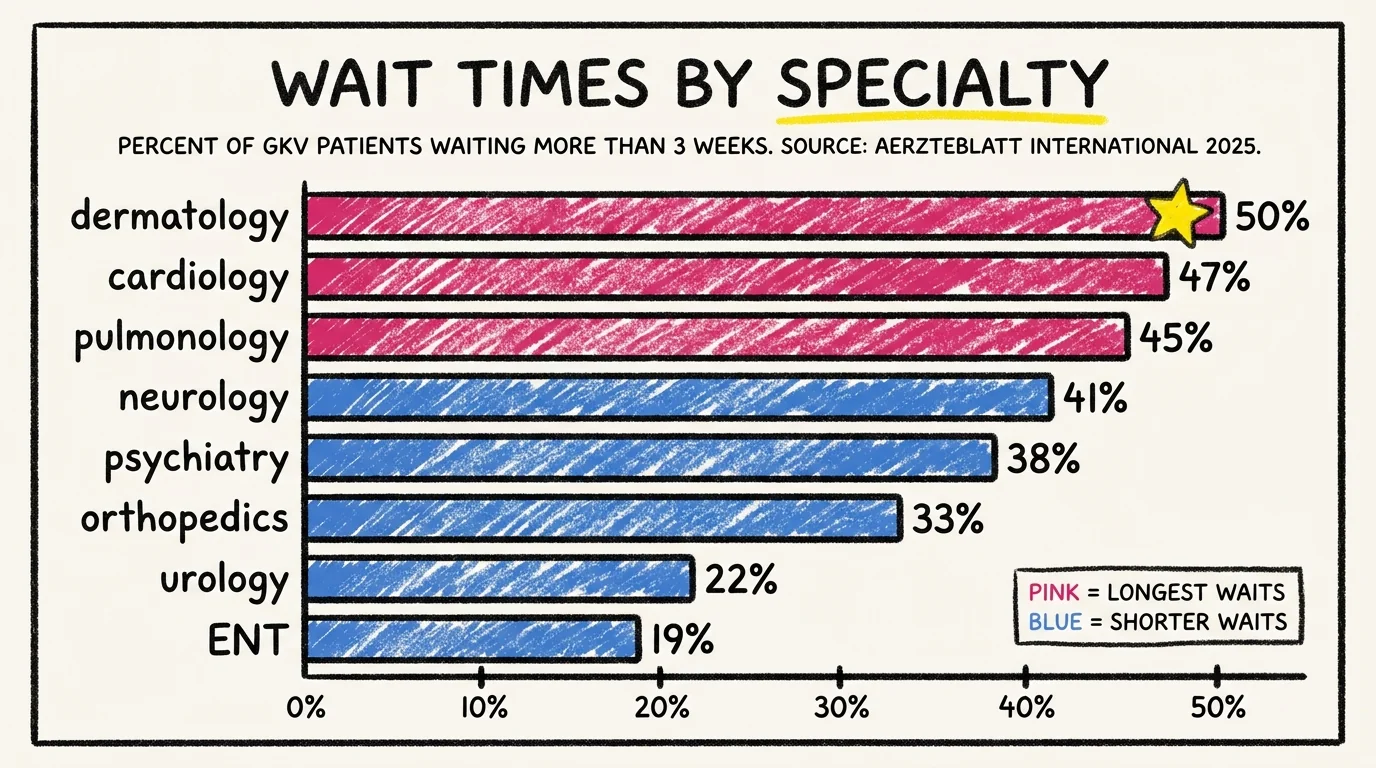
The Ärzteblatt study tracked the ten most common specialty visits and ranked them by share of patients waiting more than three weeks. Dermatology, cardiology, and pulmonology sat at the top of the queue. ENT, urology, and gynecology were the easiest to get into. After controlling for age, sex, region, and reason for visit, patients booking dermatology, pulmonology, cardiology, psychiatry, or neurology were four to five times more likely to wait over three weeks than those booking ENT.
GKV versus PKV: is the access gap real?
Roughly one in three GKV patients (32.8 percent) felt that practices made a distinction between statutory and private insurance when handing out appointments. 41.3 percent did not feel that distinction. The rest were not sure. Perceived discrimination was highest in dermatology, cardiology, orthopedics, and ENT.
Why it happens: practices are paid per service, and the fee schedule for private insurance (PKV) pays roughly 1.7 to 2.3 times the GKV rate for the same consult. From the practice's perspective, a private slot is more profitable. The federal Terminservicestelle (described below) was created in 2015 to flatten this. It works in some cases. It does not eliminate the gap.
For most internationals on a student visa, Blue Card, or job seeker route, this is moot: you will be on GKV unless you are over the PKV income threshold or freelance. Plan around GKV waits.
Four ways to skip the queue
1. Terminservicestelle: the legal right you probably did not know you had
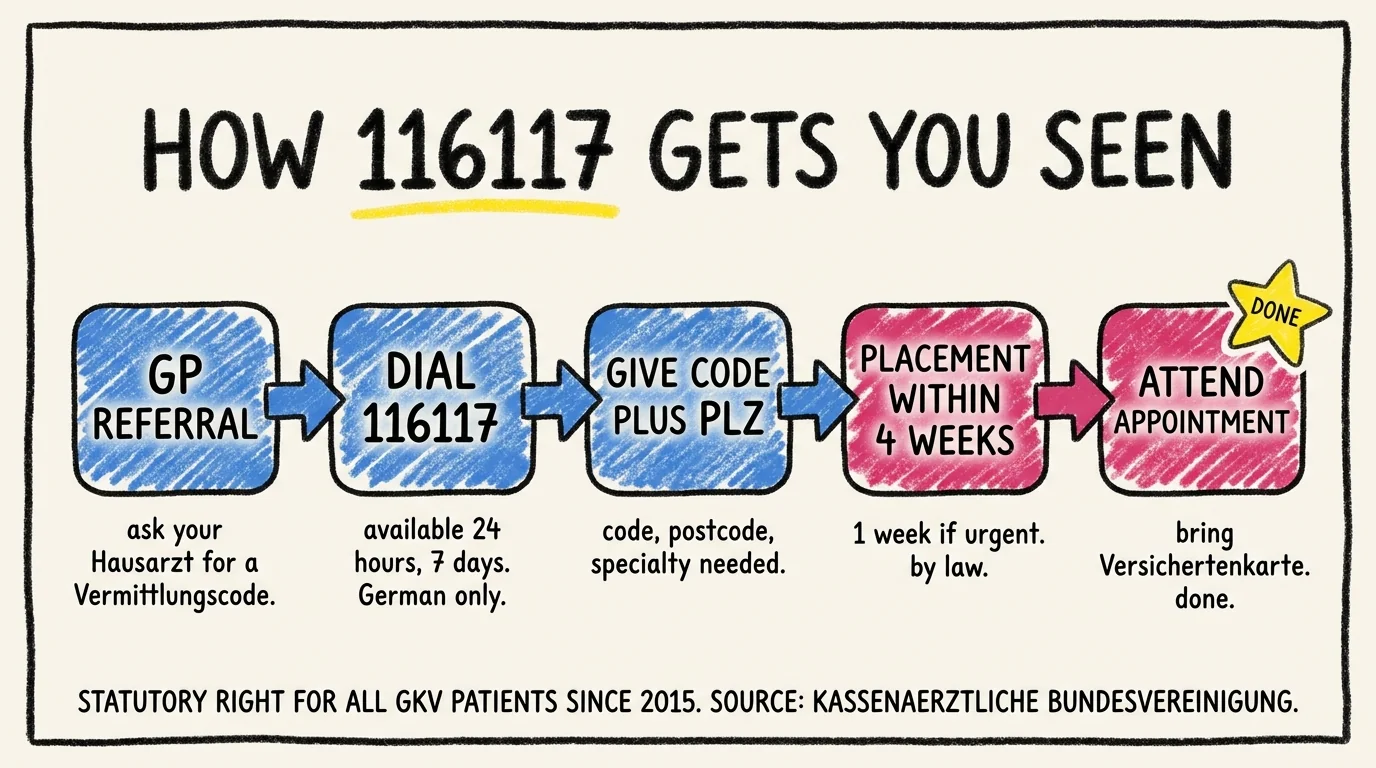
Since 2015, GKV-insured patients have a statutory right to a specialist appointment within 4 weeks, or 1 week for urgent cases. The Kassenärztliche Bundesvereinigung runs the placement service through the helpline 116117. The service operates 24 hours a day, 7 days a week, though the agents primarily speak German.
You will need three things to call:
- Your Versichertenkarte (the GKV chip card)
- A Vermittlungscode from your GP for most non-urgent specialties (the GP issues this on request when they refer you onward)
- Postal code or city where you want the appointment
The placement does not let you choose the doctor. The slot may be 30 km away. It will be in the next 4 weeks. For most situations that beats a 6 to 9 week wait at your preferred clinic.
2. Offene Sprechstunde: walk-in slots without an appointment
Practices in certain specialties (gynecology, ophthalmology, ENT, pediatrics, surgery, urology, neurology) are required to offer at least 5 hours per week of open consultation hours. You walk in. You take a number. You wait that morning, not three weeks. GKV pays the practice extrabudgetary fees for these slots, which is why physicians actually keep them. Federal expenditure on offene Sprechstunde rose to roughly 814 million euros in 2023 from 291 million in 2020, so the slots exist and are funded. Ask your local practice if they have offene Sprechstunde and on which weekday.
3. Online booking and Selbstzahler
Doctolib and jameda surface last-minute cancellations that the practice did not advertise on the phone. Filter by GKV-accepting practices in your specialty, refresh the view across two or three days, and you can sometimes pick up a same-week slot. The other lever is paying for a consult yourself (Selbstzahler) at 80 to 250 euros, which gets most specialists to see you within days. Sensible for a one-off second opinion or rapid diagnostics, not for chronic care.
What international patients should know specifically
A few things from the same 2025 Ärzteblatt regression are worth flagging if you arrived in Germany within the last year or two.
- Foreign nationality slightly raises wait odds even after controlling for region, specialty, and reason. The effect is small but statistically present. Expect to spend a touch more time chasing the appointment than a German-passport-holder colleague would.
- Language is not covered by GKV in most situations. Translators are reimbursed only for psychotherapy and a narrow set of other diagnoses. For every other specialty, you bring a German-speaking friend, you book an English-speaking practice, or you manage with translation apps.
- Find English-speaking practices via 116117.de. The same KBV portal that runs the wait-skipping service has an arztsuche where you filter by language. This is the single best free directory for international patients.
- Anmeldung first. You cannot register on most insurance funds before your address is registered, and you cannot get a 116117 placement without an active GKV card. If you have not yet done your residence registration, do that before you start fighting for a specialist slot.
FAQ
Are doctor wait times the same everywhere in Germany?
No. Berlin, Munich, and Hamburg generally have shorter waits because of physician density. Smaller cities and rural Bundesländer run longer, particularly for cardiology, dermatology, and pulmonology. Place of residence shifted the odds of waiting more than 3 weeks by up to a factor of 2 in the 2025 Ärzteblatt regression.
Do I need a referral from a GP to see a specialist?
For most specialties yes, you need a Vermittlungscode from your Hausarzt to use 116117 routing. Direct booking is allowed for gynecology, ophthalmology, ENT, and pediatrics without a referral, though waits are typically longer. Book your Hausarzt first; they coordinate the rest.
What if I do not speak German?
Use 116117.de's arztsuche and filter by Englisch under the language field. English-speaking practices exist in Berlin, Munich, Hamburg, and Frankfurt. For psychotherapy, GKV reimburses interpreters under specific diagnostic codes; the practice has to apply for it. For other specialties, bring a friend or use a translation app.
Do private health insurance patients really get faster appointments?
The 2025 Ärzteblatt survey says one in three GKV patients perceive a difference. Practices are paid more per private consult, so the structural incentive is real. PKV usually means same-week for non-urgent specialty appointments. GKV can match this through the Terminservicestelle, but only if you actively use it.
What is 116117 and is it 24/7?
It is the federal patient hotline operated by the Kassenärztliche Bundesvereinigung, running 24 hours a day, 7 days a week. It places you with a specialist within 4 weeks (1 week urgent), and routes you to the on-call medical service when your regular practice is closed. The hotline itself is German-language; the website 116117.de has English content.
What if I need urgent care outside practice hours?
Call 116117 for medical help that is not life-threatening. The on-call service will direct you to a Bereitschaftsdienst-Praxis attached to a hospital. If the situation is life-threatening, call 112 instead.
How fast can I see a Hausarzt (GP)?
GP visits are usually within 1 to 3 days, often same-day for established patients. The bottleneck is specialty care, which is what 116117 was designed to address.
Where to next
- The pillar guide: Health insurance in Germany covers GKV vs PKV, costs, and how to switch funds.
- A tactical companion: Healthcare in Germany guide for international students for first-week setup.
- Setup adjacent: Anmeldung in Germany is a prerequisite for getting a GKV card and using 116117.
Continue reading
Living in Germany·7 min read
Affordable Shopping in Germany: Budget-Friendly Guide for International Students
Save money while living in Germany. Discover affordable places and tips for shopping in Germany. A student-friendly guide covering groceries, fashion, electronics, books, and home essentials.
Read articleLiving in Germany·10 min read
Having a baby in Germany as an expat: Hospitals, midwives, Mutterschutz, paperwork
Plain-English guide to having a baby in Germany as an expat. Mutterschutz, Elterngeld, Kindergeld 2026, Hebamme, hospital choice, and paperwork order.
Read articleLiving in Germany·10 min read
Parental leave (Elternzeit and Elterngeld) in Germany for expats 2026
Up to 3 years job-protected parental leave and EUR 1,800 monthly Elterngeld. The 2026 expat guide to eligibility, the new EUR 175,000 income cap, and deadlines.
Read articleReady to plan your Germany journey?
Explore our tools and resources to find the perfect university and program for your academic goals.