Cost of living in Munich 2026: Rent, transport, groceries, real expat budgets
Real Munich monthly costs for 2026: WG rent EUR 600 to 900, 1-BR EUR 1500 to 2100, Deutschlandticket EUR 63, plus three real expat budget snapshots.

Table of contents
Last updated: May 2026
TL;DR: A single working professional in Munich needs around EUR 2,400 to EUR 2,800 per month in 2026. A student sharing a WG can manage on EUR 1,400 to EUR 1,700. The biggest line item is rent (50 to 60 percent of every Munich budget), followed by health insurance, groceries, and the EUR 63 Deutschlandticket.
Munich is the most expensive city in Germany, and the gap to second place is wider than most arrival guides admit. A 1-room apartment that rents for EUR 750 in Leipzig costs EUR 1,500 in Munich. Rent is the line that decides everything else, so this guide leads with rent, then walks through transport, groceries, hidden costs, and three real budget snapshots so you can match the closest one to your own situation.
If you have not chosen Munich over other options yet, compare it against the alternatives in our best German cities to live and work guide and the broader /live/cities pillar. If you are already locked in, this guide gives you the actual 2026 numbers.
How much does it cost to live in Munich in 2026?
A single working professional in Munich spends EUR 2,400 to EUR 2,800 per month including rent, health insurance, transport, groceries, utilities, and discretionary spend. A Master's student in a WG spends EUR 1,400 to EUR 1,700. A couple in a 2-bedroom apartment spends EUR 3,200 to EUR 3,800. Numbeo's May 2026 baseline puts a single person at EUR 1,074 per month excluding rent; once Munich rent is added, that climbs above EUR 2,500 fast.
These numbers assume you live in Munich, not the surrounding ring (Garching, Freising, Dachau), where rent drops 20 to 30 percent. They also assume public health insurance and a Deutschlandticket, not a car. A car in Munich adds EUR 400 to EUR 600 per month once you account for insurance, parking, fuel, and the resident parking permit.
Munich rent: what you actually pay in 2026
Rent is quoted two ways in Germany and the difference matters. Kaltmiete (cold rent) is the base apartment rent and excludes utilities. Warmmiete (warm rent) adds Nebenkosten: heating, water, building maintenance, and trash collection (EUR 150 to EUR 280 per month for a 1-bedroom). Listings on ImmoScout24 default to cold rent. WG-Gesucht usually quotes warm. Always confirm before signing.
What you pay by housing type
| Housing type | Monthly rent (warm) 2026 | Notes |
|---|---|---|
| Studentenwerk dorm room | EUR 280 to EUR 450 | Apply 6 to 12 months ahead. Long waitlist. |
| WG room | EUR 600 to EUR 900 | Average EUR 790. Most flexible option. |
| Studio (1-room, ~30 sqm) | EUR 1,100 to EUR 1,500 | Hard to find under EUR 1,200 in central Munich. |
| 1-bedroom apartment | EUR 1,500 to EUR 2,100 | Schwabing 1-BR runs EUR 2,016 to EUR 2,352 on second-hand contracts. |
| 2-bedroom apartment | EUR 1,800 to EUR 2,800 | Cheaper neighborhoods around EUR 1,400 cold; central Munich EUR 2,000 cold and up. |
| 3-bedroom family apartment | EUR 2,400 to EUR 3,800 | Family-sized stock is scarce; expect a 6-month search. |
What you pay by neighborhood
| Neighborhood | Vibe | 1-BR rent (cold) |
|---|---|---|
| Maxvorstadt | Universities, museums, central | EUR 1,700 to EUR 2,200 |
| Schwabing | Cafes, expat-heavy, near LMU | EUR 1,600 to EUR 2,400 |
| Glockenbachviertel | Bars, nightlife, central | EUR 1,800 to EUR 2,400 |
| Lehel | Old-money, riverside, quiet | EUR 1,800 to EUR 2,500 |
| Au-Haidhausen | Mid-tier, well-connected | EUR 1,400 to EUR 1,800 |
| Sendling | Working-class roots, gentrifying | EUR 1,200 to EUR 1,600 |
| Pasing | West Munich, S-Bahn hub | EUR 1,000 to EUR 1,400 |
| Moosach | North, family-friendly | EUR 1,000 to EUR 1,400 |
| Berg am Laim | East, mixed industrial | EUR 1,000 to EUR 1,400 |
If you are flexible on commute, Pasing, Moosach, Berg am Laim, and Untermenzing each save EUR 400 to EUR 600 a month versus Maxvorstadt.
Up-front cash you need before signing
- Kaution (security deposit): 2 to 3 months cold rent, capped by law at 3 months. Held in a separate Mietkautionskonto.
- First month's rent in advance.
- Schufa Auskunft (credit report): EUR 29.95 self-service version online; landlords ask for this.
- Liability insurance (Privathaftpflicht): EUR 5 to EUR 10 per month. Most landlords want proof.
- Possible broker fee (Provision): only on first-occupation rentals, capped at 2 monthly rents plus VAT. Most apartments are provisionsfrei.
For a EUR 1,500 cold-rent 1-bedroom, expect EUR 6,000 to EUR 7,500 cash on the table the day you sign.
Transport:
Deutschlandticket, MVV, biking
The single biggest 2026 update is the Deutschlandticket: starting January 1, 2026, the price moved from EUR 58 to EUR 63 per month. It covers all local public transport (U-Bahn, S-Bahn, Tram, Bus) across Germany except long-distance ICE and IC trains. In Munich that means full MVV access for EUR 63.
| Ticket type | Monthly cost 2026 | Who it is for |
|---|---|---|
| Deutschlandticket | EUR 63 | Anyone, all transit nationwide |
| Deutschlandticket Ermäßigung | EUR 43 | Students, trainees, volunteers (where issuer offers) |
| Munich semester ticket | EUR 198 to EUR 215 per semester (~EUR 33 to EUR 36/month) | Enrolled students at TUM, LMU, others. Bundled with semester fee. |
The semester ticket is the cheapest option if you are studying. For everyone else, the Deutschlandticket is the default. Drop your car if you have one. Munich parking permits cost EUR 30 per year for residents, but finding a spot in central districts is its own time tax.
Cycling is excellent in Munich (city-wide bike lane network, MVG Rad public bikes). A used bike from Kleinanzeigen runs EUR 100 to EUR 250.
Groceries and food: weekly budget
A single person spends EUR 200 to EUR 350 per month on groceries in Munich, depending on where you shop and how much you cook.
| Store tier | Weekly grocery spend (single) | Examples |
|---|---|---|
| Discounter | EUR 40 to EUR 60 | Aldi, Lidl, Penny, Netto |
| Mid-tier supermarket | EUR 60 to EUR 90 | Rewe, Edeka |
| Bio / organic | EUR 90 to EUR 130 | Alnatura, Denn's, Vollcorner |
Practical numbers in Munich (May 2026): a litre of milk EUR 1.15, a kilo of chicken breast EUR 9 to EUR 11, a kilo of pasta EUR 2.50, a six-pack of Augustiner from a Getränkemarkt around EUR 7.50 plus pfand. Eating out, a Mittagstisch (set lunch) runs EUR 12 to EUR 18 in most neighborhoods, while a weekend dinner with a starter and one beer is EUR 35 to EUR 50 per person. A draught half-litre Helles in a beer garden is EUR 5.20 to EUR 7.
Hidden costs no one warns you about
These are the line items that ambush new arrivals because they are not part of any quoted rent or salary number:
- Rundfunkbeitrag (broadcasting fee): EUR 18.36 per month, per household, mandatory once you Anmeldung. WG splits one fee across roommates.
- Electricity (Strom): EUR 40 to EUR 100 per month for a 1-bedroom in 2026. Federal grid-fee subsidies are bringing this down slightly versus 2024 to 2025 peaks, but Munich rates still run higher than the German average.
- Internet: EUR 30 to EUR 45 per month for 50 to 250 Mbps. Vodafone, Telekom, 1&1, M-net (Munich-specific).
- Mobile: EUR 10 to EUR 25 per month on a discounter SIM (winSIM, Aldi Talk, Congstar). See our SIM cards in Germany guide.
- Public health insurance (GKV): about EUR 141 to EUR 146 per month on the 2026 student tariff at TK; for working professionals, 14.6 percent + Zusatzbeitrag of gross salary up to the assessment ceiling, half paid by the employer. A EUR 60,000 salary lands at roughly EUR 450 to EUR 500 per month employee share.
- Privathaftpflicht (personal liability insurance): EUR 5 to EUR 10 per month, EUR 60 to EUR 120 per year. Almost mandatory in practice.
- Schufa Auskunft: EUR 29.95 every time a landlord asks (some accept the older free version).
- Bank: EUR 0 (N26, DKB) to EUR 12 per month (Sparkasse Munich). Set up your account early using our German bank account guide.
That is EUR 200 to EUR 700 per month of additional fixed cost on top of rent, before you have bought any groceries.
Real expat budgets: three actual snapshots
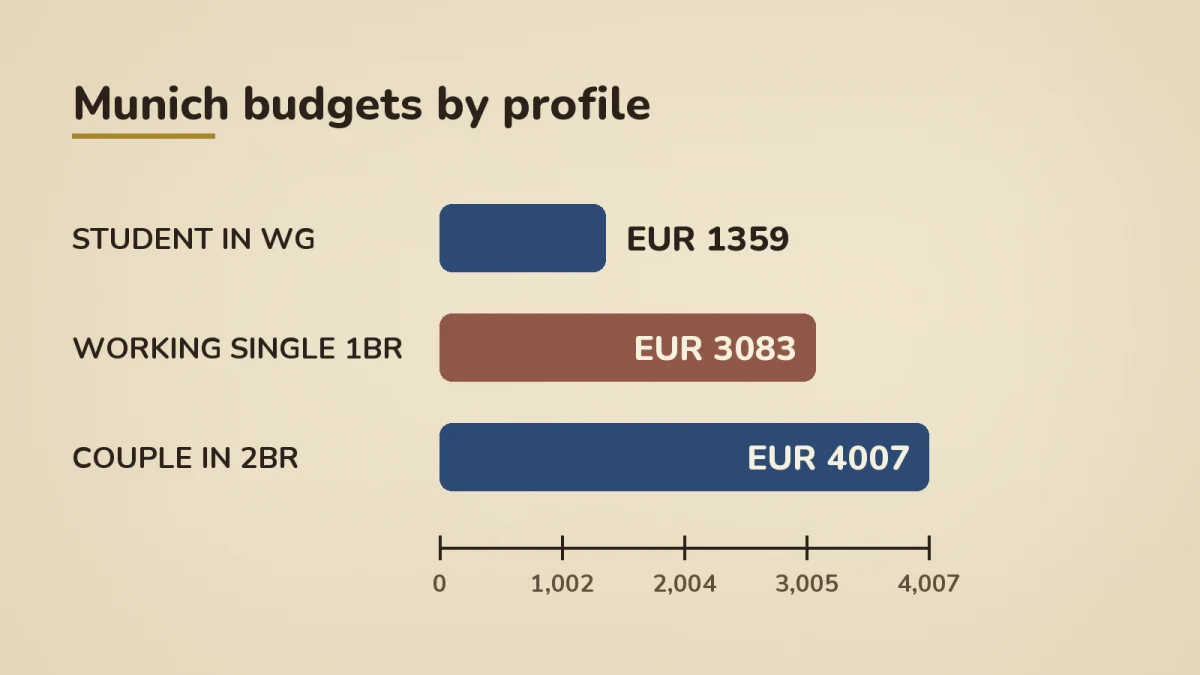
The number that matters is yours, not Numbeo's. Here are three real Munich budgets that match the most common situations.
Snapshot 1:
Master's student in a Schwabing WG
- Rent (WG room, warm): EUR 750
- Health insurance (TK student tariff, 2026): EUR 146
- Deutschlandticket Ermäßigung: EUR 43
- Groceries (Aldi/Lidl, cooks at home): EUR 220
- Mobile: EUR 12
- Internet (split with WG): EUR 12
- Going out, gym, books, misc: EUR 200
- Total: EUR 1,383 per month
This budget assumes the blocked account requirement of EUR 992 per month is the floor; this student is slightly above it.
Snapshot 2:
Working professional, single, 1-bedroom in Au-Haidhausen
- Rent (1-BR, warm): EUR 1,650
- Health insurance (employee share, EUR 65k salary): EUR 480
- Deutschlandticket: EUR 63
- Groceries (mix of Rewe and Aldi, eats out twice a week): EUR 350
- Electricity: EUR 65
- Internet + mobile: EUR 50
- Rundfunkbeitrag: EUR 18.36
- Privathaftpflicht: EUR 7
- Going out, gym, travel, misc: EUR 400
- Total: EUR 3,083 per month
Net take-home on a EUR 65,000 salary in Munich (Steuerklasse 1, no church tax) is roughly EUR 3,300 to EUR 3,500 per month. The math is tight but workable.
Snapshot 3:
Couple in a 2-bedroom in Sendling
- Rent (2-BR, warm): EUR 1,950
- Health insurance (one working, one family-insured): EUR 520
- 2x Deutschlandticket: EUR 126
- Groceries (cook most nights): EUR 600
- Electricity + heating top-up: EUR 110
- Internet + 2x mobile: EUR 75
- Rundfunkbeitrag: EUR 18.36
- Privathaftpflicht (couple plan): EUR 8
- Going out, travel, misc: EUR 600
- Total: EUR 4,007 per month
Two-income households (both partners working at EUR 60k+) easily clear this. Single-income couples on Munich rents get squeezed.
How Munich compares to other German cities
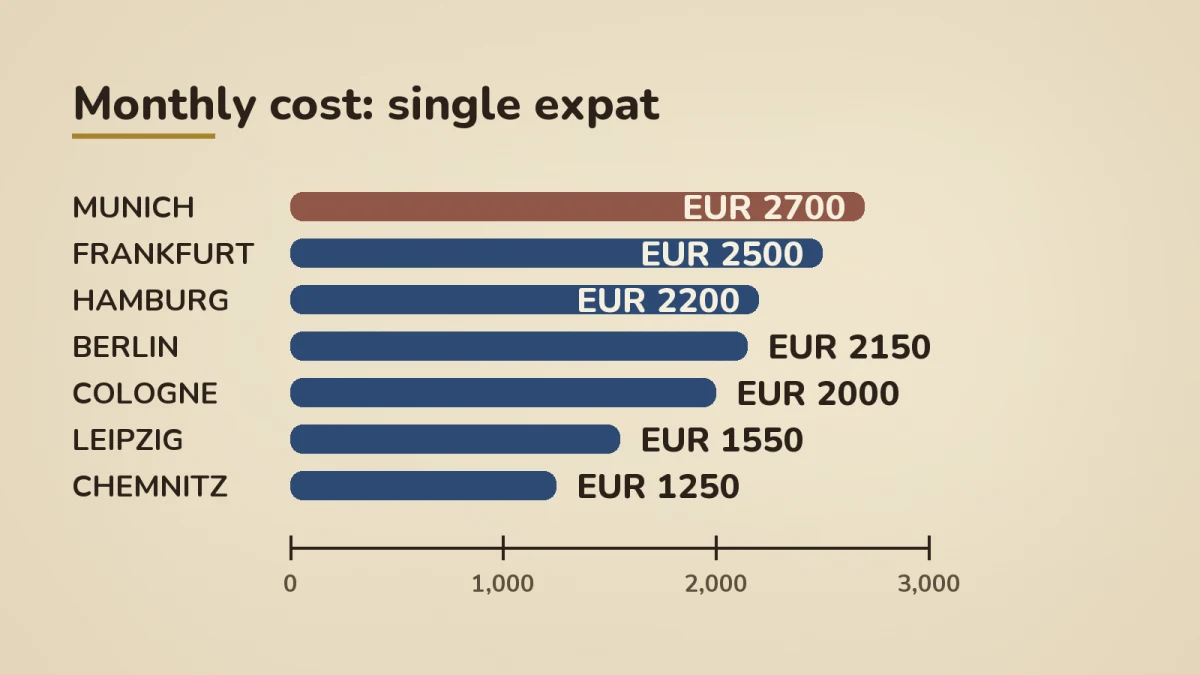
Same lifestyle (1-bedroom apartment, Deutschlandticket, mid-tier groceries, modest social life), different city. Approximate single-person all-in monthly cost (rent + everything else):
- Munich: EUR 2,500 to EUR 2,900
- Frankfurt: EUR 2,300 to EUR 2,700
- Hamburg: EUR 2,000 to EUR 2,400
- Berlin: EUR 1,900 to EUR 2,400 (rent rising sharply since 2024)
- Cologne: EUR 1,800 to EUR 2,200
- Leipzig: EUR 1,400 to EUR 1,700
- Chemnitz: EUR 1,100 to EUR 1,400
Munich is roughly twice Chemnitz on equivalent lifestyle. If your salary is portable (remote work, federal scientific institutes, federal banks) the Munich premium is a hard sell. If your industry is anchored in Munich (BMW, Siemens, Allianz, MunichRE, the bigger startups) the salary usually offsets the cost.
How to lower your Munich cost of living
- Live on the S-Bahn ring, not inside it. Pasing, Moosach, Berg am Laim save EUR 400 to EUR 600 a month versus central districts.
- Take a WG before a solo flat. A WG room runs EUR 750; a studio runs EUR 1,300. The annual delta funds a vacation.
- Apply to Studentenwerk Munich dorms 9 to 12 months before semester start. Rents start at EUR 280. For how Munich's dorm and WG rents compare to six other German student cities, see our city-by-city housing guide.
- Shop Aldi, Lidl, Penny first. Saves EUR 100 to EUR 150 a month versus Rewe and Edeka.
- Drop the car. Public transit and biking handle 95 percent of trips; a car costs EUR 400 to EUR 600 per month here.
- File your tax return. Working professionals routinely get EUR 800 to EUR 1,500 back per year via Werbungskosten. See our finance management guide.
- Werkstudent jobs at BMW, Siemens, and the bigger Munich startups pay EUR 16 to EUR 22 per hour. See part-time jobs in Munich.
Frequently asked questions
How much money do I need per month to live in Munich as an international student?
Plan for EUR 1,400 to EUR 1,700 per month if you live in a WG and use the student Deutschlandticket. The blocked account minimum of EUR 992 per month covers the absolute floor and assumes Studentenwerk dorm rent. Munich-specific rent pushes the realistic floor above that, so most students top up the blocked account or supplement with a Werkstudent job.
Is Munich more expensive than Berlin in 2026?
Yes, by 20 to 30 percent on rent and 10 to 15 percent on most other line items. A 1-bedroom apartment in central Munich runs EUR 1,500 to EUR 2,100 cold, versus EUR 1,100 to EUR 1,500 in central Berlin. Berlin rents are climbing fast, but Munich still leads.
How much does the Deutschlandticket cost in 2026 and is the student version cheaper?
The standard Deutschlandticket is EUR 63 per month from January 1, 2026, up from EUR 58 in 2025. Students, trainees, and volunteers can buy the Deutschlandticket Ermäßigung for EUR 43 per month where issuers offer it. Students enrolled at TUM or LMU also get a Munich semester ticket bundled with their semester fee for around EUR 33 to EUR 36 per month equivalent.
How much rent should I budget for a 1-bedroom apartment in central Munich?
EUR 1,500 to EUR 2,100 cold rent (Kaltmiete) per month, plus EUR 150 to EUR 280 in Nebenkosten. Schwabing and Maxvorstadt run higher (EUR 1,800 to EUR 2,400). Sendling, Pasing, and Moosach drop to EUR 1,000 to EUR 1,400 cold. Always confirm whether a listing quotes Kaltmiete or Warmmiete; the difference is EUR 200+ per month.
What are the hidden monthly costs in Munich beyond rent?
Health insurance (about EUR 141 to EUR 146 student, EUR 450 to EUR 500 working pro), Rundfunkbeitrag broadcasting fee (EUR 18.36), electricity (EUR 40 to EUR 100), internet (EUR 30 to EUR 45), Privathaftpflicht liability insurance (EUR 5 to EUR 10), and bank fees (EUR 0 to EUR 12). Together these add EUR 200 to EUR 700 per month on top of rent before any groceries or discretionary spend.
Can I live in Munich on EUR 2,000 per month as a single working professional?
Tight but possible if you take a WG room (EUR 700 to EUR 900) instead of a 1-bedroom. A solo flat plus full health insurance, transport, groceries, and utilities pushes a single working professional past EUR 2,400 even on a strict budget. Outside the S-Bahn ring (Garching, Freising, Dachau) the same lifestyle drops below EUR 2,000.
Where to next
- Cost of living in Germany for international students - the broader cluster pillar
- Best cities to live and work in Germany - if you are still choosing
- Tips to manage finances in Germany - tax, savings, banking
- Part-time job opportunities in Munich for international students - to top up your budget
- Cost calculator - run your own numbers
Continue reading
Living in Germany·15 min read
Schufa in Germany explained: How to build credit as a new arrival, and the myths to ignore
Schufa is Germany's main credit file. Here is how it actually starts, the new 2026 score model, and how to build it from zero as an expat.
Read articleLiving in Germany·9 min read
Buying a car in Germany as a new arrival: Registration, insurance, TÜV, financing
Practical guide to buying a car in Germany as a new arrival in 2026: Anmeldung first, eVB insurance, Zulassung at the Kfz office, TÜV and financing options.
Read articleLiving in Germany·19 min read
Public vs Private Health Insurance in Germany: PKV vs GKV Head-to-Head with Real Numbers
Public vs private health insurance in Germany compared with 2026 numbers. JAEG, BBG, GKV monthly cost, PKV premiums, family math, and the age 55 lock-in.
Read articleReady to plan your Germany journey?
Explore our tools and resources to find the perfect university and program for your academic goals.