Deutschlandticket 2026: monthly cost explained, semester-ticket rules, who really saves
The Deutschlandticket is Germany's nationwide flat-rate transit pass. What it costs in 2026, how the semester ticket works, and who really saves.

Table of contents
Last updated: May 2026
TL;DR: The Deutschlandticket is a €63 per month subscription that lets you ride every local and regional train, bus, tram, and U-Bahn anywhere in Germany. It was €58 in 2025 and €49 when it launched in 2023. Students at most universities pay €37.80 per month for the bundled Deutschlandsemesterticket from the winter semester 2026/27. Anyone whose old city pass cost more than €63, or who takes more than roughly 17 single trips a month, saves money the moment they switch.
For anyone moving to Germany, the Deutschlandticket is one of the most useful pieces of infrastructure on the daily-life pillar. One subscription, one price, every U-Bahn in Berlin, every S-Bahn in Munich, every regional train between Hamburg and Stuttgart. If you are still working through the rest of the moving-to-Germany checklist, this is the cheapest part of it. If you have just landed and are figuring out how to actually get around, our guide on things to do in your first weeks in Germany puts the ticket in context with Anmeldung, bank account, and SIM card.
This post answers the three questions most readers actually have. What does the ticket cost in 2026 and what does it actually buy you. How does it interact with the Semesterticket your university already charges. And given the new €63 price, who really saves money compared with single tickets or old city passes.
What is the Deutschlandticket and what does it cost in 2026?
The Deutschlandticket, also called the D-Ticket, is a flat-rate monthly subscription introduced in May 2023 that gives you unlimited rides on local and regional public transport across all of Germany. It costs €63 per month from January 2026, up from €58 in 2025 and €49 at launch. From 2027, the price moves to a cost-based formula tied to the federal subsidy and operating costs, so another increase is expected.
The ticket is a subscription, not a one-time purchase. You subscribe through Deutsche Bahn, your local transit association (BVG in Berlin, MVG in Munich, HVV in Hamburg, VRR in the Rhine-Ruhr region, and so on), or through certain employers. You can cancel by the 10th of any month and the cancellation takes effect at the end of that calendar month. There is no minimum contract length.
Three things make the price meaningful. First, every old city-only monthly pass that used to sit between €70 and €110 is now redundant for most riders. Second, regional connections that used to cost extra (a day trip from Berlin to Potsdam, or Cologne to Bonn) are bundled in. Third, because the federal government and the states co-fund the ticket, it is politically fragile. The political agreement to keep funding it runs through 2030 with annual price reviews, which is why the post-2027 formula matters.
What is actually included for €63
The rule is simple: if it is local or regional transport, it is included. If it is long-distance, it is not.
Included nationwide, 24 hours a day, every day of the year:
- Regional trains: RB (Regionalbahn) and RE (Regional-Express)
- S-Bahn networks in every German city
- U-Bahn (subway) in Berlin, Munich, Hamburg, Frankfurt, Nuremberg, and others
- Trams (Straßenbahn) in every city that runs them
- Local and regional buses
- Some ferries inside city transit networks (for example, Hamburg's HVV harbour ferries)
Not included, ever:
- ICE, IC, and EC trains (long-distance Deutsche Bahn services)
- FlixTrain
- FlixBus and other long-distance coaches
- A handful of private regional railways that opted out
- Any seat reservations or sleeper supplements
Two practical implications. If your route on Deutsche Bahn's app shows an ICE leg, you pay separately for that leg even if the rest of the trip is covered. And the ticket is digital and personal: you cannot share it, lend it, or use someone else's, because every transit operator now spot-checks against an ID.
How students use the Deutschlandsemesterticket
Most German universities now bundle a discounted version of the Deutschlandticket, called the Deutschlandsemesterticket, directly into the semester contribution students already pay. From the winter semester 2026/27 the price is €37.80 per month, which works out to €226.80 per semester. It has been in effect at most universities since the summer semester 2024 and gives you the same nationwide validity as the regular ticket.
There are three patterns to know:
- Mandatory inclusion. At most universities, every enrolled student pays the Deutschlandsemesterticket fee as part of the Studierendenschaftsbeitrag. There is no opt-out and no way to refuse it without de-registering. If you are at a university that does this (Berlin, Hamburg, most Bavarian universities, most NRW universities), you already have the ticket; it is on your student ID or in your university app.
- Upgrade option. A few universities still issue an old-style regional Semesterticket (valid only in the city's transit zone). Students at those universities can pay an extra €20 to €35 per month to upgrade to nationwide validity. The upgrade is voluntary and you handle it through the local transit operator's app.
- Opt-in subscription. A small number of universities have no Semesterticket at all. Students there subscribe to the regular Deutschlandticket at the full €63 per month.
If you are not sure which pattern your university uses, check the StuRa or AStA page on the university website. The fee line item is usually called "Mobilitätsbeitrag" or "Semesterticket" on your enrollment confirmation. Working students who already have the ticket through the university should not also subscribe through their employer; the discount stacks the wrong way.
Reduced and subsidised versions worth knowing about
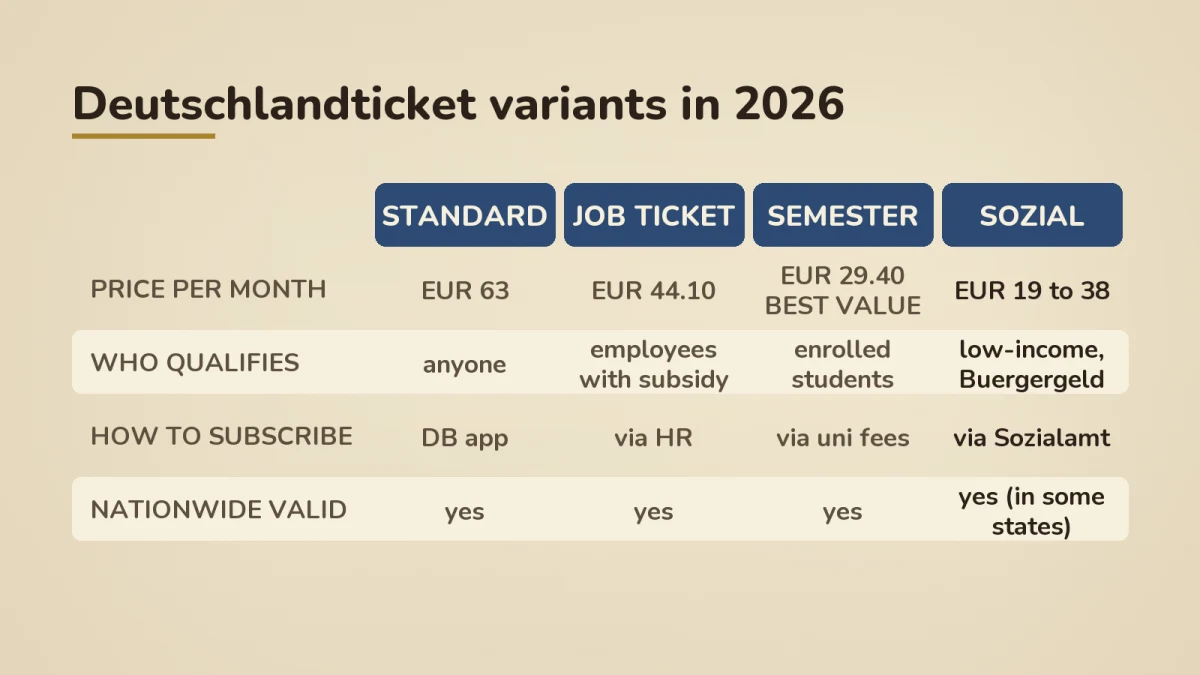
Three variants exist alongside the standard €63 ticket. Each has its own eligibility rule.
Deutschlandticket Job. Companies that offer the Deutschlandticket to employees as a Jobticket get a subsidy structure: if the employer pays at least 25 percent of the price (€15.75), the transit association adds another 5 percent discount, so the final out-of-pocket cost lands at around €44.10 per month for the employee. Many large employers cover more than the 25 percent minimum and some cover the full €63. Ask HR before you subscribe yourself, because the Jobticket is cheaper than the regular ticket and you cannot run both.
Deutschlandticket Sozial / Sozialticket. Several federal states (NRW, Berlin, Bremen, Hesse, and others) offer a reduced "Sozialticket" version of the Deutschlandticket for low-income residents, Bürgergeld recipients, refugees with a residence permit, and pensioners on Grundsicherung. Prices and eligibility vary by state but typically land between €19 and €38 per month. Apply through your local Sozialamt or Jobcenter, not through Deutsche Bahn.
Schüler-Ticket / Junges Deutschlandticket. Several states offer a youth or school-student version for under-18s or under-21s. In NRW, this is the "Deutschlandticket Schule"; in Bavaria, the "Junges Deutschlandticket" runs at €29 per month. Eligibility usually requires school enrollment and ends at the start of university.
The variants do not stack. You pick the one cheapest version you qualify for and run it.
Who actually saves money with the Deutschlandticket
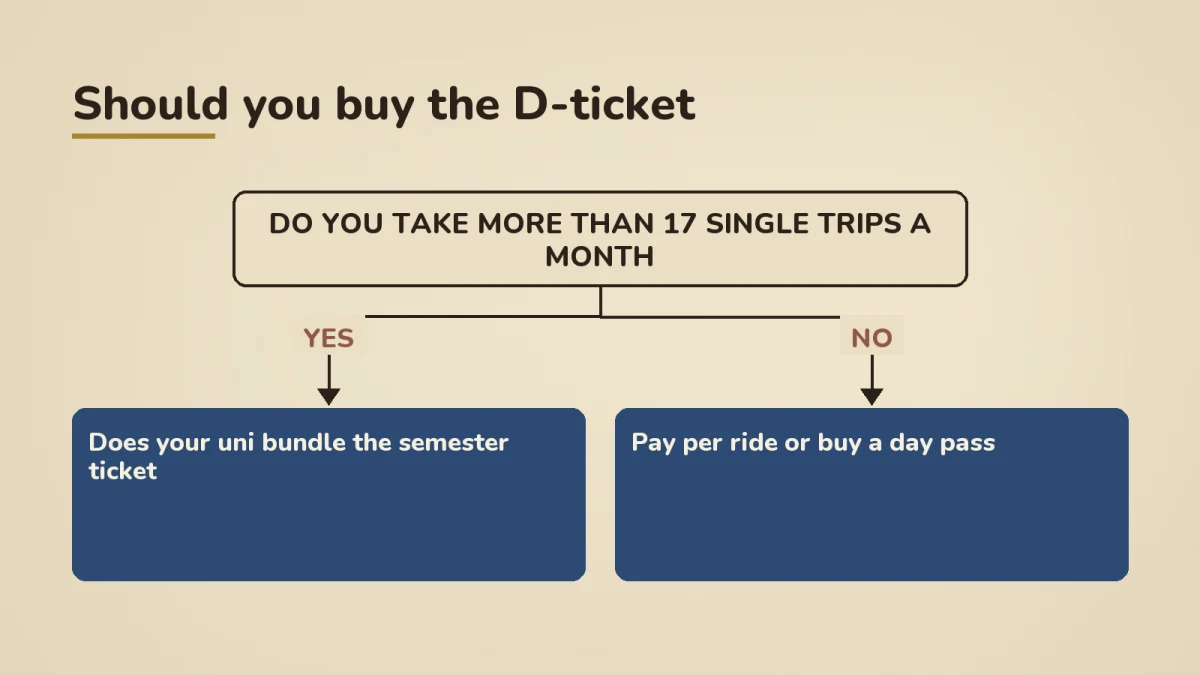
Run the comparison against three baselines.
Against single tickets. A single AB-zone ticket in Berlin costs €3.80 in 2026. A single short-trip ticket in Munich costs €2.10. The break-even point against the €63 monthly ticket is about 17 Berlin trips or roughly 30 Munich trips per month. Most commuters cross that easily on weekday work or class travel alone. Anyone who only takes the bus a few times a week is better off paying per ride.
Against the old city monthly pass. Most major cities used to sell a monthly pass between €70 and €110 (Berlin AB Monatskarte was €88, Munich M-Zone was €63.40, Hamburg's HVV was €119.20). The Deutschlandticket replaces all of them, gives you nationwide regional reach as a bonus, and saves you €5 to €56 a month. There is no scenario where keeping the old monthly pass is cheaper.
Against regional commuting. This is where the ticket really earns its keep. A monthly Bahn-only commuter pass between Frankfurt and Mainz, or Cologne and Bonn, used to cost €130 to €200 per month. Anyone who lives in one city and works or studies in another is the biggest single winner of the ticket; the math is unambiguous.
When you do not save:
- You take fewer than 15 single rides a month and never cross transit zones. Pay-per-ride is cheaper.
- You commute long-distance with ICE or IC trains. The Deutschlandticket does not cover those; you need a BahnCard 50 or 100 instead.
- You rely on FlixTrain, FlixBus, or private regional railways. None of them honour the ticket.
- Your university already includes the Deutschlandsemesterticket. Subscribing again at €63 is wasted money.
The simplest rule of thumb: if your old monthly transit pass cost more than €63, switch. If you take more than 17 single rides a month, switch. Otherwise, run the numbers.
How to subscribe, cancel, and not get fined
Subscriptions go through three channels.
- Deutsche Bahn app or website. Cleanest path. Sign up with email, payment method, and address. Ticket appears in the DB Navigator app as a digital pass.
- Local transit operator. BVG (Berlin), MVG (Munich), HVV (Hamburg), VRR (Rhine-Ruhr), VBB (Berlin-Brandenburg), and others all sell their own Deutschlandticket subscriptions. The price is identical and so is the validity; you pick whichever app you already use for journey planning.
- Employer Jobticket. Through HR, with the subsidy structure explained above.
Three rules people get wrong:
- Cancellation deadline. You must cancel by the 10th of the month for the cancellation to take effect at the end of that month. Miss the deadline and you pay for one extra month.
- Photo ID and ticket name match. Inspectors check that the name on the ticket matches your government ID. Save your Aufenthaltstitel, German ID card, or passport to your phone wallet.
- No paper backup. The ticket is digital-only. If your phone dies during an inspection, you can be fined €60 for travelling without a valid ticket, even if your subscription is active. Keep a screenshot or use a chip card variant if your operator offers one.
You can also pause a subscription if you are travelling outside Germany for a month, but the simpler move is usually to cancel and re-subscribe; there is no signup fee.
Common mistakes to avoid
- Doubling up at university. If your university already bundles the Deutschlandsemesterticket into your fees, do not also subscribe to the regular ticket. You are paying twice for the same product.
- Booking through a route planner that hides ICE legs. If Google Maps or DB Navigator shows you a route with a 2-minute ICE leg, you need a separate ICE ticket for that leg. The app does not warn you in red; check the train type column.
- Treating it like a tourist pass. The Deutschlandticket is a subscription. If you visit Germany for two weeks, you can subscribe and cancel by the 10th of the next month, but you will still pay one full month. For trips under a month, single tickets or city day passes are usually cheaper.
- Sharing logins. The ticket is personal and tied to your name. Letting a flatmate use it on a non-checked night may seem harmless until an inspector asks for ID and you both get fined.
- Ignoring the Jobticket. If your employer offers the Jobticket but you subscribed yourself first, you are leaving the 25-30 percent subsidy on the table. Cancel your personal subscription and re-subscribe through HR.
FAQ
Is the Deutschlandticket valid for tourists?
Technically yes, anyone with a German address and a payment method can subscribe. Practically, for trips under a month, single tickets or regional day passes are cheaper because the Deutschlandticket charges a full €63 even if you only use it for two weeks.
Can I use it on the ICE if I pay extra?
Yes. The Deutschlandticket covers regional segments of mixed-train journeys. If a Deutsche Bahn route uses an ICE for one leg and an RE for another, you only need to buy the ICE leg separately. The DB Navigator app shows the supplemental fare at booking time.
What happens if I forget to cancel by the 10th?
Your subscription auto-renews for the next month and you pay another €63. The cancellation only takes effect at the end of the month in which you cancelled, and only if you cancelled before the 10th. There is no refund for partial months.
Does the Deutschlandsemesterticket cover the whole semester or only the months I am studying?
It covers every calendar day of the semester for which your university charged the contribution, including the lecture-free weeks (semester break). Most German universities run March 1 to August 31 for summer semester and September 1 to February 28 for winter semester. Check the validity dates printed on your student card.
Can I get the ticket if I am on a Job Seeker Visa or Chancenkarte?
Yes. The ticket has no immigration-status condition. You need a German address and a SEPA-compatible payment method or credit card. Most short-term arrivals subscribe through the Deutsche Bahn app the day they get a postal address.
Is there a printed paper version?
No. The ticket is digital-only by design (PDF or app-based) or available as a Chipkarte through some local operators. There is no traditional paper ticket. If you do not own a smartphone, ask your local transit operator about the Chipkarte option.
What does "from 2027" mean for the price?
State transport ministers agreed that from 2027, the ticket price will be calculated using a cost-based formula tied to operating expenses and the federal subsidy share. No specific 2027 figure has been announced as of May 2026. The political agreement to fund the ticket runs through 2030, so the ticket itself is not at risk; only the price is.
How does this affect long-distance commuting with the BahnCard?
The Deutschlandticket and BahnCard 50 or 100 are complementary, not substitutes. The Deutschlandticket covers all your local and regional transport. A BahnCard discounts your separate ICE and IC tickets (50 percent for BahnCard 50, fully included for BahnCard 100). Heavy long-distance travellers buy both.
Where to next
Three reads that build on this:
- Cost of living in Germany for international students for full monthly budget context.
- Best cities to live and work in Germany for picking a city where the Deutschlandticket actually replaces a car.
- Working as a student in Germany for Werkstudent commute math and Jobticket eligibility.
Continue reading
Living in Germany·15 min read
Schufa in Germany explained: How to build credit as a new arrival, and the myths to ignore
Schufa is Germany's main credit file. Here is how it actually starts, the new 2026 score model, and how to build it from zero as an expat.
Read articleLiving in Germany·19 min read
Public vs Private Health Insurance in Germany: PKV vs GKV Head-to-Head with Real Numbers
Public vs private health insurance in Germany compared with 2026 numbers. JAEG, BBG, GKV monthly cost, PKV premiums, family math, and the age 55 lock-in.
Read articleLiving in Germany·15 min read
Rundfunkbeitrag explained: why every German household pays it and how students legally skip it
Germany's broadcasting fee in 2026: who pays, who is exempt, how to apply for the Befreiung, and what happens if you ignore the bill.
Read articleReady to plan your Germany journey?
Explore our tools and resources to find the perfect university and program for your academic goals.