Cost of living in Berlin 2026: Neighbourhood-by-neighbourhood rent and lifestyle
What does it cost to live in Berlin in 2026? Neighbourhood-by-neighbourhood rent, real monthly budgets, and the rules every tenant should know.

Table of contents
Last updated: May 2026
TL;DR: Berlin in 2026 sits at roughly 16.20 EUR per square metre cold rent on the open market, but where you actually land matters more than the headline. A single working professional needs around 2,200 to 2,800 EUR net per month to live comfortably across most districts. A student or recent arrival can do it on 1,100 to 1,400 EUR if they take a WG room in Wedding, Lichtenberg, or Neukölln's quieter blocks.
Berlin still ranks as the most affordable A-tier German city to live in, but the open-market gap between what existing tenants pay and what newcomers pay has stretched to 40 percent or more. The rent brake (Mietpreisbremse) was extended through end of 2029, vacancy sits near 1.5 percent, and the city is approaching 3.7 million residents. That tightness reshapes the math of where you choose to live. This post walks you through what every district costs in 2026, what total monthly budget to plan for, and the rules that protect tenants once you sign. For broader context across all German cities see our German cost of living guide for international students, or jump to the Live pillar's cities hub for relocation pages.
What does it cost to live in Berlin in 2026?
A realistic single-person budget in Berlin in 2026 ranges from about 1,200 EUR per month at the lean end (WG room, Deutschlandticket, cooking at home) to 3,000 EUR per month at the comfortable working-professional end (1-bedroom in a central district, occasional restaurants, gym, travel buffer). The median for a young expat in tech or consulting tends to land around 2,400 to 2,600 EUR net monthly.
Three numbers anchor every Berlin budget. First, average open-market cold rent is around 16.20 EUR per square metre. A 50 sqm one-bedroom therefore lists at roughly 1,050 EUR cold, plus 200 to 300 EUR Nebenkosten (utilities, heating, building costs) for a warm-rent total near 1,300 EUR. Second, the citywide single-person non-rent budget tracked by Numbeo and Destatis sits at about 990 to 1,030 EUR per month covering groceries, transport, mobile, gym, leisure, and minor purchases. Third, public health insurance for an employee runs around 7.3 percent of gross salary plus an income-related supplement, capped by the contribution ceiling.
Rent in Berlin: the citywide picture
Most listings quote cold rent (Kaltmiete), the figure for the apartment itself with no utilities. Warm rent (Warmmiete) adds Nebenkosten: heating, water, building maintenance, garbage, caretaker, sometimes building electricity. Plan on 200 to 300 EUR Nebenkosten on a one-bedroom and 300 to 450 EUR on a two-bedroom. Electricity for the apartment itself is usually a separate contract you sign with a provider like Vattenfall or a cheaper alternative; budget another 40 to 70 EUR monthly for a single, more for a couple.
Studio rents now average around 800 EUR cold for unfurnished units, ranging from 550 EUR in outer districts to over 1,100 EUR for renovated stock in Mitte or Prenzlauer Berg. One-bedrooms (about 50 sqm) average 1,050 EUR cold, with 750 EUR floors in Marzahn or Spandau and 1,400 EUR ceilings in central neighbourhoods. Two-bedrooms (75 sqm) average 1,650 EUR cold and routinely cross 2,200 EUR in Mitte and Charlottenburg.
Furnished apartments carry a 200 to 400 EUR monthly premium over equivalent unfurnished units. They make sense for the first six months while you set up Schufa, salary slips, and a deposit history; longer than that and unfurnished plus IKEA usually wins on cost.
Berlin neighbourhoods: rent and lifestyle by district
The expensive central core
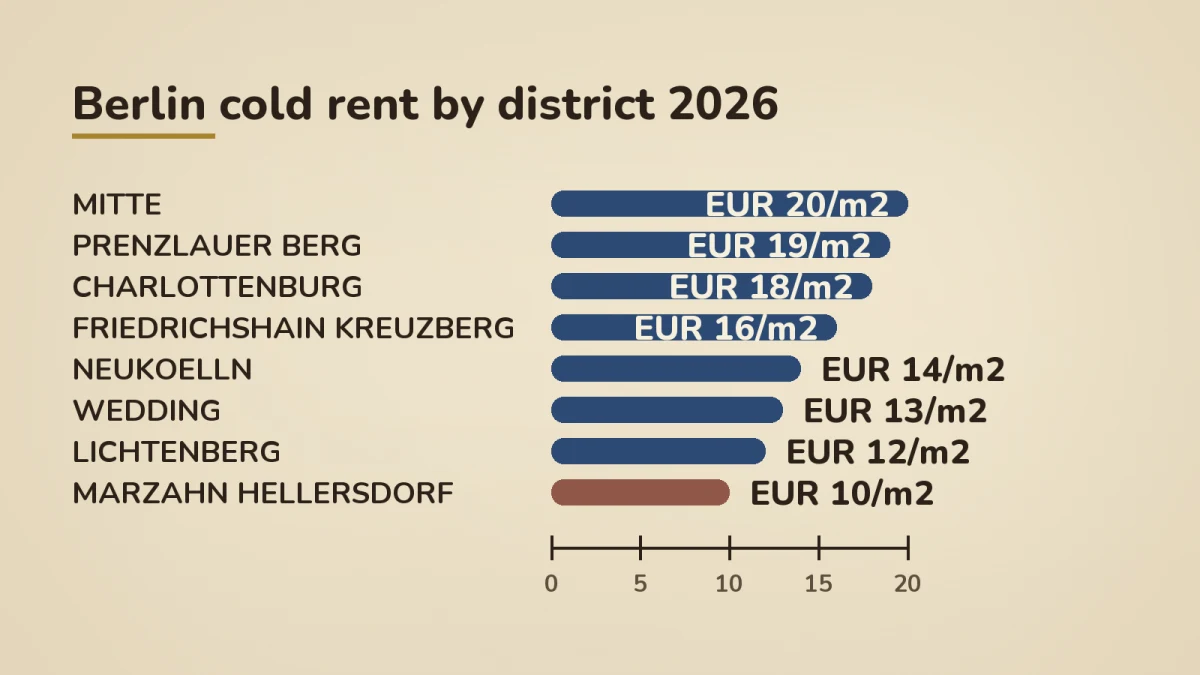
Mitte is the postcard Berlin: government quarter, Museum Island, Hackescher Markt. Cold rent runs 18 to 22 EUR per sqm. A renovated one-bedroom lists at 1,300 to 1,700 EUR cold. You pay for transit access, walkability to landmarks, and an English-friendly retail belt around Rosenthaler Straße. Worth it for relocators on company budgets and dual-income couples; tight on a single salary under 60,000 EUR gross.
Prenzlauer Berg is bohemian-meets-bourgeois, leafy Altbau streets, brunch culture, the highest density of cargo bikes per capita in Germany. Cold rent runs 17 to 21 EUR per sqm. Strong with families who want central without the Mitte tourism, and with established creative-class professionals.
Charlottenburg-Wilmersdorf is the older West-Berlin elegance: KaDeWe, Kurfürstendamm, broad boulevards, classical music venues. Cold rent runs 16 to 20 EUR per sqm. Quieter than Mitte, popular with French and East-Asian expat communities, and the natural choice if you work near TU Berlin or City West.
Where young professionals live
Kreuzberg (Bergmannkiez especially) and Friedrichshain (around Boxhagener Platz) are the loud, creative, internationally-connected core of working Berlin. Expect 14 to 19 EUR per sqm. A 50 sqm one-bedroom lands between 900 and 1,400 EUR cold, with the high end approaching central rents. These districts win on bike commute distance to most tech offices, nightlife density, and a deep international restaurant scene.
Neukölln has been the hottest gentrification story of the last five years. The Reuterkiez and Schillerkiez bands run 13 to 17 EUR per sqm; the southern stretches toward Rudow stay closer to 11 EUR. Cafes and coworking are walking distance, but the noise and density are real. Best for solo expats in their 20s and early 30s.
Family neighbourhoods
Pankow (including Weißensee) offers larger apartments, parks, quieter streets, and rents in the 13 to 16 EUR per sqm band. A two-bedroom family flat lists at 1,400 to 2,000 EUR cold. Strong public Grundschulen and Kitas; tram and S-Bahn into Mitte in 20 minutes.
Steglitz-Zehlendorf is the leafy southwest, suburban feel with Freie Universität, the Botanic Garden, Wannsee. Cold rent runs 13 to 17 EUR per sqm. Home to the Europäische Schule and several international schools. The trade-off is commute distance to most tech and creative offices, which sit east and central.
Treptow-Köpenick stretches into the southeast lakes and forests. Cold rent runs 11 to 14 EUR per sqm. Excellent for families who prioritise outdoor weekends and don't mind a 35 to 45 minute commute.
Best value
Wedding and the parts of Mitte north of the S-Bahn ring still hold pockets at 12 to 15 EUR per sqm. Diverse, well-connected, gentrifying without being expensive yet. Strong choice for first-job arrivals.
Lichtenberg has flipped from "former East" stigma to genuinely livable, especially around Rummelsburg and the Friedrichsfelde park belt. Expect 11 to 14 EUR per sqm. Big new-build supply means more available stock than in central districts.
Marzahn-Hellersdorf and Spandau are the lowest-rent districts, around 9 to 12 EUR per sqm. Plattenbau apartment blocks dominate; commutes can hit 50 minutes; expat density is low. Right for budget-maximising students and anyone whose work or studies are nearby.
WG room or solo apartment?
A WG (shared apartment) room in Berlin averages around 650 EUR per month all-in, with central districts running 700 to 850 EUR and outer districts 500 to 600 EUR. WG-Gesucht and Wunderflats are the dominant platforms. WGs make sense if you are under 30, new to the city, or studying, because they bypass the Schufa-check and salary-slip gauntlet that solo lettings require. Berlin's WG average sits roughly mid-pack on student housing rents across Germany's seven biggest student cities.
A solo studio or one-bedroom requires three things landlords will ask for: a Schufa credit report (free annual self-disclosure via meineschufa.de), the last three salary slips or a work contract, and an Wohnungsgeberbestätigung from your previous landlord. Without those documents in hand, you will lose every viewing race in central districts.
Beyond rent: groceries, transport, insurance, utilities
Groceries for a single who cooks at home land at 200 to 300 EUR per month. Aldi and Lidl set the floor; Edeka and Rewe sit roughly 15 percent higher; Bio Company and Alnatura are 30 to 40 percent higher and only worth it if organic matters to you. A weekly Wochenmarkt run for produce often beats supermarket prices in summer.
Transport is the simplest line item. The Deutschlandticket gives you all local and regional transport across Germany for 63 EUR per month (since January 2026). There is a discounted job-ticket version if your employer subsidises (most large Berlin employers do); the old 29 EUR Berlin-only ticket no longer appears on BVG's list of subscriptions. Most Berliners do not own a car; bike infrastructure has improved sharply since 2020.
Health insurance is mandatory. For an employee, public insurance (GKV) deducts 7.3 percent plus half of your insurer's additional contribution (the 2026 average is 2.9 percent) from gross salary, capped by the contribution ceiling of 5,812.50 EUR gross monthly in 2026. Self-employed and freelancers pay the full rate themselves and can typically expect 350 to 600 EUR per month. Private insurance (PKV) is only available above the JAEG income threshold and is usually a long-term commitment.
Utilities for a one-bedroom add 250 to 400 EUR warm-rent supplement plus 40 to 70 EUR for separate apartment electricity. Internet runs 25 to 40 EUR per month for a 100 to 250 Mbit fibre connection. Mobile data on a German SIM (Telekom, O2, 1&1) runs 10 to 30 EUR.
Two real Berlin budgets
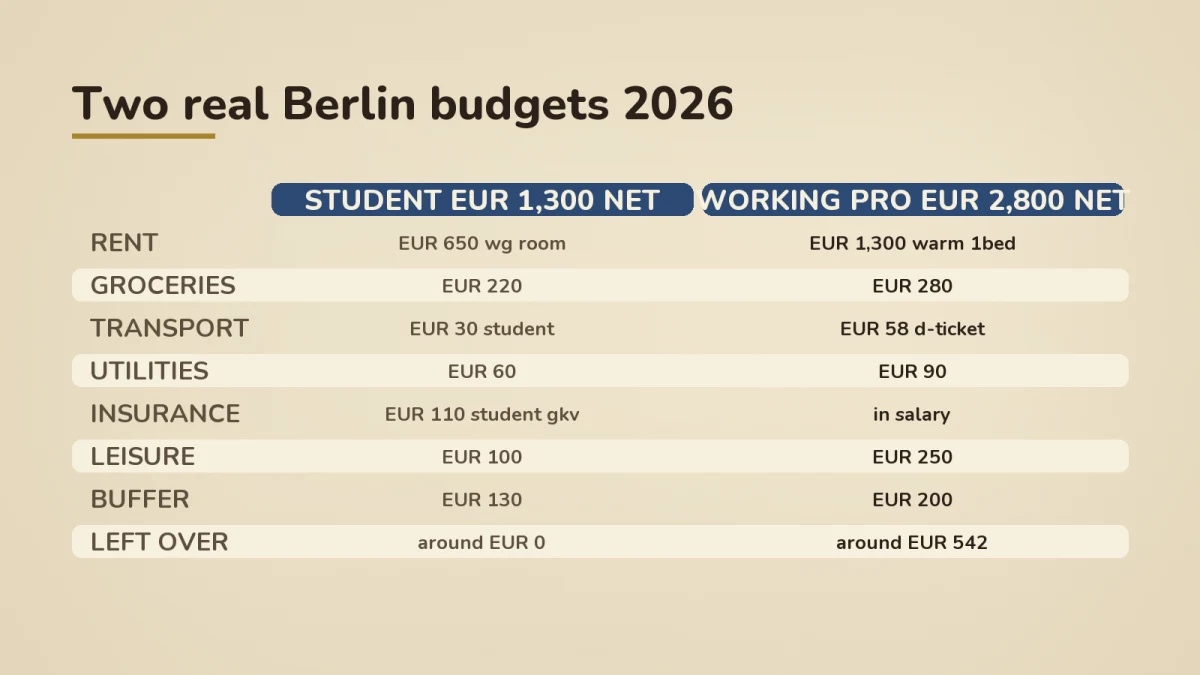
A solo working professional on 2,800 EUR net might land at 1,300 EUR rent (warm) for a one-bedroom in Wedding or Lichtenberg, 280 EUR groceries, 63 EUR Deutschlandticket, 90 EUR utilities and internet, 80 EUR mobile and gym, 250 EUR restaurants and leisure, 200 EUR travel buffer, and still bank around 537 EUR per month.
A solo Master's student on 1,300 EUR net (BAföG plus part-time job) might land at 650 EUR for a WG room in Lichtenberg, 220 EUR groceries, 37.80 EUR Deutschland-Semesterticket (60 percent of the Deutschlandticket), 60 EUR utilities and internet, 146 EUR public health insurance student rate (TK, age 23 and over), 100 EUR leisure, and 86 EUR buffer. It works, but barely. For income-side ideas see part-time jobs in Berlin for international students.
How Berlin's rent rules protect you
The Mietpreisbremse (rent brake) caps new rents in designated zones at 10 percent above the local Mietspiegel reference rent. The Berlin Senate extended it through end of 2029 in 2025. If you suspect your landlord is overcharging, the Berliner Mieterverein (Tenants' Association) will check your contract for around 100 EUR annual membership and write the formal challenge for free.
The Kappungsgrenze caps total rent increases on existing contracts at 15 percent over three years in tight markets like Berlin. Index-linked contracts (Indexmietverträge) tied to consumer inflation are increasingly common in newer leases; they bypass the Kappungsgrenze and can move faster than salaries during inflation spikes. Read every lease carefully; if it is an Indexmietvertrag, factor 3 to 5 percent annual increases into your long-term plan.
Common budgeting mistakes
- Confusing cold rent with warm rent. Listings show cold rent. Add 25 to 40 percent for the realistic monthly outflow.
- Skipping Schufa prep. Every solo flat application asks for it. Pull yours free in week one.
- Underestimating Anmeldung delay. You cannot open a normal bank account or sign most contracts without registered residence; central Bürgeramt slots can run six to ten weeks out.
- Renting furnished forever. Premium of 200 to 400 EUR per month adds up; switch to unfurnished by month six.
- Targeting peak months. April to July and August to October are the worst times to flat-hunt. November to February listings move slower, give you better leverage, and have less competition.
FAQ
How much rent should I budget for a one-bedroom in central Berlin?
Plan for 1,200 to 1,500 EUR warm (cold rent plus Nebenkosten) for a renovated one-bedroom in Mitte, Prenzlauer Berg, or Charlottenburg. Add another 40 to 70 EUR for separate electricity. Older Altbau without renovation can land 200 to 400 EUR cheaper but expect higher heating bills.
What is the cheapest Berlin neighbourhood with reasonable transport?
Lichtenberg around Rummelsburg and Friedrichsfelde, and parts of Wedding within the Ringbahn, give you 30 to 35 minute connections to Mitte at cold rents around 11 to 14 EUR per sqm. Marzahn-Hellersdorf is even cheaper but adds 15 to 20 minutes of commute.
Is the Mietpreisbremse actually enforced?
Yes, but you have to invoke it. Tenants who challenge their landlord in writing through the Mieterverein win in most cases where the rent exceeds the Mietspiegel by more than 10 percent. Landlords rarely refund without the formal challenge.
How much does a WG room cost in 2026?
The Berlin average is around 650 EUR per month. Central districts run 700 to 850 EUR; Wedding, Lichtenberg, and outer Neukölln stay between 500 and 650 EUR. Add a one-time deposit of one to three months' rent.
Do I need German to find an apartment in Berlin?
For viewings in Mitte, Kreuzberg, Friedrichshain, Neukölln, and Prenzlauer Berg you can survive in English; many landlords and brokers operate bilingually. For Pankow, Spandau, Marzahn-Hellersdorf, and most older private landlords, B1 German materially helps. Bring a German-speaking friend to viewings if you are still at A2.
Is buying instead of renting realistic in Berlin?
Only if you have 100,000 EUR-plus equity and plan to stay 8 to 10 years. The buy-vs-rent break-even sits around year nine in most Berlin districts in 2026. Below that horizon, renting wins on optionality and after-tax math.
Where to next
- Cost of living in Germany for international students, the broader breakdown across Munich, Frankfurt, and the rest.
- Cost of living in Munich 2026, the equivalent district-by-district breakdown for Germany's priciest major city.
- Best German cities to live and work if you are still picking between Berlin, Munich, Hamburg, and Frankfurt.
- Tips to manage finances in Germany, once you have a tenancy and a salary going into a German account.
- The Live pillar's cities hub covers neighbourhood guides, Anmeldung, Schufa, and the rest of the relocation stack.
Continue reading
Living in Germany·15 min read
Schufa in Germany explained: How to build credit as a new arrival, and the myths to ignore
Schufa is Germany's main credit file. Here is how it actually starts, the new 2026 score model, and how to build it from zero as an expat.
Read articleLiving in Germany·9 min read
Buying a car in Germany as a new arrival: Registration, insurance, TÜV, financing
Practical guide to buying a car in Germany as a new arrival in 2026: Anmeldung first, eVB insurance, Zulassung at the Kfz office, TÜV and financing options.
Read articleLiving in Germany·19 min read
Public vs Private Health Insurance in Germany: PKV vs GKV Head-to-Head with Real Numbers
Public vs private health insurance in Germany compared with 2026 numbers. JAEG, BBG, GKV monthly cost, PKV premiums, family math, and the age 55 lock-in.
Read articleReady to plan your Germany journey?
Explore our tools and resources to find the perfect university and program for your academic goals.