Best city to live in Germany: 7 maps that decide for you
There is no single best city to live in Germany. Seven maps decide for you: rent share, salary, citizenship wait, crime, foreigners, housing, 2026 rules.

Table of contents
Last updated: May 2026
TL;DR: There is no single "best" city to live in Germany. There are seven maps. Each one shows a different way Germany is unequal, and where you land on each decides more about your life than your visa stamp does. Read all seven before you sign a lease.
Most expats pick a German city the same way: a job offer arrives, the city is wherever HR sent the contract, and the lease follows the offer. That works until the second year, when the rent eats half the paycheck or the citizenship paperwork takes four years instead of one.
Germany is one country on the map and sixteen federal states in real life. State borders decide rent, salary, processing times, schools, healthcare access, and how long until you get the passport. The brand calls this our /live/cities hub for a reason. Below are the seven maps that should have been in your relocation packet.
Where you live decides more than where you work
A short answer to "what is the best city to live in Germany": it depends on which of the next seven trade-offs you care about most. Munich pays well and crushes you on rent. Leipzig is half the price but the salary is also smaller. Bonn processes citizenship in months and Leipzig takes years. Frankfurt is the finance capital and has the highest median wage. Hamburg is calmer than Berlin and gets you to permanent residency faster than Saxony. Bremen has the highest reported crime rate per 100,000 residents in the country, while Bavaria has the lowest. None of this is on the visa form. All of it is on these seven maps.
This post is the companion to our Munich cost of living breakdown and the Berlin neighbourhood-by-neighbourhood guide. Use those once you have a city in mind. Use this one to decide which city.
Map 1:
How long until you get citizenship
The same five-year naturalisation rule, the same B1 German requirement, the same passport at the end. The wait time to actually get your appointment is the difference.
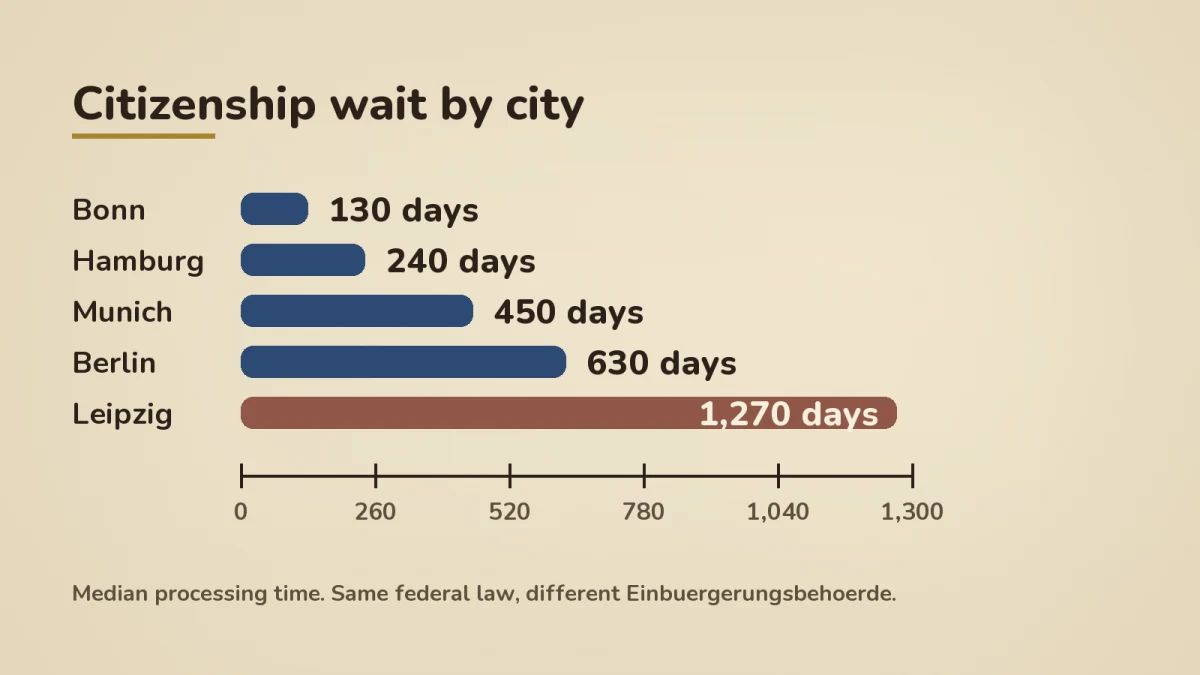
The Citizify processing tracker in early 2026 showed Bonn finishing the average file in roughly four months while Leipzig was still working on applications submitted in 2022. Same federal law. Same form. The bottleneck is the local Einbuergerungsbehoerde, and Saxony has been the slowest department in the country for two years running.
If your goal is the German passport on the earliest possible date, you optimise for Bonn, Cologne, Hamburg, or Frankfurt. If your goal is the cheapest rent, you accept that Leipzig and Dresden will hold your file for years. Read our German citizenship 2026 guide for the full rule set.
Map 2:
How much of your salary goes to rent
Rent in Germany is a state-level number, not a national one. The Stepstone Gehaltsreport 2026 puts the median gross salary in Munich at about EUR 60,000 a year. The latest LohnTastik and Investropa rent data put the average rent for an 80 square metre apartment in central Munich near EUR 24 per square metre, or roughly EUR 1,920 a month.
For a single tenant on a median Munich salary, that is around 42 percent of net income going to rent before utilities. Leipzig charges EUR 11 per square metre on average. The same 80 square metre apartment is closer to EUR 880, and the median Leipzig salary is lower but the rent share collapses to about 22 percent.
| City | Average rent per square metre | Median monthly rent (80 sqm) | Approx share of net salary |
|---|---|---|---|
| Munich | EUR 24.11 | EUR 1,920 | 42 percent |
| Frankfurt | EUR 18.50 | EUR 1,480 | 33 percent |
| Hamburg | EUR 15.20 | EUR 1,220 | 30 percent |
| Berlin | EUR 14.80 | EUR 1,180 | 28 percent |
| Leipzig | EUR 11.01 | EUR 880 | 22 percent |
The takeaway is simple. A Munich job offer that pays 20 percent more than a Leipzig job offer will leave you with less spare money, not more, after rent.
Map 3:
How foreign your neighbours are
The official Statistisches Bundesamt foreign-population share for Germany sits around 16 percent. That number averages a country where Offenbach am Main is 43 percent foreign nationals and a Saxon district 90 minutes away is under 5 percent.
Cities where you are visibly normal as an expat in 2026: Offenbach, Frankfurt, Munich, Stuttgart, Mannheim, Berlin (Wedding, Neukoelln, Mitte), Hamburg (Wilhelmsburg, St Pauli). Cities where you will be one of the few non-German faces on the U-Bahn: most of Saxony, Saxony-Anhalt, Mecklenburg-Vorpommern, Thuringia, and Brandenburg outside Potsdam.
This shows up in three practical ways. English-friendly clinics and lawyers cluster in high-foreign-population cities. Anti-foreigner incidents reported to the Bundesamt fuer Verfassungsschutz are higher in low-share regions. Schools in Offenbach and Frankfurt are equipped for kids who arrive with no German. Schools in rural Saxony usually are not.
Map 4:
The salary you get for the same job, west versus east
The Stepstone Gehaltsreport 2026 shows the median gross salary in West Germany at EUR 56,250 and in East Germany at EUR 48,750. That is a EUR 7,500 gap on the median, and the gap widens at senior levels: a senior software engineer in Munich earns roughly EUR 12,000 more per year than the same role in Leipzig or Dresden.
The east is cheaper to live in, but not by enough to close the gap on net pay. After rent, transport, and groceries, the same household in Munich and Leipzig usually ends up with comparable monthly savings, with Munich slightly ahead at higher salary bands and Leipzig slightly ahead at junior salary bands. If you are early in your career and the offer is in the east, take it for the experience. If you are senior and the offer is in the east, negotiate hard or stay west.
Run our salary calculator with both numbers before signing. Net pay after Steuerklasse and health insurance is the only number that matters.
Map 5:
Where the housing actually exists
Germany needs about 320,000 new homes per year to keep up with demand. In 2024 the country built 251,937, the lowest figure since 2015. The shortfall is concentrated in three cities: Berlin, Munich, and Hamburg. These are the three places the most people want to live and the three places where new construction is the most blocked by local planning rules and rent caps.
In practice this means:
- Berlin viewings draw 50 to 100 applicants per apartment in 2026.
- Munich landlords ask for three months of payslips and a Schufa report before showing the place.
- Hamburg rents have risen about 30 percent in five years.
- Leipzig, Dresden, Magdeburg, and Chemnitz still have apartments that show same-week.
- Frankfurt is tight but turnover is faster than Berlin because of finance-sector mobility.
Our Schufa explainer covers the credit-report side of why landlords are picky. Our student housing breakdown across seven major student cities covers dorm waitlists, PBSA chains, and WG rents through a student-renter lens.
Map 6:
How safe the state actually is
The 2024 BKA Police Crime Statistics rank Bavaria as the safest German state at 4,218 reported crimes per 100,000 residents. Bremen is at 15,424, almost four times higher. Saxony is mid-pack. Berlin sits high but not as high as Bremen or Hamburg.
Crime stats are a noisy signal. They reflect what gets reported, not just what happens, and city-states like Bremen and Berlin are denser so the per-capita number rises mechanically. But the Bavaria-Bremen gap is too large to be measurement noise. Bavaria invests in police and prosecution, has lower urban density outside Munich, and has a stable middle class. Bremen and Berlin trade off some safety for the things you go to a city for.
If you have small kids and you are choosing between Munich and a comparable Bremen suburb, the BKA numbers are worth a column in your decision spreadsheet.
Map 7:
The shortcut that disappeared
This one applies to everyone. The 2024 reform allowed dual citizenship and a 3-year fast-track for "exceptional integration" (meaning C1 German plus volunteer work). The Merz coalition cancelled the 3-year track in October 2025. From October 2025 onward the minimum is back to 5 years. Dual citizenship stayed.
The state-by-state map of citizenship processing time (Map 1) is now operating against a 5-year floor everywhere. Bonn at 130 days only matters once you have completed those 5 years. Leipzig's 1,270-day backlog stacks on top.
If you arrived in Germany before October 2025 and applied under the 3-year rule, your file is grandfathered. If you arrived after, plan for 5 years plus the local processing time. That is anywhere from 5.5 years in Bonn to almost 9 years in Leipzig.
How to use these seven maps to pick a city
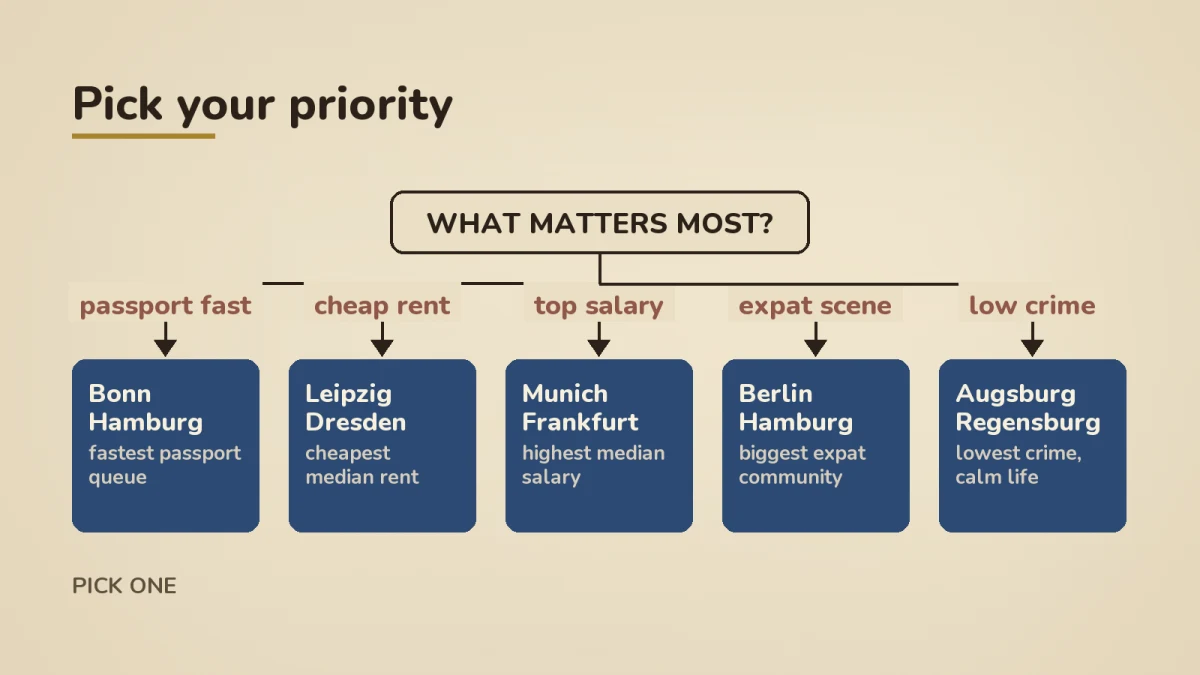
Optimise for one or two of the maps, accept the trade-offs on the others. Trying to win all seven puts you in Frankfurt or nowhere.
- You want the passport fastest. Choose Bonn, Cologne, Duesseldorf, or Hamburg. Citizenship processing is fast and a Blue Card salary is realistic.
- You want the cheapest rent and a real job. Choose Leipzig or Dresden. Accept the slow citizenship queue and the lower median salary.
- You want the best paycheck. Choose Munich, Frankfurt, or Stuttgart. Accept the rent.
- You want the most international scene with kids. Choose Frankfurt, Offenbach, or Munich. International schools, English clinics, and a foreign-resident share above 25 percent.
- You want creative scene plus expat density. Choose Berlin or Hamburg. Accept the housing-shortage chaos.
- You want quiet small-city life with low crime. Choose Augsburg, Regensburg, Wuerzburg, or Karlsruhe. Bavaria's crime numbers and Baden-Wuerttemberg's job market both work in your favour.
For the deeper city-by-city reads we have already published Living in Frankfurt as an expat, Living in Hamburg as an expat, and Living in Stuttgart as an expat.
Common mistakes when picking a German city
- Picking the city based only on the gross salary on the offer letter, without running net pay against local rent.
- Assuming "Berlin is cheap" because that was true in 2015. Berlin rents have doubled since then.
- Treating Saxony cities as a budget alternative without knowing the citizenship queue is the country's slowest.
- Moving to a state with under 8 percent foreign residents and being surprised that English-friendly services are scarce.
- Counting on the 3-year fast-track citizenship rule. It does not exist anymore.
FAQ
Which is the best city to live in Germany for expats?
There is no single answer. Frankfurt is the most balanced for working professionals: high salary, fast citizenship processing, large international community, top-tier transport. Munich pays the most but takes the most rent. Berlin is the most expat-friendly culturally but has the worst housing market. Leipzig is the cheapest. Pick based on which of the seven maps in this post matters most to you.
Is Munich or Berlin better for living in Germany?
Different trades. Munich pays roughly 20 percent more on median, has lower crime, and processes citizenship in 12 to 18 months. Berlin has cheaper rent (though not as cheap as a decade ago), the largest expat scene, and a 18 to 24 month citizenship queue. Munich wins for finance and engineering careers; Berlin wins for tech, startups, and creative work.
Where in Germany is rent cheapest?
Saxony, Saxony-Anhalt, and Thuringia. Leipzig and Dresden have the best balance of low rent (around EUR 11 per square metre) plus real job markets. Chemnitz, Magdeburg, and Erfurt are even cheaper but have weaker labour markets.
Which German state has the lowest crime rate?
Bavaria, with about 4,218 reported crimes per 100,000 residents in the 2024 BKA Police Crime Statistics. Baden-Wuerttemberg is second. Bremen has the highest rate at over 15,000 per 100,000.
How long does German citizenship take in 2026?
Minimum 5 years of legal residence plus the local processing queue. Bonn averages around 130 days for the queue, Hamburg 7 to 9 months, Munich 12 to 18 months, Berlin 18 to 24 months, Leipzig roughly 1,270 days. The 3-year fast-track for exceptional integration was cancelled in October 2025.
Where do most expats live in Germany?
Berlin, Munich, Frankfurt, Hamburg, Stuttgart, and Cologne hold the largest absolute expat populations. By foreign-resident share, Offenbach am Main leads at 43 percent, followed by Frankfurt, Pforzheim, and Munich.
Is east Germany worth it for the lower cost of living?
For students and early-career workers: yes. For senior professionals on Blue Card salaries: usually no. The salary gap of around EUR 7,500 to 12,000 per year on the median plus the slower citizenship processing usually outweighs the rent savings once you cross the EUR 60,000 mark.
Which German city has the best public transport?
Munich and Hamburg consistently lead the German Mobility Atlas rankings. Berlin is dense but reliability has dipped since 2023. Frankfurt has excellent international rail connectivity. Smaller cities like Karlsruhe and Freiburg score high on per-capita coverage. The Deutschlandticket works in all of them.
Where to next
- The pillar page: /live/cities
- Cost breakdowns: Munich and Berlin
- City deep dives: Frankfurt, Hamburg, Stuttgart
- Tools you will need: salary calculator, cost calculator, permanent residency eligibility checker
Continue reading
Living in Germany·9 min read
Buying a car in Germany as a new arrival: Registration, insurance, TÜV, financing
Practical guide to buying a car in Germany as a new arrival in 2026: Anmeldung first, eVB insurance, Zulassung at the Kfz office, TÜV and financing options.
Read articleLiving in Germany·19 min read
Public vs Private Health Insurance in Germany: PKV vs GKV Head-to-Head with Real Numbers
Public vs private health insurance in Germany compared with 2026 numbers. JAEG, BBG, GKV monthly cost, PKV premiums, family math, and the age 55 lock-in.
Read articleLiving in Germany·15 min read
Schufa in Germany explained: How to build credit as a new arrival, and the myths to ignore
Schufa is Germany's main credit file. Here is how it actually starts, the new 2026 score model, and how to build it from zero as an expat.
Read articleReady to plan your Germany journey?
Explore our tools and resources to find the perfect university and program for your academic goals.