German citizenship 2026: 5-year track, dual citizenship, and the scrapped 3-year fast-track
Germany's 2026 citizenship rules: 5 years legal residence, B1 German, the test, and dual citizenship. The 3-year fast-track was scrapped.

Table of contents
Last updated: May 2026
TL;DR: From 30 October 2025 the standard track to German citizenship is back to 5 years of legal residence with B1 German, a passed Einbürgerungstest, a clean record, and self-financed livelihood. The 3-year fast-track for "specially integrated" applicants was scrapped on the same date. Dual citizenship stays permitted for everyone under the June 2024 reform, including non-EU nationals. The spouse-of-a-German exception (3 years) is unchanged.
If you have been living in Germany on a residence permit and you have started counting the years, the rules you should plan around in 2026 are simple, recent, and not the ones most older guides describe. Two reforms in 18 months reshaped the rulebook: the June 2024 Staatsangehörigkeitsgesetz (StAG) cut the standard residency from 8 to 5 years and made dual citizenship the default; the October 2025 amendment killed off the "turbo" 3-year route. What survives is a clearer, more predictable 5-year path with one big modern feature, the right to keep your original passport.
This guide walks through the 2026 rules end to end: who qualifies, what proof you need, how the application actually moves through the Einbürgerungsbehörde, what it costs, and what changed for anyone who started a 3-year application before October 2025. For background on the older post-MS framing of citizenship, see the companion guide to German citizenship after MS studies. For the broader pillar context on living in Germany long-term, the citizenship hub is the parent page this post sits under.
Can you become a German citizen in 2026?
Yes, after 5 years
If you are a non-EU national legally resident in Germany, the 2026 baseline is 5 years of continuous legal residence on a qualifying permit, plus B1 German, plus the Einbürgerungstest, plus self-supporting income, plus a clean record, plus a written commitment to the German legal order. Meet all of those and the Einbürgerungsbehörde at your local town hall is required to naturalise you. There is no longer a residency-only or language-only pathway, and there is no longer a 3-year option for "specially integrated" applicants.
Three groups have a different timeline. Spouses of German citizens can still apply after 3 years if they have been married for at least 2 of those years. Recognised refugees, stateless persons, and former German citizens (and their descendants) follow their own rules. Children born in Germany to long-resident foreign parents can acquire citizenship at birth under the ius soli rules, which the 2024 reform left intact.
What changed: the 2024 reform and the 2025 reversal
Two amendments in quick succession reshaped German citizenship law. Reading them together is the only way to make sense of the 2026 status quo.
What June 2024 brought
The Bundestag voted on 19 January 2024 and the new StAG took effect on 27 June 2024. Three big shifts arrived in one go:
- Standard residency dropped from 8 years to 5. The historical rule under §10 StAG was 8 years, reducible to 7 with an integration course or 6 with strong language skills. The reform replaced that ladder with a flat 5 years.
- A 3-year "turbo" track opened. Applicants who could demonstrate C1 German plus "special integration achievements" (sustained voluntary work, outstanding career milestones, top school performance) could naturalise after just 3 years.
- Dual citizenship became the default. Non-EU applicants no longer had to renounce their original passport. The renunciation rule, which had blocked countless Indian, Pakistani, Turkish, Iranian, Egyptian, Filipino, and Nigerian residents from applying, is gone.
The dual-citizenship piece is the part that mattered most to expats already in Germany. Indian and Pakistani citizenship law, for example, does not allow dual nationality going outwards, but the German side now permits incoming dual nationals freely; the practical question becomes whether your home country lets you hold both, not whether Germany does.
What October 2025 took back
A change of government in the spring of 2025 brought the StAG back to the Bundestag. The coalition argued that 3 years was too short to evidence integration. On 30 October 2025 the amendment came into force and removed the 3-year fast-track without replacement. From that date forward:
- The 5-year general track stays.
- The 8-year "long route" with integration course no longer exists; everyone now uses the 5-year clock.
- The spouse exception (3 years) is unchanged. It predates the 2024 reform and was not touched.
- Dual citizenship is unchanged. The 2025 amendment left it in place.
Pending 3-year applications submitted before 30 October 2025 sit in legal limbo. Many Einbürgerungsbehörden have either paused them or rejected them on the grounds that the legal basis disappeared at the time of decision. If your application went in on the 3-year clause, the practical move is to ask the authority to "reinterpret" it as a 5-year application once you cross that threshold, rather than letting it die. Specialised immigration lawyers in Berlin, Munich, and Frankfurt have already been litigating this; a clear administrative-court line is expected through 2026.
Who qualifies for the 5-year track
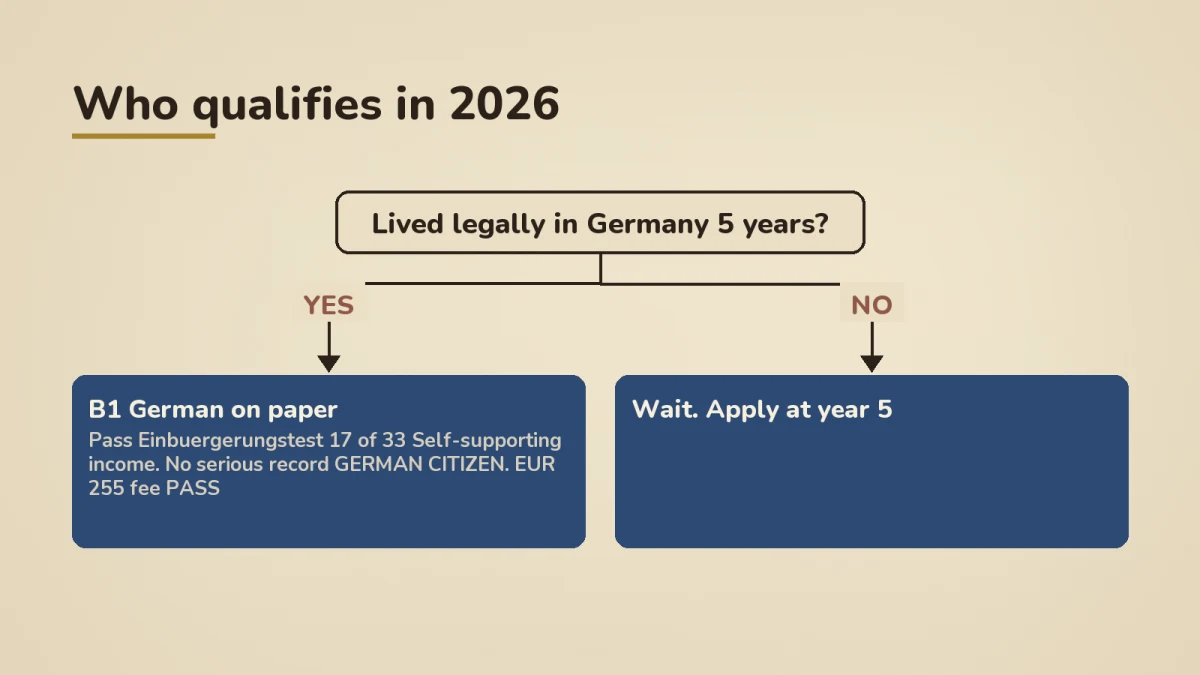
The §10 StAG checklist for the 5-year route in 2026 is short, public, and uniformly applied across federal states.
Residency: 5 years on a qualifying permit
You need 5 years of legal residence in Germany at the time of decision. Qualifying permits include the EU Blue Card, the Niederlassungserlaubnis, the §18b/§18c work permit, the family reunification permit, and the Aufenthaltserlaubnis for skilled workers. Stays on a Schengen visa, a tourist permit, or an asylum-applicant tolerance (Duldung) do not count. Time spent on a student residence permit counts in full, which is a common point of confusion.
Language:
B1 German, on paper
You must demonstrate B1 German under the Common European Framework of Reference. A goethe-zertifikat B1, a telc Deutsch B1, an Österreichisches Sprachdiplom B1, the DTZ "Deutsch-Test für Zuwanderer", or a German school-leaving certificate (mittlerer Schulabschluss or higher) are all accepted. A B2 or C1 certificate satisfies B1 by definition; a B2 certificate from your Blue Card application can be reused here. If your residence permit was originally issued because you completed a German-medium degree, the university transcript counts.
Einbürgerungstest: 33 questions, EUR 25
The "Leben in Deutschland" test is 33 multiple-choice questions in German on history, society, and constitutional basics. You must answer at least 17 correctly. The fee is EUR 25 per attempt, payable to the Volkshochschule that hosts the test. You can sit it as many times as you need. The test is held in German and there is no English version. For the practical "where do I book" question, the step-by-step guide to booking the German citizenship test walks through the VHS portal.
Livelihood and clean record
Two threshold checks finish the eligibility list. First, you must support yourself and any dependents without recurring social benefits (Bürgergeld, housing benefit). A salary on a current contract, freelance income with a tax filing trail, or a pension all qualify. Second, you must have no criminal record above a small threshold; specifically, no conviction with a sentence above 90 daily fines for an individual offence, and no aggregate convictions exceeding 90 daily fines. Traffic offences are usually not disqualifying; serious offences (drugs, violence, immigration fraud) almost always are.
Recognition of the German legal order
Every applicant signs a Loyalitätserklärung, a one-paragraph commitment to the free democratic basic order of the Grundgesetz. The form is provided by the Einbürgerungsbehörde and signed at submission.
Dual citizenship in 2026: the part that did not change
The 2025 amendment left the dual-citizenship rules from June 2024 fully intact. In 2026, all naturalising applicants may keep their original citizenship by default, regardless of nationality. Indian and Pakistani applicants will lose their home citizenship under their own countries' rules (which forbid dual nationality), but the German side does not require it. Turkish, Egyptian, Lebanese, Iranian, Nigerian, Filipino, and Brazilian applicants typically can hold both passports without conflict.
Children born to a German parent and a non-German parent receive German citizenship at birth and may hold both nationalities for life. The "option model" that used to force dual citizens born in Germany to choose at age 21 is fully gone.
If you become a German citizen in 2026 and later acquire a third citizenship, no special permission is required as long as the third country also accepts dual nationality. The Beibehaltungsgenehmigung process, which used to be the only escape valve, is now unnecessary for most cases.
Comparison: the three citizenship timelines in 2026
| Track | Residency | Language | Other conditions | Dual citizenship | Status in 2026 |
|---|---|---|---|---|---|
| Standard §10 | 5 years | B1 | Einbürgerungstest, livelihood, clean record | Allowed | Active, the default route |
| Spouse of a German | 3 years | B1 | Married >= 2 years, sharing a household | Allowed | Active, unchanged |
| 3-year "turbo" | 3 years | C1 | Special integration achievements | Allowed | Scrapped 2025-10-30 |
| Old 8-year route | 8 years | B1 | Pre-2024 rule | Renunciation required | Replaced |
For an at-a-glance picture of how the timeline maps onto the broader stay-in-Germany journey (Blue Card, settlement permit, citizenship), the fast-track to permanent residency in Germany post compares the 21-month and 27-month settlement-permit clocks against the 5-year naturalisation clock.
How the application moves: step by step
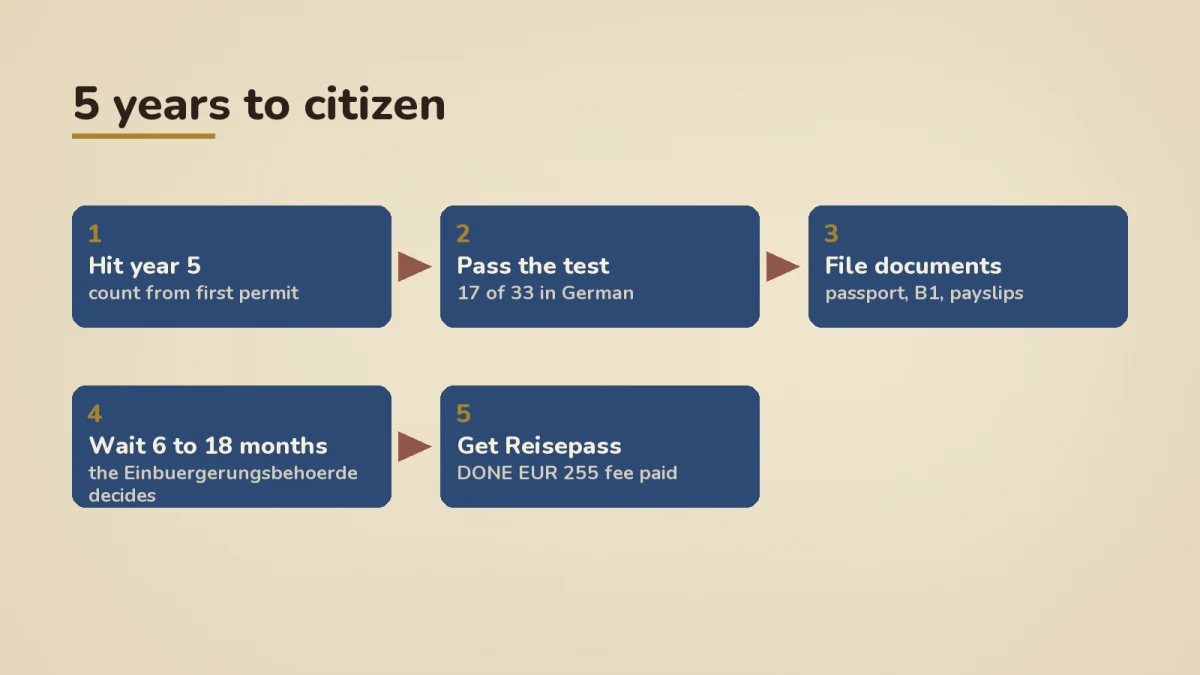
The actual mechanics are slower than the eligibility list suggests, because every step happens at your local Einbürgerungsbehörde and processing volumes vary wildly between cities.
- Hit the 5-year mark. Count from the start date on your first qualifying residence permit. Brief absences (vacation, business trips) do not interrupt the clock; absences over 6 months usually do.
- Sit the Einbürgerungstest. Book a slot at the nearest Volkshochschule. The test runs every few weeks in most cities. Score arrives by post in 4 to 8 weeks.
- Collect documents. A typical Einbürgerungsbehörde wants: your current passport, residence permit, birth certificate (apostilled and translated for non-EU nationals), marriage certificate if applicable, school or degree certificates, B1 language certificate, Einbürgerungstest result, three months of payslips or tax returns, employment contract, proof of pension contributions, proof of health insurance, Anmeldung confirmation for every German address you have held.
- Submit at the Einbürgerungsbehörde. Some cities (Berlin, Munich) have moved to online intake portals; most still require a physical appointment. Wait time for the appointment alone is currently 2 to 6 months in major cities.
- Wait for the decision. Processing runs 6 to 18 months in 2026 depending on the authority. Berlin's backlog is the longest, Bavarian small towns are the fastest.
- Sign the Einbürgerungsurkunde. You are invited back to the Bürgeramt or Einbürgerungsbehörde for a small ceremony, sign the Loyalitätserklärung in person, and receive the naturalisation certificate.
- Apply for the German passport. Take the Einbürgerungsurkunde to the Bürgeramt, file for a Reisepass and Personalausweis. The passport arrives in 4 to 6 weeks.
Costs and processing time
The official fees are predictable; the timeline is not.
- Application fee: EUR 255 per adult applicant.
- Children co-applying with a parent: EUR 51 per child.
- Einbürgerungstest: EUR 25 per attempt.
- B1 language exam: EUR 110 to EUR 220 depending on provider (Goethe, telc).
- Document translation and apostille: EUR 50 to EUR 300 depending on country of origin and number of documents.
- Total realistic budget for a single applicant: EUR 450 to EUR 800 in 2026.
Processing time once your file is complete:
| Authority | Typical decision time |
|---|---|
| Berlin | 12 to 18 months |
| Hamburg | 9 to 12 months |
| Munich | 6 to 10 months |
| Frankfurt | 8 to 12 months |
| Cologne | 8 to 14 months |
| Smaller Bavarian / Baden-Württemberg towns | 4 to 8 months |
The new 5-year baseline plus the 6 to 18 month processing window means most working-professional applicants who arrived in 2021 are receiving decisions in 2026 and 2027.
Common mistakes that cost time
Five recurring missteps account for most rejections and delays in the 2026 caseload.
- Counting student-visa years incorrectly. A 3-year MS plus 18-month job-seeker visa plus 18 months on a Blue Card is 6 years on paper, but the job-seeker stretch is sometimes contested by the authority. Carry your original visa stickers and Aufenthaltstitel decisions.
- Letting your residence permit expire mid-application. The Aufenthaltstitel must be valid on the day of decision, not just on the day of submission. Renew well in advance.
- Submitting an unapostilled birth certificate. Indian, Pakistani, Filipino, and Egyptian birth certificates need an apostille from the issuing country before German recognition. The Einbürgerungsbehörde will not chase this for you.
- Underestimating the language step. B1 means certified B1. Living in Germany for 5 years and speaking the language conversationally is not proof; the certificate is.
- Skipping the livelihood check. A 6-month stretch on Bürgergeld in the past 12 months will sink the application. If you are between jobs, defer the application until you are back on a contract.
Frequently asked questions
Is the 3-year fast-track really gone?
Yes. The fast-track for "specially integrated" applicants was repealed on 30 October 2025. The only remaining 3-year route is for spouses of German citizens, and that one predates the 2024 reform.
Can I keep my Indian passport after becoming German?
Germany allows it; India does not. Indian law (Article 9 of the Indian Citizenship Act, 1955) automatically terminates Indian citizenship when an adult acquires another nationality. After naturalisation as a German citizen, you are eligible to apply for an Overseas Citizen of India (OCI) card, which provides a lifetime visa and most civil rights short of voting and government jobs. Pakistani applicants face the same constraint; OCP-style status is not available, but a 5-year visa for ex-Pakistani nationals is.
Do I need to give up my original citizenship if I qualify under the 5-year track?
No. The renunciation requirement was removed for all nationalities on 27 June 2024 and the 2025 amendment did not bring it back. Whether you can hold both passports depends entirely on whether your home country allows dual nationality.
Does my time on a job-seeker visa count toward the 5 years?
Yes, in most jurisdictions. The job-seeker visa under §20 AufenthG is a legal residence title, and the years on it count toward the 5-year residency requirement. Some authorities scrutinise gaps between the job-seeker visa and the next permit; carry full documentation.
What German level do I actually need: B1 or B2?
B1, full stop. B2 used to be one of the routes to shave a year off the old 8-year track; that ladder is gone in 2026. B1 is the floor and the ceiling. C1 was the language bar for the 3-year turbo track, and that track is scrapped, so C1 has no legal advantage now.
What is the cheapest and fastest place in Germany to apply?
Smaller cities in Bavaria and Baden-Württemberg consistently run the shortest queues, often 4 to 8 months from complete file to decision. The fees are uniform across the country (EUR 255), so "cheapest" really just means processing speed. If your job allows mobility, registering your Anmeldung in a smaller town before the 5-year mark can shave months off the wait.
Can I apply for citizenship while my residence permit is on a Fiktionsbescheinigung?
No. The Fiktionsbescheinigung covers a permit-renewal gap; it is not a residence title in itself for citizenship purposes. Wait until your renewed Aufenthaltstitel is in hand, then submit.
What happens if I fail the Einbürgerungstest?
You re-book and re-sit. The fee is EUR 25 per attempt and there is no cap on retries. Pass rates in 2024-2025 averaged above 95 percent across all VHS centres, so most applicants who study a few hours pass on the first try. The 300-question pool is published online by the BAMF; the test draws 33 questions from that pool, so the material is fully memorisable.
Where to next
The 5-year clock for citizenship runs in parallel with the 21-month or 27-month clock for the Niederlassungserlaubnis (settlement permit). For most working professionals on an EU Blue Card, settlement comes first and citizenship follows. The pillar guide on living in Germany long-term covers how the two permits interact at the bureaucratic level. When you are ready to book the Einbürgerungstest, the VHS booking walkthrough is the practical next step.
Continue reading
Visa & Immigration·13 min read
Acquiring German Citizenship after Master’s in Germany
Discover the steps and requirements for acquiring German citizenship after completing your Master’s degree in Germany. Learn about the eligibility criteria, application process, and benefits of becoming a German citizen.
Read articleVisa & Immigration·20 min read
German Student Visa for Bachelor’s in Germany
This guide provides a step-by-step process for obtaining a German student visa for bachelor's aspirants. From eligibility criteria to document requirements, visa application submission, and interview preparation, this comprehensive guide covers everything you need to know to navigate the visa application journey with confidence and secure your place in a German university.
Read articleVisa & Immigration·17 min read
German Student Visa for Master’s in Germany: A Complete Guide
Learn the step-by-step process to acquire your German student visa to head to Germany for your Master’s.
Read articleReady to plan your Germany journey?
Explore our tools and resources to find the perfect university and program for your academic goals.