Germany's new immigration rules in 2026: changes that affect you
Germany's immigration rules tightened across 2025 and 2026. Citizenship, family reunification, Bürgergeld, EES, ETIAS: what changed and who it affects.

Table of contents
Last updated: May 2026
TL;DR: Germany has tightened the rules for new arrivals and long-time residents alike since mid-2025. The 3-year fast-track to citizenship is gone, family reunification for subsidiary protection holders is suspended until July 2027, Bürgergeld becomes Neue Grundsicherung on 1 July 2026, and the EU's Entry/Exit System is now live at every Schengen border. Skilled workers still have a clear path in; the side roads are narrower.
If you live in Germany or plan to move here, the immigration landscape that shaped 2024 is not the one you face in 2026. The current government took office in May 2025 and made migration its first big lever. Some changes affect new arrivals at the airport; others reach back to people who have already built lives here.
This post walks through the changes that actually matter, how each one affects different audiences, and which doors are still wide open. For the legal foundations, start with the pillar guide on German visa types and residence permits.
The short answer: what changed in 2026
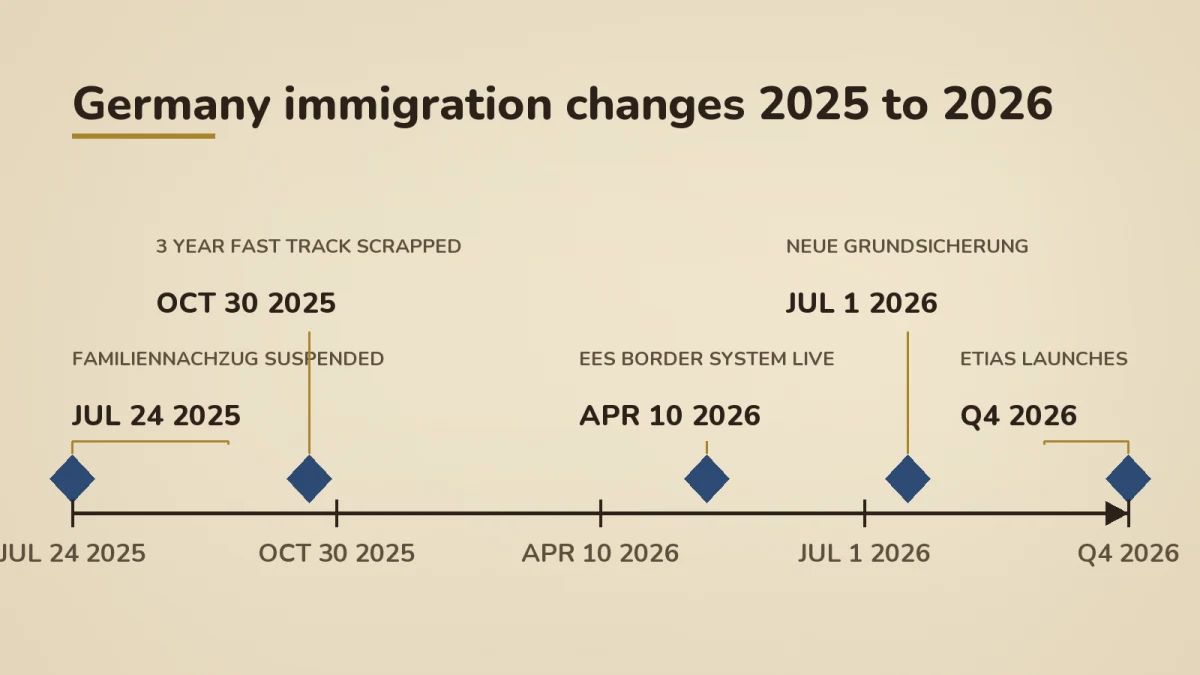
Eight things moved between mid-2025 and mid-2026, and most of them tightened rather than loosened. Here is the headline list, in plain language:
- The 3-year "fast-track" to citizenship was scrapped on 30 October 2025. The new minimum residency for naturalisation is 5 years.
- The CDU-led coalition has tabled a further proposal to push the standard residency from 5 years to 8 years. The Bundestag began debating it in early 2026; it is not law yet.
- A 10-year ban from naturalisation for anyone caught submitting forged language certificates or financial documents is in the legislative pipeline, with the Bundestag debating it in January 2026.
- Bürgergeld is being replaced with Neue Grundsicherung from 1 July 2026, with sharper sanctions for refusing reasonable job offers.
- Family reunification for beneficiaries of subsidiary protection has been suspended since 24 July 2025 and stays suspended until 23 July 2027.
- The EU's Entry/Exit System (EES) became fully operational at every Schengen external border on 10 April 2026. Biometric data is now captured on arrival.
- ETIAS, the travel authorisation for visa-exempt non-EU nationals, is on track for a Q4 2026 launch. It is a separate step on top of EES.
- Internal Schengen border checks at every German land border are still in place, and removals are running about a fifth higher than the year before.
What did not change is just as important. The EU Blue Card, the Chancenkarte (Opportunity Card), the skilled worker visa, the student visa, and dual citizenship rules all stand. The Skilled Immigration Act stays in full effect.
The rest of this post takes each change in turn, with dates, sources, and who it actually affects.
1. The 3-year fast-track to citizenship is gone
The 2024 reform allowed naturalisation after just 3 years of residence for "specially integrated" applicants. That route ended on 30 October 2025 when the new coalition's reversal bill came into force. The statutory minimum is back to 5 years for the standard track.
In practice, this only affects people who were timing their application around the 3-year window. If you were already at 5 years or beyond and waiting on a Bürgeramt appointment, your timeline is unchanged. If you were planning to apply at 3 years and 6 months because of strong B2 German plus volunteer work, that option closed. You now wait until year five.
The other parts of the 2024 reform are intact: dual citizenship is still allowed for every nationality, and the C1 / B2 thresholds for the integrated track continue to count toward your application. The post on citizenship after a Master's walks through the full requirements.
2. There is a proposal to push citizenship from 5 to 8 years
This is a proposal, not a law. The CDU brought a motion in the Bundestag in February 2026 to extend the standard residency requirement from 5 to 8 years and tighten the integration tests. As of May 2026 the bill has not passed.
We mention it because the coalition has the votes to move further if it chooses, and several state CDU branches have publicly backed the 8-year proposal. If you are within 24 months of your 5-year mark, file as soon as your residency clock allows. Reform bills usually include a transitional clause that protects applications already in the queue, but the queue at most Bürgeramts is itself measured in months.
3. Forged documents will trigger a 10-year naturalisation ban
The Federal Ministry of the Interior tabled a "false document" amendment in late 2025; the Bundestag debated it in January 2026. If passed in its current form, anyone caught submitting forged language certificates, falsified income statements, or fabricated employment contracts as part of a citizenship application is barred from re-applying for 10 years. There is no second chance and no fee waiver to "withdraw" the application before it is decided.
This matters because the test-fraud market has grown. Several large fake-Goethe and fake-telc rings were busted in 2024 and 2025, and the Ausländerbehörde now cross-checks language certificates against the issuing institute's database before approving naturalisation. If you sat your B1 or B2 with a real, accredited provider, this rule is invisible. If you used a "guaranteed pass" service, walk away.
For the language side, our breakdown of Goethe vs TestDaF vs DSH exams explains which certificates are accepted and where to book a real one.
4. Bürgergeld becomes Neue Grundsicherung on 1 July 2026
Bürgergeld, the long-term unemployment benefit that replaced Hartz IV in 2023, is itself being replaced. Neue Grundsicherung takes effect on 1 July 2026, and the change is not just cosmetic.
The headline differences:
- A first refusal of a "reasonable" job offer triggers a 30 percent cut to the monthly payment.
- A second refusal can lead to a full suspension of benefits, including rent assistance.
- The "Karenzzeit" grace period at the start of a claim is shortened, so the Jobcenter can require flat-share moves and budget-housing transitions sooner.
- Around 5.5 million people currently on Bürgergeld move onto the new system. The transition is automatic; you do not re-apply.
For non-EU residents, the rule on benefits and residence has not changed: Blue Card and skilled worker permit holders can still draw short-term benefits without losing their permit, as long as employment was genuine and ended through no fault of their own. The Ausländerbehörde reviews benefits history at renewal, so the sharper sanctions raise the cost of an extended gap.
5. Family reunification is frozen for subsidiary protection holders until July 2027
The suspension came into force on 24 July 2025 and runs through 23 July 2027. It applies specifically to people who hold subsidiary protection in Germany (a status granted to those who do not qualify for full refugee protection but face serious harm at home). It does not apply to:
- Spouses of skilled workers, Blue Card holders, or graduates on a §18b residence permit.
- Children of full refugee status holders (these reunifications continue, with caps).
- Family of EU nationals.
- Spouses of German citizens.
Before the suspension, around 1,000 family reunification visas a month were issued under this category. The Federal Ministry of the Interior estimates roughly 380,000 people are affected by the freeze, mostly relatives of Syrian and Afghan beneficiaries already in Germany. Hardship cases (illness of the beneficiary, minors separated from sole parents) can still apply through a humanitarian exception, but the bar is high.
If you are a skilled worker or student bringing your spouse, the family reunion visa guide is your starting point, and the dependent visa for children covers the section 32 route for kids under 18. The A1 German requirement for spouses still stands, with the same exemptions.
6. The Entry/Exit System (EES) is live at every Schengen border
EES went fully operational on 10 April 2026 after a phased rollout that began in October 2025. Every non-EU traveller crossing a Schengen external border is now biometrically registered: 4 fingerprints and a facial image on first entry, then face-only matching on subsequent crossings. The system tracks the 90-out-of-180-days rule automatically and replaces passport stamps in most cases.
Practical effects at the airport:
- First entry takes 5 to 10 minutes longer while biometrics are captured. Repeat entries use the kiosk and run faster than the old manual stamp.
- If you overstay, the system flags you the moment you try to leave. The 90/180 counter is exact, with no goodwill rounding.
- Indian, Pakistani, Nigerian, Filipino, US, UK, Canadian, Australian, and Brazilian passport holders are all affected.
- Children under 12 are exempt from fingerprinting but still get a face image.
If you hold a valid German residence permit (eAT card, Blue Card, Niederlassungserlaubnis), EES does not capture your biometrics. You queue in the EU/EEA/CH lane.
7. ETIAS is launching in Q4 2026
ETIAS is the European travel authorisation that visa-exempt third-country nationals must obtain before flying to a Schengen country. The European Commission has confirmed late 2026 as the operational date.
Key facts:
- Cost: 20 euros, valid for 3 years or until your passport expires (whichever is earlier).
- Applies to nationalities that do not need a Schengen visa today (US, UK, Canada, Australia, Brazil, Japan, South Korea, etc.). It is not a visa.
- Indian, Pakistani, Nigerian, and Filipino travellers already need a Schengen visa; ETIAS does not change that.
- Application is online and decided within 96 hours in the typical case.
If you already hold a German residence permit, ETIAS does not apply to you.
8. Border checks and deportations are tighter
Internal Schengen border checks at every German land border have been in place since May 2025 and the current government extended them through at least mid-2026. The Federal Police has prevented more than 28,000 entries since the checks began, and 9,097 people were turned back at the land borders in the first quarter of 2026 alone.
Removals are also up. Germany deported about 11,800 people in the first half of 2025, up from roughly 9,500 in the same period of 2024. The "safe country of origin" list can now be expanded by federal regulation rather than full Bundestag vote, which lowers the threshold for adding new countries.
For people travelling from neighbouring EU countries, expect random ID and document checks at the border crossings most of the time. If you are commuting from a border city such as Strasbourg or Salzburg, carry your residence permit and a valid ID. The checks are quick if your paperwork is in order.
What did not change (and why that is good news)
The Skilled Immigration Act 2.0 framework is intact. That includes:
| What stayed | Status in 2026 |
|---|---|
| EU Blue Card | Active. General threshold €50,700 (2026), shortage occupations and recent graduates €45,934.20 (2026), both with annual indexing. |
| Chancenkarte (Opportunity Card) | Active. Points-based, 1 year on the ground to find a qualifying job. |
| §18b skilled worker visa | Active. University degree plus a job offer in your field. |
| §19c standalone work visa for IT specialists without a degree | Active. 2 years of relevant IT experience plus the shortage-occupation salary qualifies. |
| Job seeker visa | Active. Up to 6 months on the ground to interview. |
| Student visa and §16b post-study work permit | Active. 18 months after graduation to find skilled employment. |
| Dual citizenship | Allowed by default for all nationalities. |
| Anerkennung (recognition of foreign qualifications) | Active and faster after the 2024 reforms. |
| Faster permanent residency for Blue Card holders | 27 months at A1 German, 21 months at B1 German. |
If you are coming to Germany to work or study, the path has not narrowed. The changes hit people who were planning to draw long-term benefits, beneficiaries of subsidiary protection waiting on family, and applicants timing a sub-5-year citizenship application. Detailed breakdowns: EU Blue Card guide, Chancenkarte explainer.
Who is most affected
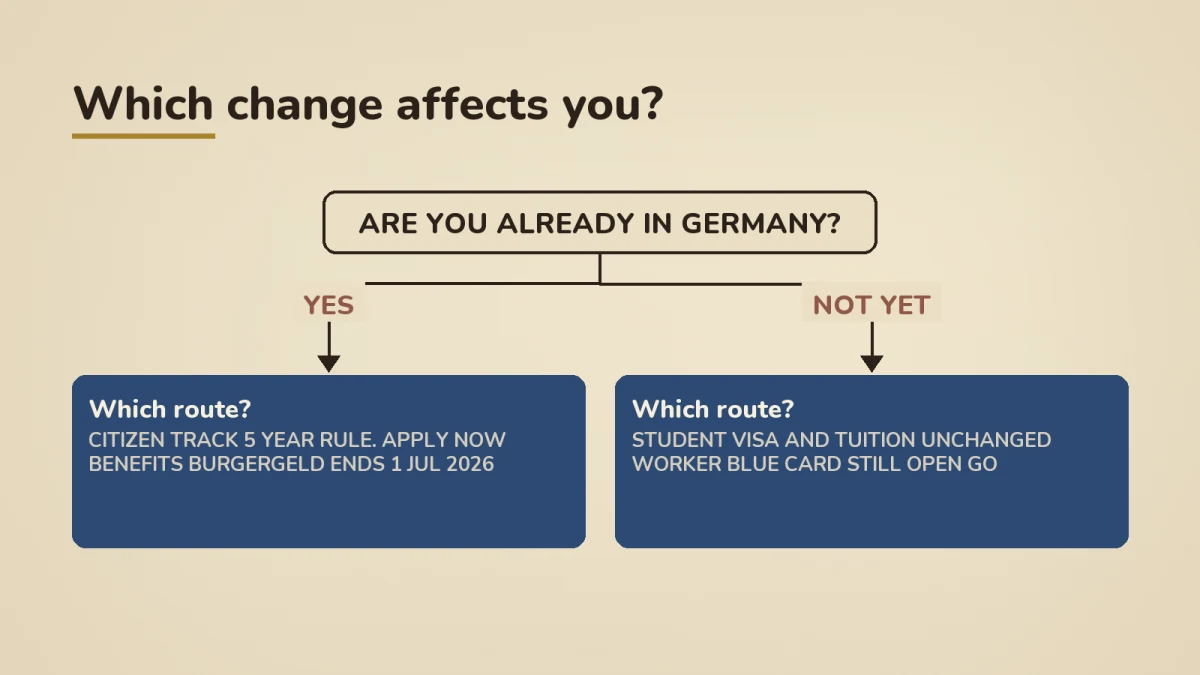
The same package of laws hits different audiences in very different ways.
- Students: unaffected on visas and tuition. Student visa, post-study work permit, and free tuition (outside Baden-Württemberg and TUM in Munich) all stand.
- Skilled workers on a Blue Card or §18b visa: unaffected on the entry side. EES means a slower first arrival; subsequent crossings are faster. Permanent residency is still 27 months at A1 or 21 months at B1.
- Long-term residents at the 5-year mark: apply for citizenship now. The current 5-year rule may be raised to 8.
- People on Bürgergeld: Neue Grundsicherung sanctions take effect on 1 July 2026. If you are between jobs, line up your next role before any refusal triggers a cut.
- Beneficiaries of subsidiary protection: family reunification is closed until 23 July 2027. Hardship exceptions exist; a specialist immigration lawyer can assess your case.
- Visa-exempt travellers (US, UK, Canada, etc.): EES requires biometric registration on entry from 10 April 2026. ETIAS becomes a separate pre-travel step in Q4 2026.
Common mistakes to avoid
- Assuming the 5-year citizenship rule is safe forever. It is the law today; the proposal to extend to 8 years is real and being debated. File early if you are eligible.
- Treating EES like the old passport-stamp system. The 90/180 counter is now automated and unforgiving. Plan exits with the day count in mind.
- Buying "guaranteed pass" language certificates. The 10-year ban for forged documents is targeted at exactly this market, and the Ausländerbehörde now cross-checks against issuing institutes.
- Counting on Bürgergeld as a long bridge between jobs. The new sanctions and Karenzzeit changes apply to everyone, and a residence permit renewal is harder to argue with months of benefits on file.
- Confusing ETIAS with a Schengen visa. ETIAS is a travel authorisation for visa-exempt nationalities only. If you already need a Schengen visa today, you still need one.
FAQ
Does the 5-year citizenship rule still apply if I was counting on the 3-year fast-track?
Yes. From 30 October 2025 the standard minimum residency for naturalisation is 5 years. There is no transition for the 3-year fast-track; it was repealed in full. The other parts of the 2024 reform, including dual citizenship and the language thresholds, still stand.
When does Neue Grundsicherung replace Bürgergeld?
The new system takes effect on 1 July 2026. The transition is automatic for everyone currently receiving Bürgergeld; you do not re-apply. The renamed payment continues, but the sanctions for refusing job offers are sharper and the early-stage protections are shorter.
Does EES mean I cannot use my eAT residence permit anymore?
EES does not affect residence permit holders entering Germany. Your eAT card or Niederlassungserlaubnis is your authorisation; you queue in the EU/EEA/CH lane and your biometrics are not captured on entry. EES applies to non-EU travellers without a residence permit.
My spouse is on subsidiary protection. Can we still apply for family reunion?
Not under the standard procedure until 24 July 2027. Hardship exceptions exist for serious illness or minors separated from a sole parent, and a specialist immigration lawyer can evaluate whether your case meets the bar. For all other family reunion routes (skilled worker spouses, German citizen spouses, EU national spouses), the rules are unchanged.
Will the citizenship requirement actually go to 8 years?
It is a proposal in the Bundestag, not a law. The coalition has the votes to move it through, but as of May 2026 the bill has not passed. If you are within 12 to 24 months of your 5-year mark, applying now is the safer call.
Does ETIAS apply to Indian or Pakistani passport holders?
No. ETIAS is for nationalities that are currently visa-exempt for Schengen (US, UK, Canada, Australia, Brazil, Japan, etc.). Indian and Pakistani travellers already need a Schengen visa, and that requirement is unchanged.
What happens if I am caught with a forged language certificate?
If the proposed amendment passes in its current form, you face a 10-year ban from re-applying for naturalisation, plus criminal charges for document fraud. The Ausländerbehörde already cross-checks certificates with the issuing institute (Goethe, telc, ÖSD, TestDaF) before approving citizenship.
Does any of this affect my student visa?
No. The student visa, the 18-month post-study job-seeker permit, and the §16b skilled worker route after graduation are all unchanged. Tuition policy in Baden-Württemberg (the €1,500/semester rule for non-EU students) is also unchanged.
Where to next
- The pillar guide to German residence permits and visa types
- Acquiring German citizenship after a Master's
- What is the Chancenkarte (Opportunity Card)
- German family reunion visa guide
- EU Blue Card guide for skilled workers
If you are still weighing whether to move at all, our free consultation walks through your specific case before you commit to a route.
Continue reading
Visa & Immigration·9 min read
What is Opportunity Card (Chancenkarte) for Germany?
Learn about Opportunity Card (Chancenkarte Deutschland), a points-based system that simplifies immigration for skilled workers.
Read articleVisa & Immigration·13 min read
Acquiring German Citizenship after Master’s in Germany
Discover the steps and requirements for acquiring German citizenship after completing your Master’s degree in Germany. Learn about the eligibility criteria, application process, and benefits of becoming a German citizen.
Read articleVisa & Immigration·20 min read
German Student Visa for Bachelor’s in Germany
This guide provides a step-by-step process for obtaining a German student visa for bachelor's aspirants. From eligibility criteria to document requirements, visa application submission, and interview preparation, this comprehensive guide covers everything you need to know to navigate the visa application journey with confidence and secure your place in a German university.
Read articleReady to plan your Germany journey?
Explore our tools and resources to find the perfect university and program for your academic goals.