Anerkennung reform Germany 2026: Faster degree recognition for nurses and doctors (ZAB explained)
What changes in Germany's Anerkennung reform on 1 November 2026: faster knowledge test for doctors, dentists, pharmacists, midwives. ZAB explained.

Table of contents
Last updated: May 2026
TL;DR: Germany's Bundestag passed a major Anerkennung reform on 26 March 2026 that takes effect on 1 November 2026. From that date, doctors, dentists, pharmacists, and midwives from third countries can go straight to a knowledge test instead of waiting months for a document-based equivalence assessment. Nurses already get a separate fast-track visa launched in March 2026 that targets a combined recognition plus visa timeline of under three months. ZAB still issues the Statement of Comparability for non-regulated jobs, but for regulated healthcare roles the route is now shorter, more digital, and more standardised.
If you trained as a nurse or doctor outside the EU and you have been watching German recognition timelines drift past a year, the rules are changing. The Anerkennungsgesetz reform that the Bundestag approved in March 2026 cuts a chunk of the paper trail for healthcare professionals and forces faster decisions from the licensing authorities. The reform sits inside Germany's broader Working in Germany push to plug a healthcare staffing gap that the Federal Ministry of Health put at over 12% of vacancies in care.
This guide explains what changed, what stayed the same, and where ZAB still fits. If you already know the basics, jump to the reform section. If you do not, start with our explainer on what ZAB is and how it issues a Statement of Comparability.
What changed on 1 November 2026, in one paragraph
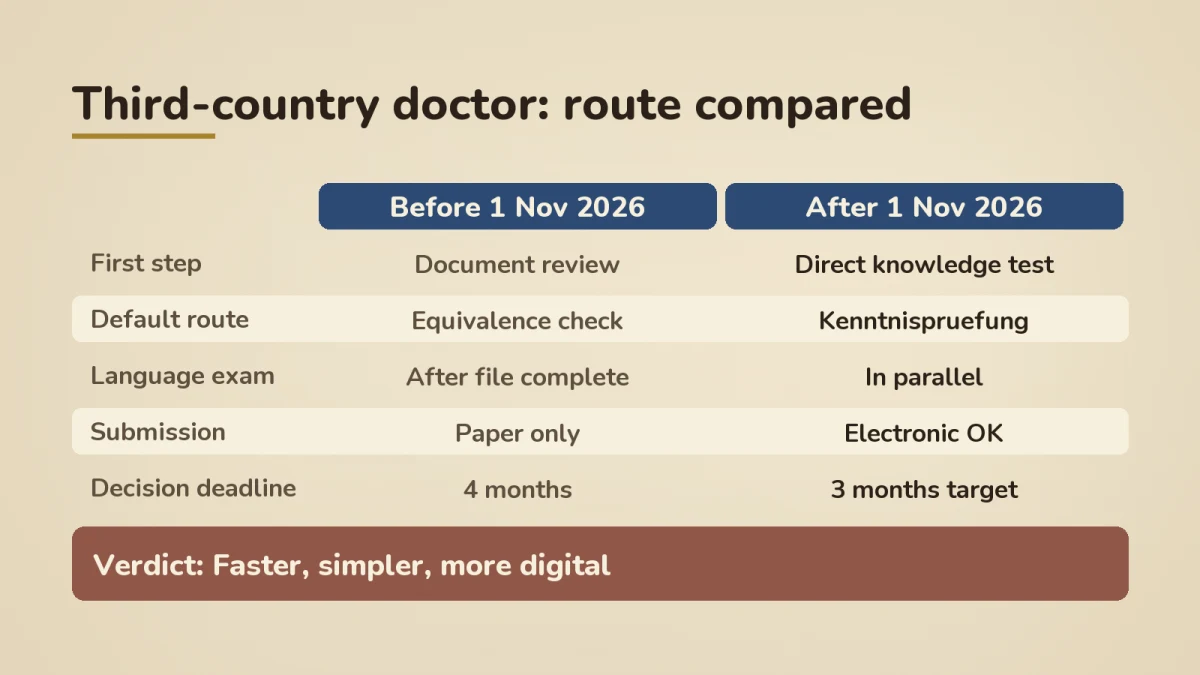
The reform does four things. It makes the direct knowledge test (Kenntnisprüfung) the standard route for third-country doctors, dentists, and pharmacists, instead of forcing applicants through a slower document review first. It gives midwives a choice between knowledge test and adaptation course. It lets the federal states check your German before you finish the recognition file, so language and qualification can run in parallel. And it allows authorities to accept electronic transmission of documents, including between agencies, instead of paper-only files. The licensing decision deadline of three months for straightforward cases stays in force, with the reform tightening how it is measured.
What is Anerkennung, and where does ZAB fit in?
Anerkennung is the German word for the formal recognition of a foreign professional qualification. It exists because Germany regulates a long list of jobs at federal and state level, and you cannot legally practice most regulated professions without a licence that says your foreign qualification is equivalent to the German one.
Regulated vs non-regulated professions
| Profession type | Recognition needed? | Who decides? | Reform affects? |
|---|---|---|---|
| Regulated healthcare (doctor, dentist, pharmacist, midwife, nurse) | Yes, mandatory | State health authority (Approbationsbehörde) | Yes, this is the core of the 2026 reform |
| Other regulated jobs (lawyer, teacher, engineer in some states) | Yes, mandatory | State chamber or state ministry | No |
| Non-regulated jobs (most IT, business, science, finance roles) | No, but a Statement of Comparability helps | ZAB issues the statement | No |
If you are a software engineer or a finance professional, you usually do not need formal recognition at all. Your employer evaluates your degree directly, and a ZAB Statement of Comparability or a database entry on anabin can support the visa file. For an EU Blue Card, the salary and contract carry most of the weight. The 2026 healthcare reform does not change any of that.
ZAB's role
ZAB is part of the Standing Conference of the Ministers of Education and Cultural Affairs (KMK). It issues a Statement of Comparability for foreign higher education qualifications (around EUR 200, three months by post and faster online), plus anabin database entries that show whether your university is on the H+ list. For a regulated healthcare profession, ZAB sits in the background. The licensing decision still comes from the state Approbationsbehörde.
The 2026 reform: what is new for healthcare professionals
Five changes matter for anyone planning to apply.
1. Direct knowledge test is now the default for doctors, dentists, pharmacists
Until November 2026, the standard procedure for a third-country doctor was a document-based equivalence assessment. The state authority compared your transcripts and clinical hours to the German curriculum, identified gaps, and either granted full recognition, partial recognition with an adaptation course, or pushed you to a knowledge test.
The reform flips this. The direct knowledge test (Kenntnisprüfung) becomes the standard procedure for doctors, dentists, and pharmacists from third countries. Document-based assessment is still available as an option, but it is no longer the default. The law also clarifies that the knowledge test is a professional licensing examination. It establishes that you meet the German standard, not that you have to repair every difference between your training and the German one.
For most applicants this is faster. The bottleneck in the old process was the line-by-line document review, which produced inconsistent verdicts across states. A direct test sidesteps the review and gives you a clear pass-fail outcome.
2. Midwives get a choice
Midwives from third countries can now waive the document-based equivalence assessment and go directly to either a knowledge test or an adaptation course.
3. Language assessment can start earlier
The federal states now have the option to assess your German language skills before your professional qualification is recognised. In practice, this means you can sit your B2 medical German exam (Fachsprachprüfung) in parallel with your knowledge test preparation, instead of finishing one before starting the other. B2 general German plus a C1-equivalent medical exam is still the bar for medical professions.
4. Electronic forms and data exchange between authorities
Several state authorities used to require paper-only submissions, with notarised translations sent by post and no email attachments. The reform makes electronic transmission permissible as an alternative to paper, both for applicant submissions and for data exchange between authorities. Each state still publishes its own portal and rules, so check the specific Approbationsbehörde for your state.
5. Indefinite licence in exceptional cases
In exceptional cases, doctors and dentists from third countries can now be granted an indefinite licence to practice (Approbation) instead of a time-limited one. A separate change: doctors, dentists, and pharmacists from EU/EEA/Switzerland can now apply for a partial professional licence (Berufserlaubnis), and there are new simplifications for anesthesia and operating room technicians (ATA/OTA).
Recognition process step by step
The reform does not rewrite every step of the recognition file. It re-orders the route and removes the document review as a forced first stop.
Here is what the process looks like from November 2026, for a third-country nurse, doctor, dentist, pharmacist, or midwife.
- Find the right authority. Each state has its own Approbationsbehörde for medical professions and a separate body for nurses. The Anerkennung-Finder on anerkennung-in-deutschland.de gives you the exact office.
- Gather documents. Passport, CV, diploma, transcript with hours per subject, clinical certificates, home-country professional licence, police clearance, and a Conduct of Practice certificate (Bescheinigung über die Berufsausübung). Notarised translations into German are required for documents not in German.
- Submit your file. From November 2026, electronic submission is permitted in states that have switched it on. Even where paper is default, most states accept pre-submission scans for review.
- Receive the receipt notice. The authority must confirm receipt within one month and tell you what is missing.
- Choose your route. For doctors, dentists, pharmacists from third countries, the default is the knowledge test. For midwives, you choose. For nurses, the procedure is governed separately and uses a knowledge test or adaptation course since 2020.
- Sit the language exam in parallel. B2 general German plus the medical Fachsprachprüfung at C1 level is the typical bar. Several states now let you start before recognition is final.
- Pass the knowledge test or finish the adaptation course. The knowledge test is run in German, in clinical settings, by the state authority.
- Receive your decision. Federal rules give the authority four months from a complete file. The reform pushes a three-month target for straightforward healthcare cases.
- Apply for the residence permit if you are still abroad. Pair with a job offer; doctors and nurses typically move to the Blue Card route for healthcare professionals once Approbation is in hand. Your employer can act as a representative under Section 81a of the Residence Act.
How the fast-track nursing visa pairs with the reform
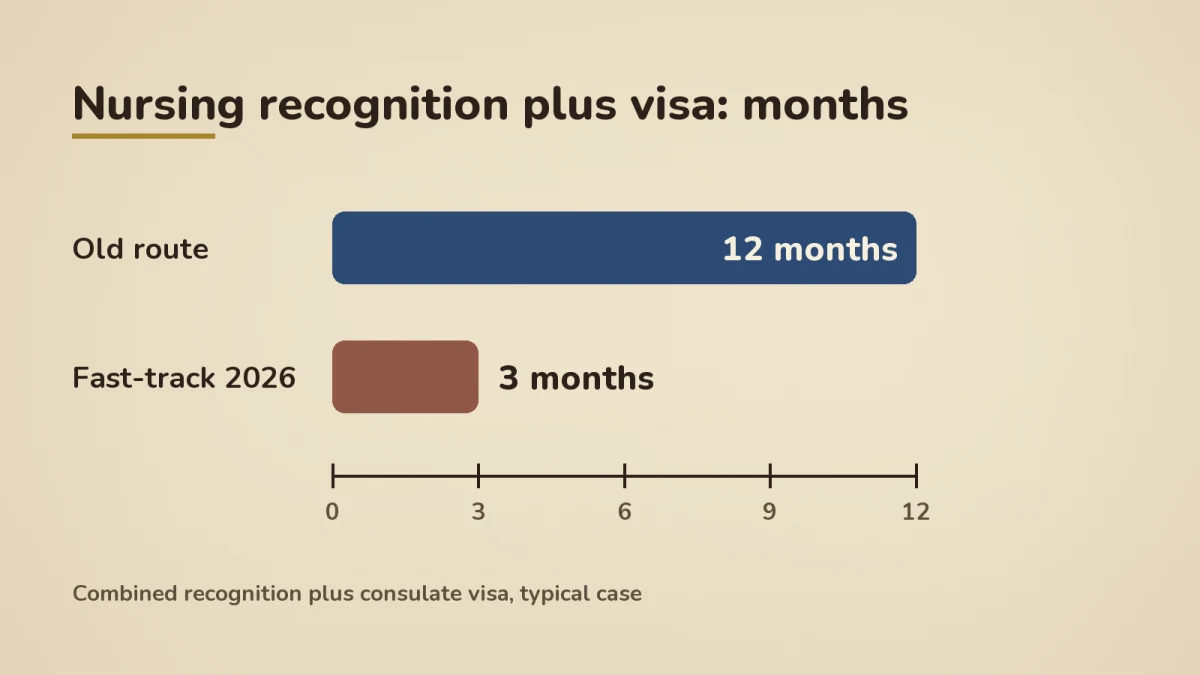
A separate change often confused with the Anerkennung reform: the Federal Ministry of the Interior launched a Fast-Track Nursing Visa on 11 March 2026. It runs alongside the recognition reform and is aimed at care sector vacancies. The headline targets:
- Recognition verdict from credential bodies within four weeks.
- Visa processing at the German consulate within eight weeks.
- Combined recognition plus visa timeline under three months in many source countries, against a previous nine-to-twelve month average.
- Six-month D-visa convertible to a residence permit after a shortened adaptation programme.
- B2 German required within 18 months of arrival, not before entry.
- Authority fee around EUR 411, plus notarisation costs.
The catch is that employers must guarantee at least the collectively agreed regional wage and provide a structured onboarding plan that covers German language tuition. For nurses applying from India, the Philippines, or Vietnam, the practical effect is a clear timeline to a residence permit instead of holding a tourist plan together for a year.
Common mistakes to avoid
- Confusing ZAB with the Approbationsbehörde. ZAB confirms your degree is comparable in level. The state authority issues the licence.
- Choosing the document review route in 2027 because you read an old guide. From November 2026, the direct knowledge test is the standard route for third-country doctors, dentists, and pharmacists.
- Assuming the language requirement softened. The reform lets you start the language exam earlier, not skip it. B2 plus medical C1 is still the bar.
- Mixing up the nursing fast-track and the medical professions reform. The fast-track is a visa procedure for nurses, launched March 2026. The Anerkennungsgesetz reform is a recognition law for doctors, dentists, pharmacists, and midwives, in force from November 2026.
- Filing in a state where you do not plan to work. Recognition is granted by a specific state authority. If you change states before practicing, you may have to re-register.
FAQ
Does the 2026 Anerkennung reform apply to me if I trained inside the EU?
The core reform targets third-country qualifications. EU/EEA/Switzerland qualifications already benefit from automatic recognition under EU Directive 2005/36/EC. The reform adds a new partial-licence option for EU/EEA/Switzerland doctors, dentists, and pharmacists, plus simplifications for ATA/OTA and midwives.
When exactly does the reform take effect?
The Bundestag passed the law on 26 March 2026. After approval by the Bundesrat, the new regulations come into force on 1 November 2026. Files submitted before that date follow the old rules unless the state authority lets you switch.
What does the knowledge test (Kenntnisprüfung) cover?
It is a professional licensing examination at German graduate level. For doctors, it covers internal medicine, surgery, plus a third subject drawn from the curriculum. The format and pass mark are set by the state. From November 2026, the law clarifies that the test establishes equivalence to the German standard, not a list of deficiencies you have to plug.
How long does the whole process take?
Under federal rules the authority must decide within four months of a complete file. The reform pushes a three-month target for straightforward healthcare cases. Add language exam preparation (often six to twelve months for B2 plus medical C1) and visa processing. End-to-end, plan for nine to fifteen months for a doctor and three to nine months for a nurse on the fast-track.
Can my employer file on my behalf?
Yes. Under Section 81a of the Residence Act, an employer can act as your authorised representative for the recognition and visa file. Many hospitals already do this for nurses, and the fast-track nursing visa is designed around it.
Do I still need ZAB for a regulated healthcare role?
Not formally. Your state Approbationsbehörde runs the recognition. ZAB and anabin are still useful as background checks on whether your university is on the H+ list, and a Statement of Comparability is helpful if you ever switch to a non-regulated job or apply for an EU Blue Card elsewhere.
Does the reform fix recognition for non-healthcare jobs?
No. The 2026 reform is targeted at healthcare. For non-regulated jobs, recognition is voluntary. For other regulated jobs (engineering in some states, lawyers, teachers), the existing rules continue. A broader review is on the federal agenda but no statutory change is in force yet.
Where to next
If you are pulling a healthcare move together, three places to read next:
- What is ZAB in Germany? for the recognition agency basics, anabin lookups, and the Statement of Comparability.
- Healthcare jobs in Germany for international students for the wider job market and what hospitals are hiring.
- EU Blue Card guide for the work visa that pairs with full medical recognition once your Approbation is in hand.
For a free recognition pre-check or an introduction to a state Approbationsbehörde, book a consultation and we will help you map the right office for your profession and your target German state.
Continue reading
Career & Jobs·10 min read
Payscale in Germany: Average Gross Remuneration by Profession and Region
Discover the average gross remuneration in Germany by profession and region. Learn how much you can earn as a student or professional and work out your ROI. Explore the payscale in Germany and make an informed decision for your higher studies.
Read articleCareer & Jobs·15 min read
Chancenkarte Germany: Point system explained, real one-year results, who actually got in
Germany's Chancenkarte point system explained with a 6-point matrix, worked examples, and real one-year results from 2024 to 2025.
Read articleCareer & Jobs·14 min read
Why Germany has 1M jobs and zero callbacks (and how to fix your application)
Germany has over 1 million open jobs but most foreign applicants get silence. Here is why your applications fail and how to fix the stack.
Read articleReady to plan your Germany journey?
Explore our tools and resources to find the perfect university and program for your academic goals.