Blue Card Germany for healthcare professionals: Doctors, nurses, recognition + salary
Doctors and nurses qualify for Germany's Blue Card via the shortage threshold of EUR 45,934 in 2026. Approbation, Anerkennung, salaries, and the visa route.

Table of contents
Last updated: May 2026
TL;DR: Doctors and nurses qualify for Germany's EU Blue Card under the shortage occupation threshold of €45,934.20 gross per year (2026). The real hurdle is not the salary, it is recognition. Doctors need an Approbation, nurses need an Anerkennung as Pflegefachkraft. Once cleared, healthcare salaries comfortably clear the threshold and the Blue Card opens fast-track permanent residency in 21 months with B1 German.
Healthcare is one of Germany's biggest shortage sectors. Hospitals, clinics, and nursing homes are short on staff and the federal government has tilted policy to fix that. The EU Blue Card is the cleanest legal route into the country if you already hold a recognised medical or nursing qualification. The catch is that "already hold" does a lot of work in that sentence.
This guide walks through both halves of the move, the salary maths and the recognition wall, with current 2026 thresholds and process steps. If you are still in school and choosing a route, our healthcare jobs in Germany breakdown maps the entry points by qualification level.
Do healthcare professionals qualify for the Blue Card?
Yes, and on better terms than most. Doctors, nurses, midwives, and other regulated healthcare roles sit on Germany's shortage occupation list, which means a lower salary threshold applies. You do not need to negotiate a top-tier package to clear the bar. You do need a recognised qualification and a job offer from a German employer.
The Blue Card itself is a residence permit issued under EU directive 2021/1883. It gives the holder the right to work for a specific employer in Germany, change employers after the first year without re-applying, bring family on a fast track, and convert to permanent residency in 21 months with B1 German or 27 months without. Healthcare professionals are explicitly named in the shortage list at section 18g of the Aufenthaltsgesetz.
Salary thresholds for 2026
There are two thresholds. Standard occupations need €50,700 gross per year. Shortage occupations, which include all regulated healthcare roles and IT specialists without a formal degree, need €45,934.20 gross per year. Both figures are indexed annually to the German pension contribution ceiling, which is why the numbers shift every January.
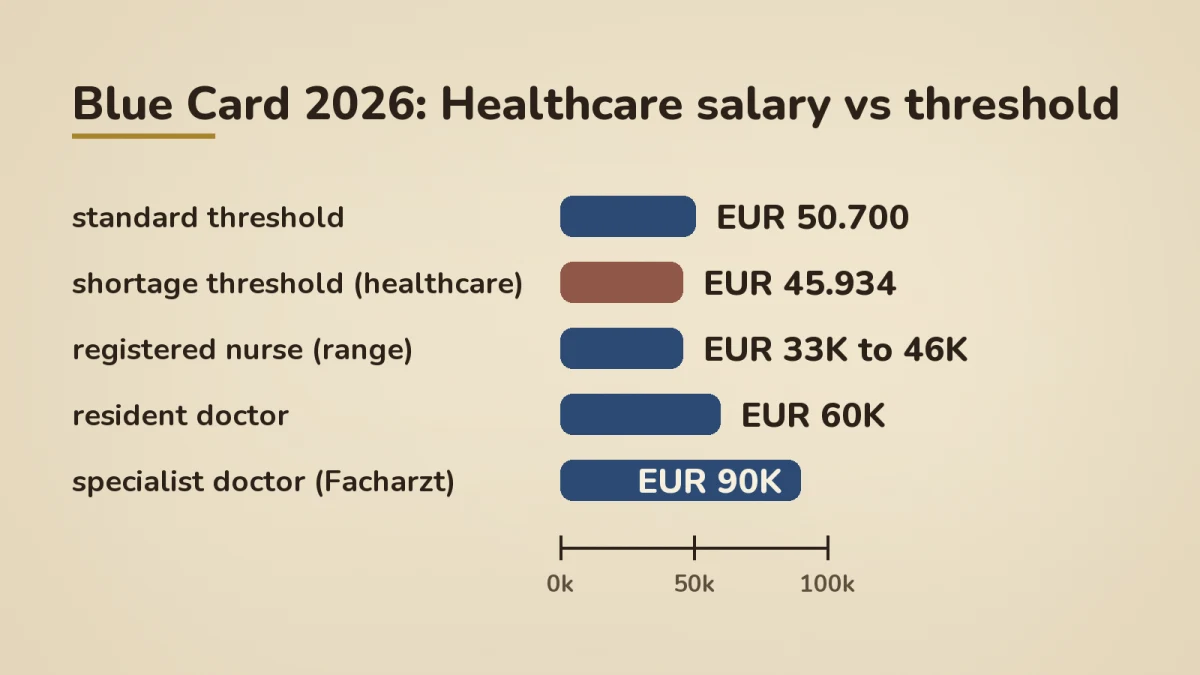
The shortage threshold is the one that matters for healthcare. A first-year resident doctor earns roughly €4,500 to €5,500 gross per month under the TV-Ärzte/VKA collective agreement, which works out to €54,000 to €66,000 per year. A specialist (Facharzt) earns €6,600 to €8,500 gross per month, or roughly €79,000 to €102,000 per year. Both clear the threshold by a wide margin.
Nurses are tighter. A recognised Pflegefachkraft earns €2,800 to €3,800 gross per month under the TVöD-P pay scale, which is €33,600 to €45,600 per year. The lower end falls below the shortage threshold, the upper end is borderline. Most large public hospitals (Charité, university clinics, big city Kliniken) pay enough to clear it once you factor in shift bonuses and the night/weekend premium. Smaller private homes and rural clinics often do not.
If your nursing offer comes in under €45,934.20, you can still come on the regular Skilled Worker Visa under section 18a, which has no minimum salary. You just lose the Blue Card's fast-track to permanent residency.
Recognition is the real bottleneck
This is where most healthcare moves stall. Germany regulates medical and nursing professions strictly, and your foreign degree is not automatically valid. You need formal recognition before any clinic can hire you in your trained role.
Doctors:
Approbation, Berufserlaubnis, Kenntnisprüfung
The Approbation is the full medical licence. It allows unrestricted practice across Germany. To get it, the relevant state authority (Landesärztekammer or Regierungspräsidium) compares your medical degree to the German curriculum. If they declare your training "equivalent", you receive the Approbation directly. If they find gaps, you sit the Kenntnisprüfung, a knowledge test covering internal medicine, surgery, and one rotating subject in German.
While the Approbation is in process, many states issue a Berufserlaubnis, a temporary permit valid for up to two years that lets you work as a doctor under supervision. Most foreign-trained doctors enter Germany on this permit, work in a hospital, and clear the Kenntnisprüfung within the two-year window.
Language: B2 general German is the federal minimum. Most states then require a Fachsprachprüfung, the medical language exam testing patient communication and clinical handover. Three of the sixteen states (Bavaria, Hessen, Schleswig-Holstein) accept C1 evidence in lieu of the Fachsprachprüfung.
Timeline reality: 6 to 18 months from application to a working Approbation. The bottleneck is document equivalence review, which varies wildly by state. Berlin and Hamburg run leaner; Bavaria and Baden-Württemberg run slower.
Nurses:
Anerkennung and Fachsprachprüfung
The nurse equivalent is called Anerkennung, the formal recognition as a Pflegefachkraft. Same logic as Approbation. The competent body in each state compares your training to the three-year German Pflegefachfrau/Pflegefachmann programme. If equivalent, you get full recognition. If gaps, you complete an adaptation course (Anpassungslehrgang) of three to twelve months at a German hospital, OR sit a knowledge test (Kenntnisprüfung).
Language: B2 general plus the Fachsprachprüfung Pflege, the nursing-specific language exam.
The 2026 fast-track is real and it matters. As of March 2026, Germany set an eight-week consulate processing target for nursing visas and a four-week recognition verdict target at credential bodies. More employers can now hire you before recognition is fully complete, on a temporary "Pflegehelfer" or "Anerkennungsstellung" contract while you finish the language exam and adaptation.
Recognition fees: roughly €100 for the application, €200 for the certificate, plus document translation and certification costs that typically add €300 to €600.
What healthcare professionals actually earn
| Role | Monthly gross | Annual gross | Clears Blue Card threshold? |
|---|---|---|---|
| Pflegefachkraft (entry, public hospital) | €2,800 to €3,200 | €33,600 to €38,400 | Borderline, often no |
| Pflegefachkraft (5+ years, public hospital) | €3,400 to €3,800 | €40,800 to €45,600 | Borderline yes |
| Specialist nurse (ICU, OR, paediatrics) | €4,000 to €4,800 | €48,000 to €57,600 | Yes |
| Assistenzarzt (resident, year 1) | €4,500 to €5,500 | €54,000 to €66,000 | Yes |
| Facharzt (specialist) | €6,600 to €8,500 | €79,000 to €102,000 | Yes |
| Oberarzt (senior physician) | €8,500 to €11,000 | €102,000 to €132,000 | Yes |
Public hospitals pay by collective agreement (TVöD-P for nurses, TV-Ärzte for doctors) so the bands are predictable. Private hospitals can pay more, but only large for-profit chains like Helios or Asklepios reliably do. Rural clinics pay TVöD-P but with fewer shift premiums, so the effective annual is lower.
Step by step from recognition to Blue Card
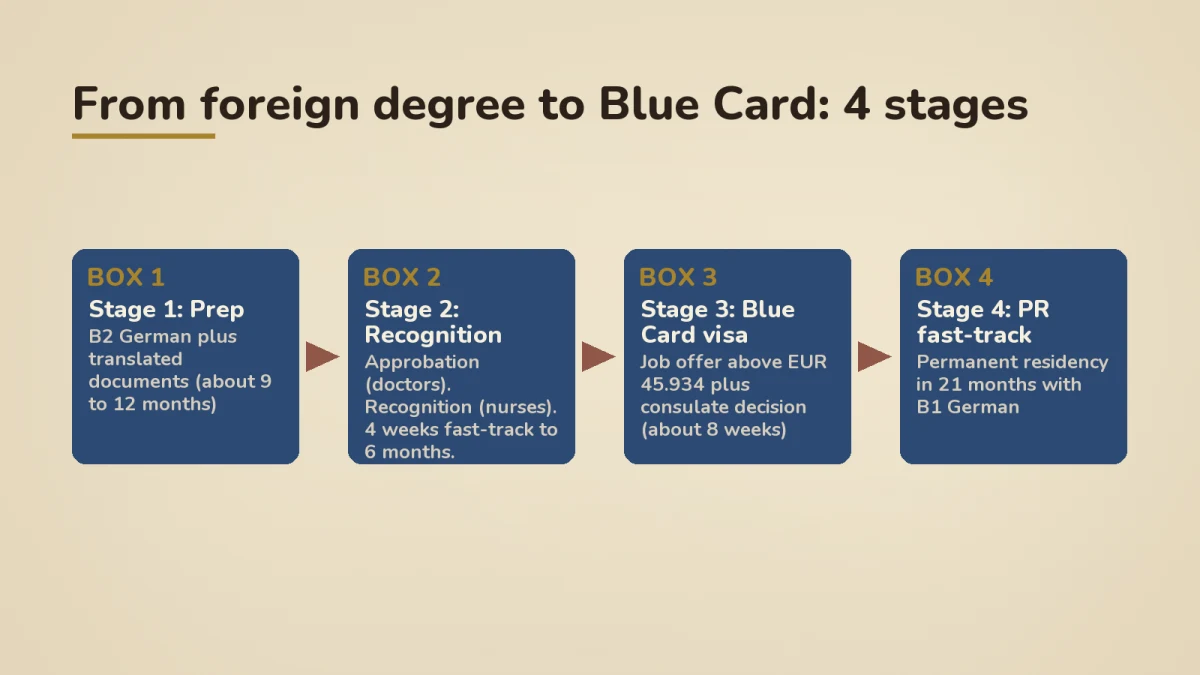
- Language first. Start B1 German before anything else. Without B1, you cannot pass the Fachsprachprüfung, which means you cannot finish recognition, which means no clinic will write a binding job offer. Goethe-Institut, telc, and ÖSD certificates are all accepted. Budget 9 to 12 months of part-time study.
- Translate and certify documents. Degree, transcript, internship records, professional registration in your home country, CV in German format. Use a sworn translator (vereidigt) listed in the Justice Ministry's database.
- Submit recognition application to the competent state authority. Search the Anerkennung-in-Deutschland portal for your specific Bundesland and profession to find the right office.
- Optional: arrive on Berufserlaubnis (doctors) or recognition partnership visa (nurses). Some hospitals sponsor you to come on a temporary work permit, finish the language exam in Germany, and clear recognition while already employed.
- Once recognition lands, your employer files for the full Blue Card via the local Ausländerbehörde or the consulate where you currently live. The pre-approval (Vorabzustimmung) typically takes four to six weeks.
- Visa decision in eight weeks (the fast-track target for nurses, longer for general healthcare). On arrival, register your address (Anmeldung), open a bank account, get health insurance, and pick up the residence permit card from the Ausländerbehörde.
Common mistakes to avoid
- Booking flights before recognition is in process. The visa hangs on the recognition file. Without a recognition reference number, the consulate will not even start your application.
- Underestimating the language gap. B1 conversational German is not B2 medical German. Plan an extra three months on top of your B1 certificate to get exam-ready for the Fachsprachprüfung.
- Picking the wrong Bundesland. Recognition rules are state-level. If your training is missing a specific module, some states require a knowledge test, others require an adaptation course, and the timelines differ. Read your target state's specific procedure before you apply.
- Accepting a salary below the shortage threshold. If your offer is €43,000 per year, the Blue Card is off the table. You can still come on the regular Skilled Worker Visa, but you give up the 21-month PR fast-track. Negotiate for the threshold.
- Skipping the Berufserlaubnis route. Many doctors think they need full Approbation before flying out. Most do not. The Berufserlaubnis lets you start working and earning German hospital wages while finishing the licence.
FAQ
Do I need German for the Blue Card itself?
No, the Blue Card has no language requirement on the visa side. But for healthcare specifically, you cannot get the underlying Approbation or Anerkennung without B2 German plus the Fachsprachprüfung. So while the Blue Card is language-free in theory, the recognition gate is not.
Can I work as a doctor in Germany without an Approbation?
Yes, on a Berufserlaubnis. It is a temporary licence valid up to two years that lets you work in a hospital under supervision while you complete the full Approbation. Most foreign-trained doctors take this route.
How long does the Anerkennung take for nurses?
Four weeks under the 2026 fast-track if your documents are complete and you submitted to a fast-track-enabled state. Three to six months under the regular procedure. If the authority requires an adaptation course or a Kenntnisprüfung, add three to twelve months.
Is the Blue Card threshold negotiable?
The threshold is fixed by federal law. What is negotiable is your salary. If your contract sits below €45,934.20 per year, you cannot get the Blue Card. Ask your employer to add overtime, shift premiums, or a base bump to clear the line. Public hospital pay scales make this hard but possible at higher experience grades.
Can my spouse work in Germany on the Blue Card family permit?
Yes, immediately and with no work restrictions. Spouses of Blue Card holders get full labour market access from day one and do not need to prove German language proficiency before joining you.
What happens if I lose my job during the Blue Card period?
You have three months to find a new qualifying job. The new offer must also meet the threshold, but it does not need to be in the same role. After 21 months on the Blue Card, you switch to permanent residency and the rules relax.
Where to next
- EU Blue Card guide for graduates, the deeper dive on Blue Card mechanics, family rules, and PR timing
- Healthcare jobs in Germany, the broader map of medical and care roles by qualification level
- Opportunity Card explained, the points-based job-seeker visa if you want to land first and find an employer locally
- The Blue Card pillar page for the full hub of related content
Continue reading
Career & Jobs·14 min read
Why Germany has 1M jobs and zero callbacks (and how to fix your application)
Germany has over 1 million open jobs but most foreign applicants get silence. Here is why your applications fail and how to fix the stack.
Read articleCareer & Jobs·15 min read
Chancenkarte Germany: Point system explained, real one-year results, who actually got in
Germany's Chancenkarte point system explained with a 6-point matrix, worked examples, and real one-year results from 2024 to 2025.
Read articleCareer & Jobs·13 min read
Universities in Berlin Offering Career Services: A Complete List
Looking for universities in Berlin offering career services? Explore our complete list of institutions providing career guidance, internships, and job placement support to help you succeed.
Read articleReady to plan your Germany journey?
Explore our tools and resources to find the perfect university and program for your academic goals.