Chancenkarte Germany: Point system explained, real one-year results, who actually got in
Germany's Chancenkarte point system explained with a 6-point matrix, worked examples, and real one-year results from 2024 to 2025.

Table of contents
Last updated: May 2026
TL;DR: Germany's Chancenkarte (Opportunity Card) is a 12-month residence permit under Section 20a AufenthG that lets non-EU professionals enter Germany to look for qualified work. You need at least 6 points across qualifications, work experience, language, age, prior stays, and partner profile. In its first year (June 2024 to June 2025) Germany issued 11,497 Chancenkartes, far below the 30,000-per-year target the federal government set, with India, China, and Turkey as the top three sending countries.
The Chancenkarte is one of the most-discussed visa routes for skilled non-EU professionals trying to relocate to Germany, but most articles still describe the announcement, not the reality. This post does both. We walk through the official 6-point matrix line by line with worked examples, then show what actually happened in year one, who got cards, who didn't, and which mistakes the data exposes. If you want the broader pillar context first, start with the Opportunity Card overview or the original what-is-opportunity-card explainer.
If you already have a job offer in Germany, the Chancenkarte is usually the wrong tool. The right one is normally an EU Blue Card under the 2026 thresholds, or, for non-degree IT specialists, a Section 19c skilled-worker visa.
What the Chancenkarte actually is
The Chancenkarte is a residence permit under Section 20a of the Residence Act (Aufenthaltsgesetz, AufenthG). It is granted to third-country nationals (non-EU, non-EEA, non-Swiss) who want to come to Germany to look for qualified employment, or to start a recognition procedure for a foreign qualification. It runs for up to one year and during that year you can:
- search for a qualified job, an apprenticeship, or self-employment;
- work part-time up to 20 hours per week in any job;
- do unpaid trial weeks of up to two weeks per employer, aimed at securing a qualified position.
The card is not a work visa. Once you have a qualified job offer, you switch from the Chancenkarte to a regular work permit at the local Ausländerbehörde, typically an EU Blue Card or a skilled-worker residence permit. If you find a qualified offer but the new permit cannot be issued immediately, the Ausländerbehörde can issue a Folge-Chancenkarte (extension) valid for up to two further years.
There are two doors into the Chancenkarte. Which one you walk through changes whether the points system applies at all.
The two routes: why most candidates need the points system
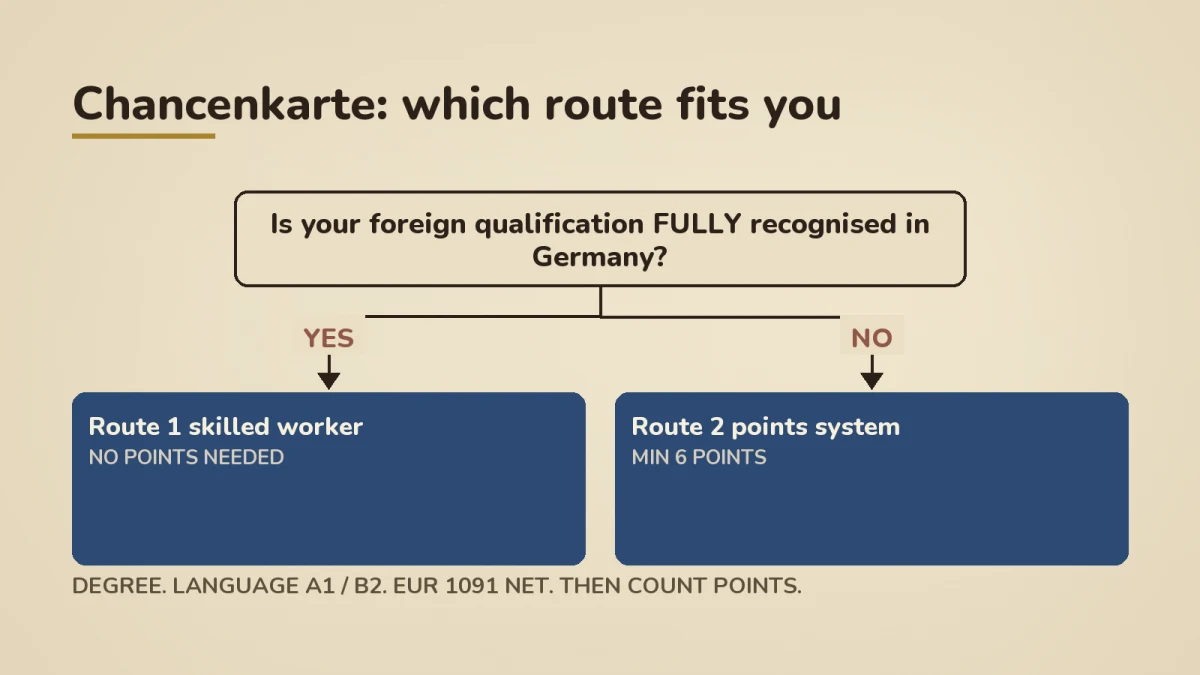
Route 1 is the skilled-worker route. If your foreign qualification has been fully recognised in Germany, or you obtained your degree or vocational training inside Germany, the Federal Foreign Office already considers you a Fachkraft. You do not run through the points table at all. You only need to prove financial means and submit the standard application.
Route 2 is the points route. Most international candidates land here, because full recognition is slow and not always achievable before applying. To use this route you need three things up front before any points are counted:
- A completed academic degree or a non-academic vocational qualification of at least two years that is recognised in the country where you trained. For an academic degree you need a positive anabin entry (a "H+" listed institution and degree) or a Statement of Comparability (Zeugnisbewertung) from the ZAB. For a vocational qualification you need a positive Digital Statement on Professional Qualification.
- German at A1 (CEFR) or English at B2. One of these is a hard floor; without it the application is rejected at intake regardless of how many points you score elsewhere.
- Financial proof of at least €1,091 per month (net amount, valid for 2026). This is usually shown via a blocked account holding the year's worth, or a Verpflichtungserklärung (declaration of commitment) from a sponsor in Germany. Part-time employment can also count if it nets at least €1,091 per month.
These are gating conditions, not point items. Miss any of them and the points calculation never starts. Score 12 points but lack a recognised qualification and the application is denied.
How the 6-point system works, line by line
Once you clear the three gating conditions, the visa officer counts your points across seven categories. You need at least 6. The categories below are the official Make-it-in-Germany matrix.
| Category | Points |
|---|---|
| Foreign qualification deemed partially equivalent by the recognition authority | 4 |
| Qualification listed in a shortage occupation (Mangelberuf) | 1 |
| Professional experience: 2 years in last 5 | 2 |
| Professional experience: 5 years in last 7 | 3 |
| German language: A2 | 1 |
| German language: B1 | 2 |
| German language: B2 or above | 3 |
| English at C1 or above (or native) | 1 |
| Age 35 or under, on the day of application | 2 |
| Age 35 to 40 (inclusive) | 1 |
| Prior legal stay in Germany of 6+ months continuous in last 5 years (study, language, or work, not tourism) | 1 |
| Spouse or partner who also meets Chancenkarte requirements | 1 |
Notes worth memorising before you score yourself:
- The two professional-experience tiers do not stack. You either get 2 (the lower tier) or 3 (the higher tier), never 5.
- The two age tiers do not stack either. The day you turn 36, the 2-point tier is gone forever.
- "Partial equivalence" is the realistic recognition outcome for most candidates. Full equivalence skips the points system entirely. Note that 4 points alone is not enough; you still need a second category to clear 6.
- Shortage occupations are listed in the BMAS Mangelberufsliste (currently the 2024 list, periodically updated). Software development, electrical engineering, mechatronics, healthcare nursing, and certain construction trades are on it.
- The English C1 point and the German A2 point can both be claimed in the same application if you have both, but you only get one point per language.
Three worked examples that actually clear 6 points
Profile A: 28-year-old Indian software engineer, 4 years experience, B1 German, no prior Germany stay. Age (under 35): 2. German B1: 2. Experience 2-in-5: 2. Shortage occupation (software development): 1. Total: 7 points. Cleared.
Profile B: 38-year-old Pakistani mechanical engineer, 6 years experience, A2 German, C1 English, partial recognition. Partial recognition: 4. Experience 5-in-7: 3. German A2: 1. English C1: 1. Shortage occupation (mechanical engineer): 1. Age 35 to 40: 1. Total: 11 points. Cleared comfortably.
Profile C: 33-year-old Filipino registered nurse, 3 years experience, B1 German, partial recognition, six-month language stay in Berlin in 2023. Partial recognition: 4. Experience 2-in-5: 2. German B1: 2. Age under 35: 2. Prior stay 6+ months: 1. Shortage occupation (healthcare nursing): 1. Total: 12 points. Cleared comfortably.
The pattern across these three: most successful applicants combine partial recognition or age with a language tier and professional experience. Almost no one clears the bar on age alone, and English-only candidates need clean experience plus shortage status to bridge the gap.
What actually happened in year one
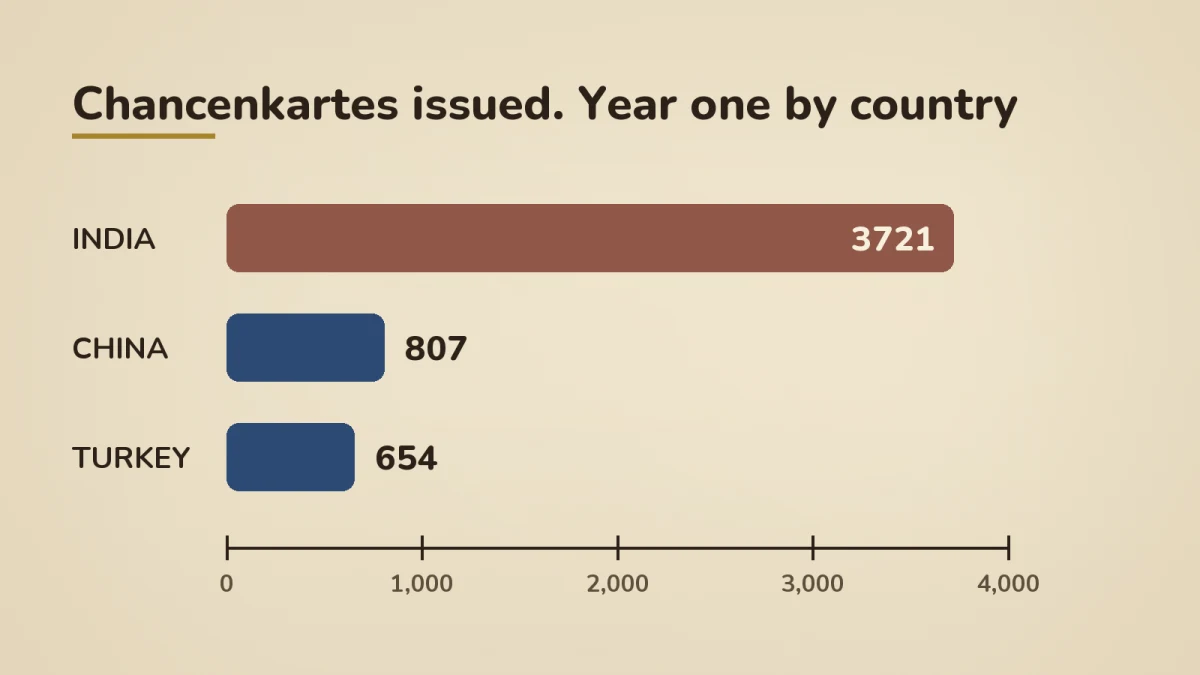
Between 1 June 2024 and 15 June 2025, Germany issued 11,497 Chancenkartes worldwide. The federal government had estimated 30,000 cards a year when the law was drafted in 2023; year one came in at roughly 38% of that target. The Federal Foreign Office cites administrative ramp-up, missing-document rejections, and a gradual digital rollout as the main reasons.
The country breakdown is dominated by India, with China and Turkey trailing.
| Country | Chancenkartes issued (June 2024 to June 2025) | Share of total |
|---|---|---|
| India | 3,721 | 32.4% |
| China | 807 | 7.0% |
| Turkey | 654 | 5.7% |
| Russia, Pakistan, and others | balance | 54.9% |
Two findings from the year-one review that don't make most explainer posts:
- The 67% pass rate is misleading. In the first half of 2025, 67% of users who completed the official Make-it-in-Germany self-check met the requirements on paper. That is not the visa-grant rate at the consulate. The grant rate is materially lower because real applications get caught on document quality, financial proof, and qualification recognition timelines, not on the points themselves.
- Demand is shifting from points-route to recognition-route applications. The German Centre for Integration and Migration Research (DeZIM) found that 2025 application volumes climbed compared to late 2024, but the share with already-recognised qualifications grew faster than points-route applications. The system is rewarding people who finished the recognition procedure before applying.
The takeaway for 2026 applicants: the points system works, but the consulate weighs documentation quality and recognition status more than the headline 6-point bar suggests.
Step-by-step: applying via digital.diplo.de
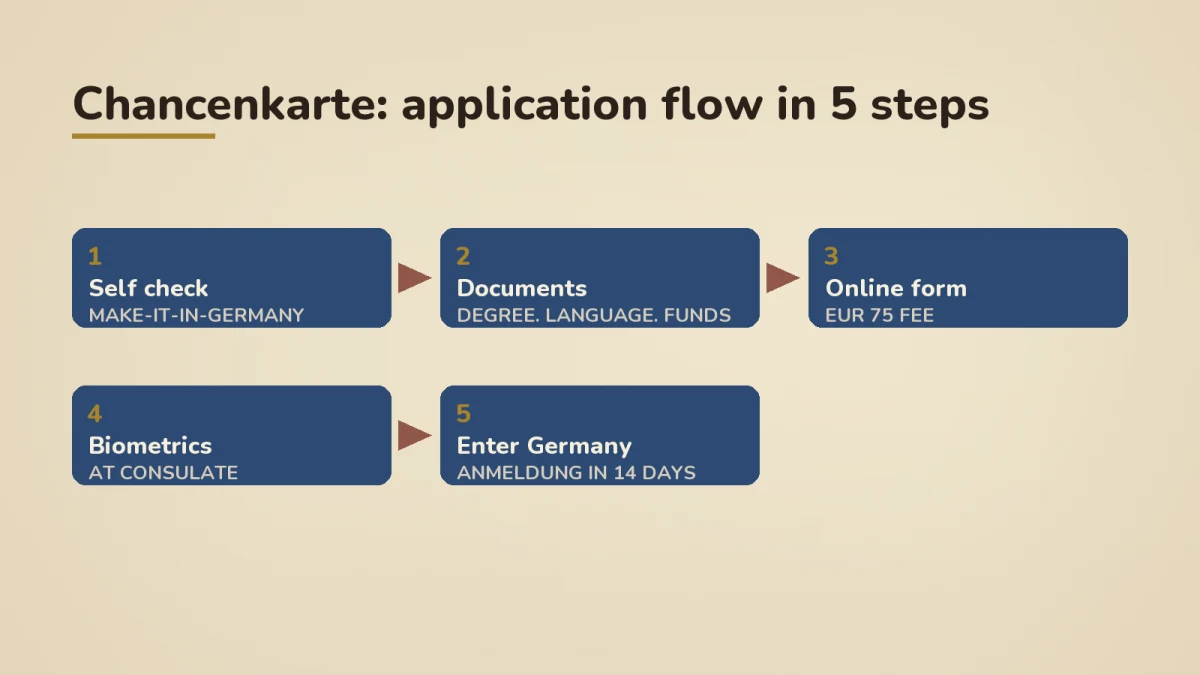
Since 1 January 2025, the entire Chancenkarte application runs through the Federal Foreign Office's Consular Services Portal at digital.diplo.de. A personal appointment at the German diplomatic mission is still required at the end, but everything before it is online. The five-stage flow:
- Self-check. Complete the official self-check at make-it-in-germany.com. The tool asks the same questions the consular officer will, in the same order. If the result is negative, fix the gap before you spend any money on document translations.
- Document preparation. Collect: passport (validity beyond 12 months), qualification certificate plus anabin printout or ZAB Statement of Comparability, language certificate (Goethe, telc, or ÖSD for German; IELTS, TOEFL, or Cambridge for English), proof of work experience (employer letters, payslips, social-security records), and financial proof (blocked account or Verpflichtungserklärung).
- Online application via digital.diplo.de. Register, open the Chancenkarte form, fill in the personal data, upload all evidence as PDFs, and pay the €75 application fee online.
- Biometric appointment. The portal issues an appointment slot at the relevant German consulate. You attend in person to give fingerprints and the original signed application. Typical processing window from this point: 4 to 12 weeks, varying significantly by consulate (New Delhi runs longer than most).
- Visa issued, travel, register. With the Chancenkarte stamped in your passport, you enter Germany within the validity window, complete Anmeldung at the Bürgeramt within 14 days, get a Steuer-ID, and start the qualified-job search.
The portal accepts the application from anywhere in the world, but the biometric appointment must be at the consulate covering your country of residence.
Common mistakes that get applications denied
The most expensive errors in year one weren't on the points side. They were on the prerequisites and documentation side.
- Submitting before recognition is done. Many candidates open the file at the consulate while their ZAB or anabin assessment is still in progress. The application is rejected for "qualification not yet established," not for low points.
- Missing the language certificate window. The CEFR certificate must be valid (typically issued within the last two years). Older certificates trigger rejection even if the language ability is real.
- Blocked-account amount based on the wrong year. The 2026 monthly threshold is €1,091 net, so a 12-month opportunity card needs around €13,092 if no other income source covers it. A 2024 figure (around €11,208 used for student visas in 2024) gets the file kicked back.
- English-only without C1 evidence. Applying with only English typically requires the C1 certificate or proof of native speaker status. B2 alone qualifies for the gating condition but does not score the +1 English point.
- Counting "partially equivalent" before it has been formally issued. The 4-point recognition score requires a formal partial-equivalence determination from the recognition authority, not just an anabin H+ entry. Treat anabin as the gating condition; treat formal partial recognition as the points trigger.
- Treating the self-check as a guarantee. It is a non-binding indicator. If the self-check passes on borderline data (exactly 6 points, 6-month stay self-claimed without passport stamps), expect intensive document review at the consulate.
Chancenkarte vs Blue Card vs Job Seeker Visa: pick the right route
The Chancenkarte is one of three main routes for non-EU professionals to enter Germany. The decision turns on whether you have a job offer, the salary on offer, and whether your degree is fully recognised.
| Question | Right route |
|---|---|
| Do you already have a qualified job offer with salary at or above €50,700 (general) or €45,934.20 (shortage / recent graduate) in 2026? | EU Blue Card |
| Do you have a qualified job offer below the Blue Card thresholds, but above standard wage levels? | Skilled Worker Visa (Section 18b AufenthG) |
| No job offer yet, foreign degree fully recognised? | Chancenkarte via Route 1 (skilled-worker route, no points) |
| No job offer yet, foreign degree only partially recognised or pending? | Chancenkarte via Route 2 (points system, ≥6 points) |
| German graduate seeking a job in Germany? | 18-month post-study Job Seeker Permit (Section 20 AufenthG, not Chancenkarte) |
Two facts to lock in: the Blue Card pays better long-term (faster permanent residency, family reunification, mobility across the EU), and the Chancenkarte is the lower-friction entry route when you have time to job-hunt on the ground but no offer yet. If you can credibly secure an offer from your home country, target the Blue Card. If you cannot, the Chancenkarte buys you a year inside Germany to land one.
Frequently Asked Questions
Can I apply for the Chancenkarte from inside Germany?
Generally no. The Chancenkarte is intended as an entry visa, applied for at the German mission abroad responsible for your country of residence. If you are already in Germany on another residence permit and want to switch, you contact the local Ausländerbehörde, not the consulate, and the rules are stricter; switching is allowed only in specific cases (e.g. completion of a recognition measure on a different permit).
How many points do most successful applicants score?
The federal government has not published a points-distribution table for issued cards. From the worked examples in the official guidance and consultancies' anonymised case data, most approved points-route applicants score between 7 and 11. Scoring exactly 6 is allowed but means zero margin for documentation challenges; build a profile to 8+ if you can.
Can I bring my spouse and kids on the Chancenkarte?
If your spouse independently meets the Chancenkarte requirements (degree, language, points), you can apply together and enter at the same time. Otherwise, family reunification is not possible during the Chancenkarte itself. Once you secure qualified employment and switch to a Blue Card or skilled-worker permit, you can apply for spouse and child reunification under standard Section 30 / 32 rules.
What happens if I don't find a qualified job in 12 months?
You leave Germany. The Chancenkarte cannot be extended for another job-search period. The only extension is the Folge-Chancenkarte, which requires that you have already received a qualified job offer for which a regular work permit cannot yet be issued; it bridges the administrative gap, not a continued job search.
Is the Chancenkarte better than the EU Blue Card?
Different tools. The Blue Card is better once you have a qualifying job offer: it pays more long-term, gets you to permanent residency faster (21 months with B1 German, 27 months without), and lets you bring family from day one. The Chancenkarte is better when you have no offer yet and want a year on the ground in Germany to land one. Compare them in detail in our Blue Card Germany 2026 guide.
Can IT professionals without a degree use the Chancenkarte?
Yes, but it is rarely the best route. Section 19c AufenthG offers a standalone work visa to IT specialists with at least 2 years of relevant experience and a job offer paying at least 45 percent of the annual contribution ceiling of the statutory pension insurance (§6 of the Employment Ordinance, BeschV). For non-degree IT professionals with an offer in hand, Section 19c beats the Chancenkarte on every dimension: longer permit, family reunification, faster permanent residency.
Does the points system penalise people over 40?
It doesn't penalise, but it stops rewarding. From age 41 onwards you score zero on the age category and need to clear the 6-point bar from qualifications, recognition, language, and experience alone. With partial recognition (4) plus 5+ years experience (3) plus B1 German (2), a 45-year-old still hits 9 points without any age contribution.
Where can I check my points before applying?
Use the official Make-it-in-Germany self-check for the binding-on-paper version. Treat it as a pre-flight check, not a guarantee. The MS in Germany visa eligibility checker covers the full set of German skilled-worker routes if you want to compare options.
Where to next
- Start with the Opportunity Card pillar page for the official MS in Germany overview.
- Read the EU Blue Card Germany 2026 guide if your salary is above €45,934.20 (the 2026 lower threshold).
- For India-specific Blue Card mechanics, see our Blue Card guide for Indian applicants.
- Run a 90-second visa eligibility check to compare the Chancenkarte against Blue Card and skilled-worker routes side by side.
Continue reading
Career & Jobs·8 min read
Should you move to Germany in 2026? What the data actually says
Should you move to Germany in 2026? The 2026 data on births, deaths, shortage occupations, sectors hiring, and the routes that work.
Read articleCareer & Jobs·14 min read
Why Germany has 1M jobs and zero callbacks (and how to fix your application)
Germany has over 1 million open jobs but most foreign applicants get silence. Here is why your applications fail and how to fix the stack.
Read articleCareer & Jobs·11 min read
International student work rules Germany 2026: The new 140-day cap, 20-hour rule, real take-home pay
Germany raised the international student work cap to 140 full days from 2024. Werkstudent rules, the 20-hour weekly limit, and 2026 take-home pay explained.
Read articleReady to plan your Germany journey?
Explore our tools and resources to find the perfect university and program for your academic goals.