EU Blue Card Germany 2026: New salary thresholds, IT-without-degree route, faster PR
EU Blue Card Germany 2026 thresholds raised to €50,700 standard and €45,934.20 shortage. IT specialists qualify without a degree under §18g. PR in 21 months at B1, spouse joins with no German required. Full guide for working professionals.

Table of contents
Last updated: May 2026
TL;DR: From 1 January 2026, the EU Blue Card Germany salary thresholds rose to €50,700 gross/year for standard occupations and €45,934.20 for shortage occupations, recent graduates, and qualifying IT specialists. IT pros without a degree can apply under §18g AufenthG with three years of relevant experience. Permanent residency drops to 21 months with B1 German, and your spouse can join you with no German requirement and immediate full work rights.
The EU Blue Card is still the fastest, cleanest route into Germany for skilled non-EU professionals in 2026. The thresholds went up about five percent on 1 January, the IT-specialist-without-degree route is fully live, and the permanent residency timeline is sharper than most other German work visas. If you have a job offer and a recognised qualification, this is almost certainly the path you want.
This guide is the 2026-current standalone for working professionals. Our older EU Blue Card guide for Indian students covers the post-Master's framing; bookmark this one if you are relocating with an existing offer or already have years of work experience. The pillar page on the Blue Card route has the full route map.
What is the EU Blue Card and who qualifies in 2026
The EU Blue Card is a residence permit for highly qualified non-EU nationals working in Germany. It is governed by §18g of the German Residence Act (AufenthG) and gives you the right to work, stay, bring family, and after a short waiting period apply for permanent residency.
To qualify in 2026 you need three things at the same time:
- A recognised university degree, or for IT specialists, three years of qualifying experience in the last seven years.
- A binding job offer from a German employer of at least six months, in a role matching your qualification.
- A gross annual salary that meets the threshold below.
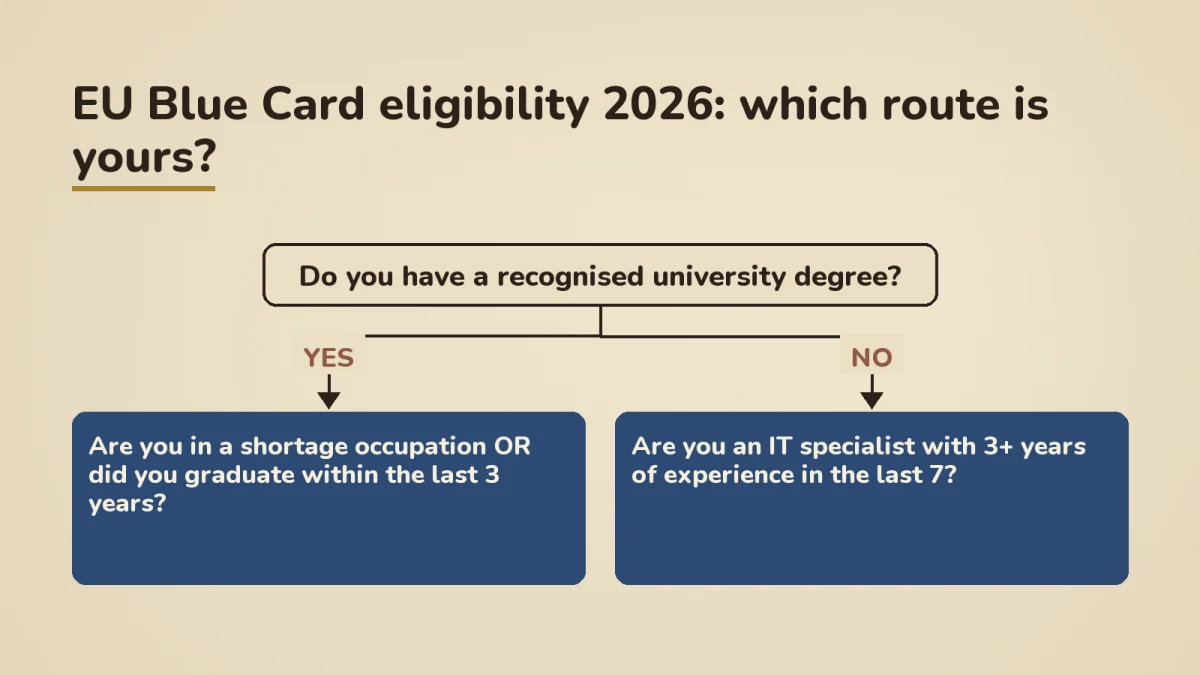
The salary threshold is the make-or-break number. The Ausländerbehörde applies whichever threshold is in force on the start date of employment, not the application date. If your contract was signed in late 2025 against the 2025 thresholds, you renegotiate before submitting. There is no grandfathering.
EU Blue Card Germany 2026 salary thresholds
The Federal Ministry of the Interior sets the thresholds annually, indexed to the German pension contribution assessment ceiling. The 2026 figures are:
| Threshold type | 2026 gross annual salary | Approx. monthly | Federal Employment Agency approval needed |
|---|---|---|---|
| Standard | €50,700 | €4,225 | No (auto-cleared) |
| Reduced (shortage occupations, recent graduates, IT specialists without degree) | €45,934.20 | €3,828 | Yes (handled inside the visa procedure) |
The reduced threshold is roughly 91% of the standard one, so most engineers, IT specialists, doctors, and STEM PhDs slot straight into it. The reduced rate also applies for three years after your most recent academic qualification, regardless of profession, which captures recent graduates from German universities entering full-time roles.
These figures are about five percent above 2025. Make-it-in-Germany, the federal portal, and the German Federal Employment Agency both publish the binding numbers each December for the year ahead.
Who counts as a "shortage occupation" in 2026
The reduced threshold applies to roles on the Federal Employment Agency's shortage occupation list (Engpassberufe), which currently runs to roughly 163 occupations spanning:
- IT and communications technology (software development, cybersecurity, systems administration, data analysis)
- Engineering (mechanical, electrical, civil, automotive, mechatronics)
- Natural sciences and mathematics
- Medicine and pharmacy (regulated; needs ZAB or chamber recognition)
- Skilled trades on the demand list
- Early-childhood education and certain teaching roles
If your role is on the list, the lower threshold and the family-friendly rules apply automatically, and the Federal Employment Agency approval is bundled into the visa procedure. You do not file a separate Bundesagentur application. We track the full list in our shortage-occupation deep dive (publishing in August 2026); for the canonical version, the Bundesagentur für Arbeit publishes the Fachkräfteengpassanalyse twice a year.
The IT specialist without a degree route (§18g AufenthG)
This is the single biggest 2026 opportunity for software developers, security engineers, data engineers, and DevOps specialists who never finished a formal computer-science degree. The route exists under §18g of the Residence Act and was introduced by the 2023 Skilled Immigration Act. It is not new in 2026, but it is now widely understood by employers and embassies, which makes the application materially smoother than in 2024.
You qualify under §18g if all of the following are true:
- You have at least three years of relevant IT professional experience within the last seven years.
- The experience is at a "university graduate level", i.e. genuine engineering work, not user support or QA-test execution.
- The experience is a prerequisite for the German role being offered.
- Your contract meets the reduced threshold of €45,934.20.
- The Federal Employment Agency approves (handled in the visa procedure).
The experience you cite must be documented. Pay slips, employment certificates with detailed task descriptions, project lists, GitHub or LinkedIn references, technical test results, and conference talks all help. Vague "Software Engineer III" titles without supporting documentation are the most common reason §18g applications get rejected. Build the documentation before you file.
Fast-track to permanent residency
Blue Card permanent residence (Niederlassungserlaubnis) timelines were shortened on 1 March 2024 and remain in force through 2026:
| German level | Months of qualifying employment to PR |
|---|---|
| A1 (default) | 27 months |
| B1 | 21 months |
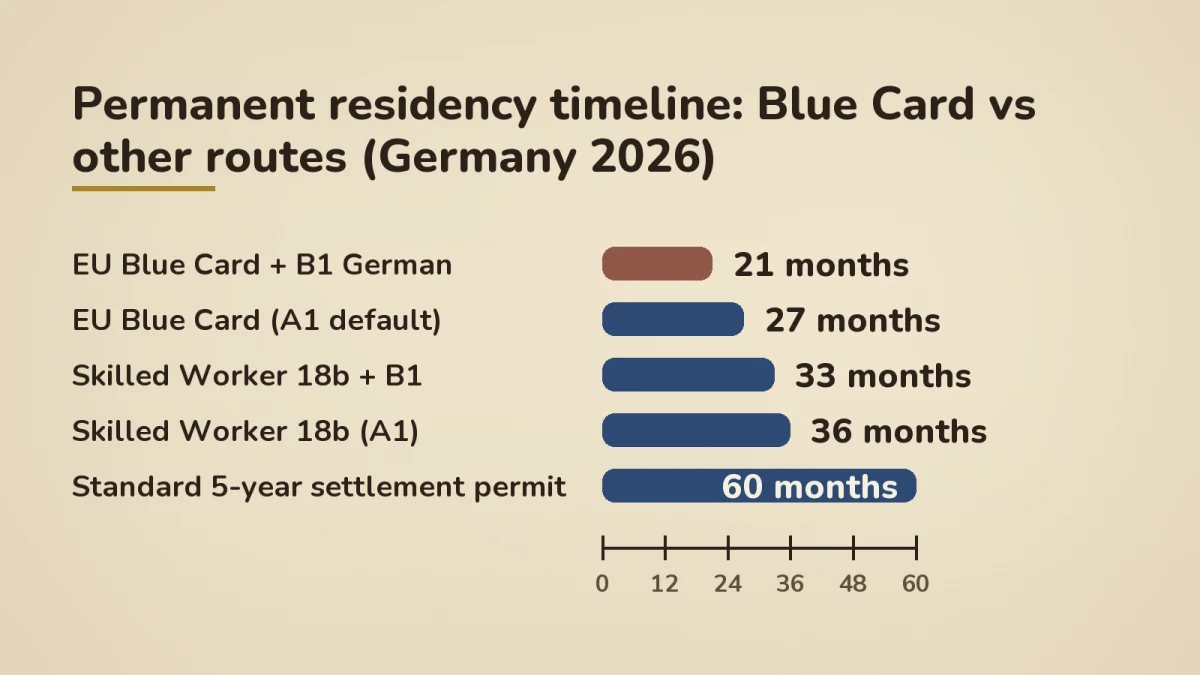
Compare this to the standard route for non-Blue-Card skilled workers, which is 36 months at A1 or 33 at B1, and the regular five-year settlement permit for everyone else. The Blue Card is the fastest non-EU route to a German settlement permit.
The 21-month B1 path is the value play. Eight to twelve months of consistent A2 → B1 study while you settle in is realistic, particularly if your employer offers a part-funded language allowance. The B1 certificate must be a recognised exam result (telc, Goethe-Zertifikat, ÖSD, or TestDaF for the relevant module) at the time of PR application. Schools and apps that issue self-assessed "B1" certificates do not count.
For the broader fast-track PR routes in Germany including how the Blue Card stacks against the §18b skilled-worker route, read the dedicated piece.
What the Blue Card unlocks for your family
This is where the Blue Card pulls clear daylight from every other German work visa.
Spouse joins without German. Spouses of Blue Card holders are not required to demonstrate A1 German before arrival. They get a residence permit on the same timeline as you and can join while you are still in your first year. The default A1 pre-arrival rule that applies to spouses of regular skilled workers does not apply here.
Spouse works immediately. From the date of the residence permit, your spouse has unrestricted right to work in Germany. No separate work permission, no industry restriction, no employer pre-approval. They can take a salaried job, freelance, start a business, or stay home; the choice is theirs.
Children get the dependent permit straight away. Minors get residence permits tied to your Blue Card. They can attend public school, are covered by your statutory health insurance, and are eligible for Kindergeld once you meet the residency conditions.
For the documents and exact procedure, see our German Family Reunion Visa guide. The timelines and document set for the spouse are largely the same; the absence of the A1 prerequisite is the Blue Card's specific advantage.
EU mobility after 12 months
After 12 months of holding your German EU Blue Card, you can move to another EU member state for employment under the cross-border procedure set out in EU directive 2021/1883. You file a Blue Card application in the new country and your existing German status counts toward the qualification check. The national German work visa under §18b gives you no comparable portability inside the EU.
In practice, mobility is most useful for professionals on a multi-year European arc, for example a software engineer who wants to live in Berlin for two years and then Amsterdam for two more. The Blue Card makes that legally clean.
Application process step by step
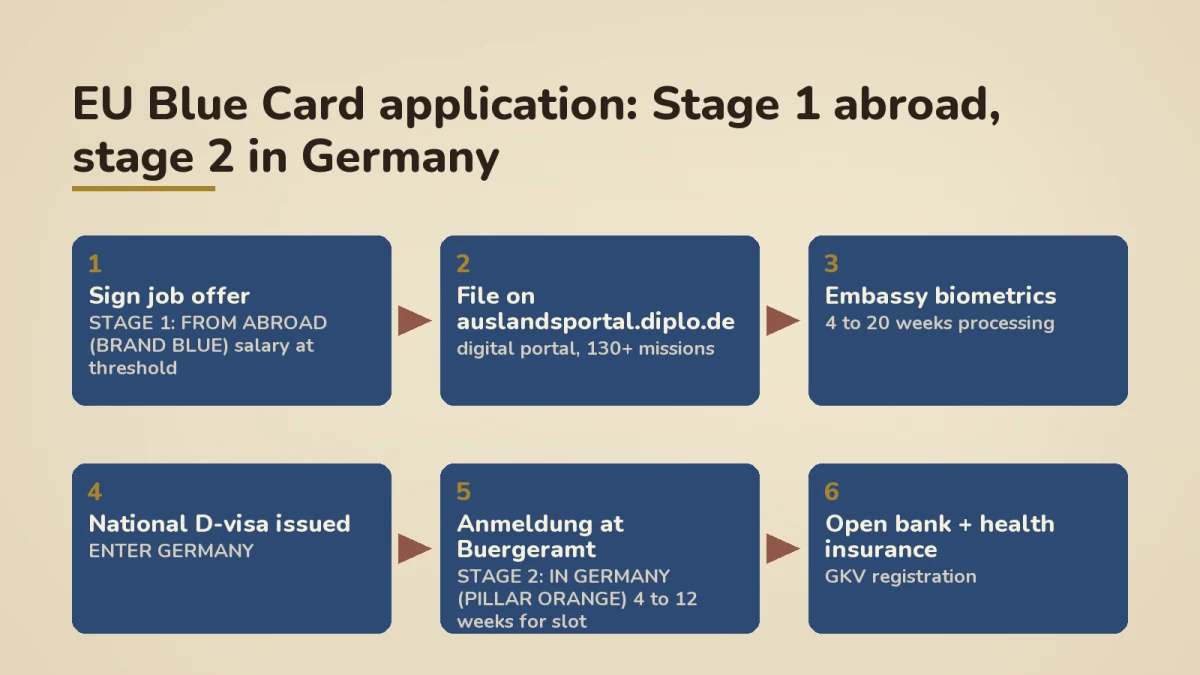
The application splits into two stages depending on whether you are abroad or already in Germany.
Stage 1:
National visa application from abroad
You file the national visa (D-visa) application at the German embassy or consulate in your country of residence. The required documents are:
- Signed employment contract or binding job offer specifying gross annual salary, role, and start date.
- Recognised university degree certificate, or for §18g IT applicants, the experience evidence package described above.
- Proof of health insurance covering the period from arrival until employment starts.
- Completed application form on the digital portal (auslandsportal.diplo.de). See our step-by-step digital.diplo.de portal walkthrough for the full upload checklist at each stage. Most German missions including New Delhi, Mumbai, Chennai, Bengaluru, Manila, Cairo, and Lagos now require digital filing.
- Biometric passport photo and valid passport.
- ZAB Statement of Comparability if your degree is from a country whose qualifications need formal recognition. Our ZAB guide walks through that procedure.
Processing time at German missions abroad runs four to twenty weeks depending on volume. New Delhi and Mumbai have been on the longer end of that range since the 2023 Skilled Immigration Act reforms increased applications. Plan with the upper bound, not the lower.
Stage 2:
Residence permit after entry
Once you arrive on the national visa you have 90 days to:
- Complete Anmeldung (residence registration) at your local Bürgeramt.
- Open a German bank account and register for statutory health insurance.
- Book and attend the Ausländerbehörde appointment to convert the visa into the actual EU Blue Card residence permit.
The Ausländerbehörde appointment involves submitting originals, biometrics capture, and a fee (typically €100 to €115). The card is mailed within a few weeks.
The Anmeldung step has become the practical bottleneck across major German cities. Berlin, Munich, and Hamburg currently run four to twelve weeks for an appointment slot. We are publishing a separate Anmeldung 2026 deep-dive on Friday with city-specific tactics.
Changing jobs after you have the Blue Card
For job changes within the first two years of holding the Blue Card you need prior approval from the Ausländerbehörde. The new role must continue to meet the salary threshold and qualification fit. Approval is usually fast (two to four weeks) provided the new contract is at or above your current threshold.
After two years, job changes within a qualifying field generally do not require prior authorisation, though you should still notify the authority of the change. A drop in salary that pushes the role below the applicable threshold can affect your renewal at year four, so make sure the new contract holds the line.
A temporary salary reduction during parental leave or illness does not invalidate the Blue Card. Permanent salary reductions below the threshold do, and the authority will examine renewal applications carefully.
Common reasons applications get rejected
The Federal Foreign Office and embassy posts publish refusal data; the same four mistakes drive most rejections.
- Salary shortfall. Contracts written against 2025 figures applied to 2026 starts. Renegotiate before filing.
- Wrong shortage classification. A role labelled "data scientist" when the actual job description reads like business analyst will be reclassified by the Federal Employment Agency and may not qualify for the reduced threshold.
- Incomplete qualification recognition. Missing ANABIN entry, missing ZAB Statement of Comparability, missing transcript translations. The fix is to start the ZAB process at least three months before filing.
- §18g experience not documented. IT specialists citing experience without pay slips, employment certificates, or detailed project descriptions. Build the file before you submit.
Reapplications after rejection are common and routine. The cost is the lost time, not the procedure itself.
Blue Card or Chancenkarte: which one in 2026?
If you already have a German job offer that meets the threshold, the Blue Card is the answer. End of question.
If you do not yet have an offer, the Chancenkarte (Opportunity Card) is the entry vehicle. It is a points-based job-seeker visa launched in June 2024 that lets you enter Germany for up to one year to look for work. Once you find a Blue-Card-qualifying job inside Germany you switch to the Blue Card without leaving the country.
The two routes are not mutually exclusive; they serve different stages of relocation. For the points system, the one-year results data, and worked scoring examples, see our Chancenkarte point system explainer (publishing tomorrow).
If you want the high-level Blue Card vs Chancenkarte head-to-head with a decision tree, the Blue Card vs Chancenkarte 2026 compare post lands in late June.
What we recommend
For most working professionals reading this, the playbook is:
- Confirm your qualification is in ANABIN. If it is not, start a ZAB Statement of Comparability now.
- Identify whether your role is on the shortage list. If yes, you are targeting €45,934.20; if no, €50,700.
- Negotiate the offer to land at or above the applicable threshold. German employers know the figures; this is a normal conversation, not a stretch. Before signing, check the contract clauses that decide your German job: probation, §622 notice, Kündigungsschutz, and non-compete.
- Open the auslandsportal.diplo.de application as soon as the offer is signed. Embassy slots in New Delhi and Mumbai book out three to six weeks ahead.
- Plan for B1 German inside the first year. The 21-month PR vs 27-month gap is meaningful for citizenship math (you need five years legal residence for citizenship after the 2025 reforms, and PR is a precondition for some civil-service roles).
- If your spouse is moving with you, gather their documents in parallel. The simultaneous filing keeps everyone on the same arrival timeline.
For the broader pay context across German tech, healthcare, and engineering, see pay scale in Germany.
FAQ
What is the minimum salary for the EU Blue Card Germany 2026?
The minimum gross annual salary is €50,700 for standard occupations and €45,934.20 for shortage occupations, recent graduates, and qualifying IT specialists. The threshold in force on your employment start date is what counts.
Can IT specialists without a degree get the EU Blue Card in 2026?
Yes. Under §18g AufenthG, IT specialists qualify with at least three years of relevant IT experience in the last seven years, university-graduate-level work, an offer that meets the €45,934.20 reduced threshold, and Federal Employment Agency approval (handled inside the visa procedure).
How long until permanent residency with the Blue Card?
27 months at A1 German, 21 months at B1. You need to have made qualifying social security contributions throughout. This is the fastest non-EU route to a Niederlassungserlaubnis in Germany.
Does my spouse have to learn German before joining me?
No. Spouses of EU Blue Card holders are exempt from the standard A1-pre-arrival language requirement and have unrestricted right to work in Germany from day one of their residence permit.
How long does the EU Blue Card application take?
Embassy processing runs four to twenty weeks depending on the mission's volume. New Delhi and Mumbai have been on the longer end through 2024 to 2026. After arrival, the Ausländerbehörde residence-permit step adds another four to eight weeks once you have your Anmeldung.
What if my contract was signed against 2025 thresholds and I start in 2026?
The 2026 threshold applies. If your contract is below the 2026 figures you have to renegotiate before filing. There is no grandfathering and no grace period.
Can I switch from Chancenkarte to Blue Card inside Germany?
Yes, and this is the standard path for professionals who arrive on the Chancenkarte to job-search. Once you have an offer that meets the Blue Card requirements you apply for the change of status at the Ausländerbehörde without leaving Germany.
Is the EU Blue Card the same as the German national work visa?
No. The EU Blue Card is governed by EU directive 2009/50/EC (recast 2021/1883) and gives you EU-wide mobility after 12 months. The national German work visa under §18b applies only inside Germany. Where both routes are available, the Blue Card is generally the better choice because of the family rules, the faster PR timeline, and the EU portability.
Where to next
- Already have an offer below the threshold? Read pay scale in Germany before going back to the negotiation.
- No offer yet? Start with the Opportunity Card / Chancenkarte explainer.
- Qualification not recognised in ANABIN? Open the ZAB process first.
- Bringing family? The German Family Reunion Visa guide covers the spouse and children documents and timeline in detail.
- After 21 months, head to fast-track PR Germany for the Niederlassungserlaubnis application checklist.
Need a personalised assessment of your case? Book a consultation with the MS in Germany team and we will walk through your qualification, salary, and timeline against the 2026 rules.
Continue reading
Career & Jobs·8 min read
Blue Card Germany for IT professionals: Salary band, employer sponsorship, top hiring cities
How IT professionals qualify for the EU Blue Card in Germany 2026, salary thresholds, employer sponsorship rules, and the top hiring cities for tech.
Read articleCareer & Jobs·11 min read
Blue Card vs Chancenkarte: Which one should you actually apply for in 2026
EU Blue Card or Chancenkarte for Germany? The Blue Card is for those with a job offer; the Opportunity Card is for job seekers. Here is how to pick in 2026.
Read articleCareer & Jobs·15 min read
Chancenkarte Germany: Point system explained, real one-year results, who actually got in
Germany's Chancenkarte point system explained with a 6-point matrix, worked examples, and real one-year results from 2024 to 2025.
Read articleReady to plan your Germany journey?
Explore our tools and resources to find the perfect university and program for your academic goals.