Blue Card vs Chancenkarte: Which one should you actually apply for in 2026
EU Blue Card or Chancenkarte for Germany? The Blue Card is for those with a job offer; the Opportunity Card is for job seekers. Here is how to pick in 2026.

Table of contents
Last updated: May 2026
TL;DR: Apply for the EU Blue Card if you already have a German job offer that meets the 2026 salary threshold (€50,700 standard, or €45,934.20 in shortage and new-graduate roles). Apply for the Chancenkarte (Opportunity Card) if you do not have an offer yet and want up to 12 months on the ground in Germany to find one. They are not competing options for the same person; they answer different questions at different stages.
You are reading this because two German visas keep showing up in the same search result and nobody is explaining the difference cleanly. The short version: the EU Blue Card is a work residence permit you collect after a German employer hires you. The Chancenkarte is a job-search visa you collect to enter Germany and look for that employer in person. Most people will use both, in that order. The detailed comparison page at Blue Card vs Opportunity Card walks through the side-by-side mechanics; this post answers the question that matters most: which one applies to your situation today.
If you want the deeper standalone explainers, the EU Blue Card guide covers eligibility, processing time, and Ausländerbehörde steps, and the What is the Opportunity Card post covers the points table and trial-work rules. This post is the bridge between them.
The short answer in one paragraph
Use the EU Blue Card if you have a confirmed job offer in Germany matching your degree, with a contract of at least six months, and a gross annual salary at or above the 2026 threshold. Use the Chancenkarte if you have a recognised qualification but no German job offer yet, you score at least six points in the Bundesregierung's points table, and you can support yourself for up to a year in Germany while looking for work. The Blue Card is the destination. The Chancenkarte is the runway. If you already have the destination, skip the runway.
What each visa actually is
EU Blue Card (Blaue Karte EU)
Issued under Section 18g of the Residence Act (AufenthG), the EU Blue Card is the residence permit Germany hands to skilled non-EU workers with an academic-level qualification and a qualifying job offer. It is valid for the contract length plus three months, capped at four years per issue, and renewable. Two routes exist: the standard route (any qualified job with a high-enough salary) and the shortage-occupation route (lower salary threshold, plus Federal Employment Agency approval). New graduates with a degree obtained less than three years ago use the lower threshold for any profession.
Chancenkarte (Opportunity Card)
Introduced 1 June 2024 under Germany's Skilled Immigration Act 2.0, the Chancenkarte is a points-based job-search residence permit. You enter Germany for up to 12 months to find qualified work. During that period you can take part-time jobs of up to 20 hours per week and trial work full-time at any one employer for up to two weeks. There are two doors in: a "fast door" if your foreign qualification is already fully recognised by the German recognition body (ZAB or the relevant federal agency), and the "points door" if it is not. Most people use the points door.
2026 thresholds at a glance
The numbers below were published by the Federal Ministry of the Interior and Community for 2026. They re-index each calendar year, so check the official portal before you sign a contract.
| Topic | EU Blue Card 2026 | Chancenkarte 2026 |
|---|---|---|
| Need a job offer first? | Yes, contract at least 6 months | No |
| Standard salary threshold | €50,700/year gross | Not applicable |
| Shortage-occupation salary threshold | €45,934.20/year gross | Not applicable |
| New-graduate (<3 yrs since degree) salary threshold | €45,934.20/year gross | Not applicable |
| IT specialist without formal degree | €45,934.20/year gross | Not applicable |
| Points required | Not applicable | 6 minimum |
| Visa validity | Contract length + 3 months, max 4 years | Up to 12 months |
| Part-time work allowed during visa? | Full-time job is the visa | Yes, up to 20 hrs/week |
| Trial work at potential employer? | Not relevant | Yes, full-time up to 2 weeks |
| Family reunification on day one? | Yes | No, only after switching to a longer permit |
| Path to settlement permit (PR) | 21 months with B1, 27 months with A1 | Convert to Blue Card or Skilled Worker first |
Decision tree: pick one in 60 seconds
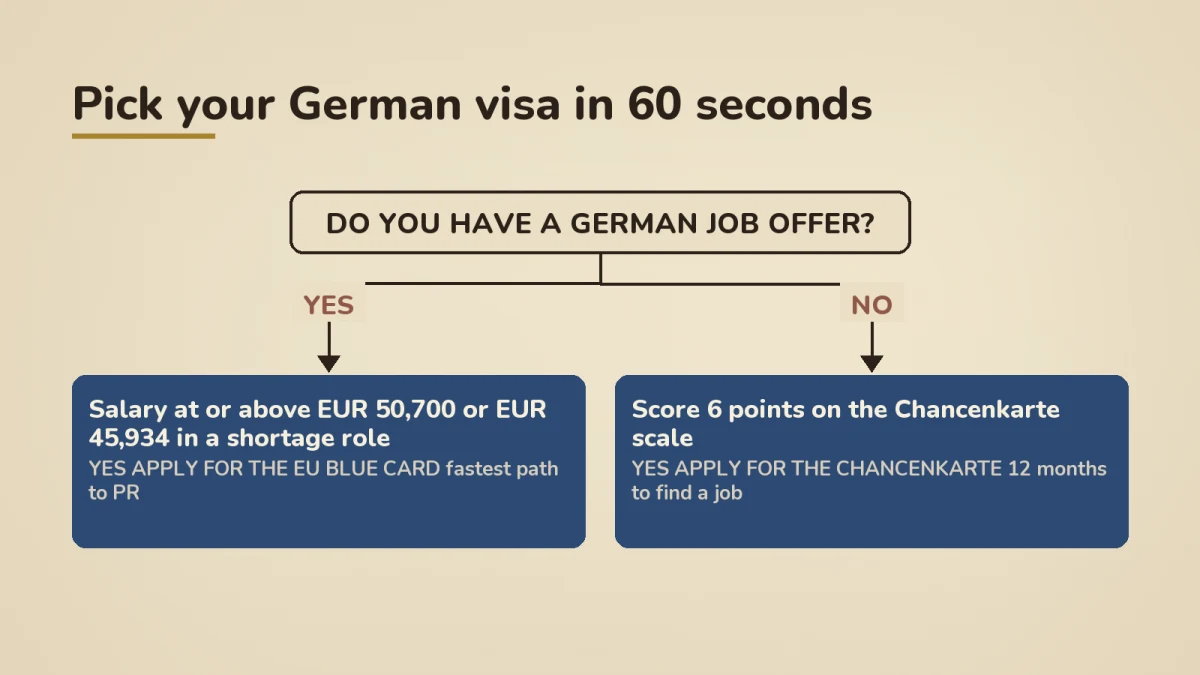
The flow below maps the question you should ask yourself before opening either application portal. Run through it once.
- Do you have a written German job offer from a registered employer? If no, go to step 4.
- Does the contract pay at least €50,700/year gross? If yes, apply for the standard Blue Card.
- Does the contract pay at least €45,934.20 gross AND fall in a shortage occupation, OR are you a new graduate within three years of your degree? If yes, apply for the lower-threshold Blue Card. If no, look at the regular skilled-worker visa under Section 18b instead, not the Blue Card.
- No job offer yet? Score yourself against the points table. If you reach 6 points and can prove livelihood (currently at least €1,091 per month for the visa period), apply for the Chancenkarte. If your foreign qualification is already fully recognised in Germany, you skip the points table entirely and apply on the recognition track.
Costs, validity, and family rules
The Blue Card visa fee is €75 at the German mission abroad. The residence permit issued in Germany at the Ausländerbehörde adds €100. The Chancenkarte visa fee is also €75. Neither has a hidden federal sponsor fee.
On family: Blue Card holders can bring a spouse and minor children from day one, with no German-language requirement on the spouse. Chancenkarte holders cannot bring family members on the Chancenkarte itself. Family reunification only kicks in once you switch to the Blue Card, the Skilled Worker visa, or another long-term permit after finding a job.
On health insurance: both visas require proof of statutory or recognised private health insurance for the entire visa period. For the Chancenkarte, your insurance must cover the full 12 months even if you find a job in month three.
Path to permanent residency from each
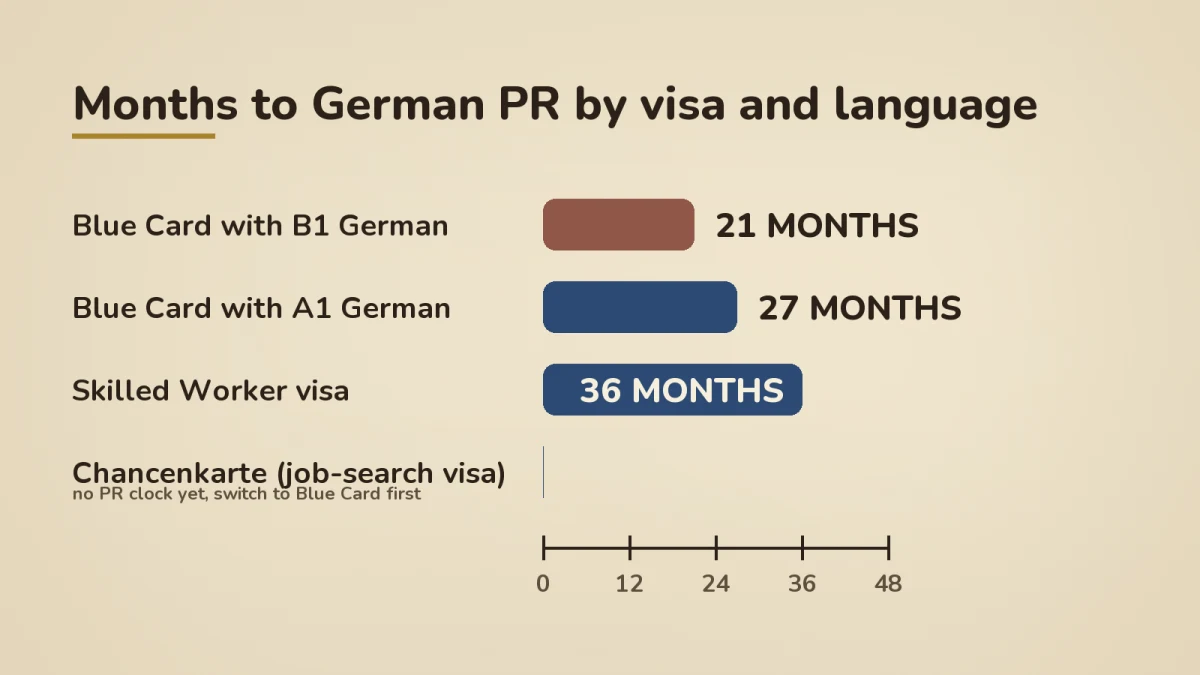
This is the gap most comparison posts skip. The PR timeline depends entirely on which permit you hold and how good your German is.
- EU Blue Card with B1 German: settlement permit (Niederlassungserlaubnis) after 21 months of qualifying employment.
- EU Blue Card with A1 German: settlement permit after 27 months.
- Skilled Worker visa under Section 18b with A1 to B1 German: settlement permit after 36 months.
- Chancenkarte: no PR clock until you convert to one of the above. The 12 months on the Chancenkarte do not count toward PR.
If long-term settlement is the actual goal, the Blue Card is the fastest route, by a wide margin. The Chancenkarte is a vehicle to reach the Blue Card. Read the fast-track PR in Germany post for the full timeline maths including citizenship after five years.
Common mistakes when applying
The patterns below come up repeatedly at consultations.
- Treating the two visas as either-or for the same applicant. They are sequential for most non-EU candidates. Job offer first means Blue Card; no offer yet means Chancenkarte.
- Applying for the Chancenkarte while holding a job offer that already meets the Blue Card threshold. You will be approved, but you will burn months you did not need to spend job hunting and lose the PR clock head-start.
- Banking on the shortage-occupation threshold without verifying the role qualifies. The Federal Employment Agency keeps a published list. Software developer, civil engineer, and physician roles routinely qualify; finance analyst and HR generalist roles do not.
- Forgetting that "new graduate" status uses the same lower threshold for any qualified job, not just shortage occupations, for three years after your degree. Many fresh graduates default to the standard threshold and overshoot what they need.
- Underestimating proof of livelihood for the Chancenkarte. Embassies typically expect a blocked account, sponsor declaration, or comparable evidence covering the full 12 months. Underspecified livelihood is the most common rejection reason.
For a deeper guide to graduate-route options, see the post-study work visa Germany guide, which covers the 18-month job-search permit available specifically to graduates of German universities and how it interacts with the Blue Card.
FAQ
Can I switch from the Chancenkarte to the EU Blue Card without leaving Germany?
Yes. Once you have signed a qualifying job contract that meets the Blue Card salary threshold, you switch at the Ausländerbehörde inside Germany. You do not return to your home country. The new permit takes effect from the appointment date.
Does the Chancenkarte give me 12 months of guaranteed stay?
It gives you a residence permit valid for up to 12 months. If you find a qualifying job earlier, you switch to the matching long-term permit and the Chancenkarte is replaced. If you do not find work, the permit ends at 12 months and is not extendable on the same basis.
What counts as a shortage occupation for the lower Blue Card threshold?
The Federal Ministry of the Interior publishes the list each year. It currently includes academic STEM professionals, medical doctors, dentists, pharmacists, veterinarians, nursing and midwifery specialists, school and out-of-school teachers, and managers in manufacturing, construction, ICT services, and professional services. The full list is on the make-it-in-germany.com Blue Card page.
Do I need German for either visa?
Not at the application stage for either. For the Chancenkarte you need either A1 German or B2 English to qualify on the points door. For the Blue Card you need neither at application. German becomes important only at the PR stage: A1 cuts your PR clock to 27 months, B1 cuts it to 21 months.
Is the Chancenkarte a path to citizenship?
Indirectly. Time on the Chancenkarte does not count for citizenship. Once you switch to a Blue Card or Skilled Worker visa, the clock starts. Under the 2024 citizenship reform you can apply for naturalisation after five years of legal residence (the three-year fast track has been abolished), and Germany now accepts dual citizenship.
Can my spouse work on the Chancenkarte?
Your spouse cannot accompany you on the Chancenkarte. Spousal work rights only become relevant once you have switched to a long-term permit such as the Blue Card, after which your spouse arrives on a family reunification visa and has unrestricted access to the German labour market.
What happens if my Chancenkarte expires before I find a job?
The permit ends. You leave Germany unless you qualify for a different permit (for example, you finish a degree at a German university and convert to the post-study work visa, or you have already begun a recognition partnership and qualify under the Anerkennungspartnerschaft route). There is no extension on the original Chancenkarte basis.
Does my country of citizenship affect which visa I should apply for?
The eligibility rules are the same for non-EU citizens. The visa-application process differs slightly: applicants from "best-friends" states (USA, Canada, Australia, New Zealand, UK, Japan, South Korea, Israel) can enter Germany visa-free for 90 days and apply for the residence permit at the Ausländerbehörde inside Germany. Other applicants apply at the German mission abroad before travel.
Where to next
- Blue Card vs Opportunity Card comparison page for the side-by-side mechanics.
- EU Blue Card guide for the full Blue Card walkthrough.
- What is the Opportunity Card for the full Chancenkarte walkthrough including the points table.
- Fast-track PR in Germany for the settlement permit timeline.
- Visa eligibility checker tool to score yourself in two minutes.
If you are deciding between the two right now, start with the points self-check on make-it-in-germany.com and the salary threshold maths on your job offer. Most readers find the answer falls out of those two checks within ten minutes.
Continue reading
Career & Jobs·13 min read
Skilled Worker Visa Germany: Section 18a vs 18b explained
Section 18a is Germany's vocational skilled worker visa; Section 18b is for university degrees. Compare requirements, salary, and SIA 2.0 changes.
Read articleCareer & Jobs·10 min read
Germany shortage occupation list 2026: jobs that unlock the lower Blue Card salary threshold
Germany's shortage occupation list names the jobs that unlock the lower 2026 EU Blue Card salary threshold. Here is what is on it and how to use it.
Read articleCareer & Jobs·14 min read
EU Blue Card Germany 2026: New salary thresholds, IT-without-degree route, faster PR
EU Blue Card Germany 2026 thresholds raised to €50,700 standard and €45,934.20 shortage. IT specialists qualify without a degree under §18g. PR in 21 months at B1, spouse joins with no German required. Full guide for working professionals.
Read articleReady to plan your Germany journey?
Explore our tools and resources to find the perfect university and program for your academic goals.