Skilled Worker Visa Germany: Section 18a vs 18b explained
Section 18a is Germany's vocational skilled worker visa; Section 18b is for university degrees. Compare requirements, salary, and SIA 2.0 changes.

Table of contents
Last updated: May 2026
TL;DR: Section 18a of the Aufenthaltsgesetz is Germany's skilled worker visa for people with a recognised vocational qualification (Ausbildung-equivalent, 2+ years). Section 18b is the version for people with a recognised university degree. Both routes need a job offer, both allow you to work in any qualified position (not just your training field), and both lead to permanent residency after 3 years with B1 German. The hard part is getting your foreign qualification recognised before you apply.
The German skilled worker visa is not one visa. It is two parallel routes inside the Residence Act, and people confuse them constantly. Section 18a is the vocational track. Section 18b is the academic track. The Skilled Immigration Act 2.0, which came into force in March 2024, kept this split but loosened almost every other requirement around it.
If you trained as an electrician, mechatronics technician, nurse, or chef, your route is §18a. If you have a Bachelor's, Master's, or PhD that the German authorities recognise, your route is §18b. The Blue Card sits inside §18b as a faster sub-track for high earners. The Chancenkarte (Opportunity Card) and the Job Seeker Visa are entry tickets to look for work; §18a and §18b are the actual employment visas you switch to once you have an offer.
What Section 18a and Section 18b actually are
Section 18a covers Fachkräfte mit Berufsausbildung. Translation: skilled workers with vocational training. To qualify you need a vocational qualification of at least two years of formal training that has been formally recognised as equivalent to a German Ausbildung. The recognition body depends on your profession: IHK FOSA for most commercial and technical fields, the relevant Handwerkskammer for crafts, the state Approbation authority for regulated medical professions, ZAB for vocational comparability statements when no specific authority covers your trade.
Section 18b covers Fachkräfte mit akademischer Ausbildung. Translation: skilled workers with academic training. To qualify you need a foreign university degree that is either listed as comparable in the Anabin database (status H+) or has a Statement of Comparability from ZAB. State-recognised German degrees count automatically.
The key shift under SIA 2.0: in both routes, your job in Germany no longer has to match your specific field of training. A trained baker on a §18a visa can now legally work as a logistics coordinator, as long as the role itself is "qualified" employment (broadly: not pure helper work, and the salary aligns with German market rates). An engineer on a §18b can take a marketing role. This was illegal before March 2024 and is the single biggest practical change skilled-worker applicants miss.
Section 18a vs Section 18b at a glance
| Criterion | §18a (Vocational) | §18b (Academic) |
|---|---|---|
| Who it is for | Holders of a recognised 2+ year vocational qualification | Holders of a recognised university degree (any level) |
| Recognition body | IHK FOSA, HWK, regulated profession authority, ZAB for comparability | Anabin database (H+) or ZAB Statement of Comparability |
| Job offer required | Yes | Yes |
| Job must match field of training | No (since SIA 2.0, March 2024) | No (since SIA 2.0, March 2024) |
| Minimum salary | None fixed; must match German market rates | None fixed; must match German market rates |
| German language requirement | None for visa itself; profession-specific rules may apply (e.g. healthcare) | None for visa itself |
| Initial visa duration | Up to 4 years, or duration of contract | Up to 4 years, or duration of contract |
| Family reunification | Allowed (spouse + minor children) | Allowed (spouse + minor children) |
| Path to permanent residency | 3 years with B1 German (§18c) | 3 years with B1 German (§18c) |
| Visa fee | EUR 75 | EUR 75 |
| Statutory basis | § 18a Aufenthaltsgesetz | § 18b Aufenthaltsgesetz |
Both routes look almost identical on paper. The thing that decides which one applies to you is the type of qualification you hold, not what kind of job you want to do in Germany.
Who qualifies for Section 18a
Three conditions, all required.
A recognised vocational qualification. Your foreign training must be assessed and certified equivalent to a German Ausbildung. You start the process on the anerkennung-in-deutschland.de portal. For non-regulated professions like IT, hospitality, or commercial trades, IHK FOSA usually issues the Bescheid. Cost: EUR 100 to EUR 600 depending on case complexity. Time: typically 3 to 4 months once your file is complete.
A concrete job offer in Germany. The role must be a qualified position. The Bundesagentur für Arbeit assesses whether the salary and conditions align with German market rates for that role.
No criminal record concerns and basic livelihood proof. Standard background checks at the embassy.
What is no longer required: your German employer does not need to advertise the job to EU candidates first. The Vorrangprüfung was abolished for skilled workers under SIA 2.0.
If you do not yet have full recognition, the recognition partnership route under §16d (introduced in March 2024) lets you enter Germany before recognition is complete. You need a 2+ year vocational qualification, an employer who signs an Anerkennungspartnerschaft commitment, and A2 German. You then have up to three years to complete recognition while working.
Who qualifies for Section 18b
The structure mirrors §18a, but the qualification side is different.
A recognised academic degree. Bachelor, Master, or PhD from a foreign institution. Check the Anabin database first. If your degree (and your university) appears with an H+ rating, that alone is your proof. If not, request a Statement of Comparability from ZAB. Cost: EUR 200, takes 2 to 3 months.
A concrete job offer in a qualified position. Same rules as §18a: must align with market rates, no field match required.
Standard documentation. Passport, biometric photos, employment contract, recognition document or Anabin printout, proof of accommodation or insurance for the trip, EUR 75 fee.
There are two faster sub-routes inside the §18b family worth knowing:
The EU Blue Card (§18g) is the high-salary fast-track. For 2026 the gross salary thresholds are EUR 50,700 for general professions and EUR 45,934.20 for shortage professions (IT, engineering, medicine, mathematics, natural sciences, teaching). The exact amounts are reset each January by the Federal Government. Blue Card holders can apply for permanent residency after 21 to 27 months instead of the standard 3 to 4 years. See our deep-dive on the Blue Card vs Chancenkarte comparison.
The IT specialist route (§19c paragraph 2) does not require any formal degree. Under §6 BeschV you need at least two years of qualifying experience gained in the last five years, and a job offer paying at least 45% of the yearly pension-insurance contribution ceiling (the minimum salary is published each year in the Bundesanzeiger), or tariff pay at a tariff-bound employer. In IT jobs no formal qualification is required. This is technically not §18b but is often discussed alongside it.
Decide which route is yours
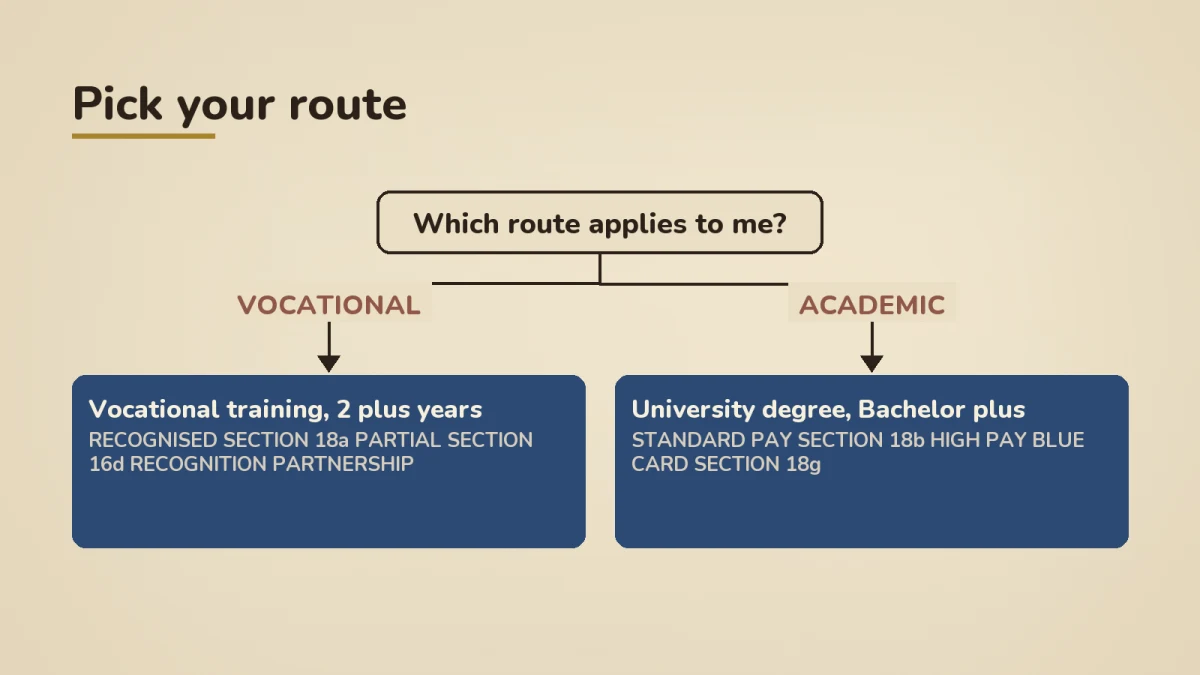
A vocational qualification opens §18a. A university degree opens §18b. If you have both, §18b is usually the cleaner choice because the documentation is simpler.
If your qualification is unrecognised today and your employer is willing to commit to supporting recognition, §16d (recognition partnership) is the third option. It is structurally separate but functionally a §18a precursor.
If your salary will exceed the Blue Card threshold, take the Blue Card. The fast PR clock alone is worth the slightly higher paperwork burden.
What changed under SIA 2.0
Five things, all in your favour.
- Job no longer has to match your field of training. Before March 2024 a recognised baker could only work as a baker. Now they can take any qualified role.
- Vorrangprüfung abolished. Employers no longer have to prove no EU candidate is available.
- Recognition partnership (§16d) introduced. Enter Germany before recognition is complete.
- Lower Blue Card thresholds for shortage professions. EUR 45,934.20 in 2026, instead of the standard EUR 50,700.
- Family reunification simplified. Spouses no longer need A1 German for skilled-worker family reunion in most cases.
These changes also opened a faster path to permanent residency. Skilled workers on §18a or §18b can now apply for the Niederlassungserlaubnis after three years; §18c also requires sufficient knowledge of German. Blue Card holders stay on the existing 21 or 27 month track. Read Fast-track PR Germany for the full timeline mechanics.
Recognition is the gating step
For both §18a and §18b, the slowest part of the process is qualification recognition, not the visa itself.
For vocational qualifications, your contact point is decided by your trade. IHK FOSA for non-regulated commercial and technical trades, the relevant chamber of crafts (Handwerkskammer) for skilled crafts, the Approbationsbehörde of the Land where you will work for regulated medical professions, the Lehrerbildungsbehörde for teachers. Costs typically EUR 100 to EUR 600 plus translations. Timelines range from a clean 3 months to a complicated 9 months.
For academic qualifications the Anabin lookup is free and instant. If your university and your degree both rate H+ in Anabin, that printout is your recognition document. If not, ZAB issues a paid Statement of Comparability for EUR 200 in roughly 8 to 12 weeks.
For both, document quality matters more than anything else. Get certified translations of your transcripts, syllabus, and completion certificate before you start. Most recognition refusals come down to missing course-content evidence, not foreign-trained shortcomings.
The application process, step by step
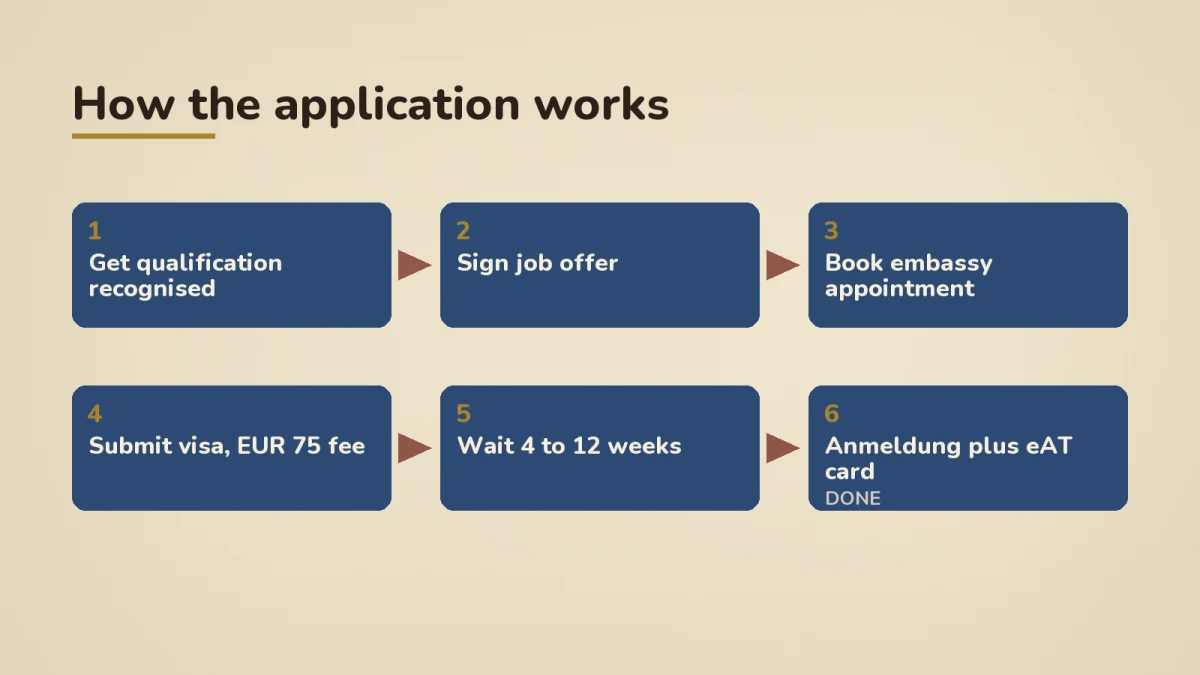
- Get your qualification recognised (or get an Anabin H+ confirmation for academic degrees).
- Find a German employer and sign an offer that matches qualified-position market rates.
- Book a national visa appointment at the German embassy or consulate in your country of residence. The wait time varies by post; Delhi, Manila, and Lagos typically run 2 to 6 weeks for an appointment slot.
- Submit the application: passport, photos, contract, recognition document, CV, qualification certificates with translations, proof of accommodation or insurance, EUR 75 fee.
- Wait for processing. The German missions in India say national visa processing can take several months. The Federal Employment Agency (Bundesagentur für Arbeit) reviews the employment side; the embassy handles the visa side.
- Travel to Germany on the entry visa (typically 6 months validity).
- Within 14 days of arrival, complete your Anmeldung at the local Bürgeramt.
- Within the validity of the entry visa, apply at your local Ausländerbehörde for the residence permit (the eAT card) which converts your entry visa into a multi-year stay.
The §16d recognition partnership has one extra step at the front: the Anerkennungspartnerschaft commitment between you and your employer must be signed and submitted before the embassy lodges the visa.
Common mistakes
Confusing §18b with the Blue Card. They are not the same. The Blue Card is a high-salary sub-track inside §18b that buys you faster PR. If your salary is below the Blue Card threshold, plain §18b still works.
Skipping recognition. Almost every refusal we see at the embassy stage traces back to a missing or partial recognition document. If your case sits in IHK FOSA's queue for partial recognition, that is grounds for refusal under §18a unless you go down the §16d partnership route instead.
Assuming the job has to match the qualification. It does not, post-SIA 2.0. The Bundesagentur cares about whether the salary and conditions are right for the role, not whether the role matches your training field.
Bringing the wrong income proof. The contract has to specify gross annual salary, not just monthly. Embassies routinely reject under-specified contracts. While you have the contract open, check the four clauses that decide your German job: probation cap, §622 BGB notice, Kündigungsschutz thresholds, and non-compete compensation under HGB.
Switching from a Chancenkarte without an offer. The Chancenkarte allows you 12 months in Germany to find work. You then switch to §18a or §18b once you sign a contract. The switch is not automatic; you apply at your local Ausländerbehörde with the new contract and the recognition document.
FAQ
Can I apply for a §18a visa without full recognition?
Not for §18a directly. If you only have partial recognition, your route is §16d (recognition partnership), which lets you enter Germany while you complete recognition. After that, you switch to §18a inside Germany.
What is the difference between Section 18b and the Blue Card?
§18b is the general academic skilled-worker visa. The Blue Card (§18g) is a higher-tier version available to §18b candidates who meet the salary threshold (EUR 50,700 for general professions in 2026, EUR 45,934.20 for shortage occupations). Blue Card holders get accelerated permanent residency, easier intra-EU mobility, and lighter family-reunification rules.
Can I switch from a German student visa to §18a or §18b?
Yes. After graduation you typically switch to the Post-Study Work Visa for 18 months to job-hunt. Once you sign a qualified contract, you switch to §18b at the local Ausländerbehörde with the new contract and your German degree certificate. §18a applies if your German qualification was a vocational Ausbildung, not a university programme.
Does my job in Germany have to match the field I trained in?
Not since March 2024. The role must still be a "qualified" position with market-rate pay, but it does not need to match your specific training. A recognised electrician can take a qualified logistics or sales role, an engineer can move into product management, and so on.
How long is the §18a or §18b visa valid?
Initial issue is up to 4 years, or the duration of your employment contract if shorter. It is extendable. Permanent residency under §18c is available after 3 years with B1 German.
Can I bring my family on §18a or §18b?
Yes. Spouses and minor children can join under family reunification. Spouses do not need A1 German in most skilled-worker family reunion cases since SIA 2.0. Spouses get unrestricted access to the German labour market.
Do I need German for the visa itself?
No. Neither §18a nor §18b requires German for the visa. Profession-specific rules may apply (medical professions require German for the Approbation, teachers and lawyers similarly). For Blue Card or §18b in non-regulated professions, you can arrive with zero German and learn after.
When can I apply for permanent residency?
After 3 years on §18a or §18b with B1 German (2 years if you graduated from a German university or Ausbildung). Blue Card holders are faster: 21 months with B1, 27 months with A1. Time spent on a student visa or Chancenkarte before switching to §18a or §18b counts only partially toward this clock.
Where to next
Continue reading
Career & Jobs·11 min read
Blue Card vs Chancenkarte: Which one should you actually apply for in 2026
EU Blue Card or Chancenkarte for Germany? The Blue Card is for those with a job offer; the Opportunity Card is for job seekers. Here is how to pick in 2026.
Read articleCareer & Jobs·14 min read
Why Germany has 1M jobs and zero callbacks (and how to fix your application)
Germany has over 1 million open jobs but most foreign applicants get silence. Here is why your applications fail and how to fix the stack.
Read articleCareer & Jobs·15 min read
Chancenkarte Germany: Point system explained, real one-year results, who actually got in
Germany's Chancenkarte point system explained with a 6-point matrix, worked examples, and real one-year results from 2024 to 2025.
Read articleReady to plan your Germany journey?
Explore our tools and resources to find the perfect university and program for your academic goals.