Permanent residency (Niederlassungserlaubnis) Germany 2026: Routes, timelines, B1 requirement
Niederlassungserlaubnis routes for Germany 2026: standard 60 months, EU Blue Card 21 to 27 months, skilled worker 36, graduate 24. Plus B1 rules.

Table of contents
Last updated: May 2026
TL;DR: Standard Niederlassungserlaubnis takes 5 years of legal residence, B1 German, and 60 months of pension contributions. EU Blue Card holders fast-track to 21 months with B1 (or 27 months with A1). Skilled workers reach it in 36 months and German graduates in 24 months. Same end document, different waiting clocks.
If you have lived in Germany for a few years on a temporary residence permit, the Niederlassungserlaubnis is the next step that turns "I am here for now" into "I am here on my own terms." It is the German settlement permit, valid indefinitely, with open work rights, and it survives a job change or a long trip abroad. Most expats reach it years before they think about citizenship. This guide explains the routes recognised in 2026, the timelines per route, where the B1 German requirement applies, and the application steps. Throughout, the legal anchor is the Aufenthaltsgesetz (AufenthG) and the publisher is the federal Make-it-in-Germany portal. For the pillar overview, see our permanent residency hub; for the related citizenship pathway, see German citizenship after MS studies.
What the Niederlassungserlaubnis is, and why it matters
The Niederlassungserlaubnis is a permanent residence title issued under §9 of the Aufenthaltsgesetz (Residence Act). It is granted for an unlimited period, allows any kind of employment or self-employment, and does not need to be renewed. You keep it through job changes, salary changes, even sabbaticals, as long as you do not leave Germany for more than six months at a stretch without notifying the Ausländerbehörde.
Three things separate it from a temporary residence permit (Aufenthaltserlaubnis):
- No expiry date and no renewal cycle.
- Open work, including any self-employment, with no purpose tied to a specific employer.
- Stronger family-reunification rights and a clear path to naturalisation.
It is not the same as the EU Long-Term Residence permit (§9a AufenthG, also called Daueraufenthalt-EU), which is also indefinite but designed for cross-EU mobility. We cover the difference at the bottom.
The five main routes in 2026
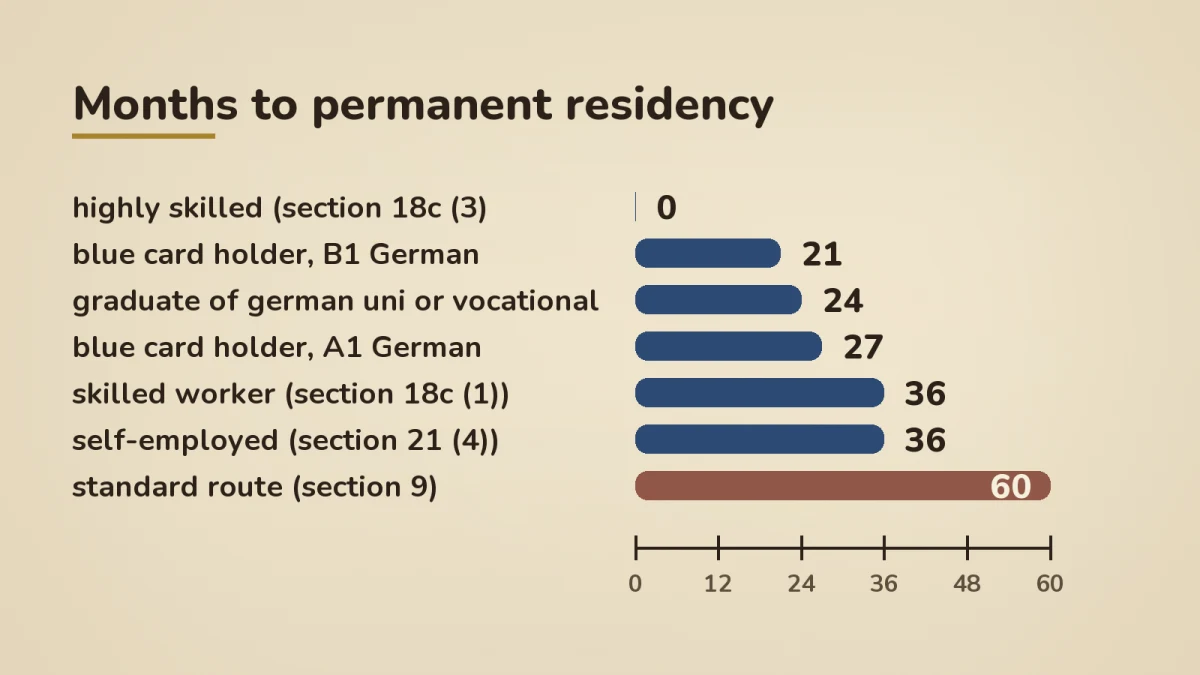
Germany does not have one settlement permit. It has one document with five distinct waiting clocks, depending on which residence permit you currently hold. The route that applies to you decides everything else, including how much German you need.
| Route | Legal basis | Minimum stay | Pension months | German level |
|---|---|---|---|---|
| Standard | §9 AufenthG | 5 years | 60 | B1 |
| Skilled worker | §18c (1) AufenthG | 3 years | 36 | B1 |
| EU Blue Card holder, A1 German | §18c (2) AufenthG | 27 months | 27 | A1 |
| EU Blue Card holder, B1 German | §18c (2) AufenthG | 21 months | 21 | B1 |
| Germany graduate (uni or vocational) | §18c special | 2 years | 24 | B1 |
| Self-employed | §21 (4) AufenthG | 3 years | n/a (business income) | B1 in practice |
| Spouse of settlement permit holder | §28 / §31 path | 3 years | n/a | B1 |
| Highly skilled (scientists, prominent teachers) | §18c (3) AufenthG | Immediate | n/a | n/a |
Read the table by your current permit, not by what you think you should qualify for. If you are on an EU Blue Card today, your clock is 21 to 27 months, not five years. If your residence permit is a §18b skilled worker permit and you have not converted to a Blue Card, your clock is 36 months. The Skilled Immigration Act revision that took effect on 1 March 2024 cut the standard skilled-worker route from 4 years to 3 years and tightened the Blue Card route to the 27/21 split, which is what is in force in 2026.
The B1 German requirement, and the A1 exception that matters
The headline German level for permanent residency is B1 of the Common European Framework (CEFR). It is the threshold the standard §9 route, the §18c (1) skilled-worker route, the graduate route, and the spouse route all use. B1 means you can hold a basic conversation, write a short email in German, and follow most everyday situations.
The exception worth knowing is the EU Blue Card route. Under §18c (2) AufenthG, A1 German is enough if you have been in qualified employment for 27 months. If you reach B1 inside that window, the waiting time drops to 21 months. The six-month difference is the single biggest reason Blue Card holders take a B1 evening course.
Accepted certificates for B1 in 2026: Goethe-Zertifikat B1, telc Deutsch B1, the ÖSD B1, the BAMF integration course final test (DTZ), and TestDaF or DSH if you studied in Germany. Many Ausländerbehörden also accept the German university degree itself as B1 proof if you graduated from a German programme taught in German.
In addition to the language certificate, every route except the immediate one requires the Leben in Deutschland test, run by the BAMF. It is a 33-question multiple-choice test on the legal system, history, and everyday life in Germany. Most applicants take it in the same integration course that gets them to B1.
Application process, step by step
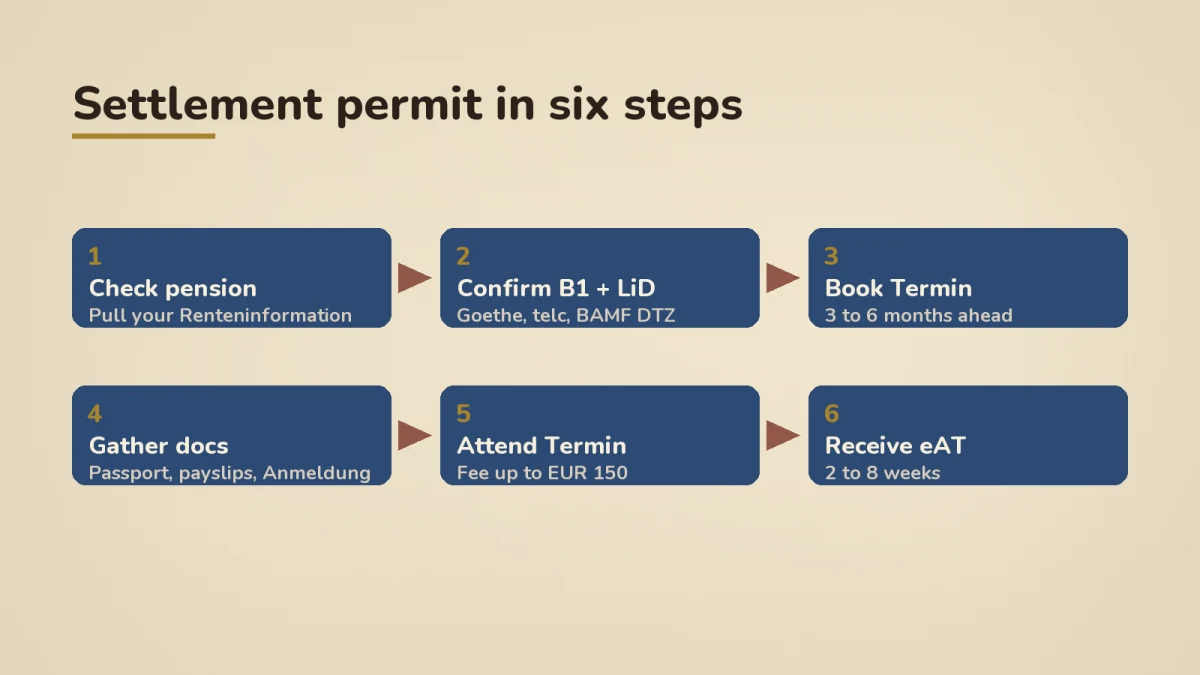
The Niederlassungserlaubnis is granted by your local Ausländerbehörde, not by the BAMF or the embassy. The process is the same across Germany; processing time varies by city.
- Check your pension contributions. Pull your Renteninformation from the Deutsche Rentenversicherung (Versicherungsverlauf). Count the months. Parental leave and time on Krankengeld do count toward pension months in most cases; pure unemployment does not. If you are short, you cannot apply yet.
- Confirm B1 and the Leben-in-Deutschland test. Take whichever you are missing. Both certificates are valid forever for this purpose.
- Book the Termin. Appointments at major-city Ausländerbehörden (Berlin, Munich, Hamburg, Frankfurt) commonly book out 3 to 6 months ahead. Smaller cities are faster. Book before your current permit is close to expiry.
- Gather the documents. Passport, current residence permit, Anmeldung, B1 certificate, Leben-in-Deutschland certificate, last 6 payslips (or self-employment income proof), full pension statement, current employment contract, proof of health insurance, and your rental contract or proof of comparable housing. Some Ausländerbehörden ask for a recent Schufa report.
- Attend the Termin and pay the fee. The application fee is up to about EUR 150 depending on status group, paid at the appointment.
- Receive the eAT card. Most cases are decided within 2 to 8 weeks. The settlement permit comes as an electronic residence card (eAT) you collect in person.
You do not need a lawyer for a clean case. You may want one if your case has gaps (unemployment periods, switched permits mid-cycle, complicated family situation, prior visa refusals, or discriminatory handling at the Ausländerbehörde).
Common mistakes to avoid
- Counting only your current permit's months. Pension contributions are cumulative across employers and across permits. The clock did not reset when you changed jobs.
- Assuming Blue Card needs B1. A1 is enough for the 27-month route. B1 is only needed to drop to 21 months.
- Booking the Termin too late. If your current permit expires before your settlement-permit appointment, you will need a Fiktionsbescheinigung as a bridge; that is a separate appointment.
- Quitting the job between application and decision. A job change is fine; a gap with no qualified employment can pause the route.
- Skipping the Leben-in-Deutschland test. It is a hard requirement on every route except §18c (3). The integration course test counts; the citizenship test does not (different test, different scoring).
- Forgetting adequate housing. "Adequate" is a square-metre check per family member. A studio that worked when you were single may fail if you applied with a partner.
FAQ
Does the Niederlassungserlaubnis ever expire?
No, it has no expiry date. It can be revoked if you commit a serious crime, stay outside Germany for more than six months without notifying the Ausländerbehörde, or rely on welfare without entitlement.
How is the settlement permit different from German citizenship?
The settlement permit gives you indefinite residence and open work, but you keep your current passport and you cannot vote in federal elections. Citizenship adds a German passport, the right to vote, and full political rights. Citizenship is a separate, longer process under the StAG, normally 5 years of legal residence under the 2024 reform. For the path from settlement to passport, see German citizenship after MS studies.
Can my spouse and children piggyback on my permit?
A spouse who joined you on a family-reunification permit can apply for their own settlement permit after 3 years of residence permit, provided they meet B1 German, the living-in-Germany test, and a 20-hour-a-week work record. Children under 16 can usually be granted one alongside their parents; older children have their own pathway.
What about the EU Long-Term Residence (Daueraufenthalt-EU)?
This is a parallel permit under §9a AufenthG. The conditions are similar (5 years residence, 60 months pension, B1, sufficient housing) but the use case is different: it lets you move to another EU country and apply for a residence permit there under facilitated rules. If your plans are firmly Germany-only, the Niederlassungserlaubnis is enough. If you might move to France, the Netherlands, or another EU member state, the §9a permit is worth the extra paperwork.
Do unemployment periods count toward the pension months?
Time on Arbeitslosengeld I (the contribution-based unemployment benefit) does count toward pension months because contributions are paid by the Bundesagentur für Arbeit. Time on Bürgergeld (the basic income support) does not. If you had a longer ALG II / Bürgergeld stretch, plan to make up those months before applying.
Can EU Blue Card holders skip B1 entirely?
Yes for the 27-month route. You need A1 German plus the Leben-in-Deutschland test. B1 is only required to compress the waiting time down to 21 months. Many Blue Card holders apply at 27 months on A1 to settle quickly, then take a B1 course on their own pace afterwards.
Does it matter if my job is below my degree level?
For the §18c routes, the role must remain "qualified employment" matching the residence permit's basis. A degree-required job that you are doing without using the degree is fine; a clearly unqualified role can pause the count. Talk to your Ausländerbehörde before voluntarily downshifting roles within the qualifying window.
Where to next
- Fast-track to permanent residency through the EU Blue Card walks the 21-month path in detail with B1 strategy and document tips.
- EU Blue Card guide for Indian students in Germany covers the salary thresholds and degree recognition that come before the settlement permit clock starts.
- Residence permit Germany for international students explains how the student permit converts into the §18b skilled-worker permit that unlocks the 36-month or 24-month settlement routes.
- For the on-site step-by-step, our permanent residency pillar page tracks current processing times by Bundesland.
Continue reading
Visa & Immigration·16 min read
Fast-track Pathways to Permanent Residency in Germany
Discover the fast-track pathways to Permanent Residency (PR) in Germany. From students to skilled professionals, explore step-by-step guides, eligibility requirements, and tips to secure your future through German Permanent Residency.
Read articleVisa & Immigration·7 min read
Residence Permit in Germany for International Students
Discover a complete guide on residence permit in Germany for international students. Learn the importance, steps, and required documents for a hassle-free registration process.
Read articleVisa & Immigration·15 min read
How to Ace Your Student Visa Interview for Bachelor’s in Germany
Get expert tips on how to successfully navigate your student visa interview for Bachelor's in Germany. Learn what to expect, how to prepare, and what to say to impress the interviewer.
Read articleReady to plan your Germany journey?
Explore our tools and resources to find the perfect university and program for your academic goals.