Freelance and Freiberufler visa Germany: Complete guide for self-employed expats in 2026
Germany's Freiberufler visa under § 21 AufenthG explained: who qualifies, the 2026 application process, costs, tax rules, and the mistakes that get applications denied.

Table of contents
Last updated: May 2026
TL;DR: Germany has two self-employment residence permits under § 21 of the Aufenthaltsgesetz: the Freiberufler permit for liberal professions (writers, designers, doctors, IT consultants, translators) and the broader self-employment permit for trade businesses. Freiberufler is faster, cheaper, and skips the Gewerbeanmeldung. Most non-EU freelancers want this route.
If you want to land in Germany as a self-employed designer, journalist, IT consultant, language teacher, doctor, or therapist, the Freiberufler visa is the route built for you. It sits inside Germany's broader self-employment pillar and shares the same legal anchor (§ 21 Aufenthaltsgesetz), but applies to a specific list of liberal professions that get tax privileges and a lighter approval process.
This guide walks through who qualifies, what changes between Freiberufler and the regular Gewerbe self-employment route, the step-by-step application, the 2026 cost and tax picture, and the mistakes that get applications denied. If you are weighing it against employed routes, see our EU Blue Card guide and the work regulations post for the salaried alternative.
What is the Freiberufler visa, and how does it differ from the regular self-employment visa?
Both permits live under § 21 of Germany's Residence Act (Aufenthaltsgesetz). The difference is which sub-paragraph applies to your work.
| Freiberufler (§ 21 Abs. 5 AufenthG) | Self-employed / Gewerbe (§ 21 Abs. 1 AufenthG) | |
|---|---|---|
| Who it covers | Liberal professions (Katalogberufe) | Trade, retail, manufacturing, founders |
| Tax registration | Finanzamt only | Gewerbeamt + Finanzamt + IHK / HWK |
| Trade tax (Gewerbesteuer) | Exempt | Owed once profit exceeds EUR 24,500 |
| Business plan needed | Light: 2 letters of intent + a financing sketch are usually enough | Full business plan, profitability forecast, often a chamber statement |
| Typical processing | Faster, especially in Berlin | Longer, more scrutiny |
| Renewal | Up to 3 years; switch to permanent residency once income and pension are stable | Same legal ladder, more documentation each round |
Both routes lead to the same destination: a permanent settlement permit (Niederlassungserlaubnis) after three years of self-employed activity if your business is viable, your livelihood is secured, and you have paid into a recognised pension scheme. The Freiberufler route just gets there with less paperwork.
Who qualifies as a Freiberufler in Germany?
The legal definition lives in § 18 of the Income Tax Act (Einkommensteuergesetz). It lists "Katalogberufe" (catalogue professions) plus "professions similar in character". The recognised groups:
- Healing professions: doctors, dentists, vets, alternative practitioners (Heilpraktiker), physiotherapists, psychotherapists, midwives.
- Legal, tax, business advisory: lawyers, notaries, tax advisors (Steuerberater), accountants, auditors, business consultants, sworn experts.
- Scientific and technical: engineers, architects, surveyors, scientists, researchers.
- Cultural and creative: writers, journalists, translators, interpreters, photographers (artistic, not commercial portrait studios), teachers, lecturers, performing artists, designers (often, depending on output).
- IT and tech: software developers, IT architects, and consultants are accepted as Freiberufler when their work is engineering-grade and project-based. A regular full-stack contractor billing one client at a fixed monthly rate often gets reclassified as Gewerbe by the Finanzamt.
If you sit on the IT borderline, two factors push you toward Freiberufler: a degree in informatics or a comparable engineering discipline, and a project mix where you advise, architect, and build rather than execute fixed tickets. A photographer who shoots weddings on a price list is Gewerbe. A photographer whose work is exhibited and licensed as art is Freiberufler. The Finanzamt makes the final call, not you.
The non-tax test the Ausländerbehörde applies is similar: do you have professional credentials (degree, accreditation, portfolio), and is there local demand for your service? Two letters of intent from prospective German clients usually answer the second question.
Step-by-step: how the Freiberufler visa application works in 2026
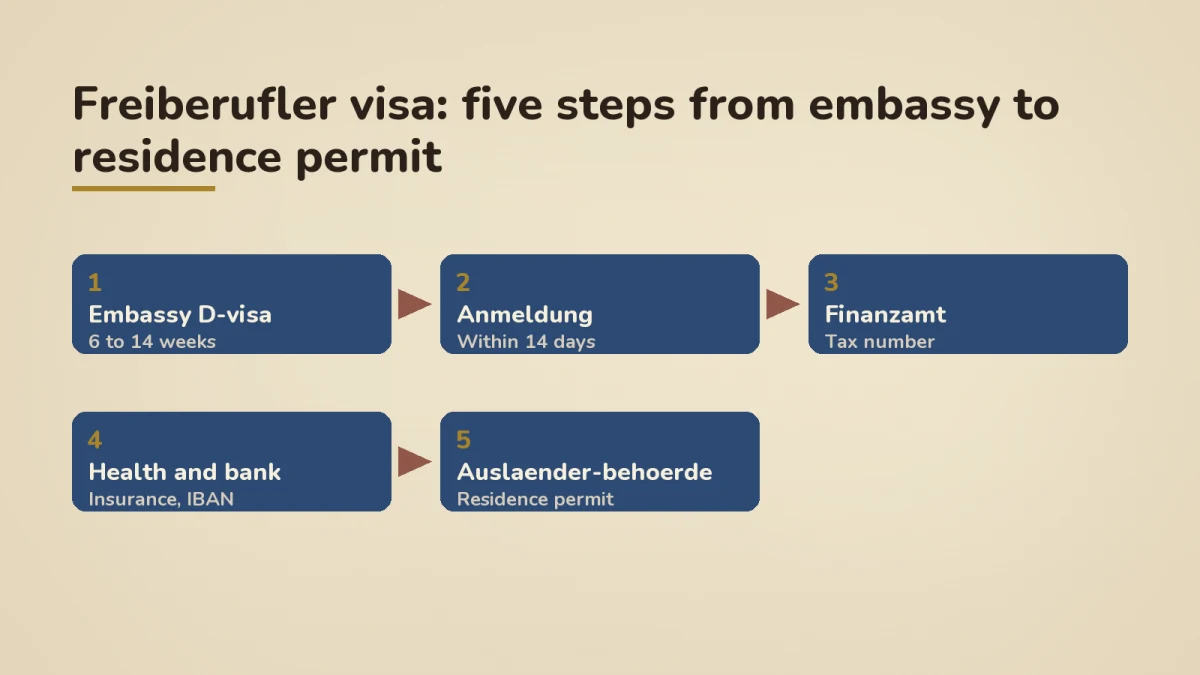
The process splits into a "before you arrive" phase at a German embassy in your home country, and an "after you arrive" phase at the local Ausländerbehörde.
1. Apply for the entry visa at a German embassy
You apply at the German embassy with jurisdiction over your residence, not at TLScontact (a frequent confusion). The entry visa is a national D-visa valid for three to six months, just enough to arrive, register, and convert it into a residence permit.
What to bring:
- Valid passport (issued in the last 10 years, valid 12+ months beyond your visa)
- Two biometric photos
- Completed VIDEX application form
- Proof of qualifications (apostilled degree, professional licences, portfolio)
- Two or more letters of intent from German clients, ideally on company letterhead with declared value and duration
- Financing plan: opening capital, expected revenue, monthly costs, runway in months
- Proof of liquid assets (bank statements covering 12 months of living costs plus business runway)
- Travel and entry health insurance covering the first 90 days
- Pension provision plan if you are 45 or older (mandatory)
- CV, motivation letter
- Visa fee: EUR 75 (D-visa)
Embassies vary on processing time. Plan for 6 to 14 weeks. Some embassies require the chamber of commerce in Germany to weigh in on your sector; others approve on the file alone.
2. Arrive in Germany and complete Anmeldung
Within 14 days of moving into your apartment, register your address at the local Bürgeramt (in Berlin) or Einwohnermeldeamt (most other cities). Bring your passport, the entry visa, your rental contract, and the Wohnungsgeberbestätigung from your landlord. The Anmeldebestätigung you walk out with is what every subsequent appointment asks for first.
3. Get a tax number from the Finanzamt
Submit the "Fragebogen zur steuerlichen Erfassung" online via the ELSTER portal. This is where the Finanzamt decides whether your activity is Freiberufler or Gewerbe. Be precise about your revenue model. The Finanzamt issues a Steuernummer within 4 to 6 weeks, and a USt-IdNr (VAT ID) on the same form if you opt in or cross the small-business threshold (EUR 25,000 revenue in the prior year for 2026).
4. Open a business bank account and sort health insurance
Self-employed residents can join either statutory health insurance (GKV) or private health insurance (PKV). Most freelancers under 35 with predictable income choose PKV for lower premiums; older entrants and those with dependents often stay in GKV. Artists, writers, journalists, designers, musicians, and similar creative workers should check eligibility for the Künstlersozialkasse (KSK), which covers roughly half of statutory pension and health contributions and is the single biggest cost saver in this group.
5. Apply for the residence permit at the Ausländerbehörde
Book the appointment as soon as you arrive. Berlin's slot pressure means the appointment date can sit 8 to 16 weeks out, so book first, prepare second. You bring a Fiktionsbescheinigung-style continuation document if your D-visa expires before the appointment.
What you submit at the appointment:
- Passport + entry visa + Anmeldebestätigung
- Steuernummer letter from the Finanzamt
- Proof of health insurance (German policy active from a stated date)
- Bank statements (last 3 months minimum)
- Updated revenue projection or signed first-client contracts
- Pension proof if 45+
- Biometric photo, application form, fee (EUR 100 to EUR 110)
Approvals usually run as a one-year permit on the first issue, then a two- or three-year extension once you have a tax assessment to show.
What documents and proofs actually carry weight
The Ausländerbehörde caseworker is reading three things: can you support yourself, is there demand for your work locally, and have you organised your taxes and insurance properly. The applications that fail tend to be light on one of these. The applications that sail through usually have:
- Three letters of intent (instead of the minimum two), with at least one from an established German company
- A 12-month financial plan with conservative assumptions, not aspirational ones
- Six months of runway in liquid savings on top of projected first-year revenue
- A clear pension plan if 45+ (Rürup, private pension fund, or proof of equivalent foreign coverage)
- A health insurance contract dated to start the day after arrival, not "to be arranged"
Costs in 2026: what self-employment actually costs in your first year
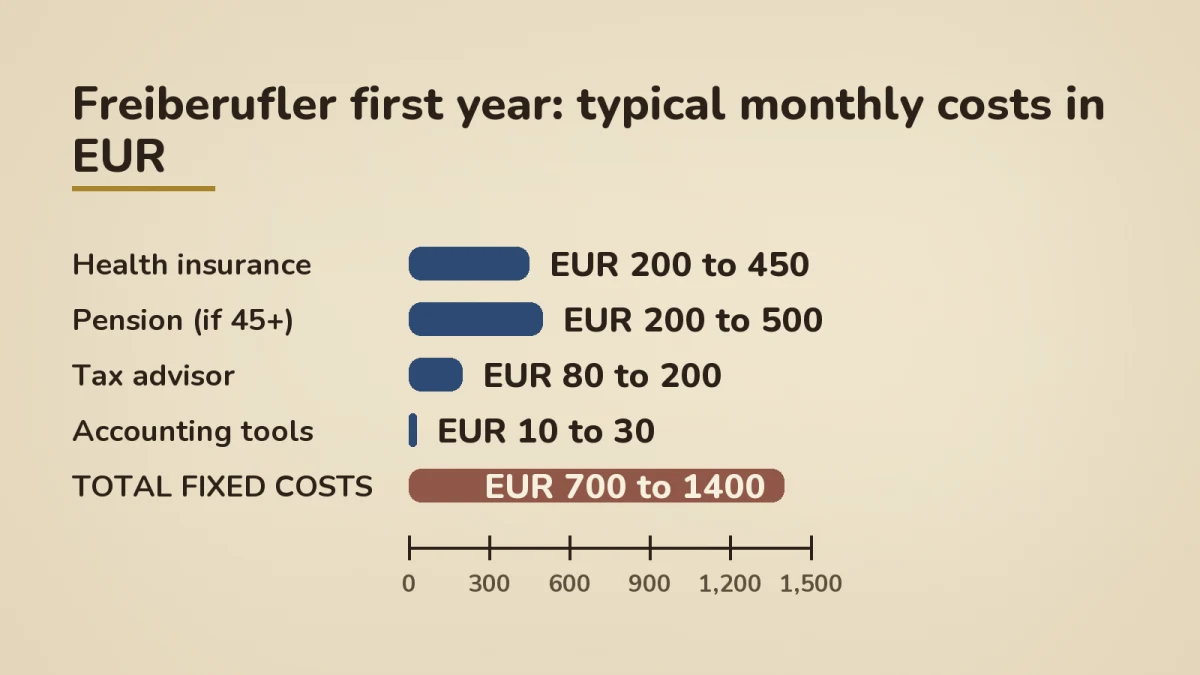
Outside salary, the recurring costs that hit Freiberufler in their first year:
- Health insurance: EUR 200 to EUR 450 per month (PKV depending on age, coverage, deductible) or roughly EUR 250 to EUR 900 per month for GKV depending on declared income, with a minimum income assumption applied if you declare under it
- Pension: voluntary for most Freiberufler, but if you are 45+ you must show provision; budget EUR 200 to EUR 500 per month for a Rürup or private pension to satisfy the Ausländerbehörde
- Tax advisor: EUR 80 to EUR 200 per month for a basic Steuerberater retainer; worth it in year one to avoid a Gewerbe reclassification surprise
- Accounting software: EUR 10 to EUR 30 per month (Lexware, sevdesk, lexoffice)
- KSK-eligible creative? KSK takes about 50% of pension and health contributions off your bill once you are accepted
Add all of this together and a typical Berlin Freiberufler in 2026 runs at EUR 700 to EUR 1,400 per month in fixed business and personal-protection costs before any rent or living expense, and the financing plan you submit with the visa needs to cover it honestly.
Tax in plain English
Freiberufler do not pay Gewerbesteuer (trade tax). They pay income tax, the solidarity surcharge if applicable, and VAT (Umsatzsteuer) once they cross the small-business threshold. The 2026 small-business threshold (Kleinunternehmerregelung) is EUR 25,000 in the prior calendar year and EUR 100,000 in the current year. Below that, you can opt to invoice without VAT and skip quarterly VAT returns.
Income tax for self-employed residents is paid quarterly as advance payments (Vorauszahlungen) once the Finanzamt has assessed your first year. The first year is invoice-cash-only with the bill arriving in the second year, which is why every experienced Freiberufler keeps roughly 30% of every invoice in a separate account from day one.
Common mistakes that get applications denied
- Applying through TLScontact instead of the embassy's visa department directly. The Freiberufler visa always goes through the embassy's own visa team.
- Letters of intent from a single client, or from a client outside Germany. The visa exists to bring economic activity into Germany. Letters from German-based companies carry far more weight.
- Declaring yourself Freiberufler on the Finanzamt form when your revenue model looks like Gewerbe (subcontracted bodyshop work, fixed monthly retainer with a single tech client, e-commerce reselling). The Finanzamt's reclassification triggers a Gewerbeanmeldung, back-dated trade tax, and an awkward conversation with the Ausländerbehörde at renewal.
- Showing only entry-month liquidity. The Ausländerbehörde wants to see runway, not a one-shot deposit.
- Skipping the pension proof at 45+. This is the single fastest "incomplete file" reason cited in Berlin and Munich.
- Booking the Ausländerbehörde slot only after Anmeldung is done. By then half your D-visa is gone. Book the slot the week you land. If a caseworker's handling at the Termin crosses into discrimination, you have formal channels to push back.
FAQ
Is the Freiberufler visa easier to get than the regular self-employment visa?
In practice, yes. The Freiberufler track does not require the full business plan and chamber statement that founders applying under § 21 Abs. 1 AufenthG go through. If your profession is clearly on the Katalogberufe list and you have client letters of intent, the Ausländerbehörde has a much shorter checklist to satisfy.
Can I switch from a Blue Card to a Freiberufler permit?
Yes. Switching from an EU Blue Card to self-employment under § 21 Abs. 5 is allowed and common, especially for IT and design contractors who land salaried, build a network, and then go independent. You apply at the same Ausländerbehörde with the Freiberufler document set, and they handle the conversion in one appointment.
Do I need to speak German for the Freiberufler visa?
The visa itself has no German language requirement. Your daily reality does. Bürgeramt, Finanzamt, Krankenkasse, and many client conversations run in German. B1 makes the bureaucracy doable; A2 makes it slow. Berlin and Hamburg have the most English-tolerant administrations; smaller cities expect German.
How long does the Freiberufler visa last?
Initial issue is usually 12 months. Once you show a first-year tax assessment and proof that your business is viable, the renewal is for two or three years. After three years of Freiberufler activity with stable income and pension provision, you can apply for the permanent settlement permit (Niederlassungserlaubnis).
Can my spouse work in Germany on a dependent visa?
Yes. The dependent residence permit attached to a § 21 Freiberufler permit grants unrestricted access to the German labour market. Your spouse can take any job (employed or freelance) without a separate work permit application.
What about the Chancenkarte: can I use it to set up as a freelancer?
The Chancenkarte (Opportunity Card) is a job-seeker permit, not a self-employment route. While on the Chancenkarte, you can take part-time work but not run a freelance business. To go freelance, you switch to a § 21 permit, which is a separate application. Many people use the Chancenkarte to come, network, and then convert.
Can I keep working for foreign clients while on a Freiberufler visa?
Yes, foreign clients are allowed and common. The visa requires evidence of German economic interest (which the letters of intent and client mix show), but it does not cap how much of your revenue comes from abroad. Tax-wise, your invoices to non-EU clients are usually outside German VAT, and EU clients invoice with the reverse-charge mechanism.
What changes are coming for the self-employment route?
The Federal Ministry of Labour has signalled a planned overhaul of self-employment rules from 2028 onward, including a clearer split between solo-self-employment and dependent contracting. The current Skilled Immigration Act 2.0 framework, which expanded routes for skilled workers, did not significantly change § 21 itself. Track Make-it-in-Germany and the BMI press releases for confirmed changes.
Where to next
- Salaried alternative: EU Blue Card guide
- The bigger picture on working in Germany: work regulations in Germany
- Tax basics for new arrivals: paying taxes in Germany
- Job-seeker route: the Opportunity Card
- Pillar hub: /work/freelance
Continue reading
Career & Jobs·14 min read
Why Germany has 1M jobs and zero callbacks (and how to fix your application)
Germany has over 1 million open jobs but most foreign applicants get silence. Here is why your applications fail and how to fix the stack.
Read articleCareer & Jobs·15 min read
Chancenkarte Germany: Point system explained, real one-year results, who actually got in
Germany's Chancenkarte point system explained with a 6-point matrix, worked examples, and real one-year results from 2024 to 2025.
Read articleCareer & Jobs·13 min read
Universities in Berlin Offering Career Services: A Complete List
Looking for universities in Berlin offering career services? Explore our complete list of institutions providing career guidance, internships, and job placement support to help you succeed.
Read articleReady to plan your Germany journey?
Explore our tools and resources to find the perfect university and program for your academic goals.