Discrimination at the Ausländerbehörde: Your rights, how to document, where to file
What discrimination at the Auslaenderbehoerde looks like, how to document the incident, and the four channels in 2026 that act on a complaint.

Table of contents
Last updated: May 2026
TL;DR: The Ausländerbehörde sits outside the AGG (the federal anti-discrimination law), so a complaint there does not run through your employer or a tribunal. It runs through four channels: Berlin's LADG-Ombudsstelle, the Antidiskriminierungsstelle des Bundes for advice, a formal Dienstaufsichtsbeschwerde to the case officer's supervisor, and civil-society support via advd.de. Document everything in real time, file in writing, and use an Untätigkeitsklage if a decision drags past three months.
If you have spent ten minutes inside a German Ausländerbehörde (in Berlin now branded LEA, the Landesamt für Einwanderung), you already know the patterns. Shorter answers when your German is rough. Longer waits when the queue ahead of you doesn't look like you. Documents accepted on Monday, rejected on Friday, with no written reason. This guide covers what counts as discrimination, how to capture evidence in real time, and the four places that will actually act on a complaint in 2026. For the wider picture of life as an expat in Germany, this fits next to your residence-permit and registration playbook.
What discrimination at the Ausländerbehörde actually looks like
It is rarely a slur. The 2025 monitoring report from Germany's Nationaler Diskriminierungs- und Rassismusmonitor (NaDiRa, run by the DeZIM-Institut) found that 54% of people with a racially-marked identity reported discrimination at least monthly in 2024, against 32% of the non-marked group. Public-facing authorities show up repeatedly in the data.
In day-to-day Ausländerbehörde practice, the patterns are:
- Asymmetric service time. White EU applicants get fifteen minutes of explanation; non-EU applicants get a two-minute "next" with a missing-document slip.
- Discretionary decisions framed as policy. "We don't accept that document here" with no statute cited.
- Language used as a filter. Switching to fast bureaucratic German the moment you ask for clarification.
- Selective document checks. Originals demanded from some applicants, copies fine for others.
- Delays as a tool. A residence-permit decision parked for six months while EU-passport peers turn around in three weeks.
None of those are friendly chat. All of them are documentable, and most of them have a paper trail you can request.
Why most people stay quiet (and why that has to change in 2026)
NaDiRa's most-quoted figure: only roughly one in five affected people files a complaint when they experience discrimination. The reasons line up across every interview series: fear of retaliation against the visa, no clarity on which office handles complaints, no German legal counsel, and the sense that "they will close ranks anyway."
Two things shifted in 2026.
The Bundeskabinett passed an AGG reform in April 2026. The current AGG text still gives employees two months to assert compensation claims against an employer in writing, so check the law text before relying on a longer deadline. The Antidiskriminierungsstelle des Bundes gets formal mediation powers and can appear as legal counsel in court. A new independent mediation office sits inside the agency.
Important catch, and the single most-misunderstood point in this whole guide: the AGG covers private-sector discrimination (employment, housing, services). It does not directly cover state authorities like the Ausländerbehörde. For authority cases you need the state-level routes below, not the federal AGG path. The Antidiskriminierungsstelle still gives free advice, but it cannot enforce against an immigration office the way it can against a landlord.
Berlin is the model state here. The Berlin Landesantidiskriminierungsgesetz (LADG, in force since 2020) explicitly binds every public administration body in Berlin, including the LEA. Other states are watching but have not yet legislated equivalents.
How to document an incident in real time
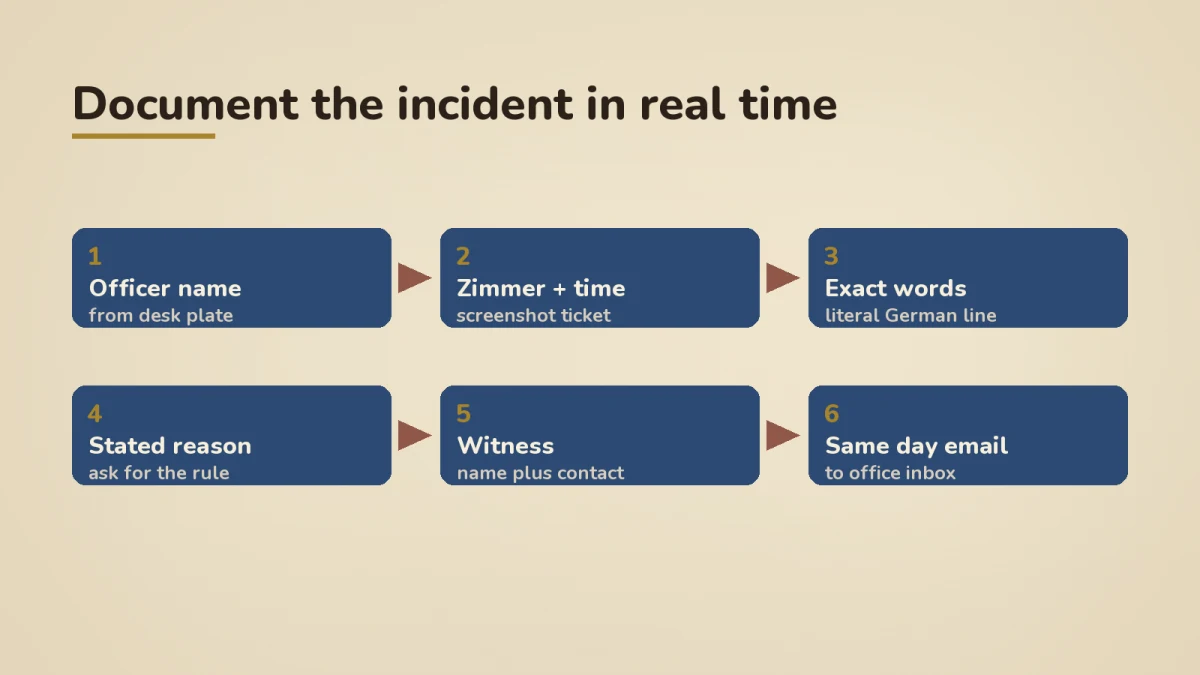
The single biggest reason complaints fail is that they arrive three weeks later with no specifics. The officer denies the conversation, the office has no record, the case dies. Capture the evidence at the counter.
What to write down before you leave the building:
- Officer name and Zimmer number. Both are on the desk plate. Photograph it from your seat if you can do so without escalating.
- Date, time, your Wartenummer. Screenshot the queue ticket or the appointment confirmation email.
- Exact phrasing of what was said. Not your interpretation. The literal sentence in German if possible, with English translation underneath.
- What was decided and on what stated grounds. "Antrag abgelehnt wegen fehlender Unterlagen" without naming which document is a flag.
- Witness present. Name, contact, and one-line statement of what they saw or heard.
- Same-day email. Send a polite German-language email to the office's general inbox restating the conversation as you understood it and requesting written confirmation. This converts an oral exchange into a discoverable record.
Two operational rules that change outcomes:
- Bring a German-speaking companion or an interpreter. You are legally entitled to bring one. Many discrimination patterns evaporate the moment a fluent German speaker is in the chair next to you.
- Request every adverse decision in writing. A spoken "no" is unappealable. A written Bescheid is appealable inside one month.
Where to file: the four channels that work in 2026
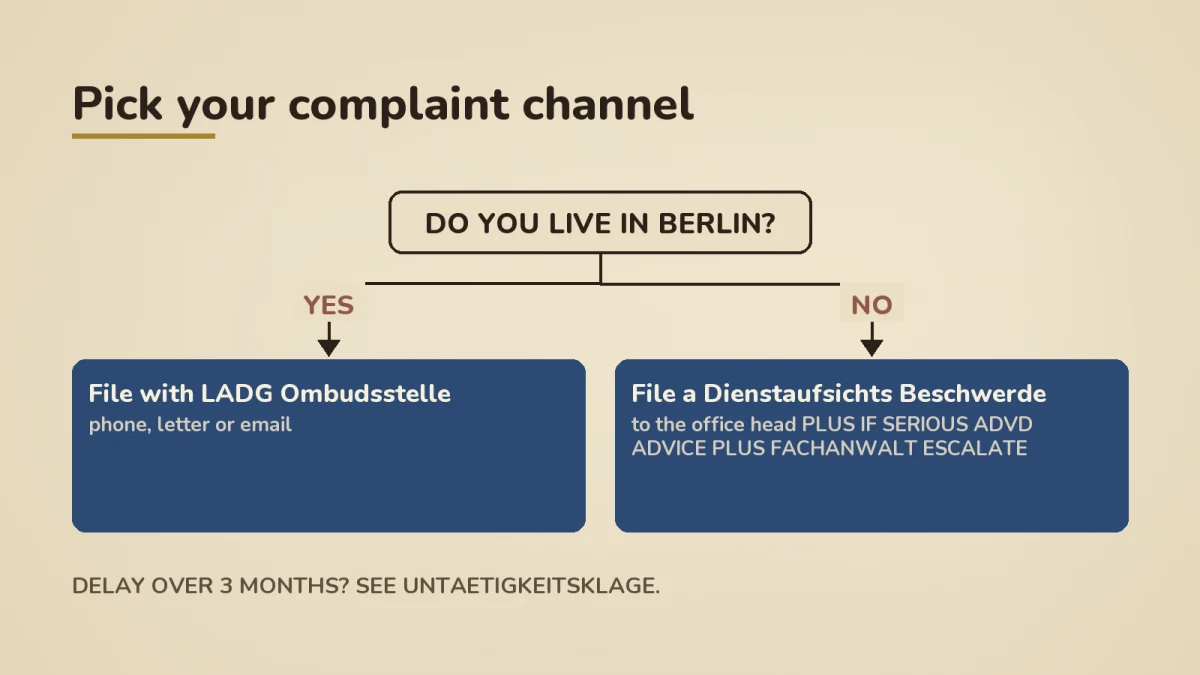
There is no single hotline. Pick the channel that matches your case and city.
1. LADG-Ombudsstelle (Berlin only)
If you live in Berlin, this is the strongest route. The Ombudsstelle of the Berliner Landesantidiskriminierungsgesetz handles complaints about discrimination by any Berlin state body, including the LEA. Free, independent, confidential. Phone (030) 9013-3456, Monday to Thursday 9:30 to 15:30, Friday 9:30 to 14:00. Complaints accepted by letter, phone, or email. Website: berlin.de/sen/lads/recht/ladg/ombudsstelle/. Other federal states have varying internal grievance offices but no equivalent statute as of 2026.
2. Antidiskriminierungsstelle des Bundes
The federal agency at Glinkastraße 24, 10117 Berlin. Free advice line 0800 546 546 5, Monday to Thursday 9 to 15. As of 2026 they can mediate and appear as counsel, but their AGG enforcement powers do not bind authorities. Use them for: orientation, written legal opinion to attach to your other complaint, referral to a regional Antidiskriminierungsberatung office.
3. Dienstaufsichtsbeschwerde (internal supervisor complaint)
A formal letter to the head of the office (Behördenleitung) describing the incident. Free, no lawyer required, can be filed in English with German translation attached. It is the route most people skip because it feels naive, but it produces an internal investigation that gets noted in the officer's personnel file. File it within two weeks of the incident.
4. Antidiskriminierungsverband Deutschland (advd.de) and a Fachanwalt
The civil-society network advd.de lists regional anti-discrimination counselling offices that will run your case for free. For substantive harm (lost work permit, missed deadline, financial loss), pair the complaint with a Fachanwalt für Verwaltungsrecht. Many offer initial consultations under €100, and Beratungshilfe can cover the cost if you qualify.
When the delay is the discrimination: the Untätigkeitsklage
If your residence permit, family-reunification visa, or naturalisation file sits for more than three months without a decision, German administrative law gives you an active remedy: the Untätigkeitsklage, an action for failure to act, filed at the Verwaltungsgericht (administrative court). Courts have started awarding compensation in the €700 to €3,000 range for documented inactivity. You do not need to prove discrimination intent, only delay beyond the statutory window. A Fachanwalt files this for you in a single hearing.
Common mistakes
- Waiting weeks to file. Memory fades, the officer's notes solidify, the witness moves on. File the documentation note within 48 hours.
- Filing only on Reddit. Venting is not a complaint. Channel two of the above is the minimum.
- Assuming the AGG covers you at the counter. It does not for authority discrimination. Use the LADG (if Berlin) or the Dienstaufsichtsbeschwerde route.
- No written request for the decision. Always ask for the Bescheid in writing. Oral decisions cannot be appealed.
- Going alone when you don't have to. Bring a German speaker. The cost is one coffee. The shift in tone is significant.
FAQ
Can the AGG help me at the Ausländerbehörde?
Indirectly. The AGG gives you legal language and the Antidiskriminierungsstelle gives free advice, but the AGG does not enforce against state authorities. For authority cases use the state law (in Berlin the LADG) or the supervisor complaint.
I'm not in Berlin. What protection do I have?
Federal law (Article 3 of the Grundgesetz prohibits discrimination by the state) plus the internal Dienstaufsichtsbeschwerde route plus the Petitionsausschuss of your state parliament. Bavaria, Hamburg, and NRW are debating LADG-style legislation but have not passed it as of 2026.
Will filing a complaint hurt my visa?
Legally no. A complaint cannot be the legal basis for a visa decision, and German administrative law explicitly forbids retaliatory action. Practically, file in writing and keep a paper trail; this protects you if you ever need to challenge a later refusal.
How long does the Antidiskriminierungsstelle take to respond?
Initial advice is usually within four weeks. Formal mediation under the new 2026 powers takes three to six months.
Do I need a German lawyer?
For documentation and a Dienstaufsichtsbeschwerde, no. For an Untätigkeitsklage or appeal of a written Bescheid, yes. A Fachanwalt für Verwaltungsrecht is the right specialty. Beratungshilfe can pay if you are below the income threshold.
Can I file in English?
The LADG-Ombudsstelle accepts English. The Antidiskriminierungsstelle accepts English. A Dienstaufsichtsbeschwerde is best in German with an English version attached, since the recipient is the office itself.
What if my case officer is the head of the office?
File the Dienstaufsichtsbeschwerde with the next layer up: the Senatsverwaltung in Berlin, the Innenministerium in other states. Copy the LADG-Ombudsstelle or the Antidiskriminierungsstelle so the complaint exists outside the chain of command.
Where to next
- Residence Permit in Germany for International Students for the underlying procedure your complaint may relate to.
- German Visa Appointment Booking and Cancellation Process for the booking system that often produces the first friction.
- Integration Course in Germany for the formal route that can shift your standing and your German level.
- Understanding the German Work Culture for the wider context of how rules and discretion interact at every official counter.
Continue reading
Living in Germany·9 min read
Buying a car in Germany as a new arrival: Registration, insurance, TÜV, financing
Practical guide to buying a car in Germany as a new arrival in 2026: Anmeldung first, eVB insurance, Zulassung at the Kfz office, TÜV and financing options.
Read articleLiving in Germany·19 min read
Public vs Private Health Insurance in Germany: PKV vs GKV Head-to-Head with Real Numbers
Public vs private health insurance in Germany compared with 2026 numbers. JAEG, BBG, GKV monthly cost, PKV premiums, family math, and the age 55 lock-in.
Read articleLiving in Germany·15 min read
Schufa in Germany explained: How to build credit as a new arrival, and the myths to ignore
Schufa is Germany's main credit file. Here is how it actually starts, the new 2026 score model, and how to build it from zero as an expat.
Read articleReady to plan your Germany journey?
Explore our tools and resources to find the perfect university and program for your academic goals.