Why Germany has 1M jobs and zero callbacks (and how to fix your application)
Germany has over 1 million open jobs but most foreign applicants get silence. Here is why your applications fail and how to fix the stack.

Table of contents
Last updated: May 2026
TL;DR: Germany has over 1 million open positions, yet most foreign applicants get silence. The shortage is real but selective. Jobs concentrate in 163 Mangelberufe (shortage occupations) where German B2, recognised qualifications, and direct outreach decide the outcome, not raw English-language skill. Fix your application by targeting the right list, raising your German to B2, sending Initiativbewerbungen, and writing a German-format CV with a recognised qualification reference.
You can read the same headline two ways. Germany has over a million job vacancies. Foreign professionals send hundreds of applications and never hear back. Both are true at the same time, and that is the paradox most career advice ignores. The sister piece on the broader market sits at how to find a job in Germany in 2026, and the data on whether 2026 is the right year to make the move at all sits one level above; this post focuses on why your applications get ignored and what to change before the next batch goes out. The pillar guide for working in Germany is /work/jobs.
Most rejection is not personal. It is systemic. Every gap below shows up in published research from the Bundesagentur fuer Arbeit, the OECD, and the Federal Anti-Discrimination Agency. Once you see them stacked, the fix becomes obvious.
Why does Germany have 1M jobs but no callbacks for foreign applicants
Two things are happening on top of each other.
The shortage is concentrated in 163 official Mangelberufe (shortage occupations) and in trades, healthcare, IT, and engineering where Germany simply does not have enough qualified residents. The Federal Employment Agency lists construction trades short by 349,000 jobs, tech and engineering short by 283,000, and healthcare projected to be short 3 million workers by 2030. That is the "1M jobs" half.
The "zero callbacks" half is the filter that sits in front of those jobs. About 70% of postings require German at B2 or higher. Foreign-sounding names get 24% fewer callbacks for the same CV. Roughly 50 to 70% of positions are filled through referrals or internal moves before they ever appear on a public board. Foreign qualifications are not automatically recognised; without a Zeugnisbewertung from ZAB, recruiters cannot verify your degree against the German equivalency framework. And most foreign CVs do not match the German format that ATS software expects.
The shortage is real. The pipeline to it is not friendly to a remote applicant pasting an English-language CV into a job board form. Fix the pipeline, and the shortage opens up.
Where the 1M jobs actually are
The vacancy figure depends on which source you read. Eurostat puts open positions in Germany above 1 million. The Bundesagentur fuer Arbeit only counts positions employers have registered with the agency, which is roughly 628,000 in early 2026. The gap between the two is the "hidden market", positions Germany knows are open but never officially lists.
Among the registered openings, the distribution is not even.
| Sector | Approximate gap | What it actually means |
|---|---|---|
| Construction and skilled trades | 349,000 | Electricians, plumbers, welders, roofers, bricklayers. Ausbildung-route or recognised trade certificate. |
| IT and tech | ~150,000 of the registered total | Backend, cloud, data, cybersecurity, SAP. English-friendly in larger cities; B1 still expected long-term. |
| Engineering | combined with IT in BA totals; ~283,000 with construction excluded | Mechanical, electrical, automotive, mechatronics. Mittelstand hires hard here. |
| Healthcare and care | 3 million projected by 2030 | Nursing, geriatric care, doctors, MTA. Approbation or Anerkennung needed. |
| Logistics and skilled labour | ongoing six-figure shortage | Drivers (Klasse C/CE), warehouse leads, technicians. |
| Business, marketing, communications | flooded | More applicants than openings. English-only postings tend to sit here, and so does most of the rejection mail. |
Most expat job-search frustration comes from applying to category six while the vacancies sit in categories one through five. If your background is in the flooded fields, the callback rate tells you to either pivot, find an English-friendly tech role, or upgrade your German until the shortage list opens up.
Why your applications go nowhere: the seven friction points
You can hold every one of these against a recent application batch. If even three of them apply, your callback rate will collapse.
1. The B2 wall
The Make-it-in-Germany portal, German chambers of commerce, and OECD all converge on the same number: about 70% of job postings require professional German, usually B2. For 98% of regular employment, recruiters expect "good to fluent German". B1 is conversational; it does not pass for client work, internal docs, or compliance roles. English-only roles exist mostly in IT in Berlin, Munich, and Hamburg, plus a thin slice of marketing and research. Outside that slice, your B1 marker on a CV is read as "cannot work here yet".
2. Name discrimination on initial screening
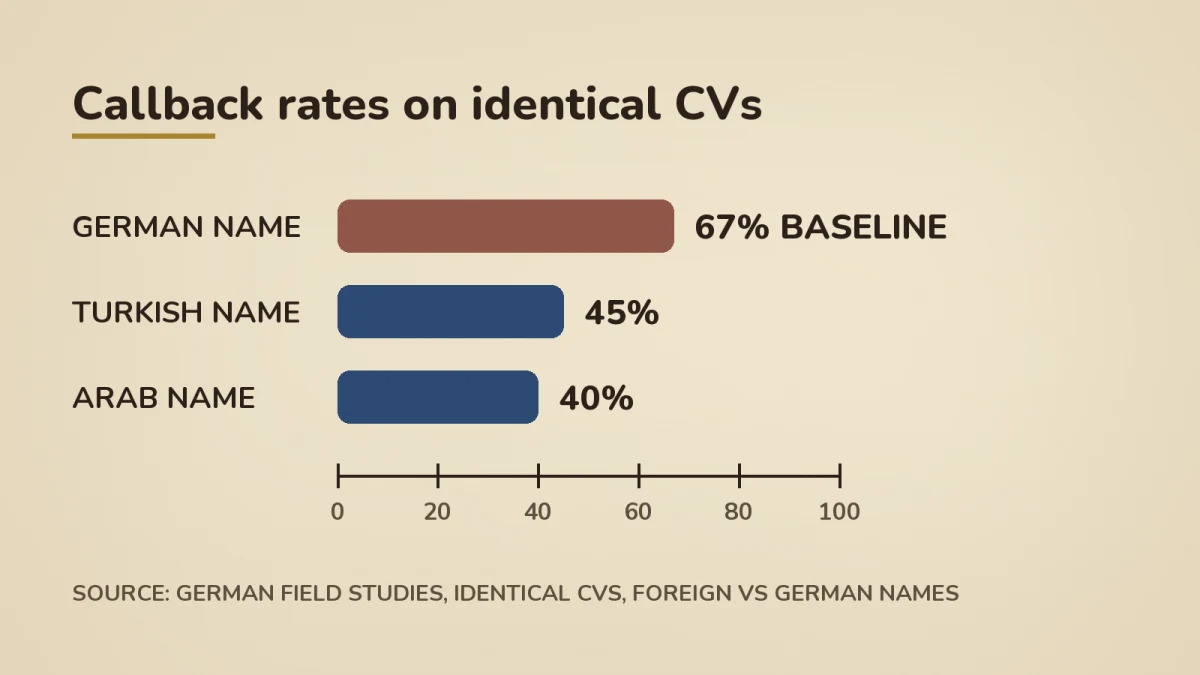
Federal Anti-Discrimination Agency findings and academic correspondence studies converge on a consistent pattern. CVs with German names get callbacks at roughly 67%. Identical CVs with Arab or Turkish names drop to about 40%. That is a 24% gap on the first filter. Two in three non-EU professionals report at least one experience of hiring discrimination. The fix is not to hide your name, it is to bypass the screening filter entirely with referrals, Initiativbewerbungen, and recruiter-led routes where a human evaluates the full CV before the name registers as a sort signal.
3. The hidden job market
Roughly 50 to 70% of professional roles are filled before they hit a public board. The Bundesagentur, OECD, and most German HR studies confirm this; in surveys of working professionals, more than 60% report finding their current job through networking or internal moves. If you are only applying to jobs you can find on Indeed, StepStone, or LinkedIn, you are seeing one third of the market.
4. Foreign degrees that are not formally recognised
Recruiters in regulated industries (engineering, healthcare, teaching, law) need a Zeugnisbewertung issued by the ZAB through the anabin database. Without a recognition reference number on the CV, your degree reads as "unknown" to a German HR system, and the application stalls. In healthcare and trades the requirement is harder still: full Anerkennung or Approbation. Skipping this step explains a large share of "qualified candidate, never called" cases.
5. CV format mismatch and ATS rules
A German CV (Lebenslauf) is one to two pages, reverse chronological, with a small headshot in the upper-right, line-item dates (month/year), and a separate signed Anschreiben (cover letter). It uses a strict block layout, not American-style storytelling. ATS systems set up for German CVs reject creative templates, multi-column designs, and PDFs with embedded graphics that scramble the text layer. If your "modern" CV looks beautiful in Canva and gets zero responses, that is your sign.
6. Generic, English-language Anschreiben
A German cover letter is short, formal, and addressed to a named person. "Sehr geehrte Damen und Herren" is the cold-call default, but recruiters can tell at a glance whether you researched the company. English-only Anschreiben for German-speaking roles is read as a mismatch between candidate and posting. Even at IT companies that work in English, the Anschreiben in German signals seriousness.
7. No Werkstudent or local reference
For graduates of German universities, a Werkstudent stint is the de facto interview that bypasses the screening filter; over 80% of internal full-time hires in Mittelstand companies come from the working-student pool. For experienced hires from outside Germany, the equivalent is a recognised local reference: a German colleague, a former employer with a DE office, a XING connection, anyone whose name on a referral changes the screening dynamic. No reference plus no recognition plus no German CV is the silent-rejection trifecta.
How to fix your application: the decision tree
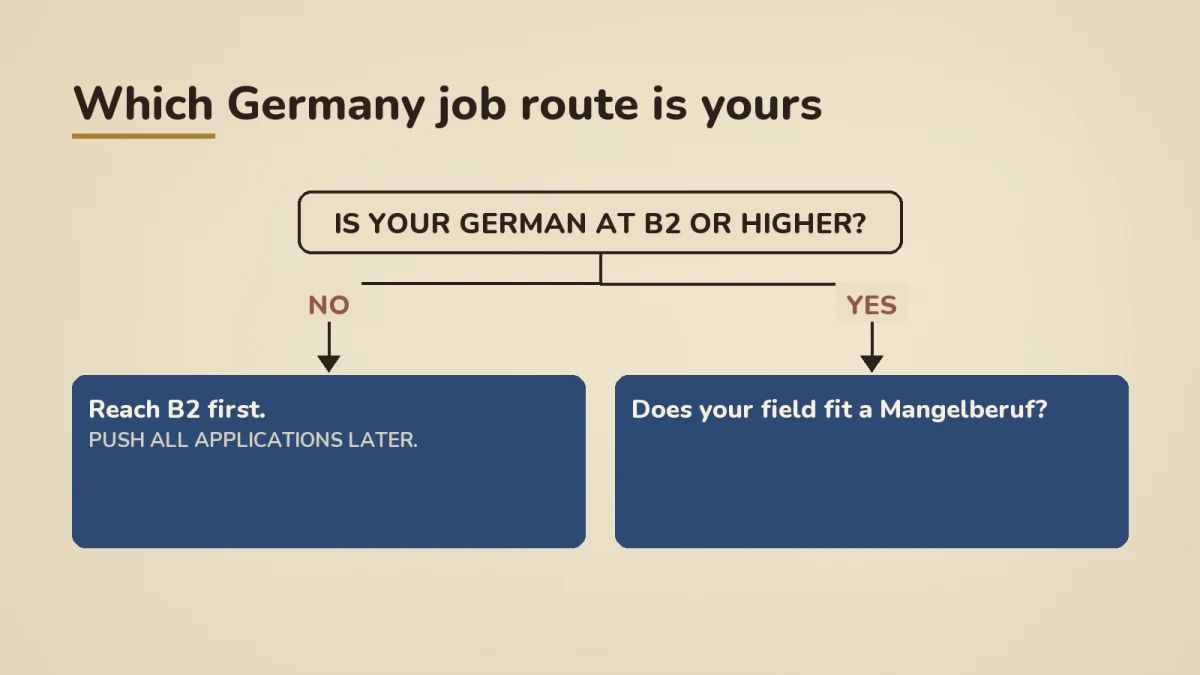
The fix depends on which subset of friction points apply to you.
If your German is below B2, fix that first. Before you redo your CV, before you spend on a translation, before you apply to a single new role. There is no version of "I will learn German once I get there" that beats arriving with a B2 certificate. The Goethe and telc B2 qualify for visa applications and most job postings; B1 alone does not unlock the shortage list. See our German language proficiency guide for the realistic timeline.
If your German is B2 and your background fits a Mangelberuf, target the EU Blue Card route. The 2026 thresholds favour shortage-list applicants: EUR 45,934.20 for shortage occupations versus EUR 50,700 for non-shortage roles. The EU Blue Card guide covers the salary bands. Mention the Blue Card eligibility in the Anschreiben; recruiters know it cuts paperwork.
If you do not yet have a German job offer but your qualifications are recognised, apply for the Opportunity Card (Chancenkarte). It is a job-seeker visa scored on points, not on a sponsoring employer, and it gives you up to 12 months on the ground to interview, do trial work, and convert.
If your background is in a flooded field (general business, marketing, junior consulting), pivot or upgrade. A 6 to 9-month German B2 plus a tactical pivot into adjacent shortage roles (e.g. marketing into B2B SaaS sales for German tech, junior strategy into Mittelstand operations) outperforms more applications in the same flooded category.
The 30-day reset
A focused month rebuilds the application stack from the bottom up. Run all of these in order, not in parallel.
- Diagnose your current callback rate. Pull the last 50 applications. Count callbacks. Below 5% means the system is filtering you out before a human reads the CV. Above 10% means the issue is the interview, not the application.
- Pick your shortage list. Map your skills to the official Mangelberufe categories. If three or more roles fit, that is your target list for the month. If zero fit, plan a pivot rather than more applications.
- Get the recognition reference. Submit your degree to ZAB for a Zeugnisbewertung, or check anabin yourself first to see whether your university is H+, H+/-, or H-. Healthcare and trades will need full Anerkennung; budget 8 to 16 weeks. Without this number, do not bother sending applications in regulated fields.
- Rewrite the CV in German format. One to two pages. Reverse chronological. Headshot upper right. Month/year dates. Recognition reference under "Bildung". Skip the personal-statement paragraph; replace with a "Profil" block of three to five concrete bullets. The CV preparation service takes care of this if you want it done in a week.
- Write an Anschreiben template you will customise per role. Five paragraphs. Why this company. Why you fit this role. Two to three concrete results from prior work. Visa status (Blue Card eligible, on Opportunity Card, EU citizen). Closing with availability date.
- Send 10 Initiativbewerbungen per week. Pick German Mittelstand companies in your shortage category. Email a named person (HR director or department head). Attach the German CV plus Anschreiben. The hidden market opens through this channel; do not skip it.
- Activate XING, not just LinkedIn. XING is where German recruiters and Mittelstand HR teams actually search. Build out the German-language profile, follow target companies, message sparingly. LinkedIn alone leaves you in the foreign-applicant pool.
- Track and adapt. Spreadsheet by company, role, channel, and outcome. After 30 days, look at the conversion rate per channel. Pour effort into the channels that converted; cut the rest.
Common mistakes
- Sending the same CV to every role. Recruiters see the absence of company-specific cues immediately.
- Applying only via job boards. Boards are 30% of the market at best.
- Skipping the German B2 step "for now". That postpones unlocking 70% of the market.
- English-only Anschreiben for German-speaking roles. Reads as inattentive even when the role allows English on the job.
- Ignoring qualification recognition. No ZAB reference for regulated fields means automatic rejection.
- Posting once on LinkedIn and waiting. German recruitment is XING-first for many sectors.
- Mass-applying to general business roles. That is the most flooded segment; the same effort in a Mangelberuf would convert.
FAQ
How long does it usually take to land a job in Germany as a foreign professional?
For graduates of a German university, 75% find a role within 6 months of graduating. For applicants from outside Germany without a German degree, the search typically takes 4 to 9 months once the application stack is German-format with recognised qualifications. Below B2 German, that timeline doubles for most non-tech roles.
Can I apply for jobs in Germany without speaking German?
Yes for a narrow slice of IT, research, and English-only multinational roles in Berlin, Munich, and Hamburg. No for roughly 70% of postings. The realistic plan is to apply to the English-friendly subset while you push your German to B2, not to assume the slice is the whole market.
Is the discrimination data really 24% lower callbacks for foreign names?
Yes. The Federal Anti-Discrimination Agency and a Bonn university audit study show roughly 67% callback for German names against 40% for Arab or Turkish names on identical CVs. The gap narrows for European-sounding names but does not disappear. The practical response is to bypass anonymous board screenings with referrals, Initiativbewerbungen, and named-recruiter routes.
What is a Mangelberuf and how do I know if my profession is on the list?
Mangelberufe are officially recognised shortage occupations. The Bundesagentur fuer Arbeit publishes the current list (163 occupations as of 2026); IT, healthcare, engineering, and trades dominate. Check your role on the arbeitsagentur.de shortage list page or against ISCO-08 codes; the EU Blue Card has a lower salary threshold for any role on this list.
Should I use LinkedIn or XING to find jobs in Germany?
Both, but XING is the default for German Mittelstand recruiters and many traditional industries. LinkedIn is stronger in English-speaking IT and multinationals. If you only have time for one, build XING first.
Do I need to translate my degree before applying?
For regulated professions (engineering, healthcare, teaching, law), yes. Submit your degree to ZAB for a Zeugnisbewertung; the reference number goes on your CV. For non-regulated roles, an English-language transcript with grade conversion using our German grade calculator is usually enough at the application stage, though employers may ask for ZAB later.
What is an Initiativbewerbung and does it work?
It is an unsolicited application sent directly to a company, not in response to a posted role. It is a primary channel for the hidden job market and works particularly well for Mittelstand companies that hire below the public-board threshold. Send 8 to 12 per week, addressed by name, with a tailored Anschreiben. Conversion rates of 5 to 15% are normal in shortage fields.
My CV is in a Canva template. Will German recruiters reject it?
Often, yes. German ATS systems are tuned for the standard German CV layout. Multi-column Canva templates frequently scramble in the text-extraction layer, so recruiters never see your content. The visual format also reads as "not German" before anyone evaluates the substance. Convert to a single-column, reverse-chronological Lebenslauf.
Where to next
- How to find a job in Germany in 2026: the broader market and channel mix.
- Job opportunities in Germany after Master's: post-graduation roles by field.
- EU Blue Card guide: salary thresholds, paperwork, fast-track to PR.
- What is the Opportunity Card: job-seeker visa for non-EU professionals.
- What is ZAB in Germany: qualification recognition step by step.
- Tool: German grade calculator and salary calculator.
- Service: CV preparation for a German-format Lebenslauf.
- Pillar: Work in Germany.
Continue reading
Career & Jobs·11 min read
Job Opportunities in Germany after Master's for International Students
Discover the job opportunities in Germany available for international students after master's degree. From research to engineering, information technology to education, explore a variety of fields and industries.
Read articleCareer & Jobs·15 min read
How to find a job in Germany in 2026: The new playbook for the hidden market
Germany has 628,629 open vacancies but IT roles take 7.7 months to fill and 50 to 70 percent of jobs never get posted. The 2026 playbook.
Read articleCareer & Jobs·12 min read
EU Blue Card Guide for Indian Students Pursuing MS in Germany
Learn about the benefits, eligibility requirements, and application process for the EU Blue Card. Find out how to apply for the EU Blue Card and become eligible for permanent residency in Germany.
Read articleReady to plan your Germany journey?
Explore our tools and resources to find the perfect university and program for your academic goals.