Should you move to Germany in 2026? What the data actually says
Should you move to Germany in 2026? The 2026 data on births, deaths, shortage occupations, sectors hiring, and the routes that work.

Table of contents
Last updated: May 2026
TL;DR: The data says go, but go prepared. Germany lost roughly 352,000 more people than it gained in 2025, the labour market still has 163 official shortage occupations, and 5.89 million foreign workers are already employed there. The risk is not "moving to a dying country", it is moving without German, without a target sector, or without a realistic city. This post walks through the actual 2026 numbers so you can decide for yourself.
If you are reading this in 2026, you are probably hearing two stories at the same time. One says Germany is shrinking, hiring has frozen, and you should wait. The other says it is the easiest decade in a generation to get a residence permit because Germany is short of workers. Both are partly true. The honest answer sits inside the numbers, not the headlines.
This post is the cross-pillar reality check we point readers to before they pick a route. If you already know the route you want, jump to the Work pillar for the visa side, or read the Opportunity Card explainer for the points-based path.
So, should you move to Germany in 2026?
Yes, if three things line up: you can reach German B1 to B2 inside the next 12 months, you target a sector that is actually hiring, and you accept a mid-tier city as a starting point. No, if you are planning to land with only English, expect a Berlin or Munich tech salary in your first six months, and want a guarantee.
Germany is not a guarantee market in 2026. It is a high-leverage market for people who arrive prepared. The headline risk in 2026 is the same one it has been since 2022: showing up underprepared, blaming the country, and going home. The headline opportunity is the same one demographers have been pointing at since 2010: there are not enough working-age Germans to keep the economy running, and that gap gets wider every year.
What the demographic numbers actually say
This is the part most "should I move" debates skip. The Federal Statistical Office and the ifo Institute have both run the math, and the math is not subtle.
In 2025 Germany recorded its largest birth deficit since records began in the postwar era. Roughly 650,000 children were born and roughly one million people died, leaving the country with about 352,000 more deaths than births in a single year. The previous year was already the worst on record. The 2025 number broke the previous record.
In February 2026 the ifo Institute revised its long-run projection. The earlier expectation was that the population would decline by about 1 percent by 2070. The new projection is closer to 10 percent. Destatis published a parallel finding the same season: by 2035, one in four people in Germany will be aged 67 or older.
That is the structural backdrop. It is also why the federal government keeps pulling immigration levers in the same direction. The current target is around 400,000 net new foreign workers per year. As of February 2026 there were 5.89 million foreign workers employed in Germany, an increase of 224,000 in twelve months.
You do not have to like this trend or believe every projection. You only have to understand that the policy direction follows the demographic direction, and the demographic direction does not flip in a year.
What is actually hiring in 2026
Headlines about layoffs are real and worth reading. Volkswagen, SAP, and Bosch have all cut roles since 2024. The same year, the Federal Employment Agency added more occupations to its shortage list, not fewer. The 2026 list runs to roughly 163 occupations, which is the largest it has ever been.
The point is that "the German labour market" is not one market. It is several, and they are moving in different directions.
| Sector | What it looks like in 2026 | Language reality |
|---|---|---|
| Healthcare and nursing | Acute shortage, India-Germany nursing recognition deal active | German B1 minimum, B2 for clinical roles |
| Skilled trades, Ausbildung roles | About 90,000 unfilled apprenticeship places in 2025 | German B1 to start, often subsidised |
| Defence and security tech | New federal spending wave, growing IT and engineering hiring | English ok at major employers |
| Semiconductors | TSMC Dresden ramp, Intel Magdeburg slower than planned | English-first at big foreign-owned plants |
| AI, cybersecurity, cloud | Steady growth, not a 2021-style boom | English ok at international firms, German helps |
| Renewables and grid | Doubled employment since 2019 | Mixed, German for installer roles |
| Generalist English-only office work | Tightest segment, lowest interview rates | German at B2 changes the funnel |
A few numbers from this segment that travel well into 2026:
- About 2.7 percent of openings advertised in Germany are listed in English. That has been roughly stable since 2024. It is the single most important number to internalise before you book a flight.
- Apprenticeship retention is high. Roughly 60 percent of Ausbildung trainees are hired by their training company at the end. See the top Ausbildung courses guide for the route.
- Healthcare hiring is structurally tight, not cyclical. Read the healthcare jobs guide for entry routes.
Where moving makes sense, and where it does not
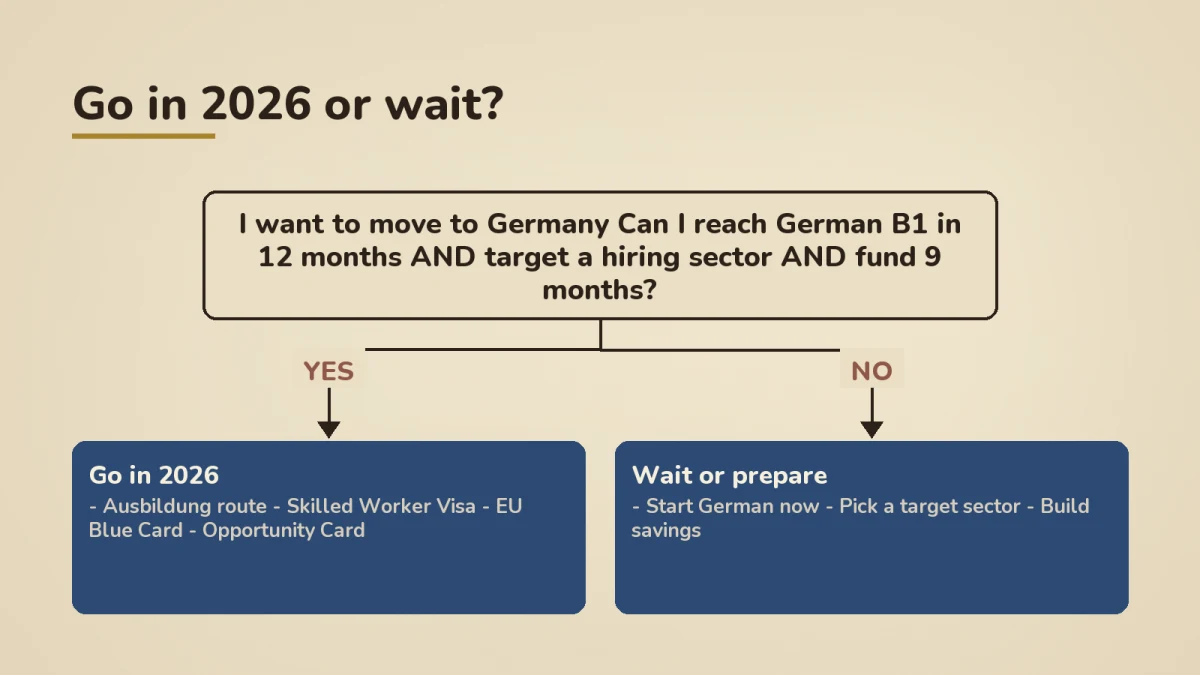
The cleanest way to think about this is to match yourself to a route, not to a vibe.
Go in 2026 if you are a nurse, an IT-Fachinformatiker, a mechatronics technician, a chef, an electrician, a welder, or a healthcare assistant willing to pass German B1 inside a year. The Ausbildung route, the Skilled Worker Visa, and the Opportunity Card all reward you here.
Go in 2026 if you have an EU Blue Card-eligible role lined up in IT, engineering, life sciences, or finance. The salary thresholds and shortage discounts are at their most generous setting since the directive launched.
Go in 2026 if you have already started German and you target Leipzig, Dresden, Chemnitz, Hannover, or the Ruhr. Cost of living is half of Munich, hiring is steadier than Berlin, and competition for entry-level roles is meaningfully lower.
Wait or rethink if you are planning a Master's purely to job-hop into a Berlin tech role with no German. The 2021 to 2023 pattern is broken. Most international graduates who relied on it now spend 12 to 18 months extending their job seeker visa while taking German classes to B2.
Wait if you cannot finance the first 9 to 12 months. The market is open, not generous. Underfunded arrivals are the single largest source of return-home stories.
Common mistakes when timing the move
- "I will learn German once I am there." Most people do not. Start before you land, treat B1 as a 6-month project, B2 as a 12-month project.
- Treating Berlin as default. Mid-tier cities have better job-to-applicant ratios in 2026 and better rental availability.
- Counting on a recession to "fix" hiring. Layoff news and shortage data coexist. They are not the same market.
- Ignoring the Ausbildung route. It is the single most underused path for non-EU candidates with a 12th-pass background.
- Picking a sector by salary, not by openness. A €55,000 cybersecurity role you cannot get is worth less than a €40,000 nursing role with a 2-week response time.
FAQ
Is the German job market actually open in 2026 or not?
It is open in specific sectors, not in general. Healthcare, skilled trades, defence and security tech, semiconductors, and renewables are hiring. English-only generalist office roles are the tightest segment.
Will the recession or war headlines change this?
Cyclical news moves quarterly numbers. The structural shortage is driven by demographics that move over decades. The Federal Statistical Office, the ifo Institute, and the Federal Employment Agency all point in the same direction: not enough working-age people to fill the roles Germany is creating.
How much German do I need before moving?
For Ausbildung and most skilled trades, B1. For nursing and clinical roles, B2. For Blue Card IT and engineering at international firms, English is workable, but B1 doubles your interview rate. For English-only office roles, plan on reaching B2 inside the first year.
Is the Opportunity Card worth applying for?
If you score 6 points or more, yes. The card gives you 12 months in Germany to find qualified work, with the right to work part-time while you search. India has received the largest single-country share so far, around 31 percent. The points calculator on our site shows where you stand.
Which city should I aim for first?
If you have a job offer, the offer dictates the city. If you are arriving on the Opportunity Card or as a job seeker, prioritise mid-tier cities (Leipzig, Dresden, Hannover, Nürnberg, Chemnitz, Düsseldorf) before Berlin or Munich. Cost of living is roughly half, response rates from employers are better, and rental availability is no longer a fight.
Where to next
- The Opportunity Card explained: points, eligibility, timeline
- Top 10 Ausbildung courses for international candidates
- Healthcare jobs in Germany: routes for international applicants
- How much German do you actually need to study and work in Germany
- Tools: Cost of Living Estimator, Chancenkarte Points Calculator
Continue reading
Career & Jobs·15 min read
Chancenkarte Germany: Point system explained, real one-year results, who actually got in
Germany's Chancenkarte point system explained with a 6-point matrix, worked examples, and real one-year results from 2024 to 2025.
Read articleCareer & Jobs·11 min read
Job Opportunities in Germany after Master's for International Students
Discover the job opportunities in Germany available for international students after master's degree. From research to engineering, information technology to education, explore a variety of fields and industries.
Read articleCareer & Jobs·14 min read
Why Germany has 1M jobs and zero callbacks (and how to fix your application)
Germany has over 1 million open jobs but most foreign applicants get silence. Here is why your applications fail and how to fix the stack.
Read articleReady to plan your Germany journey?
Explore our tools and resources to find the perfect university and program for your academic goals.