Job-hunting in Germany without German: Which industries actually hire in English
Yes, you can get a job in Germany without German. Tech, research, finance, and startups hire in English at scale. The realistic 2026 industry guide.

Table of contents
Last updated: May 2026
TL;DR: Yes, you can get hired in Germany without speaking German, but only in specific industries and cities. Tech, research, English-taught finance roles, and product teams at international scale-ups hire in English every day. Public-sector, customer-facing, and most mid-tier German companies will still ask for B2. Pick your industry first, then pick your city, and the job hunt becomes solvable.
If you have read that "Germany hires in English now" and you have also read that "you cannot work in Germany without German", both are partly right. The honest answer depends entirely on the industry, the company, and the city you target. Roughly 600 to 1,500 English-only roles are listed at any given time across Glassdoor, Arbeitnow, and englishjobs.de in May 2026, with a steady pipeline of new postings every week.
This guide is the realistic version. We will name the industries that hire in English, the ones that quietly do not, the cities where you have a fighting chance, and the search tactics that find these jobs faster than scrolling LinkedIn for hours. If your end-game is the EU Blue Card or a Chancenkarte job search, this is how you get to a contract.
Can you actually get hired in Germany without German?
Yes, but only in industries that have already moved to English as their internal working language. That list is shorter than the marketing posts suggest, and longer than the doom posts suggest.
Three signals tell you whether a company is genuinely English-first: the job ad is in English (not German with English copy-paste), the interview process is in English, and the hiring manager you meet on the call is comfortable in English. If two of those three are missing, the role is bilingual at best and German-preferred at worst, even if the JD says "English is sufficient."
The cleanest cases are tech scale-ups, research institutes, international finance, and global functions at large MNCs. Almost everywhere else, German B1 to B2 is the unwritten requirement, and you will lose at the final round to a candidate who has it.
Which industries actually hire in English
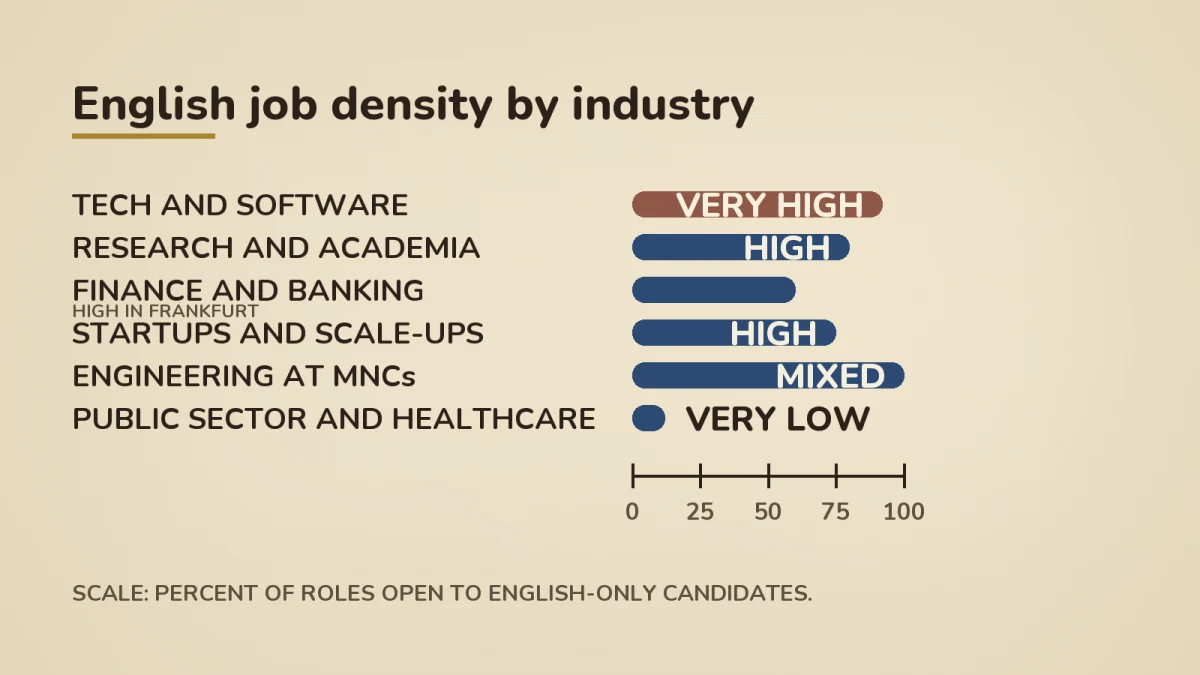
These are the industries where English-only candidates land jobs in 2026, ranked by how dense the English-speaking pipeline is:
Tech and software
The most reliable bucket. Software engineering, data engineering, machine learning, DevOps, SRE, product management, design, and product analytics all hire in English at scale-ups and at the German offices of US/EU multinationals. Berlin is the centre of gravity. Munich and Hamburg are next. Companies actively hiring in English include SAP, Zalando, Delivery Hero, HelloFresh, Personio, Celonis, About You, N26, Trade Republic, Scout24, Wayfair Germany, and Idealo. Senior software engineering salaries cluster around EUR 68,000 to 75,000 gross at mid-tier scale-ups and stretch into EUR 130,000 to 250,000+ at FAANG-style employers.
Research and academia
Almost every PhD and postdoc role at the Max-Planck-Gesellschaft, Helmholtz, Fraunhofer, Leibniz, and TUM/LMU/Heidelberg/RWTH research groups runs in English. Application calls, group meetings, and publications are English by default. The Max Planck Postdoc Program runs an English-language application cycle every spring (next call September 2026). PhD pay is on the TVöD-E13 scale, between EUR 51,000 and EUR 65,000 depending on level. Postdoc roles pay E13 to E14 (EUR 60,000 to EUR 80,000+).
Finance, banking, and asset management
Frankfurt-based international banks, the European Central Bank, JPMorgan, Goldman Sachs, BlackRock, Allianz Global Investors, and Deutsche Bank's IT and quant divisions hire in English for trading, risk, quant research, and engineering roles. The retail and customer-advisor side of German banks is German-only. If your CV reads "FX trading" or "quant developer" you are fine. If it reads "branch banker" you are not.
Startups and scale-ups
Berlin's startup ecosystem is English-first because the founders and early hires often were. Munich and Hamburg are catching up. Job boards that filter for this segment include BerlinStartupJobs, JoinTheBerlinStartupScene, and Workinstartups. Salaries are typically below FAANG and slightly below SAP/Siemens, but the equity and pace are different.
Engineering and global functions at large MNCs
BMW, Mercedes-Benz, Bosch, Siemens, Continental, Lufthansa Technik, and ZF run sizable English-speaking R&D, IT, and corporate functions in addition to their German shop floors. Roles in central engineering, software, embedded, IT infrastructure, and global HR/finance/strategy are bookable in English. Anything customer-facing, supplier-facing in German, or shop-floor production is not.
Healthcare and life sciences (limited slice)
Pharmaceutical R&D at Bayer, Boehringer Ingelheim, Merck, BioNTech, and Sanofi hires in English for laboratory, biotech, regulatory affairs, and clinical-trial management. Anything patient-facing, nursing, or clinical practice is German B2 to C1, full stop, and the Approbation pathway for foreign doctors requires fluent German.
Which industries do NOT hire in English (the honest list)
Save yourself months by knowing these upfront:
- Public sector and civil service. Government, Bürgeramt, Finanzamt, and most state-funded organisations are German-only.
- Healthcare patient-facing roles. Nursing, doctors, allied health, paramedic. German B2 minimum, C1 in practice.
- Sales with German clients. Account management, business development, customer success at any company selling primarily to the DACH market.
- Marketing and communications targeting German consumers. Copywriting, brand, PR, content marketing in the German market.
- Skilled trades. Electrician, plumber, carpenter, mechanic, Ausbildung-track roles. German B1 minimum, B2 typical.
- Hospitality. Front-of-house, restaurant management, hotel reception. German B1 to B2 preferred even in tourist cities.
- Retail. Store management, merchandising, customer-advisor roles outside of luxury and tourist Berlin.
- Most law and tax advisory. German legal system runs in German.
- Mid-sized Mittelstand companies in non-tech sectors. Most German Mittelstand still operates internally in German, even if their export business is English.
Which cities give you the highest English-job density
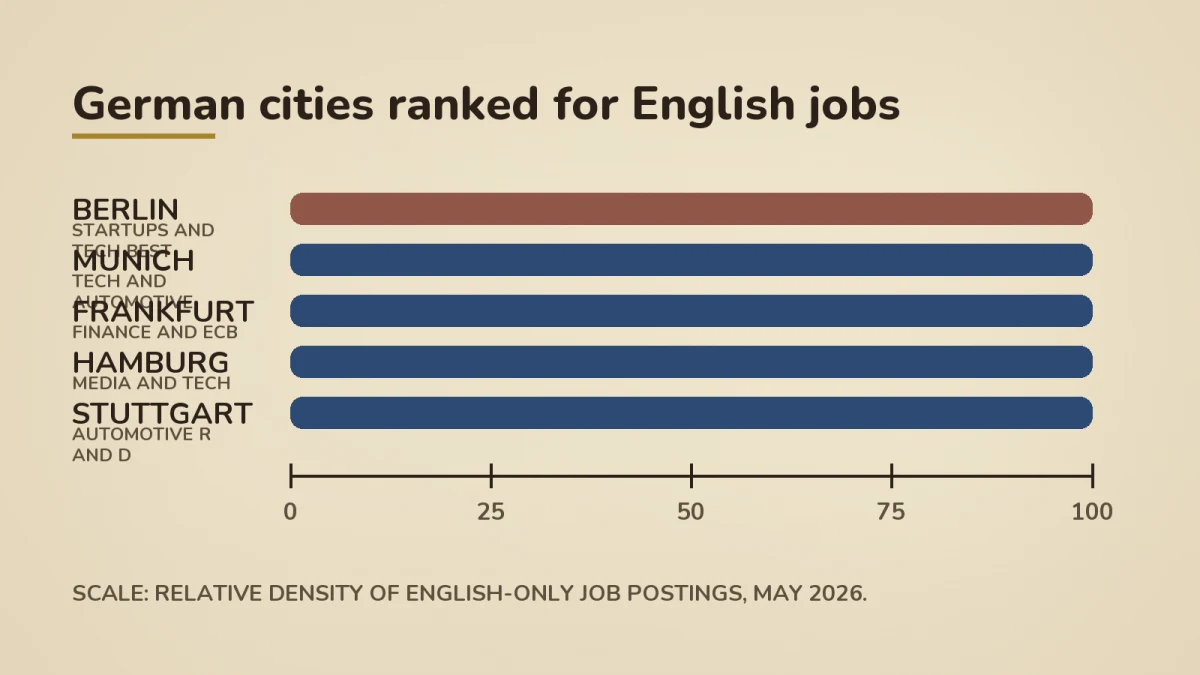
Berlin tops the list by a wide margin. The other cities have specific industries that lift their English-job count.
| City | English-job strength | Best for |
|---|---|---|
| Berlin | Very high | Startups, tech, product, AI/ML, design, scale-ups |
| Munich | High | Tech (Google, Apple, Microsoft offices), automotive R&D, consulting |
| Frankfurt | High (finance) | International banking, ECB, asset management, fintech |
| Hamburg | Medium-high | Tech (Google, Facebook, About You), media, logistics tech |
| Heidelberg, Tubingen, Goettingen | Medium (research-only) | Max Planck, Helmholtz, university research |
| Stuttgart | Medium | Automotive R&D, embedded software at Bosch, Mercedes, Porsche |
| Cologne, Dusseldorf | Medium | Consulting at Big 4 and BCG/McKinsey, FMCG global functions |
| Leipzig, Dresden, Chemnitz | Low to medium | A handful of tech roles, semiconductor research |
| Smaller cities under 200,000 | Low | German B2+ usually required |
If you can be flexible on city, target Berlin first. If you cannot relocate to Berlin, Munich and Frankfurt give you specific verticals (tech, finance) where English roles cluster.
How to find these jobs faster than LinkedIn cold-scrolling
Six job boards consistently surface English-only roles in Germany:
- Arbeitnow (arbeitnow.com) filters for English-speaking and visa-sponsorship roles by default.
- englishjobs.de is built explicitly for the English-only audience and tags visa-sponsorship.
- BerlinStartupJobs for the Berlin startup pipeline.
- LinkedIn with these filters:
Germanylocation, languageEnglishin the Easy Apply filter, and search termsenglish speaking,no german required,visa sponsorship. Save the search and turn on alerts. - Glassdoor Germany for English-tagged roles with company ratings and salary bands attached.
- The careers pages of named employers. SAP, Zalando, N26, Personio, Celonis, BioNTech, Max Planck, BMW, Allianz, BlackRock all post in English on their own careers sites and update faster than aggregators.
Two search-string tricks save hours:
- On LinkedIn search:
"english speaking" OR "no german required" OR "english only"together with your role keyword. - On Google:
site:linkedin.com/jobs "berlin" "english" "[your role]"to surface long-tail postings the LinkedIn UI hides.
For the visa side, Make-it-in-Germany lists the Skilled Worker Visa, EU Blue Card, and Chancenkarte routes in English, and most of the listed employers explicitly mark English-friendly roles.
Common mistakes and what to avoid
- Applying to bilingual roles thinking "they will accept English." They won't. The bilingual JDs filter at the recruiter stage on first call.
- Sending a German-style CV with a photo, DOB, and signature. International employers want a US-style one-page CV with metrics. Use our CV preparation guide and CV-mistakes checklist.
- Skipping German entirely. Even if your job is in English, day-to-day life (Anmeldung, Krankenkasse, Mietvertrag) is smoother with B1. And every promotion track in Germany eventually rewards German fluency. Start A1 the day you land. Our take on the German-language myth covers this.
- Targeting Mittelstand companies in non-tech sectors hoping they will hire in English. They will not, in most cases. Stick to the industries above for the first job.
- Ignoring the EU Blue Card threshold. If your offer is below the Blue Card salary minimum, you may end up on a regular Skilled Worker Visa with slower permanent-residency timelines. Negotiate up. While reviewing the offer, scan the standard German contract clauses for probation, notice, and non-compete terms before you sign.
- Treating the Chancenkarte as a backup plan only. The Chancenkarte lets you enter Germany to job-hunt for up to 12 months. Many candidates land roles faster from inside Germany than from abroad because employers value local availability.
FAQ
Q:
How many jobs in Germany are available without German in 2026?
A: Aggregators show 600 to 1,500 English-only roles open at any given time. Englishjobs.de listed 177 visa-sponsored English roles in May 2026, and Glassdoor showed 627 English-speaking jobs in Germany the same week. Add LinkedIn, careers pages, and arbeitnow and the realistic monthly flow is in the low thousands.
Q:
Which industries pay the most for English-speaking workers?
A: Tech and finance pay the highest. Senior software engineers at FAANG offices in Berlin and Munich earn EUR 130,000 to 280,000+ in total compensation. Investment banking and quant roles in Frankfurt clear EUR 100,000+ at mid-level. Research and academia pay less in cash (EUR 60,000 to 80,000) but offer permanent contracts and strong benefits.
Q:
Do I need a German degree to get an English-speaking job in Germany?
A: No. A foreign degree recognised on the Anabin database is enough for the visa. International tech and research employers care about portfolio, GitHub, publications, and interview performance. Recognition matters more for regulated professions (medicine, law, teaching).
Q:
Is Berlin really the only city for English jobs?
A: No, but it is the easiest. Munich is strong for tech and automotive R&D. Frankfurt is strong for finance. Hamburg is strong for tech and media. Heidelberg, Tubingen, and Goettingen carry the research workload. Outside these cities your English-only options drop sharply.
Q:
Should I learn German anyway if my job is in English?
A: Yes. Daily life (Anmeldung, doctors, contracts, neighbours) is much easier with A2 to B1. Promotion tracks reward German over time. And if you ever want to move out of tech-island Berlin or pivot industries, German is what makes that move possible. Start with A1 the day you land.
Q:
Can I switch from a Chancenkarte to a work visa once I get an English-speaking job?
A: Yes. The Chancenkarte is designed exactly for this. Once you sign an offer that meets the EU Blue Card or Skilled Worker Visa requirements, you convert to that residence permit at the local Auslaenderbehoerde without leaving Germany.
Q:
Are remote-only jobs an option for English speakers in Germany?
A: Some, especially at distributed startups. But for visa sponsorship you usually need a German entity to employ you. Pure remote-from-anywhere roles will not sponsor a German visa. Hybrid roles based in Berlin, Munich, or Frankfurt are the practical sweet spot.
Q:
How long does the job search typically take?
A: For mid-level tech roles in Berlin with strong portfolios: 6 to 12 weeks from first application to signed offer. For research roles tied to call cycles (Max Planck, DFG): 3 to 6 months. For finance in Frankfurt: 2 to 4 months. Add another 6 to 10 weeks for visa processing on top of the offer.
Where to next
- The full EU Blue Card guide for salary thresholds, eligibility, and the 21/27-month permanent-residency timeline.
- Everything about the Chancenkarte (Opportunity Card) and how the points system works.
- Our job opportunities after Master's in Germany post for graduates currently in the country.
- The engineering-graduate jobs guide for fields with the strongest German-English bilingual demand.
- Use the salary calculator to model your gross-to-net before negotiating an offer.
Continue reading
Career & Jobs·10 min read
Payscale in Germany: Average Gross Remuneration by Profession and Region
Discover the average gross remuneration in Germany by profession and region. Learn how much you can earn as a student or professional and work out your ROI. Explore the payscale in Germany and make an informed decision for your higher studies.
Read articleCareer & Jobs·15 min read
Chancenkarte Germany: Point system explained, real one-year results, who actually got in
Germany's Chancenkarte point system explained with a 6-point matrix, worked examples, and real one-year results from 2024 to 2025.
Read articleCareer & Jobs·14 min read
Why Germany has 1M jobs and zero callbacks (and how to fix your application)
Germany has over 1 million open jobs but most foreign applicants get silence. Here is why your applications fail and how to fix the stack.
Read articleReady to plan your Germany journey?
Explore our tools and resources to find the perfect university and program for your academic goals.