Living in Stuttgart as an expat: Automotive jobs, Swabian culture, housing
Stuttgart for working expats in 2026: automotive jobs at Mercedes, Porsche, and Bosch, Swabian culture, rents vs Munich, and the first 90 days settled.

Table of contents
Last updated: May 2026
TL;DR: Stuttgart is Germany's automotive capital, with Mercedes-Benz, Porsche, and Bosch headquartered here. The wages are high, the rent is sharper than the national average but softer than Munich, and the dialect is its own thing. The 2024 to 2025 layoff cycle reshaped the job market: traditional automotive is hiring software, electrification, and battery roles, not gearbox engineers. If you can read German job listings and tolerate Kehrwoche, Stuttgart pays you well to live in a green basin city you may never want to leave.
Stuttgart often sits in the shadow of Munich and Berlin in expat guides, which is unfair. The Stuttgart region has the highest GDP per capita of any German metro area, the densest automotive cluster in Europe, and a cost-of-living profile that rewards working professionals more than tourists or students. This guide is for the working expat planning a move, or the one already here trying to make sense of the Schwabenland. For a wider comparison across German cities, see our best cities in Germany to live and work guide and the /live/cities hub.
Who actually lives in Stuttgart
Stuttgart proper has roughly 635,000 residents. The Stuttgart metro region (Mittlerer Neckar) is closer to 2.8 million across cities like Esslingen, Ludwigsburg, Sindelfingen, Böblingen, and Reutlingen. About 25 percent of city residents hold a foreign passport, and a much larger share have an immigration background. The biggest international communities are Turkish, Italian, Greek, Croatian, and increasingly Indian and Eastern European, driven by automotive engineering hiring through the 2010s and 2020s.
The city is built inside a basin (Kessel) ringed by vineyards. This single geographic fact explains a lot: housing is harder than the population alone suggests, the air can stagnate in winter, and locals are obsessive about wine because there is literally a vineyard on the U-Bahn line.
Automotive jobs: still the biggest game, but the game has changed
Stuttgart is the headquarters or major site for Mercedes-Benz Group, Porsche, Bosch, MAHLE, Daimler Truck, ZF (in nearby Friedrichshafen but with Stuttgart-region operations), and hundreds of Tier 1 and Tier 2 suppliers. If your CV says automotive, this is the deepest job market in Europe.
The 2024 and 2025 layoff cycle changed the hiring profile, though. Bosch announced multi-thousand job cuts at its Gerlingen and Feuerbach sites. Mercedes ran a voluntary severance program and reduced headcount in legacy combustion teams. The roles that survived and are still hiring fall into a few clusters:
- Software engineering for vehicle platforms (SDV, infotainment, ADAS)
- Battery cell and pack engineering, including manufacturing process roles
- Power electronics and electric drive systems
- Functional safety, cybersecurity, and homologation for connected vehicles
- Production engineering for new EV platforms
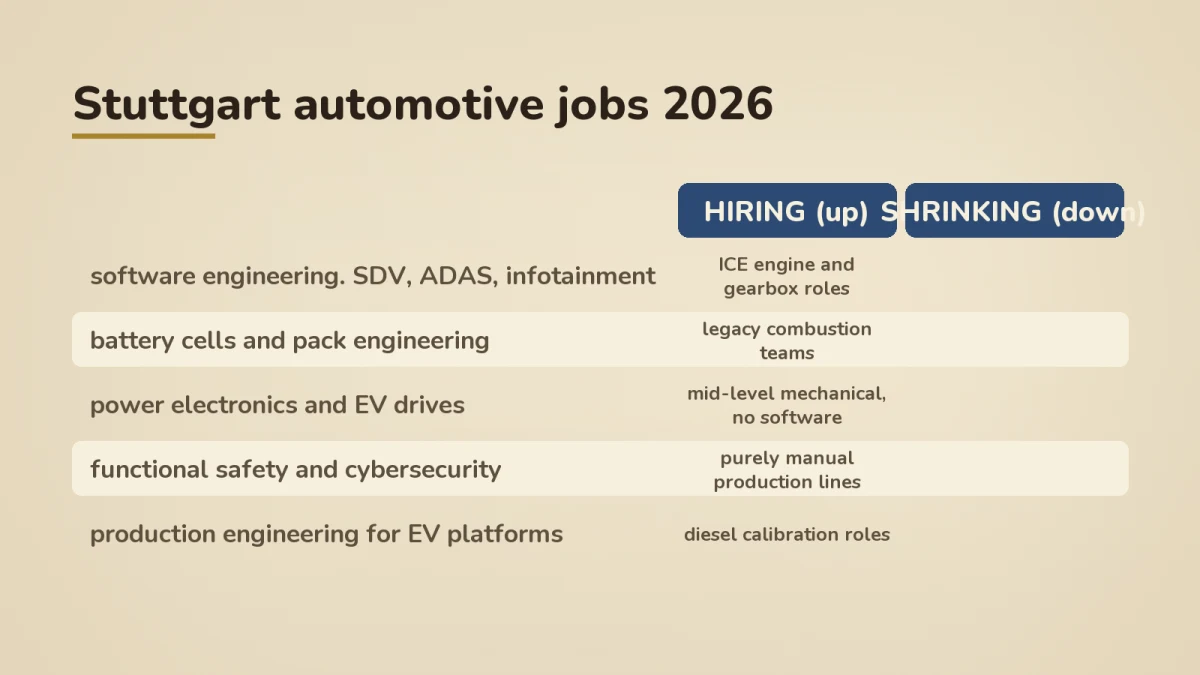
Mechanical engineers from a pure ICE background are competing in a shrinking pool. If you are arriving from India, Pakistan, or Eastern Europe with a Master's in mechanical engineering, the path that works in 2026 is to retrain into one of the clusters above, or pivot into Mittelstand suppliers (the family-owned mid-sized firms that still need classic mechanical talent for industrial and aerospace contracts).
Salaries remain among the highest in Germany. A software engineer at Porsche or Mercedes with three to five years of experience typically lands in the EUR 75,000 to 95,000 range. Tarifvertrag (collective bargaining) coverage at the OEMs adds 13th-month bonuses, profit sharing, and 30 days of leave. Bosch and Mercedes both use the IG Metall Baden-Württemberg pay scales, which are public.
For a deeper read on engineering paths, see job opportunities for engineers after a Master's in Germany and the top 7 universities for automotive engineering in Germany, most of which feed directly into Stuttgart-region hiring.
Housing: tighter than the data suggests
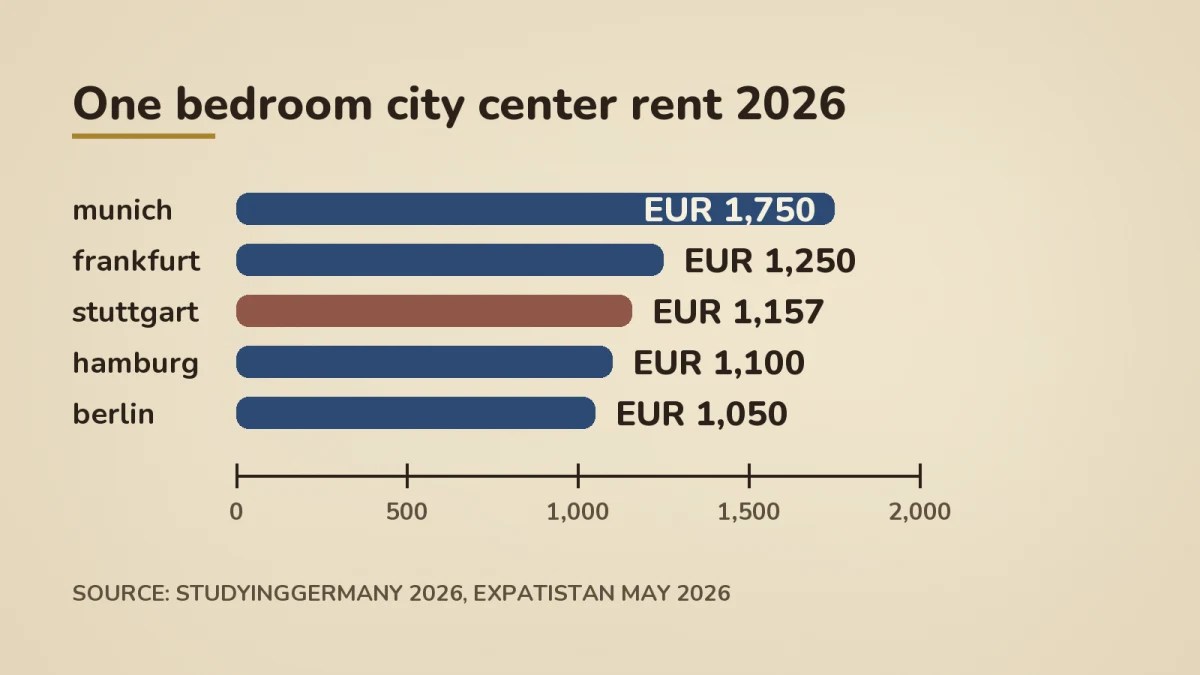
The published average rent for a one-bedroom city-center apartment in Stuttgart sits around EUR 1,157 per month in 2026, with a 70 to 90 square metre family flat in central neighborhoods often clearing EUR 1,800 to 2,400 cold rent. That is roughly 30 to 40 percent cheaper than central Munich and 10 to 20 percent more expensive than Hamburg or Frankfurt's outer ring.
The number that matters more is the search. Stuttgart's basin geography limits where new housing can go, the city has had population growth without proportional construction since 2015, and many vacancies never list publicly because landlords fill them through networks. Realistic budget for a single-person move is six to twelve weeks of active searching, ImmoScout24 alerts on every new listing, and being ready to attend group viewings (Massenbesichtigungen) within hours of a posting.
Neighborhoods worth knowing:
- Mitte, Süd, West: central, expensive, well connected, walkable
- Bad Cannstatt: across the Neckar, more affordable, big international population, the spa quarter and the autumn Wasen festival are here
- Vaihingen, Möhringen: south-west, near the airport and the university, popular with families and engineers at Bosch and IBM
- Feuerbach, Zuffenhausen: north of the basin, near Porsche HQ, industrial but improving
- Sindelfingen, Böblingen, Esslingen: outside the city, near Mercedes plants, S-Bahn commute, often the only realistic option for newcomers
Suburbs are not a downgrade. The S-Bahn runs every 15 to 20 minutes off-peak and connects everything to Stuttgart Hbf. Most engineers commute. For finding listings, see top websites to find accommodation in Germany.
Swabian culture, in plain English
Stuttgart sits in Württemberg, the Swabian half of Baden-Württemberg. The Swabian (schwäbisch) dialect is real, it is heavy, and most of your colleagues will switch to it the moment work stops. Hochdeutsch is fine in offices and in Mercedes or Porsche meetings. Outside that bubble, expect to hear "Grüß Gott" instead of "Guten Tag", "Schaffe" instead of "arbeiten", and a cadence that drops endings on every word.
Two cultural specifics that catch newcomers off guard:
Kehrwoche. A rotation system in shared houses where every tenant takes a weekly turn cleaning the staircase, sidewalk, and sometimes the cellar. It is real, it is enforced socially, and ignoring it is the fastest way to be the unpopular foreigner in your building. Read your rental contract for whether your building has Kehrwoche, and if it does, do it the week it is your turn.
Schaffe schaffe Häusle baue. Roughly: work, work, build a little house. The Swabian work ethic is not a stereotype, it is a cultural baseline. Stuttgart's wealth was built by families who saved obsessively to buy or build. Expect colleagues to leave at 4:30 PM sharp because they have something to do, not because they are leaving early.
The flip side is real: Cannstatter Wasen in autumn (the second-biggest Volksfest after Munich's), the Stuttgart Weindorf in late summer (a wine festival in the city center), Schwäbische Maultaschen and Spätzle as everyday food, and a vineyard culture that is centuries older than the cars.
Practical first 90 days
The settlement steps are the same nationwide, but the Stuttgart specifics are:
- Anmeldung at a Bürgerbüro. Book online via the Stuttgart city portal weeks in advance. Walk-in slots are rare. Bring your rental contract and the Wohnungsgeberbestätigung from your landlord.
- Tax ID and Steueridentifikationsnummer. Mailed automatically within two to four weeks of Anmeldung.
- Bank account. Most engineers default to N26, Commerzbank, or Sparkasse Baden-Württemberg. The Sparkasse branch network is genuinely useful in this region.
- Health insurance. TK (Techniker Krankenkasse) is the most common public insurer for engineers. See our guide on insurance every expat in Germany needs.
- VVS Abo. The transit pass for the metro region. The Deutschlandticket at EUR 63 per month replaces it for most commuters in 2026.
- Rundfunkbeitrag. The public broadcasting fee, EUR 18.36 per month per household. You will get a letter; pay it.
Common mistakes to avoid
- Treating Munich rents as the benchmark. Stuttgart is cheaper, but the search is harder. Budget time, not just money.
- Only applying to Mercedes and Porsche. The Mittelstand suppliers in Sindelfingen, Esslingen, and Reutlingen pay competitive rates with shorter hiring cycles.
- Ignoring German. Tech roles in Berlin survive on English. Most Stuttgart engineering teams switch to German the moment a customer or a senior colleague joins the call. B1 is the realistic minimum to feel included; B2 unlocks promotion conversations.
- Living in Stuttgart-Mitte if you work in Sindelfingen. The reverse commute on S-Bahn S1 in the morning is fine, but the evening direction is brutal. Pick the side of the basin that matches your office.
- Skipping Kehrwoche. Genuinely. Just do it.
FAQ
Is Stuttgart a good city for non-German-speaking expats?
For software, IT, and some research roles at the OEMs, yes. Mercedes, Porsche, and Bosch all run English-default teams in software, ADAS, and corporate functions. For most other roles, B1 to B2 German is expected, and your job options expand dramatically once you cross B2.
What does an engineer earn in Stuttgart in 2026?
Starting salaries for graduate engineers run EUR 55,000 to 65,000 at the OEMs and large suppliers. Three to five years of experience moves you to EUR 75,000 to 95,000. Senior software and ADAS engineers regularly clear EUR 100,000 with bonuses. Mittelstand pays slightly less but with broader scope.
How does Stuttgart compare to Munich for cost of living?
Stuttgart is roughly 20 to 30 percent cheaper on rent and 10 to 15 percent cheaper overall. Munich pays similar engineering salaries, so disposable income is meaningfully higher in Stuttgart, especially if you live in the metro region rather than central Stuttgart-Mitte.
Can I survive in Stuttgart without a car?
Yes. The S-Bahn, U-Bahn, regional trains, and Deutschlandticket cover almost all of daily life. A car is useful for weekend trips into the Black Forest or Lake Constance, but most engineers in central neighborhoods do not own one.
Is the Swabian dialect a real barrier?
At work, no. Office German defaults to Hochdeutsch. Socially, yes, especially in older neighborhoods or in family settings. Most locals will switch to Hochdeutsch when they realize you are foreign. Knowing a handful of Swabian words ("Gell?", "Grüß Gott", "Schaffe") earns goodwill faster than fluent Hochdeutsch.
How is the school system for international families?
Stuttgart has the International School of Stuttgart (ISS) in Sindelfingen and Degerloch, plus the European School Stuttgart in Sillenbuch (English, French, German sections, free for children of EU institution staff). State schools (Grundschule, Gymnasium) are free and high quality but teach in German.
Where to go from here
- Best cities in Germany to live and work for the full intercity comparison
- Job opportunities for engineers after a Master's in Germany for the engineering job market
- Top websites to find accommodation in Germany for the housing search
- Must-have insurance every expat in Germany needs for health and liability cover
- The /live/cities pillar for visas, residence permits, and city-by-city moves
Continue reading
Living in Germany·9 min read
Buying a car in Germany as a new arrival: Registration, insurance, TÜV, financing
Practical guide to buying a car in Germany as a new arrival in 2026: Anmeldung first, eVB insurance, Zulassung at the Kfz office, TÜV and financing options.
Read articleLiving in Germany·19 min read
Public vs Private Health Insurance in Germany: PKV vs GKV Head-to-Head with Real Numbers
Public vs private health insurance in Germany compared with 2026 numbers. JAEG, BBG, GKV monthly cost, PKV premiums, family math, and the age 55 lock-in.
Read articleLiving in Germany·15 min read
Schufa in Germany explained: How to build credit as a new arrival, and the myths to ignore
Schufa is Germany's main credit file. Here is how it actually starts, the new 2026 score model, and how to build it from zero as an expat.
Read articleReady to plan your Germany journey?
Explore our tools and resources to find the perfect university and program for your academic goals.