Living in Hamburg as an expat: Shipping, media, tech jobs, neighbourhoods
Hamburg expat guide for 2026: tech, aviation and media salaries, the neighbourhoods that actually work, real rent figures, and a first-month checklist.

Table of contents
Last updated: May 2026
TL;DR: Hamburg is the quiet alternative to Berlin and Munich for expats: Germany's biggest port, a serious media and aviation hub, an underrated English-friendly tech scene, and rent that still sits below Munich and Frankfurt. Pick Eimsbüttel or Altona for grown-up calm, Sternschanze or St. Pauli for nightlife, Winterhude or Ottensen for families, HafenCity for waterfront new-build.
If you are weighing German cities for the long run, Hamburg rarely shows up on the first page of expat lists. That is exactly why it works. The city is the headquarters of Airbus's commercial division, of Otto Group, of Beiersdorf (Nivea), of Spiegel and Zeit and NDR, and of Germany's largest seaport. Salaries are healthy, English-only roles exist in tech and media, and the rent ceiling sits noticeably below Munich. This guide covers the four things expats actually research before moving: where to work, where to live, what it costs, and how to settle in. For the broader pillar, read our German cities overview. For the sibling guide on the finance hub, see living in Frankfurt as an expat.
Why Hamburg works for expats
Hamburg is Germany's second-largest city by population (about 1.9 million in the city proper, 5.4 million in the metropolitan region) and its richest by GDP per capita. The economy rests on four pillars that all employ international talent: aviation (Airbus's Finkenwerder plant), maritime and logistics (the port plus Otto Group, Hapag-Lloyd, Kühne+Nagel), media (Spiegel, Zeit, NDR, Bauer, Gruner+Jahr), and consumer goods (Beiersdorf, Tchibo). Tech sits on top: a growing startup scene in Schanze and Altona, plus enterprise digital teams at Otto, Lufthansa Technik, Airbus, and Blohm+Voss.
What makes the city feel different to most expats is the mix of money and water. Hamburg is denser with billionaires per capita than any other German city, but the Hanseatic culture is understated, walking-friendly, and visibly green. Two large lakes (the Alster) sit in the middle of the city, the Elbe runs along the south, and parks are stitched between the central districts.
What Hamburg actually pays
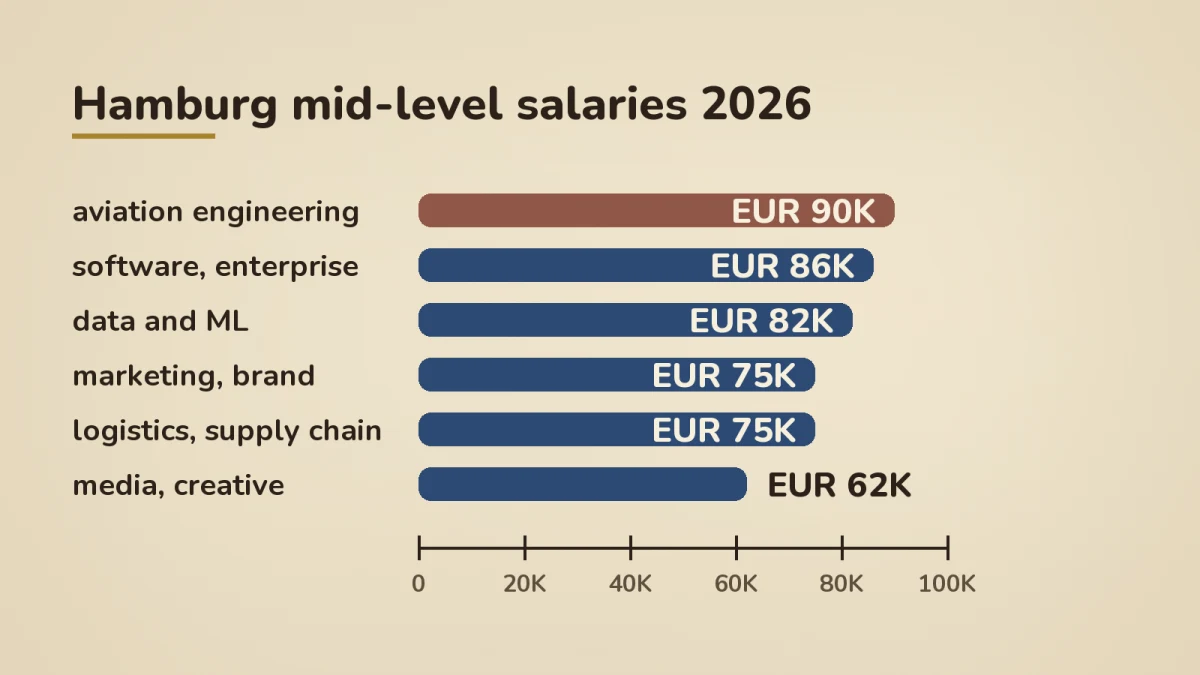
The Hamburg Metropolitan Region's largest employers (by headcount, 2026 figures from Hamburg Business) are Airbus (around 12,700), Asklepios, Lufthansa Group, and Otto Group. Each runs international teams where English is workable for the technical and senior roles, though German still helps for promotions.
Realistic gross salary bands for English-comfortable roles in 2026:
| Field | Junior | Mid | Senior |
|---|---|---|---|
| Software engineering (product / startup) | 55,000 to 65,000 EUR | 70,000 to 85,000 EUR | 90,000 to 115,000 EUR |
| Software engineering (Otto, Lufthansa Technik, enterprise) | 60,000 to 70,000 EUR | 78,000 to 95,000 EUR | 100,000 to 130,000 EUR |
| Data / ML / analytics | 58,000 to 68,000 EUR | 75,000 to 90,000 EUR | 95,000 to 125,000 EUR |
| Aviation engineering (Airbus) | 60,000 to 72,000 EUR | 80,000 to 100,000 EUR | 105,000 to 135,000 EUR |
| Logistics, supply chain (Hapag-Lloyd, Kühne+Nagel) | 50,000 to 60,000 EUR | 65,000 to 85,000 EUR | 90,000 to 120,000 EUR |
| Media, creative, content | 42,000 to 52,000 EUR | 55,000 to 70,000 EUR | 75,000 to 95,000 EUR |
| Marketing, brand (Beiersdorf, Tchibo) | 50,000 to 60,000 EUR | 65,000 to 85,000 EUR | 90,000 to 120,000 EUR |
These bands sit roughly 10 percent below Munich and Frankfurt for tech, level with Berlin, and clearly above Cologne or Düsseldorf for engineering. To translate gross to take-home, use our salary calculator.
English-only roles, realistically
Hamburg is more English-friendly than people expect, but less so than Berlin. Aviation, shipping, and the bigger media houses run English daily because their operations are international. Mid-size local companies will say "English okay" in the job ad and then run all-German team meetings. Filter on this in interview round one. The simplest question to ask: "what language are your standups, your slack, and your code reviews in?"
If you are coming in on a Blue Card, your offer needs to clear the 2026 threshold. We track the current number on the EU Blue Card guide.
Where expats actually live
Hamburg has 7 administrative districts (Bezirke) and 104 quarters (Stadtteile). The expat shortlist below is the one local relocation consultants actually use, organised by what kind of life you are buying.
| Neighbourhood | Vibe | Indicative rent (EUR / m², new lease) | Best for |
|---|---|---|---|
| Eimsbüttel | Grown-up, leafy, cafés on every corner, family-loaded | 16 to 19 | Mid-career, couples, parents who want walking-friendly streets |
| Altona | Mixed-income, arts-heavy, fast S-Bahn into Mitte | 14 to 17 | Creatives, designers, anyone who wants character without St. Pauli prices for nightlife |
| Ottensen | Quieter cousin of Altona, dense with cafés and bookshops | 15 to 18 | Couples, young families, freelancers |
| Sternschanze (Schanze) | Loud, young, bar-and-club-dense, gentrifying fast | 17 to 22 | Twenties, no kids, tolerance for noise |
| St. Pauli | Iconic nightlife, harbour-adjacent, gritty in patches | 14 to 18 | Night people, music industry, no early-morning meetings |
| HafenCity | Modern waterfront new-build, glass towers, expensive | 22 to 30 | Senior corporate, families with school-age kids, those who want concierge living |
| Winterhude | Calm, lake-adjacent, school catchment-friendly | 16 to 20 | Families, anyone wanting Alster proximity |
| Barmbek | Solid middle ground, quieter rents, well connected | 12 to 15 | Cost-conscious singles, first-job professionals |
| Eppendorf | Doctors, lawyers, designer pram crowd | 17 to 21 | High earners, families targeting Gymnasium feeders |
Hamburg's average new-lease rent across the city sat at about 13.30 to 13.58 EUR per square metre at the start of 2026 (Mietenspiegel and market trackers), with existing contracts up roughly 2 percent year over year. New leases in Mitte routinely top 19 EUR per square metre. Numbers in the table above are mid-2026 asking rents for furnished and unfurnished mid-market flats; budget furnished platforms (Wunderflats, Blueground) start around 920 to 1,500 EUR per month for a one-bedroom, with peaks well above that in HafenCity and Eppendorf.
If you are doing a multi-city comparison, our cost of living guide and best cities to live and work cover the full ranking.
What it costs to live in Hamburg in 2026
Single-person monthly budget for a mid-market lifestyle in 2026:
- Rent (1-bedroom, mid-tier neighbourhood): 1,150 to 1,500 EUR cold
- Nebenkosten (utilities, heating, water): 220 to 320 EUR
- Public health insurance (TK or similar, employee contribution): typically deducted from gross
- Deutschlandticket (nationwide public transport): 63 EUR per month
- Groceries (Edeka, Rewe, Aldi, Lidl mix): 280 to 380 EUR
- Phone and internet: 50 to 70 EUR
- Going-out budget (eating out, bars, gym): 300 to 500 EUR
- Total: roughly 2,200 to 3,000 EUR per month
Couples splitting a 2-bedroom in Eimsbüttel or Altona land at 1,800 to 2,500 EUR per person per month, all-in. Families with one school-age child in Winterhude or HafenCity, paying for a nursery or international school, will see the figure rise to 4,500 to 7,000 EUR per household per month.
The Hamburg-specific cost driver to watch is the harbour-side premium. HafenCity is the cleanest, newest housing in the city, but you pay roughly 60 percent more per square metre than the city average. Eimsbüttel and Altona deliver 80 percent of the lifestyle for 70 percent of the rent.
English-friendly daily life
The honest version: Hamburg is workable in English, and German still pays compounding dividends. Doctors in Eppendorf, Eimsbüttel, and HafenCity often consult in English. Bürgerämter (the registration offices, where you do your Anmeldung) are German-only at the counter, so bring a friend, a translator app, or a relocation agent for the first appointment. Grocery shopping is muscle memory regardless of language. Taxes (ELSTER) are German, but a Steuerberater (tax adviser) is the standard expat solution.
The international community runs through three networks: the InterNations Hamburg events (largest), industry-specific meetups in tech and media (regular at Mindspace and Betahaus), and the school-parent networks (International School of Hamburg in Blankenese, Phorms in Eilbek, Lycée Français in Eppendorf).
First-month checklist
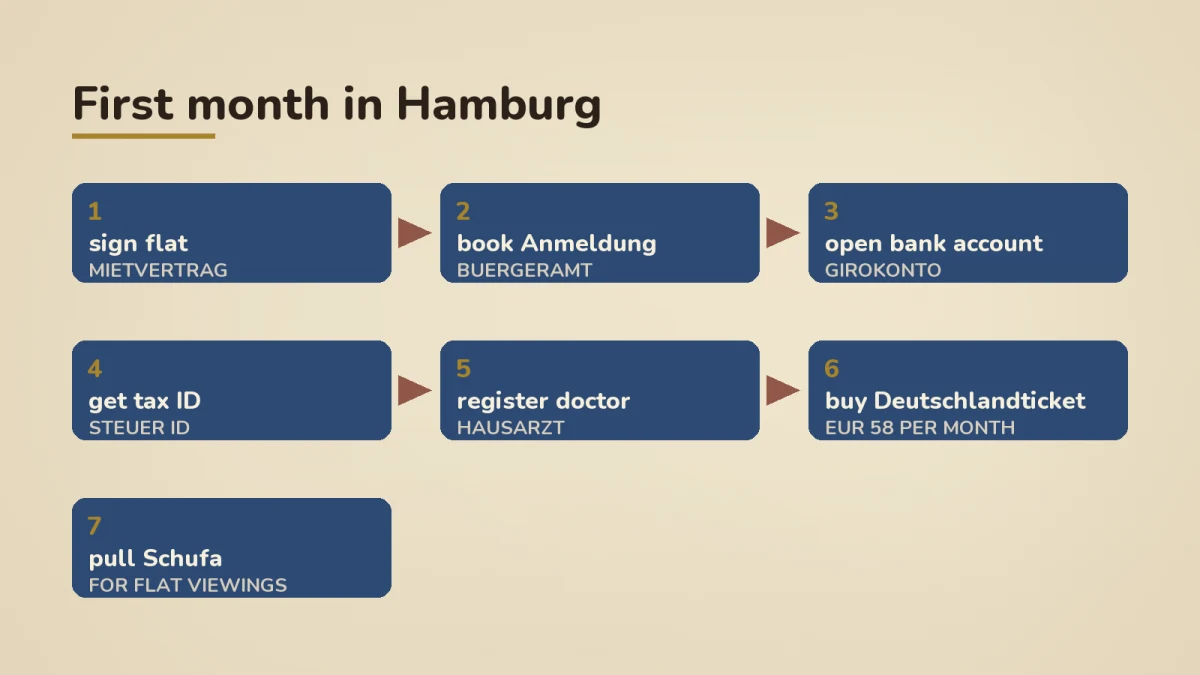
A practical sequence that works:
- Sign a flat (formal Mietvertrag, even for furnished) and collect the Wohnungsgeberbestätigung from your landlord on day one.
- Book your Anmeldung appointment online before you fly. Slots in Hamburg book out 2 to 4 weeks ahead in 2026.
- Open a German current account (Sparkasse, ING, Commerzbank, or a digital bank) within week one. The Anmeldung confirmation address is what most banks require.
- Pull your tax ID (Steuer-ID) from the Bürgeramt or wait for the postal letter (10 to 14 days). Hand it to your employer to unfreeze your first proper payslip.
- Register with a Hausarzt (GP) before you need one. Eimsbüttel and Eppendorf have the highest density of English-speaking practices.
- Register at your local Bürgeramt for the Deutschlandticket if your employer does not offer a Jobticket subsidy.
- Get your Schufa credit report (digital, around 30 EUR for the certified version). You will be asked for it at every flat viewing.
The Hamburg twist: many landlords still require an in-person viewing and a paper Schufa, even in 2026. The big rental-search platforms (ImmoScout24, Immowelt, Wunderflats, eBay Kleinanzeigen) all work, but the best off-market flats still come through colleague referrals and HVV bulletin boards in expat-heavy neighbourhoods.
Common mistakes
- Treating Hamburg like Berlin. Berlin is loud, English-default, club-driven, late-night. Hamburg is quieter, more Hanseatic, more business-formal, earlier to bed.
- Booking HafenCity sight unseen because the photos look great. The wind off the Elbe is real, the school catchment is thin, and the rent multiple is the highest in the city.
- Skipping the Anmeldung past 14 days post-arrival. The fine is small, but every downstream step (bank, tax, lease, phone contract) trips on the missing certificate.
- Underestimating Hamburg weather. Half the year is mild and grey. A waterproof jacket and good boots are operating expenses, not optional.
- Settling for the first English-only job offer. Hamburg has more English-friendly roles than people think, especially in aviation, shipping, and media. Run two or three offers in parallel.
FAQ
Is Hamburg good for expats compared to Berlin or Munich?
Hamburg is the calmer, more Hanseatic alternative. It pays slightly less than Munich for tech, roughly the same as Berlin, and more than Cologne. Cost of living is below Munich and Frankfurt and roughly level with Berlin. The English-friendliness is between Berlin (highest) and Munich (lowest). Pick Hamburg if you want maritime, aviation, media, or logistics, and you prefer water and parks over alpine weekends.
How much rent should I budget for Hamburg in 2026?
A one-bedroom in a mid-tier neighbourhood (Altona, Eimsbüttel outer ring, Barmbek, Ottensen) runs 1,150 to 1,500 EUR cold per month at 2026 asking rents. HafenCity, Eppendorf, and Mitte routinely sit 30 to 60 percent above that. Existing rent contracts (Bestandsmiete) are 25 to 40 percent cheaper than new leases, but they are hard to find without a personal connection.
Can I work in Hamburg without speaking German?
Yes for tech, aviation, shipping, media, and senior corporate. No for most customer-facing roles, frontline healthcare, public sector, and many SME jobs. Filter job ads by "language of work" and ask in interview round one. B1 German typically opens up a wider range of roles and a 5 to 15 percent salary uplift.
What are the best neighbourhoods in Hamburg for families?
Winterhude (Alster proximity, calm, good schools), Eppendorf (doctors and lawyers, family-loaded), Ottensen (Altona-adjacent, leafy, dense with cafés), and Eimsbüttel (the grown-up Schanze) are the four most family-friendly choices. HafenCity has new-build and good infrastructure but limited green space and a small number of family-aged peers compared to the others.
How do I find a flat in Hamburg as an expat?
Combine ImmoScout24, Immowelt, Wunderflats (furnished), and eBay Kleinanzeigen with neighbourhood-specific Facebook groups. Have a Schufa, two payslips, and your Anmeldung confirmation ready before you view. Most landlords still require in-person viewings. Relocation agents typically charge 1 to 1.5 months' rent and are worth it for HafenCity, Eppendorf, and Winterhude where supply is tight.
What is the tech scene like in Hamburg?
Smaller than Berlin and Munich, larger than Cologne or Düsseldorf. Otto Group runs one of the country's biggest e-commerce engineering teams. Lufthansa Industry Solutions and Airbus run big enterprise digital teams. Startups cluster in Schanze and Altona (Mindspace, Betahaus). Senior product engineering and data science roles routinely break 100,000 EUR gross.
Do I need a car in Hamburg?
No. The HVV transport system (S-Bahn, U-Bahn, buses, ferries) covers every expat-relevant neighbourhood, and the Deutschlandticket at 63 EUR per month makes intercity travel within Germany viable. Cars are expensive to park in Eimsbüttel, Altona, Ottensen, and HafenCity. Rent one only for IKEA runs and weekend Schleswig-Holstein trips.
How does Hamburg compare to Frankfurt for expats?
Frankfurt is the finance capital, denser with international schools, more English-default in central districts, and pays the highest gross salaries in finance. Hamburg is the media, aviation, and shipping capital, with lower rent, more green space, and a calmer pace. If you are in finance, Frankfurt wins. If you are in everything else, Hamburg is the better life. We compare both directly in our Frankfurt expat guide.
Where to next
Continue reading
Living in Germany·16 min read
Anmeldung in Germany 2026: How to actually get a Bürgeramt appointment in Berlin, Munich, Hamburg
Anmeldung in Germany 2026: how to actually get a Bürgeramt appointment in Berlin, Munich and Hamburg. Wait times, documents, fines, online route.
Read articleLiving in Germany·15 min read
Schufa in Germany explained: How to build credit as a new arrival, and the myths to ignore
Schufa is Germany's main credit file. Here is how it actually starts, the new 2026 score model, and how to build it from zero as an expat.
Read articleLiving in Germany·9 min read
Buying a car in Germany as a new arrival: Registration, insurance, TÜV, financing
Practical guide to buying a car in Germany as a new arrival in 2026: Anmeldung first, eVB insurance, Zulassung at the Kfz office, TÜV and financing options.
Read articleReady to plan your Germany journey?
Explore our tools and resources to find the perfect university and program for your academic goals.