Living in Frankfurt as an expat: Finance jobs, housing, schools, English-friendly daily life
Frankfurt is Germany's most international city. Here is the 2026 guide to finance jobs, expat neighbourhoods, international schools, and English daily life.

Table of contents
Last updated: May 2026
TL;DR: Frankfurt is the most international city in Germany. Roughly one in three residents holds a foreign passport, the financial sector pays well in English-speaking roles, and the city is small enough that you can live in a quiet leafy district and still walk to the office in the banking quarter. The trade-off is rent: a 1-bedroom apartment in a desirable neighbourhood now sits between EUR 1,500 and EUR 2,200 a month.
If you have just accepted a job offer at a Frankfurt bank, fintech, or consultancy, you are about to land in the German city built for expats. Frankfurt is compact, functional, well-connected by air, and the banking ecosystem makes English-only roles common in a way that Munich and Stuttgart cannot match. This guide walks through what it actually costs to live here in 2026, where expat families and singles tend to settle, how schools work if you have kids, and how much German you really need for daily life.
For a wider view of which German city fits your goals, see our best cities for expats and working professionals overview, or jump up to the Live in Germany pillar for the full city directory.
What does living in Frankfurt as an expat actually look like?
Frankfurt is Germany's financial capital, headquartered in the European Central Bank, Deutsche Bank, Commerzbank, the German Stock Exchange, and around 150 international banks. The city has a population of roughly 770,000 within the city limits and about 5.8 million in the wider Rhein-Main metro region. Around 30 percent of city residents are foreign nationals, the highest share of any major German city, which makes Frankfurt the easiest German city to land in if you do not yet speak German.
Daily life feels closer to a European hub than a stereotypical German town. The skyline is full of glass towers, the airport is one of the largest in Europe, and the metro region is dense with corporate offices, international schools, and English-language services. Public transport (S-Bahn, U-Bahn, trams) is excellent inside the city, and the Deutschlandticket at EUR 58 a month covers all regional public transport across Germany.
The catch: Frankfurt is one of the most expensive German cities for rent, behind only Munich. If you are coming on a finance salary, the math works. If you are coming on a postdoc or junior role, expect to share a flat or commute from outside the city.
Finance jobs and what English-only roles look like in 2026
The financial sector dominates Frankfurt's job market and is the main reason expats relocate here. The cluster includes the ECB, Bundesbank, the four big German banks (Deutsche Bank, Commerzbank, DZ Bank, KfW), American and Asian bank branches, asset managers, fintechs, and a deep accounting and consulting layer (Big Four audit firms all have major Frankfurt offices).
Roles that are routinely advertised in English:
- Investment banking, asset management, and capital markets analysts at international banks
- Risk, compliance, and audit specialists (highly regulated, English is the working language)
- Quantitative developers and data engineers in trading and risk teams
- Accounting, controlling, and FP&A roles at multinational HQs and shared service centres
- Product managers and engineers at fintechs and crypto-asset firms
- ECB and EU institution roles (English is one of the working languages)
Salary ranges for full-time roles in 2026, based on public job postings:
| Role | Years of experience | Approximate gross annual |
|---|---|---|
| Junior analyst (banking, audit) | 0 to 2 | EUR 55,000 to EUR 70,000 |
| Mid-level associate / specialist | 3 to 6 | EUR 75,000 to EUR 110,000 |
| Senior manager / VP | 7 to 12 | EUR 110,000 to EUR 180,000 |
| Director / head of desk | 12+ | EUR 180,000 and up, plus bonus |
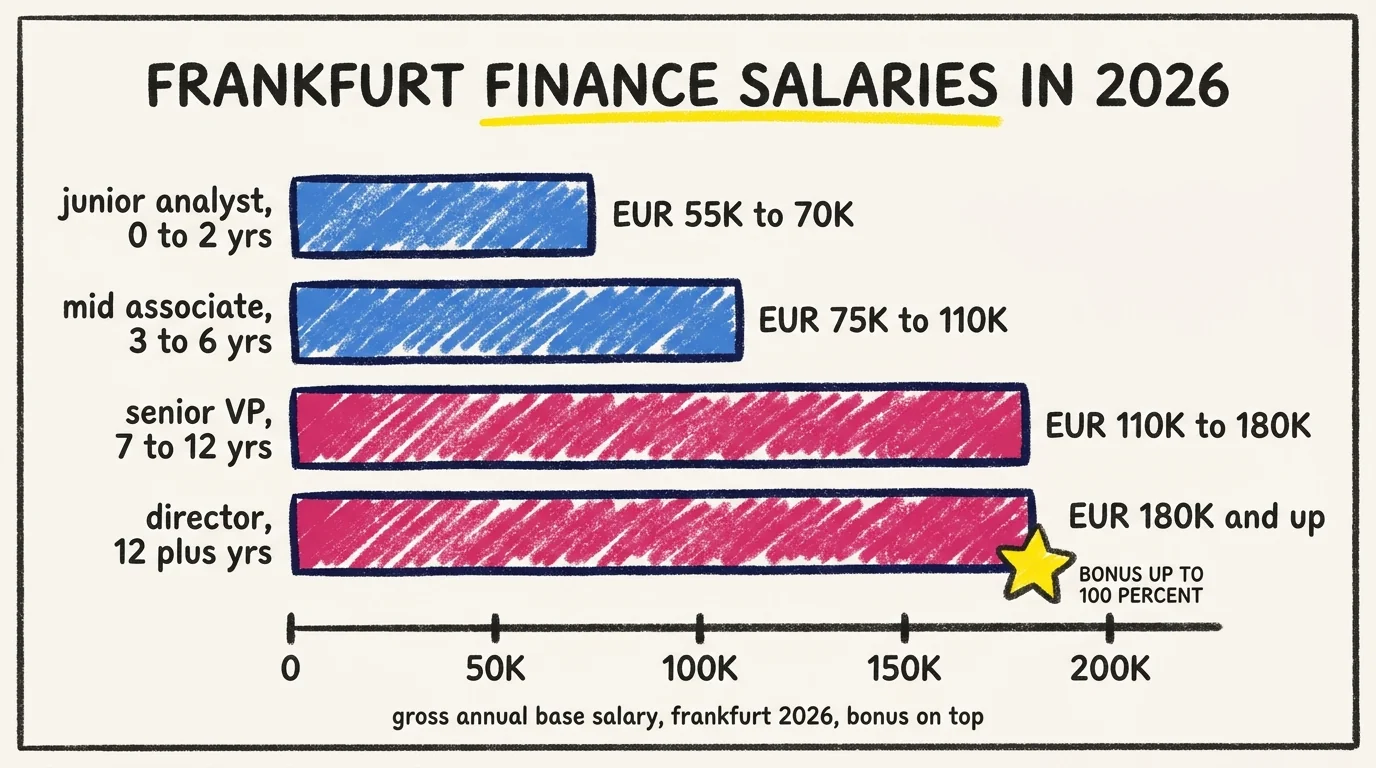
Bonuses in front-office banking roles can add 20 to 100 percent on top of base. Most finance jobs in Frankfurt qualify you for the EU Blue Card, which fast-tracks permanent residency to as little as 21 months if you reach B1 German.
Where to look for English-friendly finance jobs: efinancialcareers.com, iamexpat.de, englishjobs.de, LinkedIn (filter by language English), and bank career pages directly. Recruiters in Frankfurt are used to onboarding non-EU candidates and most international banks have in-house mobility teams that handle visa paperwork.
Where expats actually live, and what rent costs in 2026
Frankfurt is small enough that any neighbourhood is within 30 minutes of the banking district by U-Bahn or bike. Most expats settle in five to six districts based on lifestyle and budget.
| Neighbourhood | Vibe | 1-bed monthly rent (cold) | Why expats choose it |
|---|---|---|---|
| Westend | Premium, leafy, embassies, banking | EUR 1,900 to EUR 2,200 | Close to the office, quiet streets, parks |
| Nordend | Residential, cafes, family-friendly | EUR 1,500 to EUR 1,800 | Mix of young professionals and families |
| Bornheim | Trendy, cafes, weekly market | EUR 1,300 to EUR 1,600 | Cheaper than Nordend, very walkable |
| Sachsenhausen | South of the Main, traditional taverns | EUR 1,300 to EUR 1,700 | Best food and nightlife, good transport |
| Bockenheim | University, mixed crowd | EUR 1,100 to EUR 1,400 | Cheapest central option, students plus expats |
| Niederrad / Höchst | Suburban, cheaper | EUR 900 to EUR 1,200 | Budget-friendly with longer commute |
Rent is quoted "kalt" (cold) in Germany, meaning excluding utilities. Add EUR 200 to EUR 350 a month for "Nebenkosten" (heating, water, building maintenance) and electricity. The average new listing across Frankfurt sits at around EUR 19 per square meter for cold rent in early 2026.
Two practical notes:
- First-hand vs second-hand contracts. A first-hand contract (you are the leaseholder, signed directly with the landlord) is roughly 20 percent cheaper than a second-hand contract (you take over from a previous tenant who keeps the lease). The catch: first-hand contracts are competitive and often need a Schufa report and proof of three months of net salary.
- Furnished apartments are common. Wunderflats and similar platforms list mid-term furnished flats from around EUR 850 a month for studios and EUR 1,400 for 1-bedrooms. They are a sane bridge for the first three months while you search for a long-term place.
For a deeper view on what your salary buys across the country, see our cost of living in Germany guide.
Schools for expat families: international and bilingual options
Frankfurt has the deepest international school network of any German city, which is the main reason many finance executives bring families here rather than to Munich or Berlin.
The main options:
- Frankfurt International School (FIS) in Oberursel: IB Diploma since 1971, the oldest international school in Germany. Pre-K through Grade 12. Tuition runs roughly EUR 23,000 to EUR 33,000 a year depending on grade.
- Metropolitan School Frankfurt: bilingual English-German, IB candidate school, central location. Slightly lower fees than FIS.
- International School of Frankfurt-Rhein-Main (ISF): American curriculum plus IB, suburban campus.
- Phorms Frankfurt Taunus Campus: bilingual private school, German Abitur plus international stream.
- European School Frankfurt (Europäische Schule): free, run under the EU framework for children of EU institution staff and others where space allows. Multilingual, very competitive admission.
- Strothoff International School: smaller IB school, Dreieich.
There are seven IB-curriculum schools in greater Frankfurt according to the IB's school directory. Many large employers (banks, ECB, EU institutions) negotiate tuition contributions as part of expat packages. Always ask HR whether school fees are reimbursed before signing a contract.
If you prefer the public German system, your child can attend a Gymnasium with bilingual streams or a Grundschule with strong English programs. Public schooling is free, which is the trade-off vs the EUR 25,000+ annual fee at international schools. The German public system works well for younger children who can absorb the language; for teenagers arriving late, an international school usually saves the academic transition.
Daily life: how English-friendly Frankfurt actually is
Frankfurt is the German city where you can survive for years on English alone. That is not the same as thriving, and the moment you go through the residency or tax process you will hit forms in German, but the day-to-day is forgiving.
What works in English:
- Bürgeramt (city hall) appointments for Anmeldung (residence registration). Several Frankfurt Bürgerämter have staff who speak English. Bring a German-speaking friend if you can, but it is not a hard blocker.
- Banking. International banks (Deutsche Bank International, ING, HypoVereinsbank, plus mobile-first banks) all operate in English. Branch staff in central Frankfurt routinely speak English.
- Healthcare. Frankfurt has a large network of English-speaking GPs, specialists, and dentists. The US Consulate maintains a public list, and frankfurtexpats.com aggregates a directory by speciality. Most expats use Doctolib for English-language search and booking.
- Retail, restaurants, supermarkets. Central districts (Westend, Bornheim, Nordend, Sachsenhausen) operate fluently in English. Discount supermarkets (Aldi, Lidl, Penny) require less language than a sit-down restaurant.
- Public transport. RMV ticket machines and the RMV app run in English. Announcements on most S-Bahn and U-Bahn lines are bilingual.
What still requires German (or a translator):
- Tax declarations beyond the salaried-employee form. The Finanzamt operates in German.
- Most rental contracts are drafted in German. Get a translation before signing.
- Doctor specialists outside the central directory may not speak English; check Doctolib filters before booking.
- Auslaenderbehoerde (immigration office) appointments are usually in German. Bring a translator or a colleague from work.
Banking practicality: most expats open a current account within the first two weeks. Mobile-first banks issue an IBAN in days; traditional banks need an appointment and the Anmeldung confirmation. Either route is fine. For a deeper read on managing finances, see our tips to manage finances in Germany.
Public transport: the Deutschlandticket and the RMV
The Deutschlandticket costs EUR 58 a month in 2026 and gives you unlimited travel on all regional public transport across Germany (S-Bahn, U-Bahn, tram, bus, regional trains). It does not cover IC, ICE, or Flixbus. For Frankfurt, this single ticket replaces the old monthly RMV pass and lets you take weekend trips to Wiesbaden, Heidelberg, Mainz, and Frankfurt's airport without thinking about fares.
Many Frankfurt employers offer a Jobticket subsidy that brings the Deutschlandticket down to EUR 30 to EUR 40 a month. Ask HR.
If you cycle, Frankfurt has a steadily growing bike network. The city is mostly flat, and a 25-minute commute by bike from Bornheim or Nordend to the Bankenviertel is realistic in good weather.
First-month checklist for new arrivals
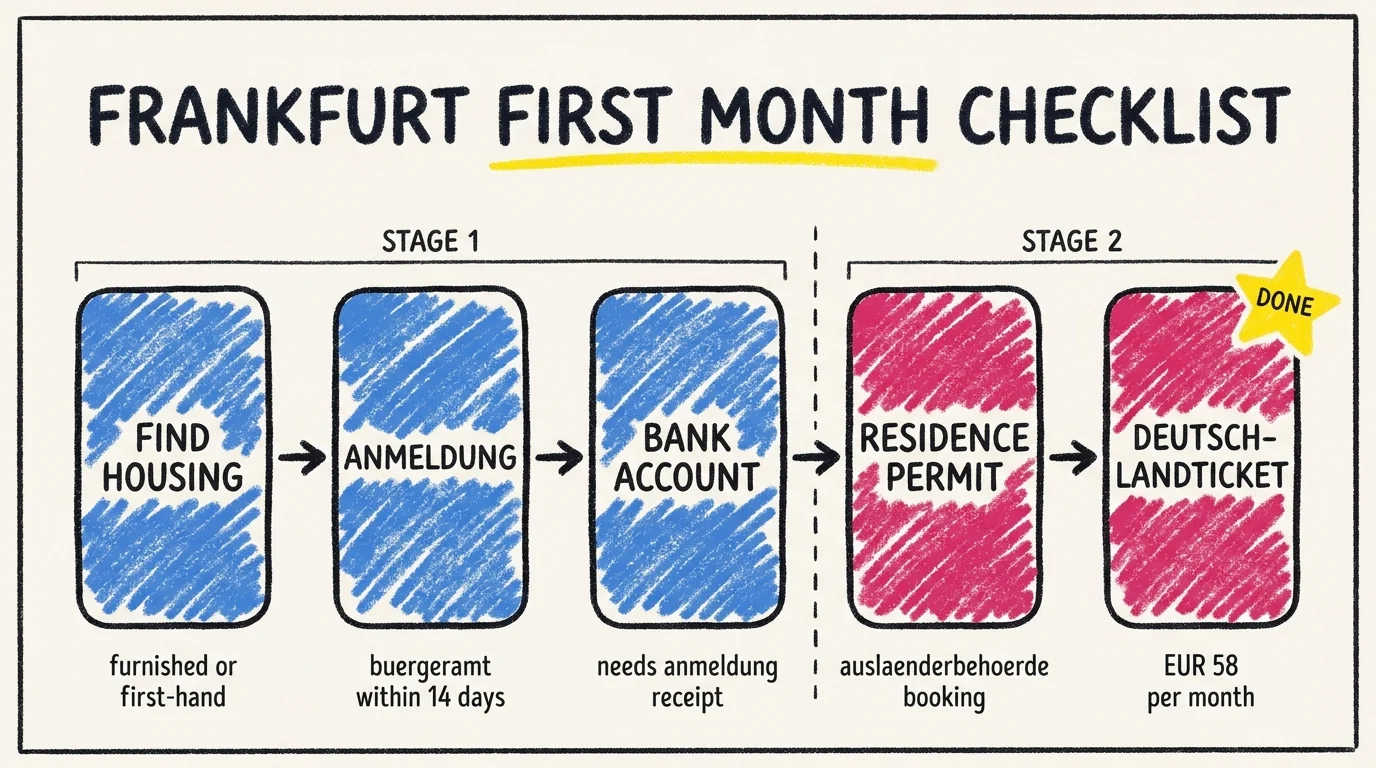
Order matters. The Anmeldung confirmation unlocks almost everything else.
- Find temporary or permanent housing. Furnished mid-term lets are the fastest route. You need a "Wohnungsgeberbestätigung" (landlord confirmation) signed by your landlord to register.
- Book a Bürgeramt appointment online for Anmeldung within 14 days of moving in. Slots fill up; book before you arrive.
- Open a German bank account. Most banks need your Anmeldung confirmation and passport.
- Sign up for statutory health insurance (TK, AOK, DAK, Barmer, etc.) on the first working day. Your employer registers you, but pick the provider before your start date.
- Apply for your residence permit at the Auslaenderbehoerde. EU Blue Card holders need their employment contract, university degree (or equivalent recognition for non-regulated jobs), Anmeldung, and biometric photos. See our residence permit guide for the full document checklist.
- Buy the Deutschlandticket for unlimited regional transport.
- Register your child for school if you are relocating with family. International schools want application packets weeks before the move; public schools are assigned by district once you are registered.
Common mistakes new Frankfurt expats make
- Underestimating Nebenkosten. A "EUR 1,400" cold rent often becomes EUR 1,750 once heating, water, internet, and electricity are layered on. Always budget warm rent, not cold.
- Skipping the Schufa check. Landlords in Frankfurt demand a Schufa credit report. New arrivals do not have one yet, so be ready to provide three months of payslips, an employer letter, and a deposit.
- Picking a flat without checking the U-Bahn line. A 30-minute commute by U-Bahn is normal, but two changes plus a tram easily turns into 50 minutes. Test the route before signing.
- Bringing a foreign driver's licence and not converting it. Non-EU licences are valid for 6 months from registration. Convert before that window closes or you face a re-test.
- Choosing private health insurance early without doing the math. Once you switch out of statutory insurance you cannot return easily. Stay on statutory for the first two years if you are unsure.
- Assuming your employer covers everything. Many do not cover school fees, language classes, or relocation tax advice. Ask in writing before signing the offer.
For a primer on the German tax basics that catch most expats off-guard, see our paying taxes in Germany guide.
FAQ
Is it realistic to live in Frankfurt without speaking German?
Yes for the first 1 to 2 years, especially if you work in finance, tech, or at an EU institution. Daily life, healthcare, and most government services are accessible in English. To get past the 21-month fast-track for permanent residency, you will need at least B1 German, so plan to start lessons within the first six months.
How much do I need to earn to live comfortably in Frankfurt?
A single working professional needs roughly EUR 3,500 net per month (about EUR 60,000 to EUR 65,000 gross) to live comfortably in a 1-bedroom apartment in a central district, with money left for travel and savings. Families need EUR 5,500 net or higher, depending on whether children attend international schools.
Which Frankfurt neighbourhood is best for an expat family?
Nordend and Westend lead for families because of the schools, parks, and quiet streets. If you commute by car or live near an international school, Oberursel and Bad Homburg (commuter towns north of the city) offer larger flats and houses at lower per-square-meter rents.
How does Frankfurt compare to Munich for expats?
Frankfurt is more international, more English-friendly, has cheaper rent, and a larger finance job market. Munich has stronger weather, mountains, BMW and Siemens, and a more polished old town, but rent is roughly 20 percent higher and English-only roles outside automotive engineering are less common.
Do I need to convert my driver's licence?
Yes, if you stay longer than 6 months from the date of your Anmeldung. EU and EEA licences convert automatically. Many non-EU countries (US, Canada, Australia, India, and others) have partial bilateral agreements; some convert directly, others require a written or practical test. Check the Auslaenderbehoerde list early.
What healthcare insurance do most expats take?
Statutory insurance (TK, AOK, DAK, Barmer) covers about 90 percent of employed expats and is deducted from your payslip at roughly 7.3 percent of gross. It works at every doctor and hospital in Germany. Switch to private only if your gross income exceeds EUR 73,800 a year and you are sure about the long-term trade-off.
Can my partner work on my Blue Card?
Yes. EU Blue Card spouses receive a residence permit that allows full work access from day one. They do not need a separate work visa and can start any job (or self-employed activity) once their residence permit is issued.
Where to next
Continue reading
Living in Germany·7 min read
Affordable Shopping in Germany: Budget-Friendly Guide for International Students
Save money while living in Germany. Discover affordable places and tips for shopping in Germany. A student-friendly guide covering groceries, fashion, electronics, books, and home essentials.
Read articleLiving in Germany·10 min read
Having a baby in Germany as an expat: Hospitals, midwives, Mutterschutz, paperwork
Plain-English guide to having a baby in Germany as an expat. Mutterschutz, Elterngeld, Kindergeld 2026, Hebamme, hospital choice, and paperwork order.
Read articleLiving in Germany·10 min read
Parental leave (Elternzeit and Elterngeld) in Germany for expats 2026
Up to 3 years job-protected parental leave and EUR 1,800 monthly Elterngeld. The 2026 expat guide to eligibility, the new EUR 175,000 income cap, and deadlines.
Read articleReady to plan your Germany journey?
Explore our tools and resources to find the perfect university and program for your academic goals.