Kita and German school system for expat families: Enrolment, costs, language support
Every child in Germany has the legal right to a Kita spot from age 1 and must attend school from 6. How the system works for expat families in 2026.

Table of contents
Last updated: May 2026
TL;DR: Every child living in Germany has a legal right to a Kita spot from their first birthday and must attend school from age 6. Public childcare and public school are free or heavily subsidised in most states; international schools cost EUR 7,000 to 25,000 a year. Register at the local Jugendamt as soon as you have a relocation date, ideally 6 to 12 months before you need the spot.
If you are moving to Germany with kids, two questions usually arrive together. Where will my child be looked after while I work? And how will the school system absorb a child who does not yet speak German? The good news: Germany takes both seriously, codes both into law, and pays for both out of public money in most states. The bad news: the rules are organised by Bundesland (federal state), spots in popular cities fill up two years ahead, and the path through secondary school is decided by age 10. This guide walks expat parents through the living-in-Germany basics: how Kita works, how the school system is structured, what it costs, and how language support actually plays out for non-German-speaking children.
How childcare and school work in Germany
Germany splits care for children into two systems. From birth to age 6, children attend Kita (short for Kindertagesstaette), which covers daycare, nursery, and kindergarten under one roof. From age 6 onwards, children are required by law to attend school (Schulpflicht). Compulsory schooling typically runs to age 15 or 16, with most students staying in education until 18 or 19.
Both systems are largely public and largely free. Kita costs vary by state but most German states have moved toward free or heavily subsidised childcare. Public schools are free everywhere; you only pay for school books, lunches, and excursions. The big exceptions are private and international schools, which charge tuition and are popular with expat families who want an English-medium curriculum.
The Kita system: from age 1 to school start
Kita is a single label covering three life stages.
- Krippe (also called U3 care): for children under 3.
- Kindergarten: for children aged 3 to 6.
- Hort: afternoon care for primary-school children, often run inside the school building.
Many Kitas combine all three age groups in one facility, so siblings can attend together and your child does not need to switch buildings as they grow.
Your legal right to a Kita spot
Since 2013, every child living in Germany has had a Rechtsanspruch (legal entitlement) to a Kita spot from their first birthday, regardless of whether the parents are working. Children under 1 only qualify if both parents are working, in training, in an integration course, or otherwise in proven need. The legal basis is paragraph 24 of the Eighth Social Code (SGB VIII).
What this means in practice: the local Jugendamt (Youth Welfare Office) must offer your child a place once they turn 1. If they fail to provide one, you may be entitled to compensation for lost income, up to roughly two-thirds of net salary capped at around EUR 2,016 a month for up to six weeks. To preserve this right, you must notify the Jugendamt in writing 3 to 6 months before you need the spot. Skip that step and you lose the legal claim.
Demand outstrips supply in most large cities. In Berlin, Munich, Hamburg, Frankfurt, and Stuttgart, popular Kitas fill up 18 to 24 months in advance. Sign up the moment you have a relocation date, even before you have an apartment in many cases.
What Kita costs in 2026
Kita fees are set by each Bundesland and often adjusted by income.
| State | Typical cost |
|---|---|
| Berlin | Free since 2018; about EUR 23 a month for food |
| Hamburg | First 5 hours a day free; full-day costs scale with income |
| Mecklenburg-Vorpommern | Free from age 1 |
| Rhineland-Palatinate | Free from age 2 |
| Bavaria | Means-tested fees, partial state subsidy |
| North Rhine-Westphalia | EUR 0 to 1,000+ a month based on income; 2 years free before school |
Where parents do pay, federal tax law lets you deduct 80% of childcare costs up to EUR 4,800 per child per year (rule effective since 1 January 2025). Many employers also offer a tax-free Kita subsidy as part of the employment contract.
The school system step by step
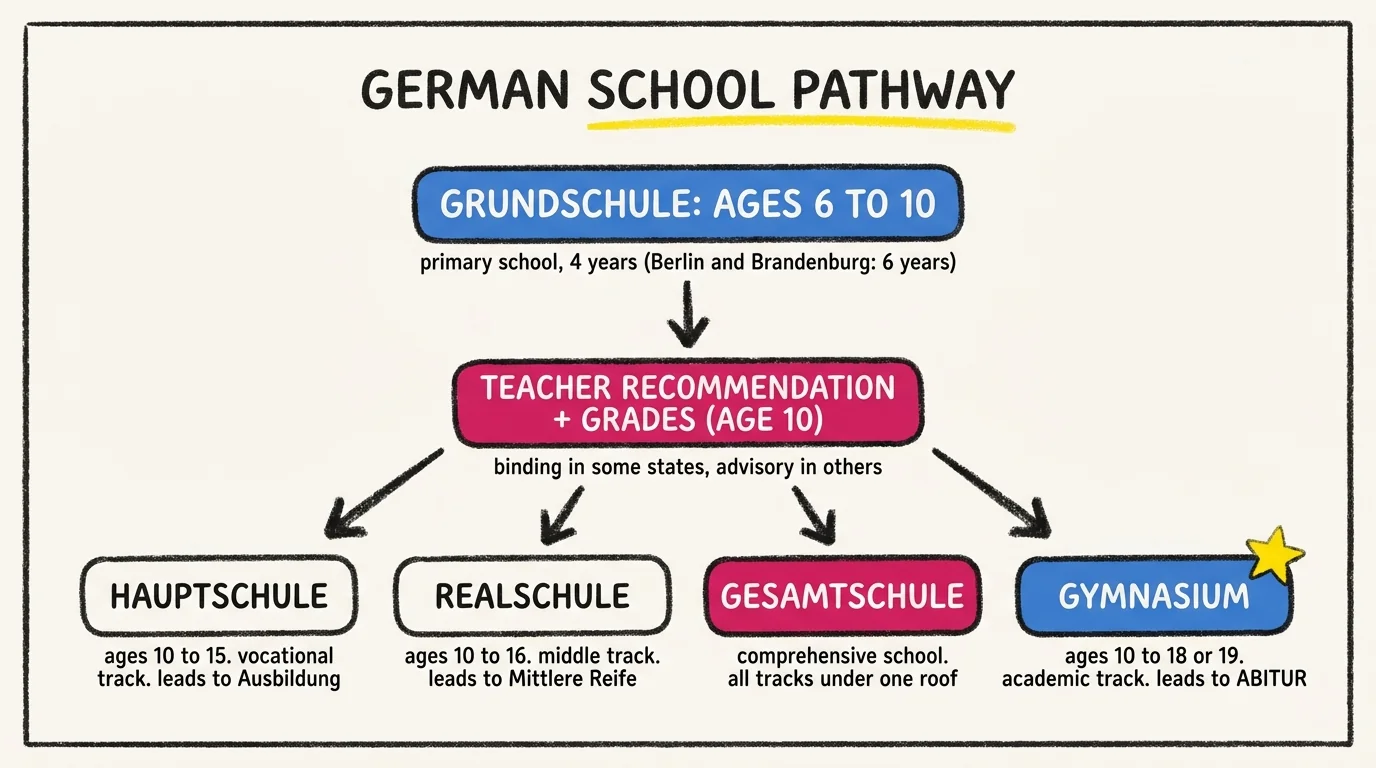
After Kita, every child enters Grundschule (primary school) the August after they turn 6. The cut-off date varies by state: in most of Germany a child who turns 6 by 30 June starts that summer; in Bavaria the cut-off is 30 September.
Grundschule (ages 6 to 10)
Primary school runs four years (six in Berlin and Brandenburg) and is the only stage where every German child sits in the same classroom together. Children are usually assigned to a school by their Schulbezirk (catchment area) tied to their registered address. If you want a different school, you can apply, but neighbouring districts only release spots if they have capacity.
After Grundschule: the four tracks
At the end of Grundschule, schools issue a recommendation that sorts children into one of four secondary tracks. The recommendation is binding in some states and advisory in others, but in every state your child's grades and the teacher's assessment shape what comes next.
- Gymnasium: academic track, ages 10 to 18 or 19, leads to the Abitur (university entrance qualification).
- Realschule: middle track, ages 10 to 16, leads to a Mittlere Reife and feeds Ausbildung or specialised secondary schools.
- Hauptschule: vocational track, ages 10 to 15, leads to apprenticeship or vocational training.
- Gesamtschule or Gemeinschaftsschule: comprehensive school combining all three tracks under one roof, available in some states.
Switching tracks later is possible but harder than choosing right the first time, which is why the age-10 decision draws so much attention from German parents and confuses many expats arriving with kids close to that age.
Language support for non-German-speaking children
Public schools in every Bundesland are required to integrate children who do not yet speak German. The mechanism is called Willkommensklasse in Berlin or Vorbereitungsklasse elsewhere: a state-funded preparation class where your child learns German intensively for one to two years while gradually attending mainstream subjects in their regular class. Once language assessments confirm they can follow lessons, they fully integrate.
How well it works depends heavily on the school and the city. Berlin, Hamburg, and Munich have well-resourced welcome programmes; smaller towns sometimes struggle to staff them. If you are choosing a city based on schools, ask the local Schulamt about welcome-class capacity before signing a rental contract.
For working professionals who want a smoother transition or plan to move again later, international schools are an alternative. Germany has more than 80 of them, mostly in Berlin, Munich, Frankfurt, Hamburg, and Duesseldorf. They teach in English (or sometimes French, Spanish, Japanese) and follow the IB, British, or American curriculum. Tuition runs from EUR 7,000 to 13,000 a year at smaller bilingual schools and EUR 15,000 to 25,000 a year at the established international schools. Many large employers contribute to international-school fees as part of a relocation package; ask before you pay out of pocket.
Common mistakes expat families make
- Waiting until you arrive to register at a Kita. By then you are already at the back of an 18-month queue. Sign up the moment you accept the job offer.
- Skipping the Jugendamt letter. No formal request, no legal claim, no compensation if no spot opens up.
- Assuming "international school" is the only English option. Many public schools have bilingual streams (Staatliche Europa-Schule Berlin is a famous example) at zero cost.
- Underestimating the age-10 decision. Plan a year in advance if you are moving to Germany with a 9 or 10 year old, and ask about Gymnasium recommendation criteria.
- Trusting a verbal Kita promise. Always get the contract and the start date in writing; verbal offers in popular cities sometimes evaporate.
FAQ
Is Kita compulsory in Germany?
No. Kita is optional. Only school is compulsory, starting at age 6. That said, most German children attend Kita from age 3 onwards, and the educational and social value at that age is significant, especially for children learning the language.
Can my child go to a German school without speaking German?
Yes. Public schools must take any child of compulsory school age living in their catchment area, regardless of language level. Your child will likely spend their first year in a Willkommensklasse or Vorbereitungsklasse with intensive German lessons before fully joining their year group.
What documents do I need to enrol a child in Kita or school?
You need the child's birth certificate, passport, current residence registration (Anmeldung), proof of vaccination against measles (mandatory since 2020), and the parents' residence permits or visas. Schools also ask for the previous school's transcripts. Many municipalities now run online Kita portals where you upload everything once and apply to multiple Kitas in parallel.
How long does it take to find a Kita spot?
In most large cities, plan on 6 to 18 months from application to start date. Smaller cities often place children within 3 to 6 months. Always notify the Jugendamt in writing as soon as you start looking, even if you have not picked a Kita yet. That letter is what protects your right to compensation if no spot materialises.
Are international schools worth the cost?
It depends on your timeline. If you plan to be in Germany for 2 to 4 years and then leave, an international school keeps your child on a globally portable curriculum (IB, British, American) and avoids the language transition. If you plan to stay long-term, a public German school costs nothing, integrates your child into the country, and gives them a German Abitur that is accepted at any German or European university.
Can both parents work while a child waits for a Kita spot?
If you have notified the Jugendamt and they cannot offer a spot in a reasonable distance from your home, you may be entitled to compensation for one parent's lost income for up to six weeks at 67% of net salary. Tagespflege (qualified family daycare) and au pairs are common bridge solutions while you wait.
Where to next
- Having a baby in Germany as an expat for the parental-leave and Mutterschutz piece that comes before Kita.
- How to bring your parents to Germany if you want grandparent help with childcare.
- Best cities in Germany to live and work for a city-by-city look at where expat families settle.
- Integration course in Germany if you also need German lessons for yourself while your kids learn theirs.
Continue reading
Living in Germany·7 min read
Affordable Shopping in Germany: Budget-Friendly Guide for International Students
Save money while living in Germany. Discover affordable places and tips for shopping in Germany. A student-friendly guide covering groceries, fashion, electronics, books, and home essentials.
Read articleLiving in Germany·10 min read
Having a baby in Germany as an expat: Hospitals, midwives, Mutterschutz, paperwork
Plain-English guide to having a baby in Germany as an expat. Mutterschutz, Elterngeld, Kindergeld 2026, Hebamme, hospital choice, and paperwork order.
Read articleLiving in Germany·10 min read
Parental leave (Elternzeit and Elterngeld) in Germany for expats 2026
Up to 3 years job-protected parental leave and EUR 1,800 monthly Elterngeld. The 2026 expat guide to eligibility, the new EUR 175,000 income cap, and deadlines.
Read articleReady to plan your Germany journey?
Explore our tools and resources to find the perfect university and program for your academic goals.