Dependent visa Germany: Bringing children, school enrolment, residence permit timeline
Bring your child to Germany on a dependent visa. Eligibility under section 32 AufenthG, the document list, 4 to 7 month timeline, Schulpflicht basics.

Table of contents
Last updated: May 2026
TL;DR: Children under 18 can join a parent who already holds a German residence permit through the family-reunion visa under §32 AufenthG. Plan 1 to 3 months for the visa decision abroad, then 6 to 12 weeks for the residence permit after arrival. Public schooling (Schulpflicht) starts at age 6, is free, and runs for at least 9 years.
Bringing a child to Germany sounds straightforward until you see the document list. It is one of the more paperwork-heavy moves you will make as a parent, and the timing has to line up across three offices: the German consulate in your home country, the local Bürgeramt for Anmeldung, and the Ausländerbehörde that issues the actual residence permit. Most families underestimate the school-enrolment piece, which only starts after the address registration is done. This guide walks through who qualifies, the documents the consulate will ask for, the realistic timeline, and how compulsory schooling works once the child is on German soil. For the broader pillar see Germany visa types and routes.
Who qualifies for the dependent visa
The dependent visa (often called the family-reunion visa for children) is governed by Section 32 of the Residence Act, the Aufenthaltsgesetz. The child must:
- Be under 18 on the date the application is submitted.
- Be unmarried, not divorced, not widowed.
- Have at least one parent in Germany on a valid residence permit, settlement permit, EU Blue Card, or Niederlassungserlaubnis.
- Have the legal custodial parent agreeing to the move (or both parents, where joint custody applies).
If only one parent is in Germany and the parents are still legally together, the consulate will usually ask for the other parent's notarised consent or a sole-custody decree. If the child is between 16 and 18 and is moving without both parents joining at the same time, German missions can ask for proof of integration potential, usually a German-language certificate or proof of schooling in a German-language stream. Children under 16 do not face this language hurdle.
Skilled workers whose first German residence permit was issued on or after 1 March 2024 also benefit from the eased living-space rule introduced by the Skilled Immigration Act 2.0. They no longer have to prove a fixed square-metre threshold for spouses and minor children. The income test still applies.
Documents the German consulate will ask for
Build the file in two stacks: documents about the child, and documents about the sponsor parent. Bring originals plus two photocopies for every item, even if the consulate's checklist says one.
| About the child | About the sponsor in Germany |
|---|---|
| Valid passport (12+ months validity, two blank pages) | Copy of residence permit / eAT card |
| Birth certificate, apostilled and translated into German | Last 6 months of payslips OR work contract |
| Two biometric photos | Tax registration (Lohnsteuerbescheinigung) for the previous year |
| Travel health insurance covering 90 days from arrival | Proof of accommodation (Wohnungsgeberbestätigung or Mietvertrag) |
| Proof of parental relationship and custody decree (if applicable) | Statutory health-insurance confirmation that the child can be added |
| Notarised consent from the non-accompanying parent (if applicable) | Bank statements showing 3 months of salary deposits |
| Two completed visa application forms | Copy of the sponsor's passport |
The German embassy in your home country sets the appointment slot. In India, that means VFS Global handling biometrics on behalf of the consulate; the wait for an appointment alone can be 4 to 8 weeks during peak season. Book this first, before the rest of the file is even ready.
Realistic timeline from visa to residence permit
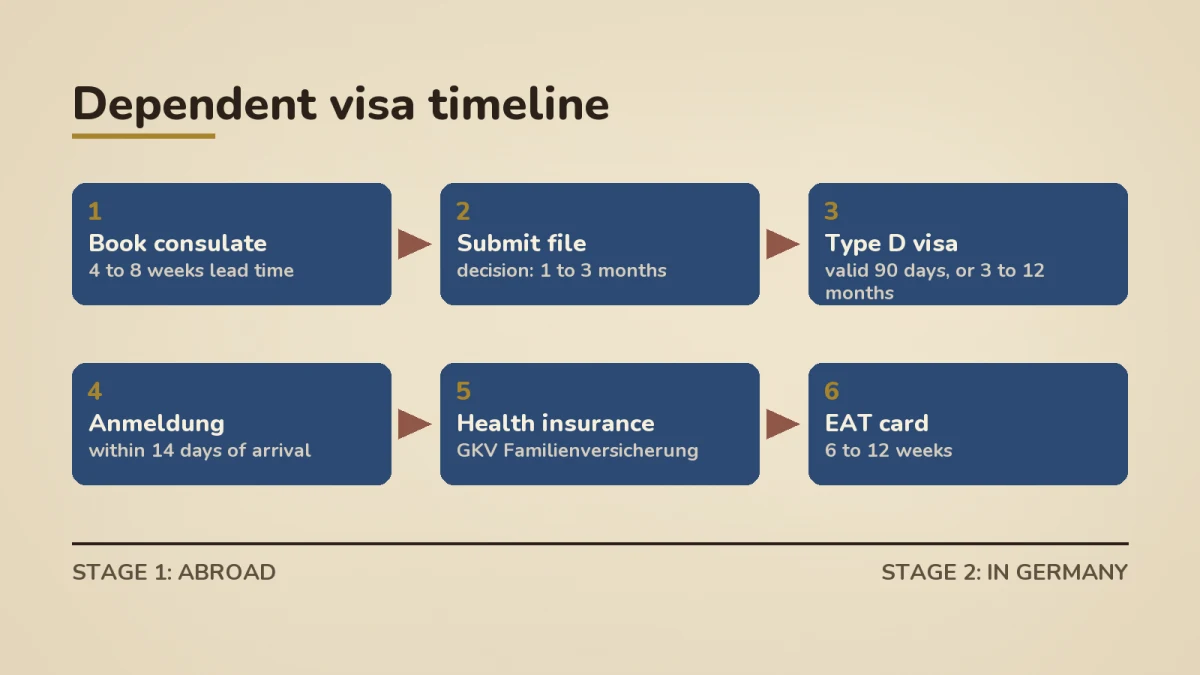
Most parents budget for three weeks and end up taking three months. Here is the timeline you should plan around, end to end.
- Book the consulate appointment. Allow 4 to 8 weeks of lead time depending on the city.
- Submit the file. The consulate issues a Type D national visa, valid for 90 days or for 3 to 12 months depending on the case. Decision takes 1 to 3 months. The Aliens' Authority (Ausländerbehörde) in Germany has to approve the application before the consulate prints the visa.
- Travel to Germany. The child must enter within the visa validity window.
- Anmeldung at the Bürgeramt within 14 days of moving into the home address.
- Activate or convert health insurance to a German plan. Children of statutory-insured (GKV) parents are usually free as a family-co-insured (Familienversicherung) dependant.
- Apply for the residence permit at the local Ausländerbehörde. The eAT card itself takes 6 to 12 weeks to print. During peak season (August to October), some city offices have run to 16 weeks.
Total realistic window from "I want to bring my child" to "child has the eAT card in hand": 4 to 7 months. Front-load the apostille and translation work, because that is the slowest part of the file and the cheapest to fix early.
School enrolment: what to do before and after the child arrives
Germany has compulsory schooling, the Schulpflicht. It starts in the August after the child turns 6 and lasts a minimum of 9 full school years (Vollzeitschulpflicht), followed by 3 years of part-time schooling (Berufsschulpflicht) for anyone who is not yet in upper-secondary general education. This is not optional. Failing to enrol a school-age child can trigger fines and, in repeat cases, a referral to the youth welfare office (Jugendamt).
The enrolment chain looks like this:
- Pre-arrival: shortlist schools in the Bundesland and city you will live in. School systems differ by state; what counts as a Realschule in Bavaria may not exist in Berlin.
- After Anmeldung: register the child with the city's Schulamt (school authority). Some cities place the child directly; others let parents apply to specific schools.
- If the child does not yet speak German, most public schools place them in a Willkommensklasse (welcome class) for one to two years. The child learns German there, then transfers into a regular class at the appropriate grade.
- Public schools (Grundschule, Hauptschule, Realschule, Gymnasium, Gesamtschule) charge no tuition. Books and excursions cost €100 to €400 per year; some Bundesländer subsidise this for low-income families.
- International schools (English-medium IB or American/British curriculum) cost €15,000 to €30,000 per year. Useful when the family expects to leave Germany again within 2 to 4 years and wants to preserve the child's English-medium track.
For a working parent on the EU Blue Card, the income threshold to qualify for family reunion is already met by the salary itself, so the school choice is a budget call, not a visa requirement. For Ausbildung trainees and lower-paid skilled workers, public school is the default.
Common mistakes that delay the case
- Submitting the consulate file before the apostille has been issued. Every German mission rejects un-apostilled birth certificates.
- Forgetting the non-accompanying parent's consent. This kills 4 to 6 weeks while you go back home for a notarisation.
- Booking flights before the visa is issued. The Type D visa has a fixed validity window. If the consulate decision comes late, you eat the change fee.
- Skipping the Anmeldung within 14 days of arrival. The Ausländerbehörde will not accept the residence permit application until the Anmeldebestätigung is in hand.
- Assuming the child can start school immediately after Anmeldung. Some Schulämter take 2 to 6 weeks to assign a place, especially mid-term.
- Treating the consulate's checklist as exhaustive. It is the minimum, not the maximum. Bring every supporting document you have.
FAQ
Can I bring my child to Germany if I am on a student visa?
Yes, if your residence permit is valid for more than one year and you can prove sufficient financial means and accommodation for the family. In practice this is hard on a typical student budget; most students wait until they convert to a post-study work or skilled-worker permit before bringing dependants.
What is the age cutoff for the child's dependent visa?
The child must be under 18 on the date of application. Children up to 16 face fewer integration tests; 16 to 17 may need German-language proof unless the family is reuniting jointly. After turning 18, the child can stay on the family-reunion permit until it expires, then must either qualify for a study/work permit or leave.
Does a Blue Card holder have an easier path?
Yes. EU Blue Card holders qualify automatically on income (the 2026 threshold is €50,700 for the general track and €45,934.20 for shortage occupations) and benefit from the eased living-space rule introduced in March 2024. Their spouses and minor children are also exempt from the German-language requirement before the visa. See the EU Blue Card guide.
Can my child work in Germany on a dependent visa?
The dependent residence permit grants unrestricted work permission. Once the child turns 15, they can take up regular employment within the limits of German youth labour law (Jugendarbeitsschutzgesetz). Before 15, only light work like newspaper rounds is allowed.
How long until the child can apply for permanent residence?
After 5 years of legal residence in Germany the child can apply for their own settlement permit, provided they meet the integration criteria. Children who attended German schools usually meet the language threshold easily. Once 18, the child also has the option to convert to an independent residence permit if they enter university or vocational training.
Is Kindergeld paid for a child on a dependent visa?
Yes. Once the child has a residence permit and is registered (Anmeldung complete), the family is entitled to Kindergeld (currently €259 per child per month in 2026). Apply through the Familienkasse of the Federal Employment Agency. Payments backdate up to 6 months from the application date.
What if my child is over 18 but still financially dependent on me?
The dependent visa under §32 does not apply. Adult children can come on a study visa, jobseeker visa, Ausbildung visa, or Chancenkarte (Opportunity Card). For elderly parents of a skilled worker whose first permit was issued on or after 1 March 2024, the new SIA 2.0 rules allow a parent-reunion route, separate from this guide.
Where to next
- Germany family-reunion visa: comprehensive guide. The parent topic with spouse and parent paths.
- Residence permits for international students in Germany. What changes when student parents bring family.
- EU Blue Card guide for Indian students and graduates. The Blue Card route makes everything easier.
- Visa types in Germany. The parent pillar with every route compared.
- Cost calculator for Germany. Model the family budget before you submit the file.
Continue reading
Visa & Immigration·15 min read
How to Ace Your Student Visa Interview for Bachelor’s in Germany
Get expert tips on how to successfully navigate your student visa interview for Bachelor's in Germany. Learn what to expect, how to prepare, and what to say to impress the interviewer.
Read articleVisa & Immigration·20 min read
German Student Visa for Bachelor’s in Germany
This guide provides a step-by-step process for obtaining a German student visa for bachelor's aspirants. From eligibility criteria to document requirements, visa application submission, and interview preparation, this comprehensive guide covers everything you need to know to navigate the visa application journey with confidence and secure your place in a German university.
Read articleVisa & Immigration·7 min read
Residence Permit in Germany for International Students
Discover a complete guide on residence permit in Germany for international students. Learn the importance, steps, and required documents for a hassle-free registration process.
Read articleReady to plan your Germany journey?
Explore our tools and resources to find the perfect university and program for your academic goals.