Having a baby in Germany as an expat: Hospitals, midwives, Mutterschutz, paperwork
Plain-English guide to having a baby in Germany as an expat. Mutterschutz, Elterngeld, Kindergeld 2026, Hebamme, hospital choice, and paperwork order.

Table of contents
Last updated: May 2026
TL;DR: Having a baby in Germany as an expat is one of the better-supported journeys you can have here. Public health insurance covers prenatal care, hospital birth, and a free midwife. Mutterschutz protects your job for 14 weeks at full pay. Elterngeld replaces income for up to 14 months. Kindergeld pays EUR 259 per child per month from January 2026.
If you are pregnant in Germany on a residence permit, a Blue Card, a Job Seeker Visa follow-on, or as a working spouse, the system treats you the same way it treats German citizens for almost every benefit. The same rules cover Indian, Pakistani, Nigerian, American, and EU couples settled here. Before you read on, the bigger picture of how Germany handles family life sits inside our Live in Germany pillar, and the practical health-insurance side is in our healthcare guide for international families. This post is the one you read once you know you are pregnant and want to map out the next 12 months.
What Germany covers automatically when you are pregnant
If you have public health insurance (gesetzliche Krankenversicherung, GKV: TK, AOK, Barmer, DAK, BKK, IKK), almost every cost related to the pregnancy is already paid. Prenatal visits with a Frauenarzt (gynaecologist), all routine ultrasounds, blood tests, the maternity record book (Mutterpass), the hospital birth, postnatal visits, and a free Hebamme (midwife) at home for up to 12 weeks after birth. You do not pay anything at the point of care. You also do not need to pre-approve any of this with your insurer.
If you have private insurance, prenatal care is similarly covered but the cash flow works differently. You pay the doctor or hospital, then claim reimbursement. Read your policy for the daily hospital allowance and the maternity package, because not every private plan matches GKV one-for-one. Anyone unsure which plan they are on should re-read our insurance starter guide.
A Hebamme is the single most underused benefit. Insurance covers the full cost. She visits you at home daily for the first 10 days after birth and then weekly for up to 12 weeks. She handles weight checks, breastfeeding support, and the questions you do not want to ask a doctor. Book one in your second trimester. Most cities have a Hebammensuche directory.
Where you can give birth: hospital, birth center, home
You choose, your insurance pays. The three options:
| Option | Where | Who attends | Best when |
|---|---|---|---|
| Krankenhaus (hospital) | Public or private hospital | OB-GYN team plus midwife | Default choice. Full medical backup, epidural available, NICU on site for high-risk pregnancies. |
| Geburtshaus (birth center) | Standalone midwife-run unit | Midwives only | Low-risk pregnancy, you want a calm setting, you are okay with no epidural and a hospital transfer if needed. |
| Hausgeburt (home birth) | Your apartment | Midwife | Low-risk, second or third birth, you have done this before. Insurance still covers the midwife. |
Most expats default to a hospital because it removes the question of "what if". You can register at any hospital that has a delivery ward; you do not have to use the closest one. Tour two or three in your second trimester and pick on feel. The German language barrier is real but most large-city hospitals (Berlin, Munich, Frankfurt, Hamburg, Stuttgart, Cologne) have English-speaking staff in the delivery ward.
Mutterschutz: your statutory protection during pregnancy and after birth
Mutterschutz is the German maternity-protection law. The numbers are fixed and not negotiable.
- 6 weeks before your expected due date, you are off work. Paid in full.
- 8 weeks after birth, you are off work. Paid in full.
- 12 weeks after for premature, multiple, or disabled births.
- During Mutterschutz you cannot be fired. The protection extends 4 months past birth.
- Most heavy lifting, night shifts, and stressful work are also banned earlier in the pregnancy if your doctor signs a Beschäftigungsverbot.
The pay during this period is called Mutterschaftsgeld. Your statutory health insurance pays up to EUR 13 per day; your employer tops up the rest to full net salary. You receive your normal income for all 14 weeks. There is no income loss. This is unlike the US system and people miss this on their first pregnancy here.
If you are a freelancer (Selbstständig) on private insurance, you can purchase a daily allowance (Krankentagegeld) rider, but Mutterschaftsgeld through GKV only flows if you opted into the optional sickness benefit (Wahltarif). Freelancers should plan ahead by 12 months.
Elterngeld and Elternzeit: paid leave after the baby arrives
These two are different things. Elternzeit is the legal right to take up to 3 years of job-protected leave. Elterngeld is the money the government pays you during part of that leave. You can have Elternzeit without Elterngeld and vice versa.
Elterngeld basics for births in 2026:
- Basiselterngeld: replaces 65% of your pre-birth net income, between EUR 300 and EUR 1,800 per month. Maximum 12 months for one parent, or 14 months if the other parent takes at least 2 months too.
- ElterngeldPlus: doubles the period at half the monthly amount. Useful if you go back part-time.
- Partnerschaftsbonus: 4 extra months for couples who both work between 24 and 32 hours per week.
- Income limit: from April 2025 onwards, couples with combined taxable income above EUR 175,000 do not qualify. The same EUR 175,000 limit applies to single parents.
- Apply at the Elterngeldstelle in your state within 3 months of birth. Backdated payments are capped, so do not wait.
Both parents can split Elternzeit and Elterngeld in any ratio. Many couples take the first 2 months together, then alternate.
Kindergeld and other ongoing family benefits
Kindergeld is the universal child benefit. From January 2026 it is EUR 259 per child per month, up from EUR 255 in 2025. There is no income cap. You receive it until the child turns 18, or up to 25 if they are still in education or training. The Familienkasse (run by the Bundesagentur für Arbeit) pays it directly to your account.
You apply once, in writing, with the child's Geburtsurkunde and your tax ID. The first payment usually lands within 6 to 8 weeks of birth, backdated to the birth month.
A few related benefits to know exist:
- Kinderzuschlag: a top-up of up to EUR 297 per child per month for low-income working families. Filed via Familienkasse.
- Kinderfreibetrag: a tax allowance you can choose at year-end instead of Kindergeld if it works out better. Your Steuerberater (tax advisor) will run the comparison automatically.
- BAföG, child sick days, daycare subsidies: all separate systems, all kick in later. Outside the scope of this post.
The paperwork: birth certificate, residence permit, insurance, and family benefits
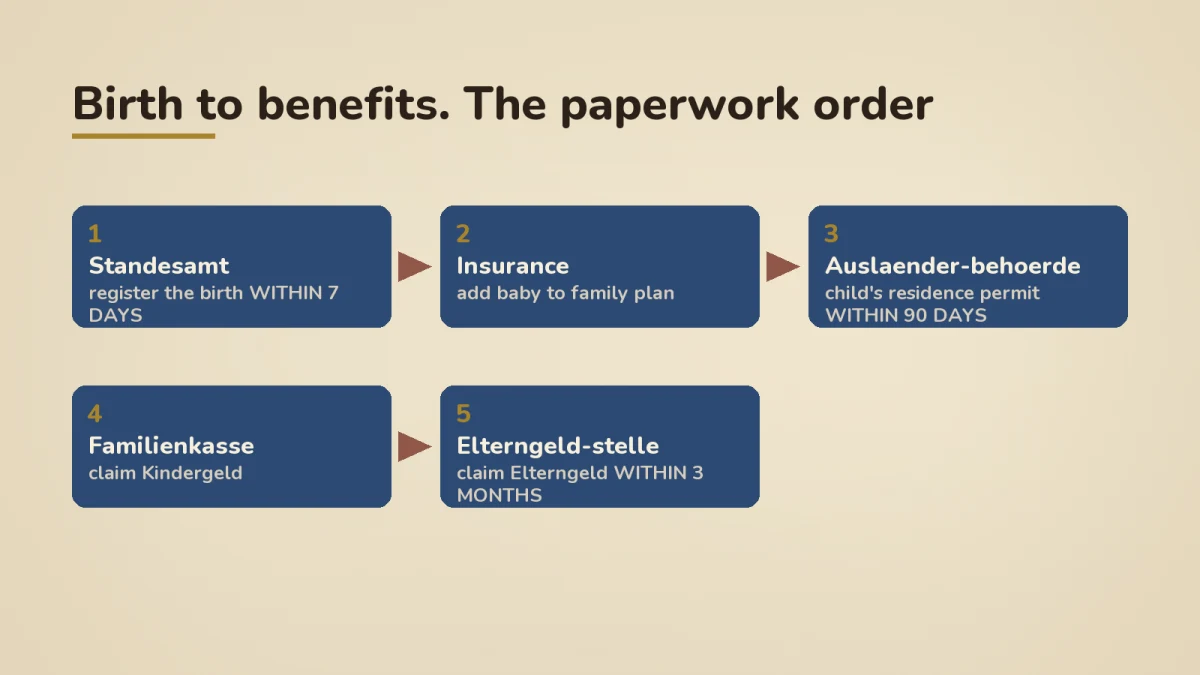
The order matters. Hospital staff will hand you a Geburtsbescheinigung (birth notice) on discharge. From there:
- Within 7 days: register the birth at your local Standesamt (registry office). They issue the Geburtsurkunde (birth certificate). Bring passports, marriage certificate (if married), Mutterpass, and the hospital notice. Many cities now allow online appointments only, so book before the birth.
- Within a few weeks: notify your health insurer to add the baby to your family policy. Public insurance covers children for free under family insurance (Familienversicherung) until age 23 or 25 if studying. Private plans require a separate child policy.
- Within 90 days of birth: apply for the baby's residence permit at the Ausländerbehörde, unless at least one parent has German or EU citizenship (in which case the child takes that citizenship by birth). Bring the Geburtsurkunde. The child's residence permit usually mirrors the parent's.
- As soon as you have the Geburtsurkunde: file Kindergeld at the Familienkasse and Elterngeld at the Elterngeldstelle. Both can be done online in most states.
- Before the baby is 4 weeks old: book paediatrician appointments for the U2, U3, and U4 well-baby checks. The Mutterpass will be replaced with a Kinderuntersuchungsheft (yellow booklet) you carry to every visit.
Anmeldung is automatic. The Standesamt forwards the birth to the Einwohnermeldeamt and the baby is registered at your address without a separate visit. If you move, you do the new Anmeldung the same way you did your own (covered in our residence-registration guide).
If you are unmarried, add one earlier step: the father visits the Jugendamt or Standesamt before the birth to sign the Vaterschaftsanerkennung (paternity acknowledgement) and a Sorgeerklärung (joint custody declaration). Without these, only the mother is the legal guardian.
A practical checklist for the months before birth
- Confirm GKV vs. private and what each covers in your case.
- Book a Hebamme in month 4 to 5. Good ones fill up early.
- Tour two delivery wards. Pick one and pre-register at week 32.
- Pack a hospital bag at week 35.
- Order the family-reunion paperwork early if your spouse is overseas. Our family reunion visa guide covers the rules.
- Bookmark the Familienkasse and Elterngeldstelle online portals for your state.
FAQ
Do I need to speak German to give birth in a hospital here?
No, but it helps. Most large-city hospitals have English-speaking midwives and OB-GYNs. Smaller-city or rural hospitals are German only. Bring a partner or friend who speaks German if your level is below B1.
Does private insurance pay for everything that public does?
Usually yes for prenatal and birth, sometimes more (private room, chief-physician treatment). Always read your policy. The catch is reimbursement: you pay first, claim back. Private plans also charge a separate premium for the baby, which public insurance does not.
What if I am not married to my partner?
Both parents register the Vaterschaftsanerkennung and Sorgeerklärung at the Jugendamt or Standesamt before the birth. Without them, only the mother is the legal guardian and only she can claim Elterngeld in joint mode. The forms are free and fast.
Does my baby automatically get German citizenship?
Only if at least one parent is German or has been a permanent legal resident for 5+ years (the Ius soli rule under the 2024 reform). Otherwise the baby takes the parent's citizenship and needs a residence permit within 90 days.
Can I claim Elterngeld if I am on a Blue Card?
Yes. Blue Card, EU residence permit, and most settlement permits qualify for Elterngeld and Kindergeld. Short-term work permits and Working Holiday visas usually do not. Check your residence-permit Zusatzblatt for the wording.
How quickly do I have to register the birth?
Within 7 days at the Standesamt. The hospital usually pre-fills part of the form for you.
Does Mutterschutz apply to freelancers?
No. Mutterschutz is an employee protection. Freelancers can opt into Krankentagegeld through GKV (Wahltarif) or buy a private rider, but the structure is different. Plan ahead.
Where to go next
Continue reading
Living in Germany·10 min read
Parental leave (Elternzeit and Elterngeld) in Germany for expats 2026
Up to 3 years job-protected parental leave and EUR 1,800 monthly Elterngeld. The 2026 expat guide to eligibility, the new EUR 175,000 income cap, and deadlines.
Read articleLiving in Germany·9 min read
Buying a car in Germany as a new arrival: Registration, insurance, TÜV, financing
Practical guide to buying a car in Germany as a new arrival in 2026: Anmeldung first, eVB insurance, Zulassung at the Kfz office, TÜV and financing options.
Read articleLiving in Germany·19 min read
Public vs Private Health Insurance in Germany: PKV vs GKV Head-to-Head with Real Numbers
Public vs private health insurance in Germany compared with 2026 numbers. JAEG, BBG, GKV monthly cost, PKV premiums, family math, and the age 55 lock-in.
Read articleReady to plan your Germany journey?
Explore our tools and resources to find the perfect university and program for your academic goals.