Parental leave (Elternzeit and Elterngeld) in Germany for expats 2026
Up to 3 years job-protected parental leave and EUR 1,800 monthly Elterngeld. The 2026 expat guide to eligibility, the new EUR 175,000 income cap, and deadlines.

Table of contents
Last updated: May 2026
TL;DR: Any expat living and working in Germany on a residence permit that allows employment is entitled to up to three years of job-protected parental leave (Elternzeit) per child and parental allowance (Elterngeld) of 65 to 67 percent of net income, capped at EUR 1,800 per month. Couples are no longer eligible if their combined taxable income before the birth exceeded EUR 175,000.
Becoming a parent in Germany while you are still figuring out the residence permit, the tax class, and the Krankenkasse can feel like running three onboarding flows at once. The good news: Germany's parental leave system is one of the most generous in Europe, and it applies to expats on the same terms as German citizens, as long as your residence permit allows you to work. This guide walks through what Elternzeit and Elterngeld actually mean, who qualifies in 2026, how much money lands in your account, and the deadlines you cannot miss.
If you are still mapping out the bigger picture of living in Germany, pair this guide with our explainers on Kindergeld for expats in 2026 and public health insurance in Germany, since both interlock with what you read here.
Elternzeit and Elterngeld are two different things
People use the words interchangeably and that is where most expat confusion starts. They are separate legal rights that happen to overlap.
Elternzeit is the unpaid, job-protected parental leave defined in the BEEG (Bundeselterngeld- und Elternzeitgesetz). Each parent can take up to three years off per child, with their job legally held open. Notice protection is strict, the employer cannot terminate you during Elternzeit except in narrow legal exceptions approved by the labour authority.
Elterngeld is the paid parental allowance. It is the money the state pays into your account during Elternzeit (or during the period you reduce your hours after the birth). It replaces a percentage of your previous net income, with a floor and a ceiling.
You can take Elternzeit without claiming Elterngeld (some high earners do, since the income cap means they get nothing). You can also claim Elterngeld without taking the full Elternzeit (you can keep working part-time, up to 32 hours per week). Most parents combine both.
Are expats eligible for Elterngeld and Elternzeit?
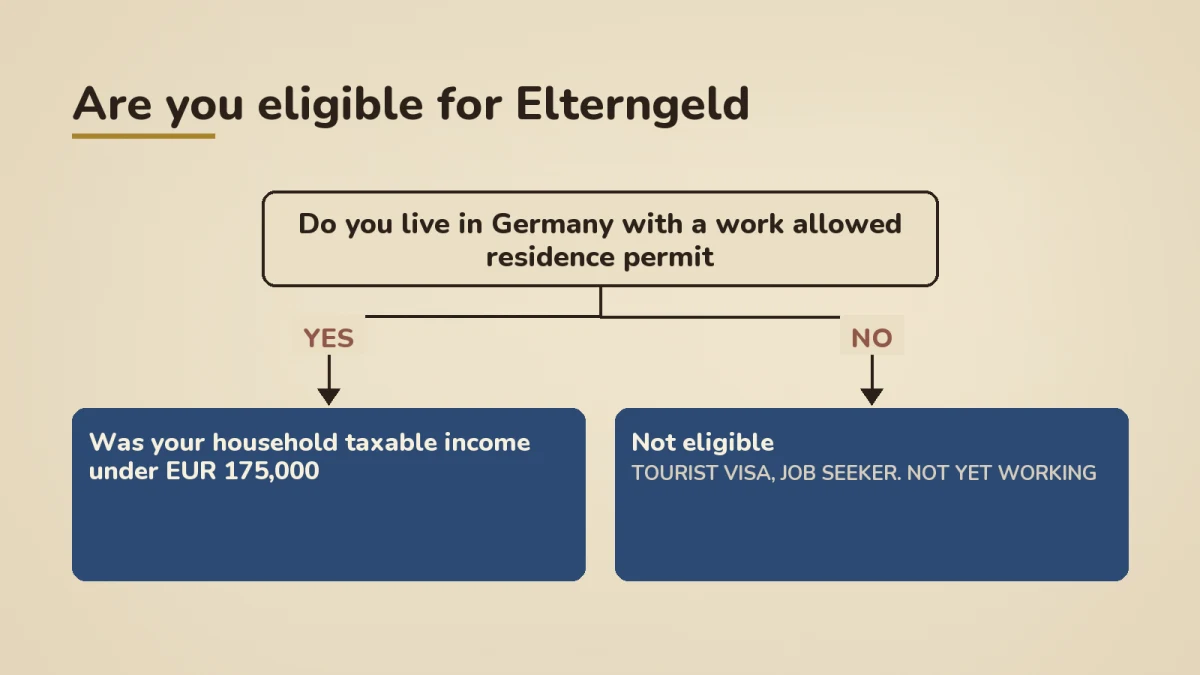
Yes, with one important condition. You must live in Germany and hold a residence title that permits employment. That covers:
- EU and EEA citizens (no permit needed)
- Holders of an EU Blue Card
- Holders of a residence permit for skilled workers (Aufenthaltserlaubnis nach §§ 18a, 18b, 18g AufenthG)
- Holders of a settlement permit (Niederlassungserlaubnis) or EU long-term residence permit
- Spouses and partners on a family reunion permit that includes a work allowance
Residence titles that explicitly forbid employment, or pure tourist and short-stay visas, do not qualify. If you arrived on a Job Seeker visa or Chancenkarte and have not yet started working, you are not yet inside the system.
A practical note for EU Blue Card holders: taking Elternzeit does NOT reset the clock toward your settlement permit. The months on parental leave still count toward the 21-month or 27-month thresholds, as long as you remain employed by the same employer.
The 2026 income cap (this is the part that surprises high earners)
Germany tightened the Elterngeld income cap twice in two years. The current rule for births on or after April 1, 2025:
- Couples: combined taxable income (zu versteuerndes Einkommen) of more than EUR 175,000 in the calendar year before the birth means no Elterngeld at all. Down from EUR 200,000 (April 2024) and EUR 300,000 (before).
- Single parents: same EUR 175,000 cap.
The threshold uses taxable income, not gross. Pre-tax salary deductions for pension contributions, Werbungskosten, and the basic allowance bring the gross-equivalent number meaningfully higher than EUR 175,000, but high earners on Blue Cards in Munich or Frankfurt should run the numbers carefully before assuming they qualify.
How much Elterngeld will you actually get?
Three flavours of Elterngeld exist, and you can mix them. The minimum is EUR 300 per month even if you had no prior income. The maximum is EUR 1,800 per month.
| Variant | Replacement rate | Months available | Best for |
|---|---|---|---|
| Basiselterngeld | 65% to 67% of net (100% for low income) | 12 months for one parent, 14 for couples splitting (each parent must take at least 2), 14 for single parents | Taking a clean year off |
| ElterngeldPlus | Half of Basis per month, paid double the duration | 24 months equivalent | Returning to part-time work earlier |
| Partnerschaftsbonus | Same as ElterngeldPlus | 4 additional ElterngeldPlus months for each parent | Couples who BOTH go part-time at 24-32 hours/week for 4 consecutive months |
The 65 percent rate kicks in for net incomes above EUR 1,240 per month. Below that, you get a sliding rate up to 100 percent. The cap of EUR 1,800 binds anyone whose pre-birth net was above roughly EUR 2,770 per month.
A worked example for a typical Blue Card software engineer:
- Pre-birth net: EUR 4,200 per month
- Basiselterngeld: capped at EUR 1,800 per month
- 12 months of Basis = EUR 21,600 received over the leave
- Switching to ElterngeldPlus for the same coverage: EUR 900 per month for 24 months (still EUR 21,600 total, but spread thinner so you can return to part-time work without losing the benefit)
How to take Elternzeit: the deadlines that trip people up
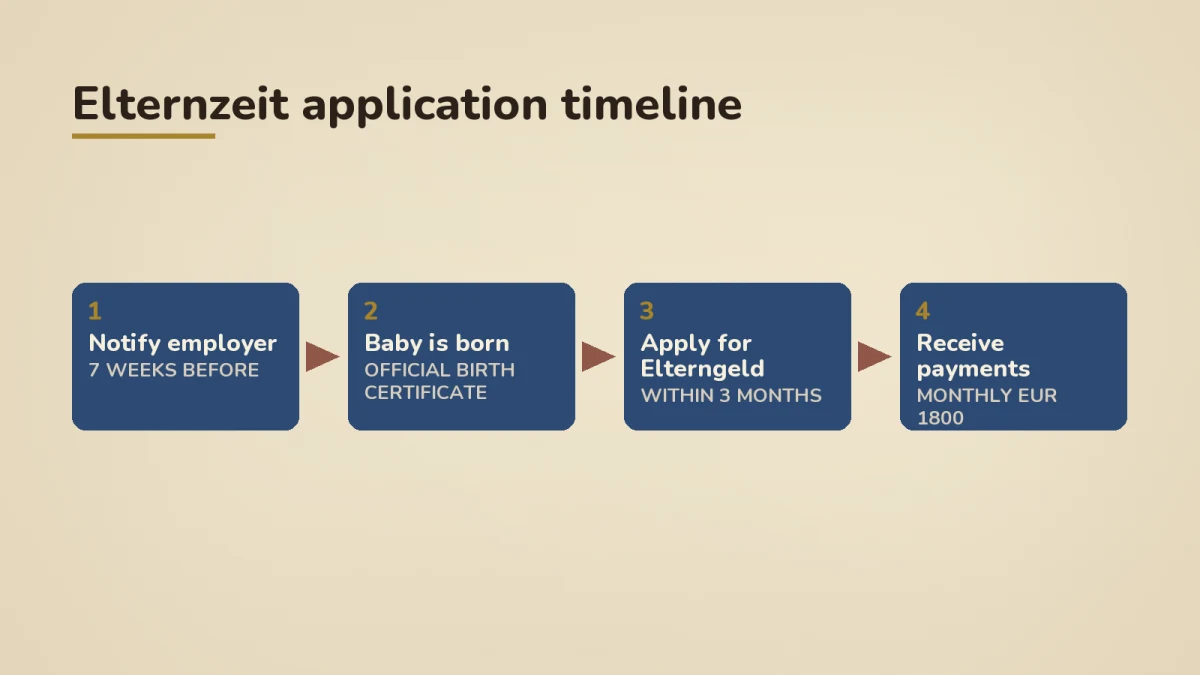
The mechanics are strict and the deadlines are not negotiable.
- Tell your employer in writing, no email, no Slack message. A signed letter or a qualified electronic signature, delivered at least 7 weeks before the start of the Elternzeit you want to take in the first 3 years of the child's life. For Elternzeit between the child's 3rd and 8th birthday, the notice period is 13 weeks.
- Specify the period exactly. You commit to a binding plan for the next two years. You can split your three years into up to three separate blocks, but the employer must be told upfront which periods you are claiming.
- Apply for Elterngeld separately at the Elterngeldstelle of your federal state. You can do this online via the ElterngeldDigital portal in most states. The application can be filed up to 3 months retroactive from when it lands at the office, so do not wait, you lose money for every month you delay past that window.
- Submit documents: birth certificate, proof of income (last 12 months of payslips for employees, last completed tax assessment for self-employed parents), residence permit, health insurance proof, marriage certificate if applicable.
- Receive monthly payments for the duration you applied for, paid into your German account.
The 7-week notice is the single most common mistake. If you tell the employer 6 weeks before, the start date is automatically pushed back by a week.
What happens to your residence permit, taxes, and health insurance during leave
This is the section that does not exist in the German-language guides because they assume you are German.
Residence permit: your permit stays valid as long as the underlying employment relationship continues. Elternzeit pauses the work, not the contract. Blue Card and skilled worker permits stay in force. If your permit is up for renewal during Elternzeit, the Ausländerbehörde will renew it on the basis of the existing employment, even though you are not currently drawing salary.
Taxes: Elterngeld is tax-free but counts toward your "Progressionsvorbehalt", meaning it raises the tax rate applied to any other income you and your spouse earn that year. Couples filing jointly often see a higher effective rate. Filing a tax return for the year you draw Elterngeld is mandatory. See our Elster filing guide for expats for the mechanics.
Health insurance: if you are on statutory (gesetzlich) public health insurance and married to a member, you can move to free family coverage during the no-income period. If you are privately insured, you keep paying premiums in full, the state does not cover them. This is one of the strongest arguments for staying public if you plan to have children in Germany.
Common mistakes expats make
- Missing the 7-week notice window. Sets the start date back automatically.
- Applying for Elterngeld more than 3 months after the birth. You lose every month past the retroactive limit.
- Assuming the income cap uses gross. It uses taxable income, the number much smaller than gross.
- Splitting Basis and Plus inefficiently. Run the numbers, ElterngeldPlus is often better for parents returning at 20-30 hours.
- Forgetting Progressionsvorbehalt. That tax bill in March of the following year can be a four-figure surprise.
- Letting private health insurance auto-renew at full premium. Negotiate a Anwartschaft (dormant policy) or switch to public if eligible.
FAQ
Can I claim Elterngeld if I gave birth abroad and moved to Germany right after?
Generally no. You must have been resident in Germany during the calendar year before the birth for the income to be assessed. Some exceptions exist for EU citizens and posted workers, contact your state's Elterngeldstelle.
My partner and I both work, can we both take Elternzeit at the same time?
Yes. Both parents can be on Elternzeit simultaneously. For Basiselterngeld, both parents claiming together still consume the joint 14-month pool, you cannot double the months. For Partnerschaftsbonus, both must work 24 to 32 hours per week for 4 consecutive months.
What if I am self-employed?
You can still claim Elterngeld. Income is calculated from your last completed tax assessment instead of the 12 months of payslips. You can keep working up to 32 hours per week without losing eligibility.
Does Elterngeld affect my Kindergeld?
No, they are separate. Kindergeld is a flat monthly child benefit (EUR 259 per month per child in 2026) paid in addition to Elterngeld. Read more in our Kindergeld for expats guide.
What about Mutterschutz (maternity protection)?
Mutterschutz runs from 6 weeks before the expected birth to 8 weeks after (12 weeks for premature or multiple births). During Mutterschutz, employed mothers receive Mutterschaftsgeld plus an employer top-up to full pre-birth salary. Mutterschutz weeks count toward your Basiselterngeld months, you cannot stack them.
Can I keep my EU Blue Card during Elternzeit?
Yes. The Blue Card stays valid as long as the employment contract is in force. The 21-month or 27-month clock to settlement permit continues to run. You should still notify the Ausländerbehörde at the start of Elternzeit so the file is up to date.
What if I was unemployed before the birth?
You still receive the minimum Elterngeld of EUR 300 per month for up to 12 months (14 with partner months). Income-replacement-based Elterngeld requires demonstrated prior earnings.
Where do I apply?
At the Elterngeldstelle of the federal state where you live. Most states accept applications via the federal ElterngeldDigital portal. Bavaria, Berlin, Hamburg, NRW, and Baden-Württemberg all have full online flows in German with English support varying by state.
Where to next
- Kindergeld for expats in Germany 2026 for the monthly child benefit on top of Elterngeld
- Public health insurance in Germany 2026 for how family coverage works during leave
- Elster tax filing for expats for the Progressionsvorbehalt return you will have to file
- EU Blue Card Germany 2026 for what Elternzeit means for your settlement permit timeline
Continue reading
Living in Germany·10 min read
Having a baby in Germany as an expat: Hospitals, midwives, Mutterschutz, paperwork
Plain-English guide to having a baby in Germany as an expat. Mutterschutz, Elterngeld, Kindergeld 2026, Hebamme, hospital choice, and paperwork order.
Read articleLiving in Germany·9 min read
Buying a car in Germany as a new arrival: Registration, insurance, TÜV, financing
Practical guide to buying a car in Germany as a new arrival in 2026: Anmeldung first, eVB insurance, Zulassung at the Kfz office, TÜV and financing options.
Read articleLiving in Germany·19 min read
Public vs Private Health Insurance in Germany: PKV vs GKV Head-to-Head with Real Numbers
Public vs private health insurance in Germany compared with 2026 numbers. JAEG, BBG, GKV monthly cost, PKV premiums, family math, and the age 55 lock-in.
Read articleReady to plan your Germany journey?
Explore our tools and resources to find the perfect university and program for your academic goals.