Kindergeld for expats in Germany 2026: who qualifies and how to claim
Kindergeld is Germany's monthly child benefit, paid by the Familienkasse to almost any parent legally living here. The 2026 rate is 259 euros per child.

Table of contents
Last updated: July 2026
TL;DR: Kindergeld is Germany's monthly child benefit, paid by the Familienkasse to almost any parent legally living here, regardless of income. As of January 2026 it is €259 per child per month. Most expats on a Blue Card, work permit, or Niederlassungserlaubnis qualify. You apply online via the Bundesagentur für Arbeit with your tax IDs, IBAN, and the child's birth certificate. Payment lands in your German bank account every month and a decision typically takes up to six weeks.
If you have moved to Germany with kids, or you are about to, Kindergeld is one of the simplest expat-friendly benefits the system gives you. There is no income test, no German-language interview, and no quota. The bigger question is usually paperwork. This guide walks through who qualifies, how to apply, what changes in 2026, and how Kindergeld interacts with the German tax system. It sits inside our broader /live pillar on settling in Germany, alongside our explainer on residence registration (Anmeldung) and residence permits for non-EU expats.
What is Kindergeld and who pays it
Kindergeld is a flat monthly cash benefit paid out by the Familienkasse, the Family Benefits Office that sits inside the Bundesagentur für Arbeit (Federal Employment Agency). The money arrives in your German bank account every month for each child you are responsible for, until the child reaches the age cap.
The 2026 amount is €259 per child, per month. That is a €4 increase on the €255 figure that ran through 2025, and it is uniform across every child you have. The Familienkasse confirmed in its December 2025 press release that existing recipients do not need to apply for the new rate; the increase is automatic from January 2026 onward.
Three things make Kindergeld unusually generous for expats:
- No income ceiling. A senior engineer on €120,000 and a part-time hospitality worker get the same flat €259.
- No deduction from your salary or tax bill. Kindergeld is tax-free.
- It survives short trips abroad. As long as your habitual residence stays in Germany, summer holidays in your home country do not stop payment.
Who qualifies as an expat
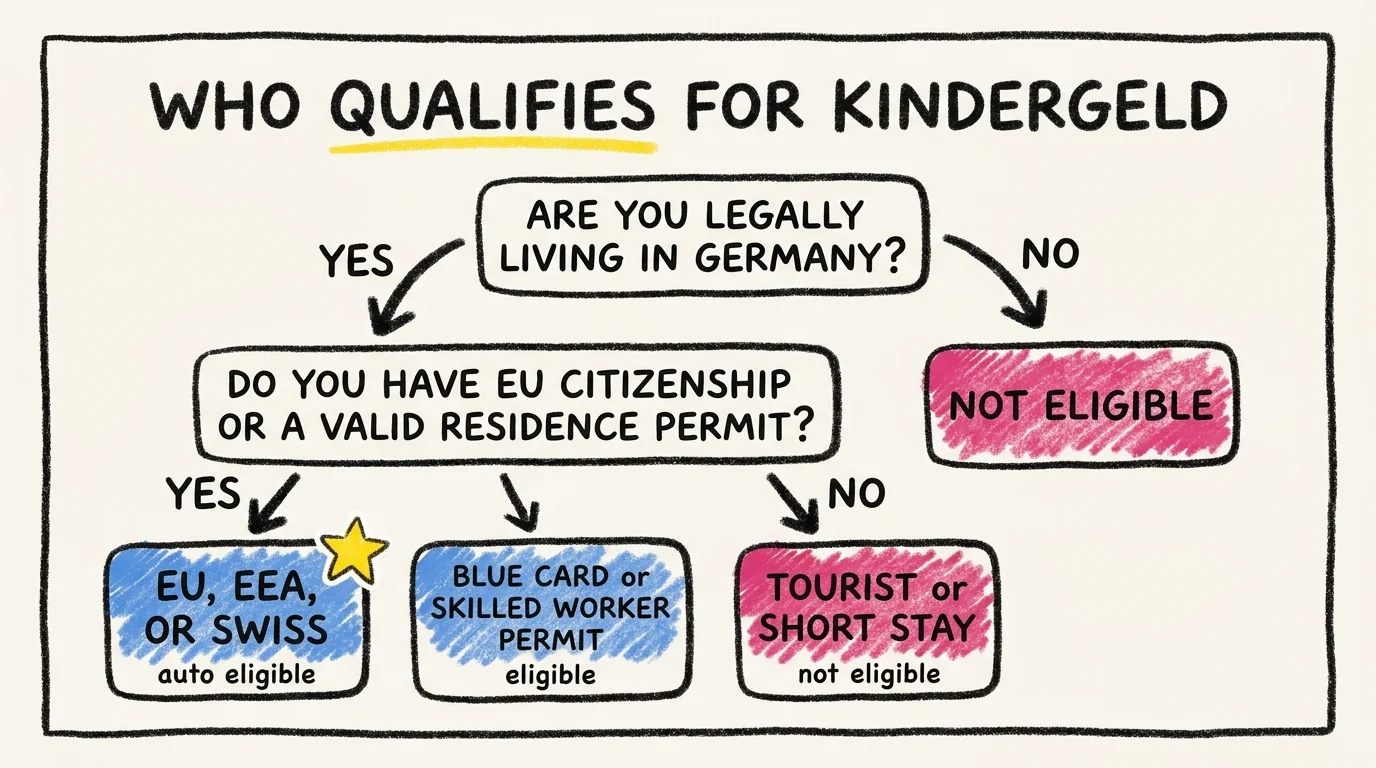
The headline rule is that anyone legally living in Germany can claim Kindergeld for the children they care for, provided they are not already drawing a comparable benefit somewhere else (no double-dipping with another country's child benefit).
The residence-permit details matter most for non-EU expats. Here is the practical breakdown the Familienkasse uses.
| Your situation | Kindergeld eligible? |
|---|---|
| German, EU, EEA, or Swiss citizen living in Germany | Yes, automatically |
| Non-EU on an EU Blue Card | Yes |
| Non-EU on a residence permit allowing employment (skilled worker, Section 18a, 18b) | Yes |
| Non-EU on a Niederlassungserlaubnis (settlement permit) | Yes |
| Non-EU recognised as a refugee or with subsidiary protection | Yes |
| Non-EU on a Chancenkarte (Opportunity Card) | Yes, once registered with employment, residence, and an active job |
| Job-seeker visa holder, no work yet | Usually no, until the residence permit upgrades |
| Tourist visa, working-holiday visa, short-stay | No |
Two special situations that trip expats up:
- Children living abroad. If your kids stay in your home country while you work in Germany, you can still receive Kindergeld in many cases, but the amount may be reduced or co-ordinated with your home country's child benefit under EU rules or a bilateral agreement. The Familienkasse evaluates this case by case.
- Non-EU spouse with the children. It is the parent who has the German residence status and habitual residence here who claims, even if the non-EU spouse is the day-to-day caregiver.
If you are bringing your family later, our guide to the German family reunion visa covers the visa side; Kindergeld kicks in once the children are physically resident with you.
How much you get and how it is paid
The 2026 figure of €259 per child applies to every child equally. Until 2023, the rate was scaled by birth order (more for the third and fourth child); the system was simplified to a single flat rate, and every increase since has kept that flat structure. The 2026 increase is the first since the €5 jump in January 2024.
Once your application is approved, the Familienkasse sends you a personal Kindergeldnummer. The last digit of that number determines which day of the month your payment lands. Bundesagentur für Arbeit publishes the full payment-date table each year; numbers ending in 0 are paid earliest, numbers ending in 9 latest.
You receive the payment by SEPA transfer, which means you need a German or other European IBAN. A US, Indian, or UK home-country account does not work for Kindergeld disbursement.
How to apply step by step
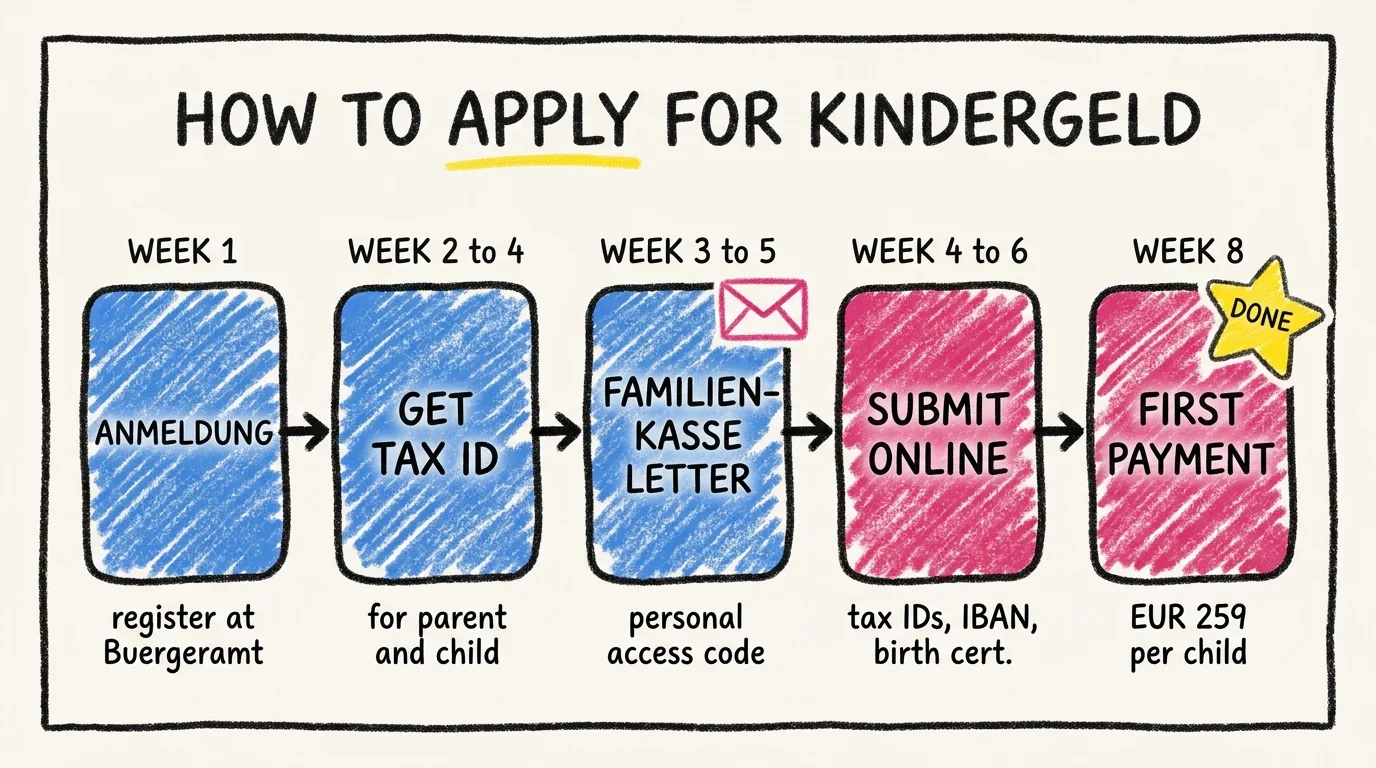
The whole process is digital, free, and takes around six weeks for a first decision. Existing recipients do nothing, the 2026 rate adjusts itself.
- Register your child's residence (Anmeldung) at your local Bürgeramt, if you have not already, when the family arrives in Germany. The child gets their own German tax ID a few weeks after registration.
- Wait for the Familienkasse welcome letter. The Federal Central Tax Office shares the new tax ID with the Familienkasse, which sends you a letter with a personal access code and a pre-filled online form. This step is automatic for newborns and most newly-registered children.
- Open the Familienkasse online portal at the Bundesagentur für Arbeit website (the family-and-children section). Log in with the welcome-letter access code, or create a BundID account if you do not have one.
- Complete the Kindergeldantrag. You will need: your tax ID, the child's tax ID, your German IBAN, your residence permit details, and the child's birth certificate (with a certified German translation if it is not already in German or English).
- Submit the form online. Most applications now go through the digital channel; paper forms still exist if you prefer to walk into the local Familienkasse office.
- Wait up to six weeks for the decision. The Familienkasse confirms the start date, the monthly amount, and your Kindergeldnummer in a written notice (Bescheid).
- Track payments by the last digit of your Kindergeldnummer. First payment usually backdates to the month your eligibility started, so do not panic if the first deposit is bigger than €259.
If the application is rejected, you have one month to file an objection (Widerspruch) in writing or in person at the office that issued the decision. Common rejection reasons are missing translations, an unclear residence-permit category, or proof of habitual residence.
Until what age you receive Kindergeld
The default cut-off is the child's 18th birthday. Three extensions push that cap higher:
- Up to 21, if the child is unemployed and registered as a job-seeker with the Agentur für Arbeit.
- Up to 25, if the child is in school, university, vocational training, or doing a recognised volunteer year (FSJ/FÖJ). The clock stops when the first vocational qualification or first degree completes, with limited exceptions for an immediate follow-on programme.
- No upper age cap, if the child has a disability that prevents them from supporting themselves, provided the disability arose before age 25.
You must inform the Familienkasse when one of these conditions changes (your child finishes university, starts a full-time job, enrolls in a Master's). Continuing to draw Kindergeld after the eligibility ends triggers a refund demand.
Kindergeld versus Kinderfreibetrag (the tax allowance trade-off)
For higher earners, Germany runs a parallel mechanism called the Kinderfreibetrag, a tax-free allowance that reduces taxable income rather than handing out cash. You do not choose between the two; the Finanzamt does the comparison automatically when you file your annual tax return and applies whichever is more favourable.
For 2026 the Kinderfreibetrag is €6,828 per child per year (€3,414 per parent), plus an additional education and care allowance of €2,928 per child per year (€1,464 per parent). The break-even point varies with marital status and tax class, but the rough rule is: middle-income families come out ahead with Kindergeld, while top earners often benefit slightly more from the allowance. Either way, Kindergeld lands in your account monthly while the Kinderfreibetrag is settled at tax time. Our explainer on paying taxes in Germany covers how these family allowances interact with your annual return.
Related benefits expat parents should know
Kindergeld is the best-known benefit, but the German family safety net has a handful of others that often apply at the same time:
- Kinderzuschlag (supplementary child allowance): up to €297 per child per month in 2026, for households where parents earn at least €900/month (€600 for single parents) but fall under a means-tested ceiling. You apply via the same Familienkasse portal.
- Unterhaltsvorschuss (maintenance advance): for single parents who do not receive maintenance from the other parent. Up to €227 (under 6), €299 (6-11), or €394 (12-17) per month in 2026. Applied at the local Jugendamt.
- Elterngeld (parental allowance): an income-replacement benefit for the months a parent stops working after a birth. Separate from Kindergeld, applied via a different office.
- Tax deductions for daycare fees and private-school tuition, declared on your annual tax return.
Common mistakes expats make
- Applying before the child has a German tax ID. The Familienkasse cannot process the form without it; wait for the letter from the Federal Central Tax Office.
- Submitting an untranslated foreign birth certificate. A certified German translation is required for most non-German, non-English documents.
- Forgetting to declare Kindergeld on the annual tax return. It is tax-free, but the Finanzamt still needs to see it to run the Kinderfreibetrag comparison.
- Letting the Familienkasse continue paying after your child finishes university or starts full-time work. Notify them; otherwise you will face a refund letter.
- Assuming Kindergeld stops if you leave Germany for a holiday. It does not. It only stops if your habitual residence shifts back to your home country.
FAQ
Can I claim Kindergeld on an EU Blue Card?
Yes. Blue Card holders are explicitly listed in the Familienkasse's eligible-permits guidance. The same applies to most skilled-worker permits issued under Sections 18a and 18b of the Aufenthaltsgesetz. See our EU Blue Card guide for the wider permit context.
Do my children need to live in Germany?
In most cases yes, but EU rules and bilateral agreements allow Kindergeld to flow to children resident in another EU/EEA country if the parent works in Germany. For children outside the EU, the Familienkasse looks at whether a comparable benefit exists in the home country and may co-ordinate or reduce the amount. If you are still planning to bring them to Germany, our dependent visa for children guide walks through the section 32 process.
I just moved to Germany. How long until the first payment?
Plan for around eight weeks from arrival. Roughly: 2 to 4 weeks for the Anmeldung and the child's tax ID, 4 to 6 weeks for the Familienkasse to process the application. The first payment usually backdates to the month you became eligible.
Can both parents claim Kindergeld?
Only one parent receives the payment per child. Couples decide between themselves and name the recipient on the application. If parents are separated, the parent with primary custody claims.
Will the Familienkasse contact me about the 2026 increase?
No, you do not need to do anything. The press release confirms the new €259 rate is applied automatically from January 2026 to all existing entitlements.
How is Kindergeld taxed?
It is tax-free. You still declare it on the Anlage Kind of your annual tax return so the Finanzamt can run the Kinderfreibetrag comparison.
What happens if I leave Germany?
Eligibility ends when your habitual residence (Lebensmittelpunkt) is no longer in Germany. Inform the Familienkasse of the move. If you keep working in Germany but the family relocates, EU and bilateral rules may still apply.
Is Kindergeld the same as Elterngeld?
No. Kindergeld is a flat €259 per child per month and runs for years. Elterngeld replaces lost income for the months a parent pauses work after a birth, ranges from €300 to €1,800 per month, and is capped at 14 months total between both parents.
Where to next
- The /live pillar covers the wider settling-in flow, from Anmeldung to health insurance to housing.
- How to bring your parents to Germany explains the family-reunion visa for older relatives.
- Healthcare in Germany covers the public-insurance side of having a family here, including pediatric coverage.
- Paying taxes in Germany walks through the annual return where Kindergeld and the Kinderfreibetrag are reconciled.
If you are still researching the move and Kindergeld is part of the family-budget calculation, the /tools hub has a salary calculator and cost-of-living estimator that already account for the standard family allowances.
Continue reading
Financial Planning·13 min read
ELSTER and German tax filing for expats: When you must file, how to claim back, what changed in 2026
Working in Germany and unsure about taxes? When ELSTER filing is mandatory, the 2026 changes, and how expats reclaim around 1,000 euro on average.
Read articleFinancial Planning·13 min read
Blocked Account Germany 2026: How much you need, providers compared, application steps
How much money you need in a 2026 German Sperrkonto, which providers are still operational, and the step-by-step application timeline before your visa appointment.
Read articleFinancial Planning·8 min read
BAföG for international students in Germany 2026: Who qualifies, how much, and the start-up grant
BAföG eligibility for international students in 2026: residence-permit rules, monthly rates around EUR 992, the EUR 1,000 Studienstarthilfe, and how to apply.
Read articleReady to plan your Germany journey?
Explore our tools and resources to find the perfect university and program for your academic goals.