German employment contract red flags: Probation, notice, Kündigungsschutz, non-compete
Probation cap, statutory notice, Kündigungsschutz thresholds, and non-compete compensation rules every expat needs to spot before signing a German contract.

Table of contents
Last updated: May 2026
TL;DR: German employment contracts are friendlier to workers than almost anywhere else, but only if you read them. The four clauses that quietly decide your life are probation length (max 6 months), notice period (§622 BGB minimum, contract can extend), Kündigungsschutz coverage (after 6 months at a company of more than 10 staff), and post-contractual non-compete (only binding if your employer pays at least 50% of your last earnings). If any of those is misshaped in your contract, push back before you sign.
The German employment contract you are about to sign is not a formality. It decides how fast you can leave a bad job, how slow your employer can fire you, whether you get sued for taking a competing role two years from now, and whether a Munich bank will give you a five-year mortgage. International hires routinely sign whatever HR sends and only read the small print after a layoff. By then, three of the four levers in this post are already locked in.
German labour law overrides a surprising amount of contract language, but not everything. This guide walks the four clauses that consistently catch expats off-guard. If you have not picked a /work route yet, start there. If you are weighing offers, work regulations in Germany and German work culture frame everything below.
What German law guarantees you, even before you sign
A German contract sits inside a layered legal stack: the Bürgerliches Gesetzbuch (BGB, civil code), the Kündigungsschutzgesetz (KSchG, dismissal protection act), the Handelsgesetzbuch (HGB, commercial code), and the Arbeitszeitgesetz (working-time act). Any collective agreement (Tarifvertrag) your industry follows sits on top. If a clause in your contract is more generous than the statute, the contract wins. If it is harsher, the statute wins and the bad clause is void.
Three practical consequences:
- You cannot waive notice protection just because the contract says you can.
- A non-compete without compensation is unenforceable, no matter how scary the wording.
- A blanket overtime clause that says "all overtime is included in your salary" is almost always invalid above a senior level.
These are the default, not loopholes. The mistake is signing a contract that contradicts the default and assuming the rights are gone when in many cases they are not.
Probation period (Probezeit): the first six months are the cheap exit
§622(3) BGB caps the probation period at six months. Inside Probezeit, either side can terminate with two weeks' notice and no reason given. Outside Probezeit, both sides switch to the statutory notice ladder in §622(1) and (2) BGB.
Two things go wrong here:
- Probezeit longer than six months. Sometimes phrased as "the first nine months are probationary" or "probation extends until performance review". Both are void. The Federal Labour Court tightened this in 2025: fixed-term contracts cannot extend probation past the six-month ceiling without case-by-case proportionality justification.
- Probation that survives a contract change. If you switch roles internally, your employer cannot reset Probezeit. Continuous employment counts as continuous employment.
The practical move during Probezeit is to keep your CV warm. Two-week notice cuts both ways. You can leave a bad fit on Monday and start somewhere else inside the same calendar month, which is structurally faster than any post-probation exit.
Notice periods after probation: §622 BGB and what your contract can extend
Once probation ends, statutory notice for the employee is four weeks to either the 15th or the end of a calendar month. For the employer, notice rises with your tenure:
| Tenure with employer | Employer notice (§622 BGB) | Effective date |
|---|---|---|
| 0 to 2 years | 4 weeks | 15th or end of month |
| 2 years | 1 month | End of month |
| 5 years | 2 months | End of month |
| 8 years | 3 months | End of month |
| 10 years | 4 months | End of month |
| 12 years | 5 months | End of month |
| 15 years | 6 months | End of month |
| 20 years | 7 months | End of month |
Your contract can lengthen these periods. It can also bind your own notice to the same extended period the employer must give, but no longer. A clause that says "the employee must give 6 months while the employer gives 4 weeks" is invalid under §622(6) BGB, which requires equal or longer notice for the employer.
Matching notice of three or six months on both sides is common in senior contracts and is fine. A one-sided clause is a red flag. If the matched figure is large, factor it into your job-search timeline. You cannot leave a senior role on the spot in Germany.
Kündigungsschutz: the protection most expats don't realise they have
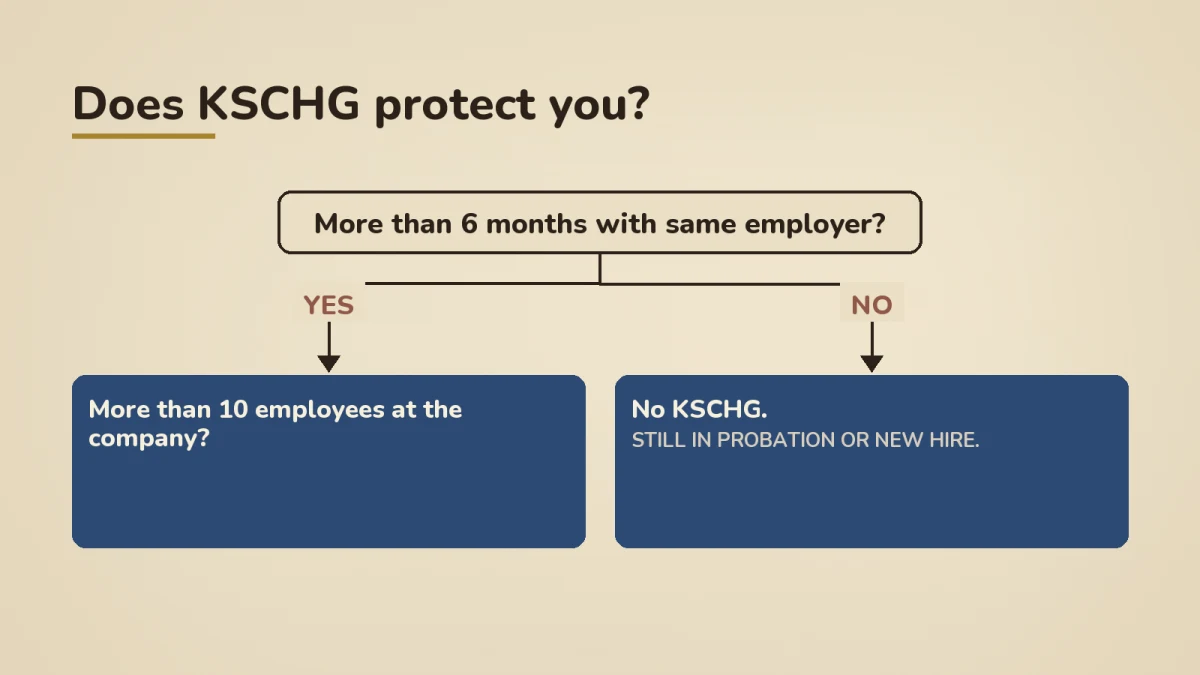
The Kündigungsschutzgesetz (KSchG) turns "fire at will" into "fire only with one of three accepted reasons": personal (you cannot perform, e.g. long-term illness), behavioural (misconduct, usually after a written warning), or operational (genuine redundancy with social-selection criteria applied across comparable employees).
KSchG applies when both of these are true:
- You have worked at the same employer for more than six months (§1(1) KSchG).
- The employer regularly employs more than 10 employees in full-time equivalents, with part-timers up to 20 hours counted as 0.5 and up to 30 hours as 0.75 (§23(1) KSchG).
Below either threshold you are in the Kleinbetrieb (small-business) zone where dismissal is much easier. A 12-person Berlin startup is in scope. A 9-person Berlin startup is not. If your offer is from a small team, you are not getting the dismissal-protection upside that mid-size employers offer, even though every other clause looks identical.
Special protections sit on top of KSchG for pregnant employees, parents on Elternzeit, severely disabled workers, and works-council members. These survive even in Kleinbetriebe.
Non-compete clauses (Wettbewerbsverbot): why most are unenforceable
Post-contractual non-competes are governed by §§74 to 75f HGB. The headline rule is brutal in your favour: the clause is binding only if the employer pays Karenzentschädigung of at least 50% of your last regular earnings for every month of the non-compete period.
Other hard limits:
- Maximum length: two years from end of contract.
- Written, signed, executed copy in your hand.
- Geographic and sector scope no broader than legitimate business interest. "Any IT role anywhere in Europe" is too broad and invalid.
- Apprentices and trainees cannot be bound at all.
Three common variations:
- No compensation mentioned. Non-binding. You can ignore it.
- Compensation below 50%. Non-binding. You can choose to honour it (and collect) or ignore it.
- Compensation at or above 50% and proper scope. Binding. You honour it and get paid. The employer can unilaterally waive (verzichten), but still owes compensation for one more year unless waiver is given before contract end.
A 2026 employer trend is "preliminary agreements" (Vorvertrag) where the employer reserves the right to switch on a non-compete at termination time. These are valid only if the trigger sits before the contract ends. If the trigger is after termination, the Federal Labour Court treats the agreement as invalid.
Other red flags worth challenging before you sign
Three more clauses regularly cause expat regret.
Blanket overtime clauses. A line saying "any overtime is fully covered by the agreed salary" is broadly invalid for non-managerial roles. Senior positions paid well above the regional collective threshold can absorb a limited clause. Mid-level roles cannot. The Federal Labour Court strikes down clauses that fail the transparency test: if the clause does not specify a maximum number of overtime hours covered, it is unenforceable.
Exclusion clauses (Ausschluss- or Verfallsklausel). These say "all claims not raised in writing within X months are forfeited". German law allows them only if the period is at least three months for raising the claim and another three for filing suit, and only if the clause carves out intentional conduct and the statutory minimum wage. A flat "all claims expire after one month" is void.
General release clauses (Freistellungsklausel). A line that lets the employer release you from work duties unilaterally during notice. The Federal Labour Court confirmed in April 2026 that blanket release clauses are invalid. Release during notice is still possible with a concrete reason, just not via a vague catch-all.
If you spot any of these, ask for a redline. Most German employers will negotiate for senior or skilled-shortage hires, especially if you have an EU Blue Card on the table or are coming off a post-study work visa.
What to do before you sign
- Get the contract in writing, ideally bilingual. An English-only contract is valid but harder to litigate. Ask for a German original alongside the translation.
- Map every numeric clause against the statutory floor. Probezeit, notice, vacation (statutory minimum 20 days at a 5-day week), sick pay (six weeks at full pay under §3 EFZG).
- Run the non-compete math. A non-compete without compensation gives the employer free option value and you nothing.
- Check the Kündigungsschutz threshold for your specific employer. Both headcount and tenure matter.
- If anything feels off, get a 60-minute consult with a Fachanwalt für Arbeitsrecht. Around EUR 150 to EUR 300, easily worth it if one clause gets rewritten.
Common mistakes
- Treating Probezeit as the employer's right only. It is mutual.
- Assuming Kündigungsschutz applies because you are permanent. Headcount and tenure both matter.
- Signing a non-compete because HR calls it "standard". Without compensation it is unenforceable.
- Ignoring the working-time clause. The Arbeitszeitgesetz caps weekly hours at 48 averaged over six months.
- Not asking about Tarifvertrag. If your industry is covered, your real entitlements are usually higher than the contract states.
FAQ
Can my employer extend my probation period beyond six months?
No. §622(3) BGB caps Probezeit at six months. Any clause extending it is void. The employer can offer a fixed-term contract with proportional probation, but the Federal Labour Court tightened that route in recent rulings, requiring case-by-case justification rather than a default six-month maximum.
Does Kündigungsschutz apply from day one?
No. You need both more than six months at the same employer and a workplace with more than 10 employees in full-time-equivalents. Below either threshold you are in the small-business zone where the employer can dismiss with notice but does not need one of the three accepted KSchG reasons. Special protections (pregnancy, parental leave, severe disability, works-council membership) apply regardless of company size.
How long do I have to file a Kündigungsschutzklage?
Three weeks from receipt of the written termination letter (§4 KSchG). Miss it and the dismissal is automatically valid, even if it was unlawful. This is one of the strictest deadlines in German employment law.
Is a non-compete enforceable if it does not mention compensation?
No. §74(2) HGB requires Karenzentschädigung of at least 50% of last regular earnings for the clause to bind you. Without compensation language, the non-compete is non-binding and you can ignore it.
Can my employer release me from work during my notice period?
Targeted release with a stated reason (handover complete, conflict-of-interest concern) is fine. A blanket clause giving the employer unilateral release rights was struck down by the Federal Labour Court in early 2026. If released, you receive full salary until notice ends and can usually start a new job earlier with employer consent.
What happens if I just stop showing up after probation?
The employer can sue for damages and refuse to issue a clean Arbeitszeugnis (work reference), which matters because every German employer expects to see one. Formally resign with contractual notice and negotiate an early release.
Where to next
- Work Regulations in Germany for the broader regulatory map.
- EU Blue Card Guide if your contract is tied to a Blue Card application.
- Post-Study Work Visa for graduates moving from a job-seeker visa into a first contract.
- Paying Taxes in Germany for the income side of the same paperwork.
- /work for the full pillar on building a career in Germany.
Continue reading
Career & Jobs·10 min read
Payscale in Germany: Average Gross Remuneration by Profession and Region
Discover the average gross remuneration in Germany by profession and region. Learn how much you can earn as a student or professional and work out your ROI. Explore the payscale in Germany and make an informed decision for your higher studies.
Read articleCareer & Jobs·15 min read
Chancenkarte Germany: Point system explained, real one-year results, who actually got in
Germany's Chancenkarte point system explained with a 6-point matrix, worked examples, and real one-year results from 2024 to 2025.
Read articleCareer & Jobs·14 min read
Why Germany has 1M jobs and zero callbacks (and how to fix your application)
Germany has over 1 million open jobs but most foreign applicants get silence. Here is why your applications fail and how to fix the stack.
Read articleReady to plan your Germany journey?
Explore our tools and resources to find the perfect university and program for your academic goals.