How to find a job in Germany in 2026: The new playbook for the hidden market
Germany has 628,629 open vacancies but IT roles take 7.7 months to fill and 50 to 70 percent of jobs never get posted. The 2026 playbook.

Table of contents
Last updated: May 2026
TL;DR: Germany has 628,629 open vacancies and a structural shortage in IT, healthcare, and the skilled trades, but the average IT role still takes 7.7 months to fill and 50 to 70 percent of jobs never get publicly posted. The 2026 playbook is narrower and slower than what worked in 2021. Get to B2 German, target the Mittelstand and second-tier cities, get on referral networks early, and use the Chancenkarte or EU Blue Card as your visa lever. This guide walks through what changed, why, and what to actually do.
The German job market in 2026 is not the market your cousin who moved in 2018 described. The country still has more than 600,000 open vacancies, the demographic gap is widening, and the government keeps the Chancenkarte and Blue Card routes open precisely because employers cannot find people. But the way hiring actually happens has shifted, and most candidates are still applying with a 2021 playbook into a 2026 market.
This post is the /work/jobs primer. It pulls together the structural numbers (vacancies, hiring cycle, salary gap, callback gap), the unspoken rules (referral-first hiring, Mittelstand dominance, B2 German wall), and the seven moves that still work in 2026. If you came here looking for a list of job portals, that list is at the end. The portal is not the playbook.
What changed about finding a job in Germany in 2026
Three structural shifts now define the market, and they compound on each other.
First, the hiring cycle stretched. Bitkom's 2025 IT specialist study (still the latest comprehensive figure) put the average time to fill an IT vacancy at 7.7 months, unchanged from 2023. SmartRecruiters' broader 2025 cross-sector data put the German average at 55 days, well above the EU average. The ifo Employment Barometer fell to 91.3 in April 2026, its lowest reading since May 2020, signalling that companies that are hiring are also being more careful. Slow hiring is not a temporary post-pandemic kink. It is the new baseline.
Second, the junior role is being squeezed. LeadDev's 2025 engineering leaders survey reported 54 percent of leaders planned to hire fewer juniors over the next year, citing AI copilots that let one senior do the work of two. Junior tech postings in Germany dropped 34 percent over five years while senior postings dropped only 19 percent. The first rung of the ladder did not just get harder to climb, parts of it were removed.
Third, the hidden market grew. Industry surveys consistently put the share of jobs filled through internal moves, referrals, or pre-arranged candidates at 50 to 70 percent. Posted vacancies are the visible tip. The bigger flow happens through XING, alumni Slack groups, IHK lists, and conference handshakes. Foreign candidates who only watch StepStone and LinkedIn are competing for the smaller, more contested half of the pool.
Why hiring takes so long (and what it means for you)
German employers over-screen because firing is expensive.
The math: severance is roughly 0.5 monthly salaries per year of service, often capped at 12 to 18 months pay. The works council (Betriebsrat) must approve every termination above a low threshold. A bad senior hire can cost the company one to two years of total compensation to undo. So they extend the funnel. Multiple interviews, technical assessments, case studies, reference calls, and decision committees are not theatre, they are loss prevention.
What this means for you as a foreign candidate:
- Your CV gets parsed harder. Every line is a risk signal or a credibility signal. Vague titles, unexplained gaps, and unverifiable degrees all push your application down the pile.
- The interview cycle is long. Expect six to twelve weeks from first call to signed contract for a tech role. Three to six months is common for engineering and Mittelstand positions.
- The hiring manager wants a low-friction yes. Make it easy: clear B1 or B2 German on the CV, recognised degree (Anabin status), and a Europass-style format reduce friction more than anything you can write in a cover letter.
The slow cycle is also why every legitimate shortcut matters. Referrals shortcut the trust gap. The Chancenkarte shortcuts the visa gap. B2 German shortcuts the language gap. Stack the shortcuts and the 7.7 months can become 7 weeks.
The hidden market: where most jobs actually fill
If half to two-thirds of German jobs never get posted, where are they?
| Channel | Why employers prefer it | How to access it |
|---|---|---|
| Internal promotions | Known performance, no severance risk | Get hired junior, perform, ask early |
| Employee referrals | Cultural fit pre-screened, often a referral bonus | Ask for warm intros on XING and alumni Slack groups |
| Recruiter shortlists | Specialist agencies maintain candidate pipelines | Get on Hays, Robert Half, Michael Page lists once you are in country |
| Conferences and meetups | Live signal, low-stakes conversation | re:publica, OMR, IFA, regional IT meetups, IHK events |
| Alumni networks | High trust, weak ties | Universities run dedicated career portals; activate yours |
| LinkedIn open-network DMs | Foreign candidates underuse this on XING | Cold outreach is normal in DACH if you lead with substance |
A practical rule: spend half your job-search time on the visible market (StepStone, LinkedIn, Indeed, Make-it-in-Germany, Bundesagentur für Arbeit) and half on the hidden market. The visible market gets you fast feedback. The hidden market gets you the offer.
If you are still abroad, the hidden market is harder to access but not closed. XING is the German LinkedIn equivalent and it is where Mittelstand recruiters actually live. Most foreign candidates ignore it. That is your edge.
Where the real demand is in 2026
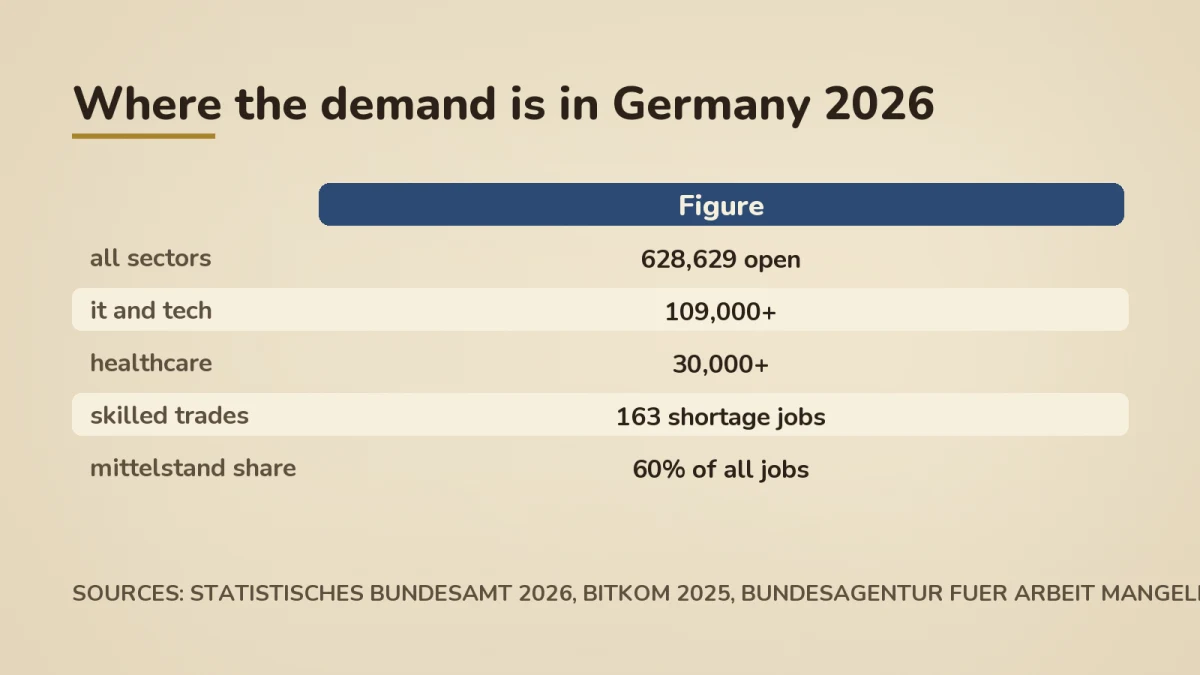
The shortage is real, but selective. Some sectors are starving for people. Others are flooded.
Statistisches Bundesamt counted 628,629 open vacancies across the whole economy in early 2026. Bitkom counts more than 100,000 open IT positions on its own. The Bundesagentur maintains a Mangelberufe (shortage occupations) list with 163 entries spanning healthcare, skilled trades, IT, engineering, and STEM teaching. The shortage list is the document that tells you where your application has tailwind, not headwind.
Where the demand actually concentrates:
- IT and tech: cloud infrastructure, cybersecurity, AI/ML engineering, SAP consulting, embedded systems. Cybersecurity senior roles run up to EUR 112,000 and AI/ML roles grew roughly 35 percent year on year.
- Healthcare: doctors, geriatric and ICU nurses, physiotherapists, medical-technical assistants. Requires B1 German minimum, B2 for most clinical roles, plus formal credential recognition (Anerkennung).
- Skilled trades and Ausbildung occupations: electrical, mechatronics, plumbing/HVAC, welding, industrial mechanics. Wages rising fast as the boomer generation retires.
- Engineering: mechanical, automotive (yes, even with the EV transition), civil, environmental, renewable energy.
- Education and care: kindergarten teachers (Erzieher), elderly care (Altenpflege), early-childhood education. B2 German plus recognition required.
What is flooded: generalist marketing, English-only sales, junior product management without a hard skill, generalist business consulting (especially without a German MBA or local network), and entry-level analytics roles where one senior plus an AI copilot now replaces three juniors.
The Mittelstand thesis: why mid-sized firms are your real target
Foreign candidates obsess over the same fifteen companies. SAP, Siemens, BMW, Porsche, Mercedes, Allianz, BASF, Bayer, Bosch, Deutsche Bank, the consulting Big Four, Zalando, Delivery Hero, N26. The applicant pool for those firms is brutal. The interview cycles are long. The salary bands are public, but so is the queue.
The Mittelstand is the other 60 percent of the labour market. These are the family-owned and privately-held firms with 50 to 5,000 employees, typically rooted in a specific region (Baden-Württemberg, Bavaria, North Rhine-Westphalia), often global leaders in a narrow product category (industrial sensors, packaging machines, niche pharma, automation, specialty chemicals). Many are profitable, debt-free, and have been hiring foreign engineers and IT staff for fifteen years.
Why the Mittelstand hires faster than DAX 40 firms:
- Smaller HR teams mean fewer screening rounds. The hiring manager often makes the decision.
- Less brand competition means fewer applicants per role and a higher chance your CV gets read.
- Many are export-led. English-friendly tech and engineering teams are common, even if German is preferred.
- They cannot offer Berlin glamour, so they compete on stability, training, and family-friendly culture. If you are mid-career and not optimising for prestige, this is a strong fit.
How to find them:
- Familienunternehmen and "Hidden Champions" rankings (manager-magazin, Forbes Germany, FAZ).
- IHK (Chamber of Commerce) directories by region. Most chambers publish member directories.
- Industry association member lists (VDMA for mechanical engineering, ZVEI for electrical, Bitkom for digital).
- Bundesagentur für Arbeit's Jobbörse, filtered by region rather than city.
If you are willing to live outside Berlin, Munich, and Hamburg, the Mittelstand is where the door is open.
What is harder in 2026
Three frictions are real, but each has a concrete workaround.
The junior role is being squeezed
The 54 percent figure from LeadDev is consistent with what Bundesagentur statistics show: junior tech postings down 34 percent in five years, senior postings down only 19 percent. AI copilots make a senior plus a tool roughly equivalent to a senior plus two juniors at lower coordination cost. This is structural.
Workaround: do not apply as a generalist junior. Apply as a specialist who has built a portfolio in a hard niche (security, ML ops, embedded, specific stack). Or come in via an Ausbildung or duales Studium track, which the Mittelstand still hires aggressively for.
Foreign-name CV screening
Multiple field experiments in Germany (most notably the 2014 IZA study and replications since) have shown that CVs with non-German names get callback rates roughly 24 percent lower than equivalent CVs with German names. This is not a 2026 number, but the pattern persists. The legal protections under AGG (the General Equal Treatment Act) help in theory but rarely in practice for individual applicants.
Workarounds that actually move the needle: build local credentials (a German degree, a recognised cert, or a German-language certificate at B2 or higher), get referrals (which bypass the screening stage entirely), and target firms with explicit international hiring tracks (most DAX 40, large Mittelstand exporters, and the public research institutes).
The salary gap
Bundesagentur für Arbeit's December 2024 statistics put median monthly earnings at EUR 4,177 for German nationals versus EUR 3,204 for foreign nationals, a 23 percent gap. Some of this is composition (foreign workers concentrated in lower-wage sectors), but some is direct wage-setting bias.
Workaround: research salary bands before negotiating. Use Kununu, Glassdoor Germany, the Bundesagentur Entgeltatlas, and IG Metall collective agreements to anchor your number. Foreign candidates routinely accept the first offer; German nationals routinely counter. Counter. Then vet the contract clauses before you sign.
The 2026 playbook: seven moves that still work
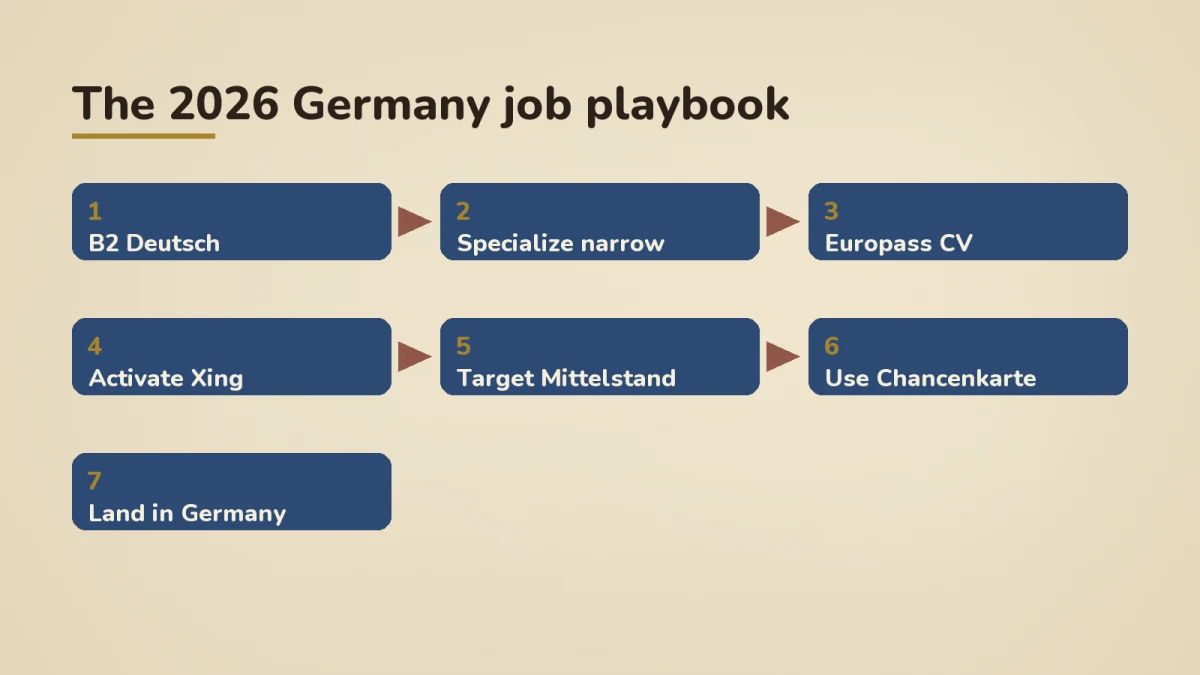
These are the moves with evidence behind them, ordered by impact.
- Get to B2 German, then put it on every line that matters. Roughly 65 percent of employers across all sectors now require B2 minimum. Healthcare, public sector, and most Mittelstand roles require B2 in writing. English-only roles exist mainly in Berlin tech, scientific research, and large multinational subsidiaries, but they are oversubscribed. See our German language guide.
- Specialize narrow, prove it deep. Generalists lose. A backend engineer with three years of Kubernetes plus security plus a public GitHub gets shortlisted; a "full-stack developer" CV does not. Same logic for data ("ML ops in regulated industries"), engineering ("functional safety, ISO 26262"), or business roles ("ESG reporting under CSRD").
- Use a Europass CV with a photo, project-focused. Yes, photo. The German market expects it. One page if early career, two pages if senior. Lead with measurable outcomes, not responsibilities. The Europass template is free at europa.eu/europass.
- Activate XING, not just LinkedIn. XING has roughly 22 million DACH users versus LinkedIn's smaller German share, and Mittelstand recruiters live there. Same profile, German if you can write it. Connect with alumni from any German university you have a tie to (DAAD, exchange, summer school, partner university).
- Target the Mittelstand and second-tier cities. Leipzig, Dresden, Jena, Aachen, Erlangen, Stuttgart's outskirts, the Ruhr area. Rents are 30 to 50 percent lower than Munich. Salary bands are 10 to 20 percent lower but real disposable income is meaningfully higher. The hiring queue is shorter.
- Use the Chancenkarte if you do not have an offer yet. Germany's points-based job-seeker route launched in 2024 lets qualified candidates enter for up to twelve months specifically to look for work. If you score the threshold (degree plus age plus German plus experience), this is the cleanest entry path. Read the Chancenkarte breakdown before applying.
- Show German ties early. Anmeldung, a German bank account, a Steuer-ID, an Anabin recognition for your degree, and a landed Aufenthaltstitel all reduce hiring friction. A candidate already in Hamburg with paperwork sorted is hired before a candidate in Bangalore who needs visa sponsorship, even at the same skill level.
Common mistakes to avoid
Most rejected applications fail on the same six patterns. Cut these and your interview rate jumps.
- Mass-applying to the same fifteen brand-name companies. Same pool, same outcome. Trade BMW for ZF Friedrichshafen, SAP for Software AG or DATEV, McKinsey for a regional Mittelstand consultancy. The pay is competitive and the queue is shorter.
- Refusing to commit to German. "I can learn it once I arrive" is a real signal that you will not. Get to A2 before you apply, B1 before you interview, B2 within twelve months of arrival. Put the certificate on the CV.
- A cluttered LinkedIn and an empty XING profile. The German recruiter looks at XING first. If your XING is blank, you are invisible to half the market.
- Translating your CV literally. German CVs are concise, formatted, and photo-bearing. Cover letters are formal and structured (Anrede, opening paragraph, three substance paragraphs, closing). Copy the format from a German-language sample, do not invent your own.
- Negotiating relocation help upfront. Bring it up after the offer, not in the first call. Asking for sponsorship, relocation, and visa help on round one tells the recruiter you cost more to onboard than the next applicant.
- Ignoring the works council role. Larger firms have a Betriebsrat that meets candidates after the manager round. Treat it as a real interview. Do not improvise on questions about overtime, work-from-home expectations, or trade-union representation.
How long should the search actually take
Realistic 2026 timelines, assuming reasonable preparation:
- IT and engineering, with B2 German and an in-country address: 3 to 5 months from first application to signed contract.
- IT and engineering, abroad with English-only: 6 to 9 months, much depends on visa pathway.
- Healthcare, with credential recognition completed and B2 German: 2 to 4 months. Recognition itself takes 4 to 12 months and is the bottleneck.
- Skilled trades and Mittelstand technical roles via Ausbildung: 4 to 8 months including school placement.
- Generalist business and marketing roles, English-only: 9 to 18 months, oversubscribed.
If you are still abroad and your search has run past 9 months without a single second-round interview, the bottleneck is almost always one of: missing B2 German, unrecognised degree (no Anabin entry), or applying to roles where the visible market is the wrong half. Fix that before sending more applications.
FAQ
How long does it actually take to find a job in Germany in 2026?
For tech, engineering, and healthcare candidates with B2 German and in-country status, three to five months is realistic. For English-only candidates abroad, six to nine months is more typical. Bitkom's 2025 figure put the average IT vacancy at 7.7 months from posting to fill, so even a successful candidate is competing in a slow funnel. The hiring cycle stretched permanently after 2022.
Do I really need German to get a job in Germany?
For most jobs, yes. Roughly 65 percent of employers across sectors now require B2 minimum, and that number is closer to 90 percent in healthcare, public sector, and Mittelstand technical roles. English-only positions exist in Berlin tech, large multinational subsidiaries, and scientific research, but they are oversubscribed. Get to B2 before arrival or commit to a fast track inside Germany.
What jobs are in highest demand in Germany in 2026?
The Bundesagentur für Arbeit's Mangelberufe list has 163 shortage occupations spanning IT (cloud, cybersecurity, AI/ML, SAP), healthcare (doctors, nurses, geriatric care, physiotherapy), skilled trades (electrical, mechatronics, HVAC, welding), engineering (mechanical, automotive, renewable energy), and education (kindergarten teachers, eldercare). Statista reported 628,629 total open vacancies across the German economy in early 2026.
Is it true that 50 to 70 percent of jobs in Germany are filled through referrals?
Yes, with caveats. Industry HR surveys consistently put the share filled internally, through referrals, or via pre-arranged candidates in the 50 to 70 percent range. The number depends on company size and sector. Mittelstand firms skew higher; large public-sector employers skew lower because formal posting is mandatory. The practical implication is the same: spend half your search time on referral-building, not just on portals.
What is the Chancenkarte and is it worth applying?
The Chancenkarte (Opportunity Card) is Germany's points-based job-seeker visa, launched in June 2024. It lets qualified non-EU candidates enter for up to twelve months specifically to look for work. You need to clear a points threshold combining degree, age, German language level, and experience. It is the cleanest entry path if you do not yet have an offer. Full breakdown in our Chancenkarte guide.
Should I move to Germany without a job offer?
Only if you can self-fund six to twelve months of living costs and you have either Chancenkarte eligibility or a strong reason to be in country (recognised degree, healthcare credential, niche tech skill, prior visit visa). The hidden-market argument means in-country candidates outcompete abroad candidates at the same skill level. If you can fund the gap, presence is a real edge. If not, build the offer first.
How do I actually access the Mittelstand from outside Germany?
Three steps. First, identify firms via Familienunternehmen rankings, IHK directories, and industry association member lists (VDMA, ZVEI, Bitkom). Second, profile their LinkedIn pages and XING company pages; identify the hiring manager directly, not the HR generalist. Third, apply with a German-format CV plus a brief cover letter in German if you have B1 or higher (English-only is acceptable for tech roles at export-led Mittelstand). Expect a longer cycle than tech-startup hiring but a higher probability of getting through.
What salary should I expect as a foreign candidate?
Median monthly gross was EUR 4,177 for German nationals versus EUR 3,204 for foreign nationals in late 2024 Bundesagentur data. The gap closes meaningfully with B2 German and a recognised local degree. Use the Bundesagentur Entgeltatlas, IG Metall agreements, Kununu, and Glassdoor Germany to anchor your number for your role and region. See our German payscale guide for sector-by-sector ranges.
Where to next
Continue reading
Career & Jobs·14 min read
Why Germany has 1M jobs and zero callbacks (and how to fix your application)
Germany has over 1 million open jobs but most foreign applicants get silence. Here is why your applications fail and how to fix the stack.
Read articleCareer & Jobs·15 min read
Chancenkarte Germany: Point system explained, real one-year results, who actually got in
Germany's Chancenkarte point system explained with a 6-point matrix, worked examples, and real one-year results from 2024 to 2025.
Read articleCareer & Jobs·11 min read
International student work rules Germany 2026: The new 140-day cap, 20-hour rule, real take-home pay
Germany raised the international student work cap to 140 full days from 2024. Werkstudent rules, the 20-hour weekly limit, and 2026 take-home pay explained.
Read articleReady to plan your Germany journey?
Explore our tools and resources to find the perfect university and program for your academic goals.