Minimum wage Germany 2026: the new hourly rate, mini-job changes, and what international students earn
Germany's 2026 statutory minimum wage increase, what it means for mini-jobs, Werkstudent roles, and how international students should think about pay.

Table of contents
Last updated: May 2026
TL;DR: Germany raised its statutory minimum wage to EUR 13.90 per hour on 1 January 2026, up from EUR 12.82. The mini-job ceiling moved with it to EUR 603 per month, the 140-day rule for international students is now fully in effect, and the next legal step is EUR 14.60 per hour from 1 January 2027.
If you work in Germany on any contract, the floor under your hourly rate just moved up. The 2026 increase is the largest single nominal jump since 2022, and it pulls a long list of secondary thresholds with it: the mini-job earnings cap, the gleitzone for midi-jobs, the legal floor for voluntary internships longer than three months, and the practical math of how many hours a Werkstudent role can run before tax kicks in. None of the rules around international students changed in 2026, but the same 20 hours per week now produces meaningfully more take-home pay.
This guide covers what the new minimum wage is, what it changed for mini-jobs and Werkstudent roles, and how it interacts with the 140-day annual work cap for non-EU students. For the wider picture on student employment options, see our deep dive on part-time jobs, mini-jobs and Werkstudent roles for international students.
What is the new minimum wage in Germany for 2026?
Germany's statutory minimum wage (Mindestlohn) is EUR 13.90 per hour gross, effective 1 January 2026. It applies to almost every employment relationship in the country regardless of nationality, residence permit, employer size, or sector. The Mindestlohn-Kommission, the independent body that recommends adjustments, set this figure in June 2025, and the federal government wrote it into law.
Two more numbers worth pinning down:
- The previous rate was EUR 12.82 per hour (in effect through 31 December 2025). The 2026 jump of EUR 1.08 is the largest single increase since the EUR 12 floor was introduced in October 2022.
- The next scheduled rise is EUR 14.60 per hour from 1 January 2027, also already locked in.
Sector minimum wages (Branchenmindestlöhne) negotiated by collective bargaining can sit above the statutory floor. Construction, care work, and electrical trades, for example, have higher mandatory floors. The statutory minimum is the absolute lower bound; sector rules can only push it up, never below.
What changed for mini-jobs in 2026?
A mini-job (geringfügige Beschäftigung) is the entry-level employment contract that lets you earn a small amount tax-free while the employer pays a flat 30 percent of payroll into pension, health, and tax. The mini-job ceiling is now legally tied to the minimum wage, so it moves whenever the wage moves.
| Year | Hourly minimum wage | Mini-job monthly cap | Annual cap |
|---|---|---|---|
| 2024 | EUR 12.41 | EUR 538 | EUR 6,456 |
| 2025 | EUR 12.82 | EUR 556 | EUR 6,672 |
| 2026 | EUR 13.90 | EUR 603 | EUR 7,236 |
| 2027 (locked) | EUR 14.60 | EUR 633 | EUR 7,596 |
The math behind the EUR 603 figure is simple: 43.4 hours per month at EUR 13.90 lands just under the cap. If you earn more than EUR 13.90 per hour (most Werkstudent roles do), the same EUR 603 ceiling means fewer hours, not more pay.
A mini-job is tax-free for the employee. The employer pays:
- 15 percent into the pension scheme (Rentenversicherung)
- 13 percent into statutory health insurance (Krankenversicherung) for non-students
- 2 percent flat-rate income tax (Pauschalsteuer)
You can opt out of the personal pension contribution, but the default is in. If you cross EUR 603 in any single month, the contract automatically converts to a midi-job, with social-security contributions phased in across the gleitzone (EUR 603.01 to EUR 2,000 per month).
How much can international students earn in 2026?
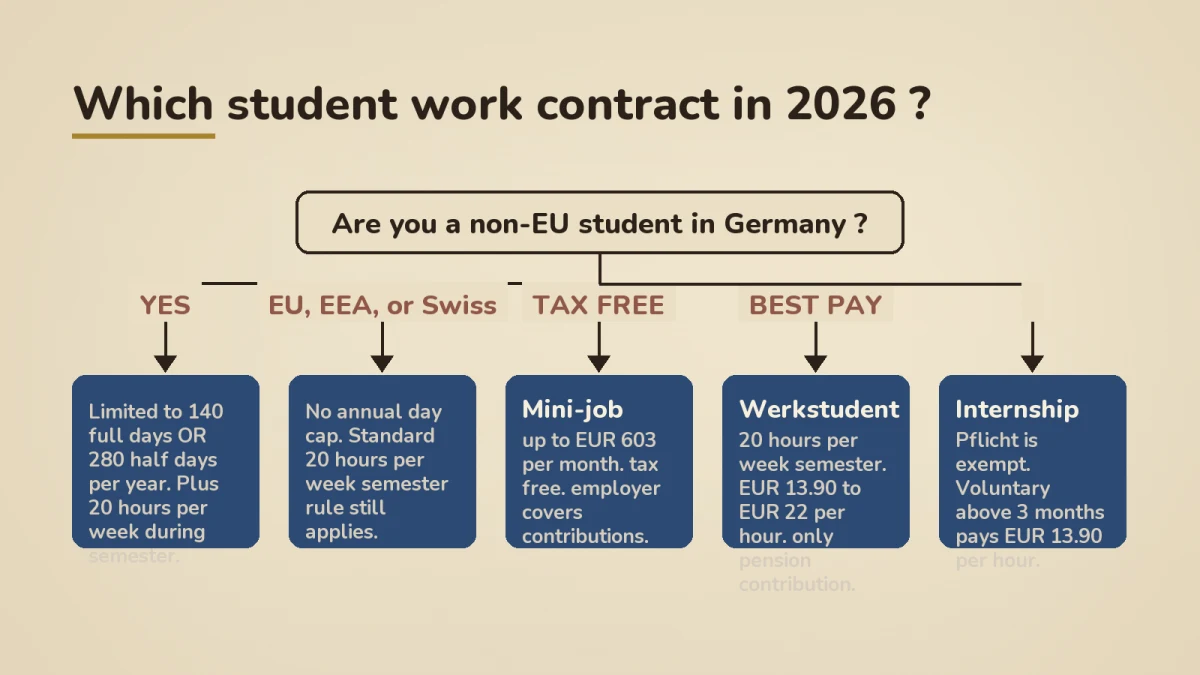
Three things matter for any international student looking at Germany's 2026 wage rules: the 20-hour-per-week semester rule that protects student status, the 140-day annual cap that replaced the older 120-day rule, and the Werkstudent privilege that exempts you from most social contributions if both above are satisfied.
Werkstudent (working-student role)
A Werkstudent contract caps you at 20 hours per week during semester. There is no upper limit on hourly pay. At the legal floor of EUR 13.90 per hour, 20 hours per week works out to roughly EUR 1,112 per month (4 weeks). At market rates for tech, engineering, or business roles, EUR 15 to EUR 22 per hour is normal, which lands you at EUR 1,200 to EUR 1,760 per month. Exam weeks and short months pull the average down slightly.
While you hold student status and stay within 20 hours per week, you only pay pension contribution (around 9.3 percent of gross). Health, unemployment, and long-term-care insurance contributions are waived. Income tax only kicks in if you cross the Grundfreibetrag of EUR 12,348 per year (2026 figure).
Mini-job for students
If your schedule cannot accommodate a Werkstudent contract, a mini-job at EUR 603 per month is the alternative. Tax-free, no social contributions for you, no income-tax declaration required. The trade-off: at the 2026 floor of EUR 13.90 per hour, you get about 43 hours of work each month before the cap stops you.
Two mini-jobs at the same time is legal but the ceiling combines. If both contracts together pay more than EUR 603 per month, the second one converts to a midi-job and pulls social-security contributions in. Most students stick to a single mini-job to keep the math clean.
The 140-day rule
The Skilled Immigration Act, in full effect across 2026, raised the annual full-day work cap for international (non-EU) students from 120 to 140 full days, or 280 half days, per calendar year. A "full day" is anything more than four hours; a "half day" is four hours or less. The semester 20-hour rule still applies in parallel: during teaching weeks, you stay under 20 hours per week regardless of how many days you have left in your annual budget.
The 140-day cap mostly bites during the semester break, when students are tempted to work full-time for six to eight weeks. Crossing it is a residence-permit issue, not just a tax one, so the Auslanderbehorde takes it seriously.
What does this mean for internships?
Internships in Germany split into two legal categories with very different rules:
- Pflichtpraktikum (mandatory internship required by your study programme): no minimum wage requirement, no duration cap on legal-floor pay, and does not count toward the 140-day annual work cap. Most reputable employers still pay EUR 800 to EUR 1,800 per month for mandatory internships, but the legal floor is zero.
- Voluntary internship: minimum wage (EUR 13.90 per hour for 2026) is mandatory once duration exceeds three months. Voluntary internships do count against the 140-day cap, and the daily-rate pay is treated like any other employment.
For longer voluntary internships, the math is straightforward. A six-month full-time voluntary internship at the 2026 floor pays roughly EUR 2,224 per month gross (40 hours per week at EUR 13.90), before tax and social contributions. Mandatory internships of similar duration land in the EUR 1,000 to EUR 2,000 range depending on sector and employer.
Always confirm in writing whether the role is Pflicht- or voluntary before signing. The contract type drives every other rule (see internship opportunities for international students for sector-by-sector pay benchmarks).
How the new wage affects your taxes and insurance
The threshold map for 2026 looks like this:
- Mini-job (up to EUR 603 per month): tax-free for you. Employer pays the flat contributions.
- Midi-job gleitzone (EUR 603.01 to EUR 2,000 per month): social contributions ramp up gradually rather than jumping at the boundary. This is helpful for Werkstudent roles that briefly cross the mini-job ceiling.
- Werkstudent under 20 hours per week, student status valid: only pension contribution (around 9.3 percent of gross) regardless of monthly earnings.
- Annual income above EUR 12,348 (Grundfreibetrag): income tax applies. File an Einkommensteuererklarung at year end. Most students under EUR 12,348 get back any wage tax that was withheld during the year.
If you hold a regular employment contract above EUR 2,000 per month, normal income-tax classes (Lohnsteuerklassen) and full social contributions apply. For most international students this only happens during semester-break full-time stretches or after graduation.
For the broader tax picture, see paying taxes in Germany as an international student.
Sector pay benchmarks for 2026
The minimum wage is the floor. Most jobs that international students actually take pay above it. Here is what the 2026 market looks like:
| Role | Typical hourly (gross) | Monthly at 20 hrs/wk |
|---|---|---|
| Cafe / restaurant server | EUR 13.90 to EUR 15 | EUR 1,112 to EUR 1,200 |
| Retail (cashier, stocking) | EUR 13.90 to EUR 14.50 | EUR 1,112 to EUR 1,160 |
| Delivery rider (Lieferando, Wolt) | EUR 13.90 plus tips | EUR 1,112 and up |
| HiWi (university research / teaching assistant) | EUR 13 to EUR 15 | EUR 1,040 to EUR 1,200 |
| Tutoring (school subjects, German A1 to B1) | EUR 18 to EUR 30 | EUR 1,440 to EUR 2,400 |
| Werkstudent IT / engineering | EUR 15 to EUR 22 | EUR 1,200 to EUR 1,760 |
| Werkstudent finance / consulting | EUR 17 to EUR 25 | EUR 1,360 to EUR 2,000 |
| Translation / freelance project | EUR 15 to EUR 40 | varies by project |
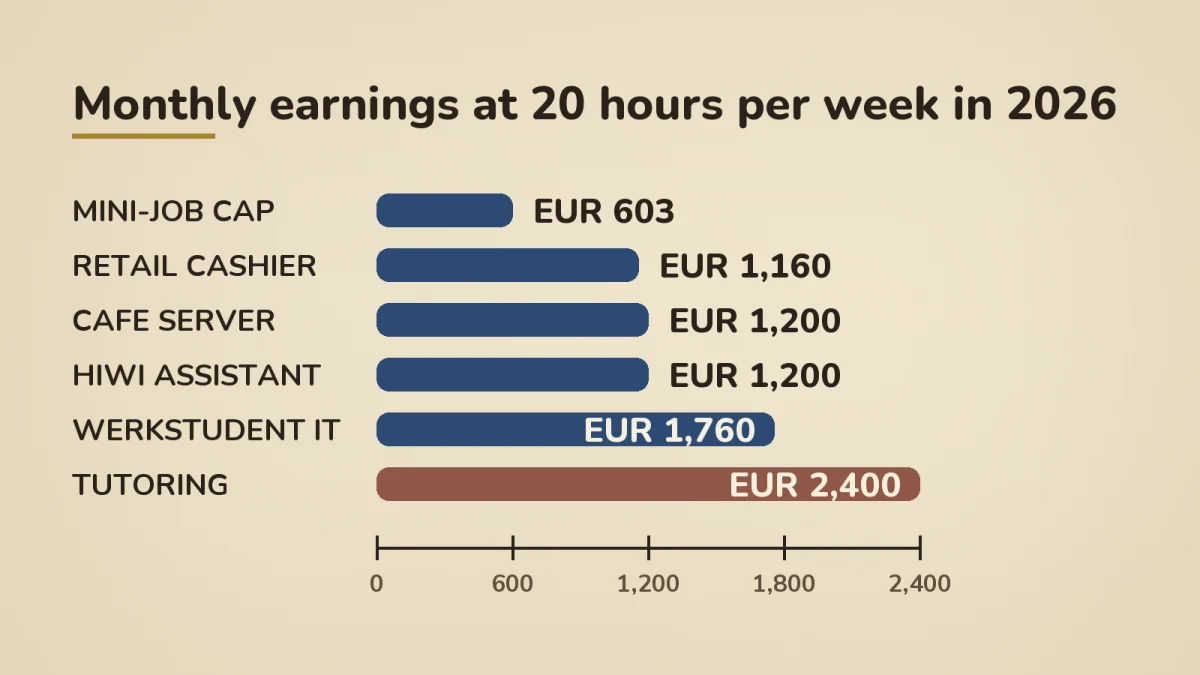
A few things worth flagging in this table. HiWi roles at universities sometimes pay below the federal minimum wage if they are structured as scholarships rather than employment contracts, but most are now realigned at or above EUR 13.90. Tutoring at the higher end usually requires a B2 or C1 German level. Werkstudent roles in tech remain the highest-yielding option for any student with a relevant degree path.
For city-by-city living-cost context, see our cost of living in Germany guide. The short version: in 2026, EUR 1,200 per month covers basic costs in most German cities, EUR 1,500 covers comfortable living in Munich and Frankfurt.
Common mistakes
- Treating EUR 603 as an hours cap. It is a euro cap. If you earn more than EUR 13.90 per hour, you work fewer hours to stay inside it.
- Stacking two mini-jobs. Ceilings combine. If the total exceeds EUR 603 per month, both contracts convert to social-security territory.
- Ignoring the 20-hour rule during exam weeks. The rule protects student status. Breaching it forces Werkstudent into regular employment, which means full social contributions and a tax class change.
- Taking a voluntary internship over three months without checking pay. The minimum wage applies from day 1 once duration crosses three months. Some employers still write contracts assuming the old rule.
- Forgetting the annual tax declaration. If you cross EUR 12,348 in a calendar year, file a return. If you stayed under, file anyway: most students get back any wage tax that was withheld at source.
- Confusing Pflicht and voluntary internship for the 140-day cap. Mandatory internships are exempt; voluntary internships count.
- Working at below EUR 13.90 per hour and not reporting it. The Zoll (customs authority) enforces the minimum wage. Employer fines run up to EUR 500,000. You report by phone or via the FKS (Finanzkontrolle Schwarzarbeit) online portal. Wages are recoverable retroactively.
FAQ
Is the EUR 13.90 minimum wage gross or net?
Gross. Mini-job earnings under EUR 603 per month are effectively tax-free at the employee level (employer pays a flat contribution), but Werkstudent and regular employment income above the relevant thresholds is subject to pension contributions and, above EUR 12,348 per year, income tax.
Does the minimum wage apply to international students?
Yes. The federal minimum wage applies regardless of nationality or visa status. Mandatory internships (Pflichtpraktikum) are the main legal carve-out, and voluntary internships under three months are exempt.
Can I work more than 20 hours per week if I take a higher-paying job?
Not during the semester. The 20-hour-per-week rule protects your student social-security status and your residence permit conditions. You can work full-time during semester breaks within the annual 140-day cap.
How is the mini-job EUR 603 number calculated?
It is set at 43.4 hours per month at the current minimum wage (43.4 times EUR 13.90 equals just under EUR 603), rounded to a clean euro figure that the Minijob-Zentrale publishes. The cap auto-adjusts every time the minimum wage moves.
Will the minimum wage rise again in 2027?
Yes. The Mindestlohn-Kommission has already locked in EUR 14.60 per hour from 1 January 2027. The mini-job ceiling will move with it, projected at around EUR 633 per month.
Does my paid internship count against the 140-day rule?
Voluntary internships count. Mandatory (Pflicht) internships do not, regardless of duration. Always check the contract type before signing.
I am a Werkstudent earning EUR 15 per hour. Do I pay tax?
Pension contribution at around 9.3 percent of gross applies from the first euro you earn. Income tax only kicks in if your annual gross crosses EUR 12,348 (the 2026 Grundfreibetrag). Most Werkstudenten do not cross that line during the academic year alone.
What if my employer pays below EUR 13.90 per hour?
Report it to the Zoll (Finanzkontrolle Schwarzarbeit). Employers face fines up to EUR 500,000 and back-pay obligations. You do not lose your residence permit or student status by reporting; the employer carries the legal exposure.
How does the 2026 increase affect Blue Card salary thresholds?
It does not directly. Blue Card thresholds are tied to gross annual salary, not hourly minimum wage. For 2026, the standard threshold is EUR 50,700 per year and the shortage-occupation threshold is EUR 45,934.20 per year. See our EU Blue Card guide for the full breakdown.
Where to next
Continue reading
Career & Jobs·10 min read
Payscale in Germany: Average Gross Remuneration by Profession and Region
Discover the average gross remuneration in Germany by profession and region. Learn how much you can earn as a student or professional and work out your ROI. Explore the payscale in Germany and make an informed decision for your higher studies.
Read articleCareer & Jobs·15 min read
Chancenkarte Germany: Point system explained, real one-year results, who actually got in
Germany's Chancenkarte point system explained with a 6-point matrix, worked examples, and real one-year results from 2024 to 2025.
Read articleCareer & Jobs·14 min read
Why Germany has 1M jobs and zero callbacks (and how to fix your application)
Germany has over 1 million open jobs but most foreign applicants get silence. Here is why your applications fail and how to fix the stack.
Read articleReady to plan your Germany journey?
Explore our tools and resources to find the perfect university and program for your academic goals.