International student work rules Germany 2026: The new 140-day cap, 20-hour rule, real take-home pay
Germany raised the international student work cap to 140 full days from 2024. Werkstudent rules, the 20-hour weekly limit, and 2026 take-home pay explained.

Table of contents
Last updated: May 2026
TL;DR: International students in Germany can now work 140 full days (or 280 half days) per calendar year, up from 120 / 240. The 20-hour weekly cap during the semester still applies. At the 2026 minimum wage of EUR 13.90/hour, a Werkstudent on a full 20-hour week grosses around EUR 1,205 a month, and a mini-jobber maxes out at EUR 603/month tax-free. This guide walks through every rule, the new insurance trap caused by the higher Mindestlohn, and a real take-home calculation for each work model.
If you are studying in Germany on a residence permit issued under §16b AufenthG, you are allowed to earn alongside your degree. The rules changed in 2024 and the numbers behind them changed again in 2026. The 140-day annual cap is now the most generous student work allowance in the EU, but the 20-hour semester rule, the new minimum wage, and the Werkstudent insurance threshold create real edge cases that catch students out every semester.
This post is the deep-dive companion to our student jobs pillar and our older working student overview, refreshed for the 2026 numbers. If you are still costing the move, our cost-to-study guide sits alongside it.
How many days can an international student work in Germany in 2026?
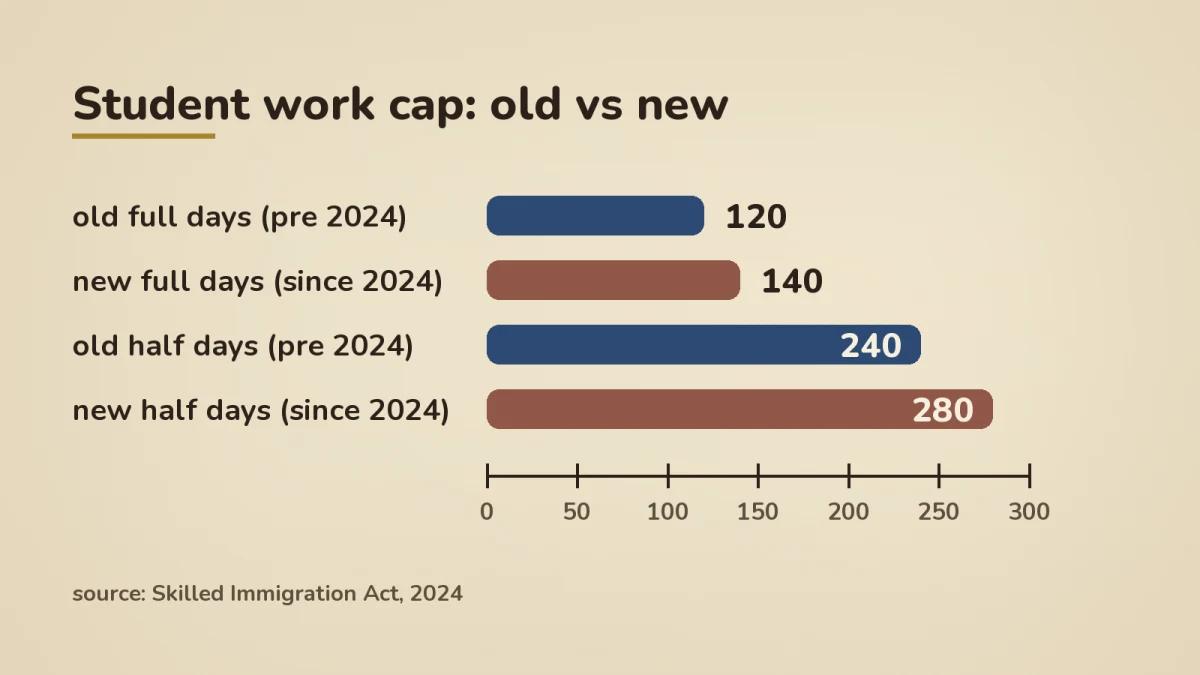
You can work 140 full days or 280 half days per calendar year as a non-EU international student on a §16b student residence permit. A full day is anything over 4 hours of paid work; a half day is 4 hours or less. The cap resets on 1 January.
This was raised in the 2024 round of the Skilled Immigration Act (Fachkräfteeinwanderungsgesetz) from the previous 120 / 240 limit. The change is permanent and applies to every non-EU student already in Germany, not just new arrivals.
EU and EEA students do not have a federal day cap at all; they fall under the Werkstudentenprivileg directly and are limited only by the 20-hour-per-week semester rule and the working-student insurance ceiling.
The 20-hour-per-week semester rule still applies
The 140-day annual cap is the outer limit. Under §16b(3) AufenthG, the immigration limit is a day account of 140 working days a year, where a day with up to four hours of work can count as a half day (so up to 280 half days), and a calendar week with up to 20 hours of work during lectures can be counted as 2.5 days. The 20-hour week is the line for the Werkstudentenprivileg: you keep the working-student social-insurance privileges only while you work no more than 20 hours a week, apart from limited exceptions such as semester breaks.
Outside lecture-free periods, including the long semester break (Semesterferien), you can work full-time, up to 40 hours per week, as long as you stay inside the 140-day annual ceiling.
Two practical consequences:
- Counting days, not hours. The 140-day cap counts days you actually worked, not contracted days. A Friday-only Werkstudent contract running for 30 weeks counts as 30 days, not 30 weeks. A full-time semester-break job counts every working day.
- The clock is calendar-year, not academic-year. A Werkstudent contract that crosses 31 December resets on 1 January. Plan accordingly.
What you actually earn at the new minimum wage
The federal Mindestlohn rose to EUR 13.90 per hour on 1 January 2026 (up from EUR 12.82). It rises again to EUR 14.60 on 1 January 2027. Every job, including mini-jobs and Werkstudent roles, must pay at least this rate. Many tech and engineering employers already pay EUR 16 to EUR 25 an hour for student roles, especially in Munich, Frankfurt, and Hamburg.
Three work models, three very different take-home outcomes:
| Model | Hours allowed | Gross/month at min. wage | Social contributions | Take-home/month |
|---|---|---|---|---|
| Mini-job | flexible, capped at EUR 603/month | up to EUR 603 | none for the student (employer pays flat 30%) | EUR 603 |
| Werkstudent during semester | up to 20 hrs/week | EUR 1,205 (20 x 4.33 x 13.90) | ~9.3% pension only | ~EUR 1,093 |
| Werkstudent during semester break | up to 40 hrs/week | up to EUR 2,409 | full social contributions if over 26 weeks/year | ~EUR 1,750 |
The mini-job ceiling auto-indexes to 130 times the hourly minimum wage, which is why it landed at exactly EUR 603 in 2026. If the Mindestlohn-Kommission raises the wage again, the mini-job ceiling moves with it.
Mini-job: the EUR 603 line
A mini-job is the cleanest option for a student: no income tax for the worker, no health or unemployment insurance contributions, just a 3.6% pension contribution that you can opt out of. Cross EUR 603 in any single month and the contract automatically converts to a Midijob (transition zone), and you start paying graduated social contributions on the surplus.
A mini-job at EUR 13.90 means roughly 43 hours per month. That is six 7-hour Saturdays or 11 hours a week. Most retail, hospitality, and tutoring contracts you will see at the Studentenwerk job board are structured this way.
Werkstudent: 20 hours, 9% pension, full health cover stays free
A Werkstudent contract is the gold standard for international students because it preserves the Werkstudentenprivileg: you keep public student health insurance (about EUR 141 to EUR 146 a month at TK in 2026) instead of the regular employee rate, and you skip health, long-term care, and unemployment contributions on the salary. You only pay the pension share (around 9.3%).
At 20 hours a week and EUR 13.90 an hour, gross is roughly EUR 1,205 a month. Pension contribution is around EUR 112. Take-home is roughly EUR 1,093, which covers most of the Studentenwerk's reference budget for cost-of-living in mid-tier German cities.
Semester break: 40 hours, but watch the 26-week ceiling
In the lecture-free period you can scale up to 40 hours a week. You stay inside the Werkstudentenprivileg as long as your 20+ hours/week phase does not exceed 26 weeks (182 days) in any rolling 12-month window. Cross 26 weeks of full-time-equivalent work and the tax office reclassifies you as a regular employee for that period, full health and unemployment contributions apply, and your student health insurance can be retroactively adjusted.
The Werkstudent insurance trap caused by the 2026 wage hike
This is the change nobody flagged at the start of 2026 and it is biting students hard.
The 20-hours-per-week cap and the 26-week annual ceiling have not changed. The hourly rate has. At EUR 12.82 in 2025, a 20-hour Werkstudent grossed EUR 1,111 a month. At EUR 13.90 in 2026, the same contract grosses EUR 1,205. That EUR 94 nominal pay rise pushes more students past internal university payroll thresholds and into mandatory income-tax withholding. It also increases the absolute pension contribution.
Practical impact:
- If you previously sat just below the mini-job ceiling, the 2026 hike will tip you over unless your hours drop. Renegotiate hours with your employer before January, or expect the contract to convert to a Midijob.
- If you have multiple part-time jobs, the hours and earnings are aggregated for the Werkstudent test. Two 12-hour-a-week jobs is 24 hours and you lose the privilege.
- Tax filing is now genuinely worth doing. Most international students who file an annual Steuererklarung get back the income tax that was withheld monthly because their annual income falls under the Grundfreibetrag (EUR 12,348 for 2026). Free apps like Taxfix or SteuerGo file it in under an hour.
Work that does not count toward the 140-day cap
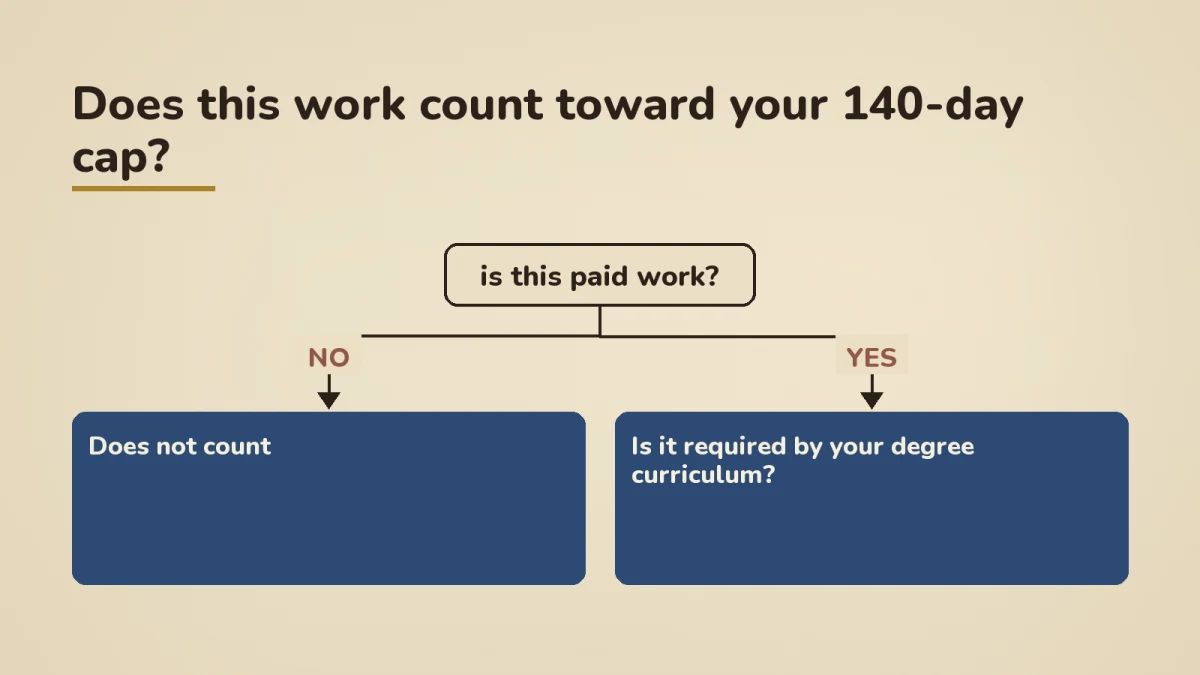
Not every paid activity eats into your annual budget. The Ausländerbehörde excludes the following from the 140-day count:
- Mandatory internships that are part of your degree's Studienordnung (curriculum). The internship contract has to be officially required by your faculty.
- Hilfskraft / wissenschaftliche Hilfskraft roles at your own university, including teaching assistant, research assistant, lab tutor, and library shifts. Some immigration offices in smaller cities still apply the cap to these; ask before you sign.
- Self-employed academic work for your own university (rare, usually scientific freelance work tied to a chair).
- Volunteer work, as long as no salary is paid. Reimbursement of expenses is fine.
Anything not on this list, including unpaid-but-perks-laden roles where you receive a "stipend", is treated as work and counts.
How to track your days and stay clean with the Ausländerbehörde
The 140-day count is enforced through your residence-permit conditions, which is why every Werkstudent contract gets cross-checked when you renew or extend.
Three habits keep you out of trouble:
- Keep a running log. A simple spreadsheet with date, employer, hours, and over/under 4 hours per day is enough. Every Werkstudent timesheet your employer files in DEUEV social-security reporting is visible to the Ausländerbehörde when they audit.
- Cap your contracts on paper. If your employer offers 25 hours during semester, sign for 20 in writing and bank the rest in the semester break. The contract is what gets audited; informal extras are a permit risk.
- File for permission if you go over. Going over 140 days is not automatic deportation, but it requires written permission from the Ausländerbehörde and the local Bundesagentur für Arbeit. Apply before, not after.
If you are still in the visa-application phase, our residence-registration walkthrough covers the Anmeldung you do in your first two weeks; the work permission sits inside the same residence permit.
Common mistakes that cost students their Werkstudent status
- Stacking a Werkstudent role on top of a mini-job and forgetting that hours aggregate. Twenty hours plus four hours equals 24 hours; the privilege is gone.
- Letting the employer record more than 4 hours on a "half day" without realising it converts to a full day.
- Working a paid summer internship that is not formally part of the curriculum and burning 60 days of the cap before the autumn semester even starts.
- Failing to switch to the regular employee health insurance when you graduate. The Werkstudentenprivileg ends the moment you finish your final exam (or your enrollment ends), not at the date your residence permit converts.
FAQ
Can international students work full-time in Germany during the semester?
No. During lecture periods, the 20-hour-per-week cap applies regardless of how many days you have left in your annual 140-day budget. Full-time work is only allowed in lecture-free periods (Semesterferien) and is bounded by the 140-day annual cap and the 26-week working-student insurance ceiling.
Has the 120-day rule for international students been replaced?
Yes. The Skilled Immigration Act stage that took effect on 1 March 2024 replaced the 120 full days / 240 half days cap with 140 full days / 280 half days. Every German consulate, university, and Ausländerbehörde uses the new numbers. Older guides still circulating online with the 120 figure are out of date.
What is the minimum wage in Germany for students in 2026?
EUR 13.90 per hour, the same as for any worker. It rose from EUR 12.82 on 1 January 2026 and will rise again to EUR 14.60 on 1 January 2027. Many tech, engineering, and consulting employers pay students EUR 16 to EUR 25 an hour, well above the floor.
How much can I earn from a mini-job per month in 2026?
Up to EUR 603 per month, tax-free. Above that the contract converts to a Midijob (transition zone) and graduated social contributions apply. The mini-job ceiling is auto-indexed to 130 times the hourly minimum wage, so it changes whenever the Mindestlohn changes.
Do mandatory internships count toward the 140-day work cap?
No. Internships that are formally required by your degree's Studienordnung are excluded. Voluntary internships, even if your professor recommends them, do count. The deciding document is your faculty's official curriculum handbook, not the internship contract.
How does the 26-week Werkstudent ceiling work?
You can work more than 20 hours a week (up to 40) in lecture-free periods without losing the Werkstudent insurance privilege, but only for up to 26 weeks (182 days) in any rolling 12-month window. Past 26 weeks of 20+ hours, you are reclassified as a regular employee and full social contributions kick in for the over-cap period.
Can I freelance as an international student in Germany?
Only with explicit written permission from the Ausländerbehörde. The standard student residence permit allows employed work and certain academic-assistant roles by default; freelance and self-employment require an extra permission, granted case by case and usually only for academic side work tied to your university.
Do I need to file a tax return as a working student?
Not always required, but almost always worth it. If you earned less than the Grundfreibetrag (EUR 12,348 for 2026), you owe no income tax and you get back any tax that was withheld monthly. Free German apps like Taxfix, SteuerGo, and Wundertax file the entire Steuererklarung in under an hour, in English.
Where to next
Continue reading
Career & Jobs·15 min read
Chancenkarte Germany: Point system explained, real one-year results, who actually got in
Germany's Chancenkarte point system explained with a 6-point matrix, worked examples, and real one-year results from 2024 to 2025.
Read articleCareer & Jobs·14 min read
Why Germany has 1M jobs and zero callbacks (and how to fix your application)
Germany has over 1 million open jobs but most foreign applicants get silence. Here is why your applications fail and how to fix the stack.
Read articleCareer & Jobs·14 min read
EU Blue Card Germany 2026: New salary thresholds, IT-without-degree route, faster PR
EU Blue Card Germany 2026 thresholds raised to €50,700 standard and €45,934.20 shortage. IT specialists qualify without a degree under §18g. PR in 21 months at B1, spouse joins with no German required. Full guide for working professionals.
Read articleReady to plan your Germany journey?
Explore our tools and resources to find the perfect university and program for your academic goals.