Werkstudent jobs in Germany 2026: Hours, salary, and the insurance traps to avoid
Werkstudent jobs in Germany 2026: 20-hour cap, EUR 1206 monthly pay at the new minimum wage, and the insurance traps that catch international students.

Table of contents
Last updated: May 2026
TL;DR: A Werkstudent in 2026 earns roughly €1,206/month at 20 hours per week, stays exempt from health, unemployment, and long-term care insurance during the lecture period, and pays only pension contribution. The catch: cross 20 hours for one week and the Werkstudentenprivileg falls apart, full social-insurance contributions kick in, and your visa hour budget shrinks. Read the rules before signing the contract.
The Werkstudent (working student) job is the single best paid-work category for international students in Germany. It pays better than a Mini-Job, gives you actual industry experience, and keeps your social-insurance bill small. But the rules around it changed in feel, not in letter, on January 1, 2026. The statutory minimum wage moved to €13.90 per hour, every working student took an automatic pay rise, and the math around the 20-hour weekly cap got tighter. This guide lays out what changed, what stayed the same, and which traps catch international students every year.
If you are still mapping the broader student jobs landscape, start there. This post focuses on the Werkstudent contract specifically. For the wider picture across part-time, mini-job, paid internships, and working-student roles, we have a separate explainer.
What is a Werkstudent and why does the privilege matter
A Werkstudent is a student in higher education who works alongside their studies under a special social-insurance status called the Werkstudentenprivileg (Section 6, Paragraph 1, Number 3 of SGB V). The privilege exempts the role from health, unemployment, and long-term care insurance contributions while you stay under 20 hours per week during the lecture period. You only pay statutory pension insurance.
Two conditions must hold: you are enrolled at a recognised university, and your studies are your primary occupation. The job has to fit around the studies, not the other way round. The employer pays no contribution to health, unemployment, or care insurance for you either, which is why a Werkstudent is cheaper for the company than a regular employee on the same hourly wage.
In 2026 the privilege saves a typical international student between €250 and €350 per month compared to a regular part-time employment contract on the same hours. That is not a minor optimisation. It is the entire reason this category exists.
How many hours can you actually work in 2026?
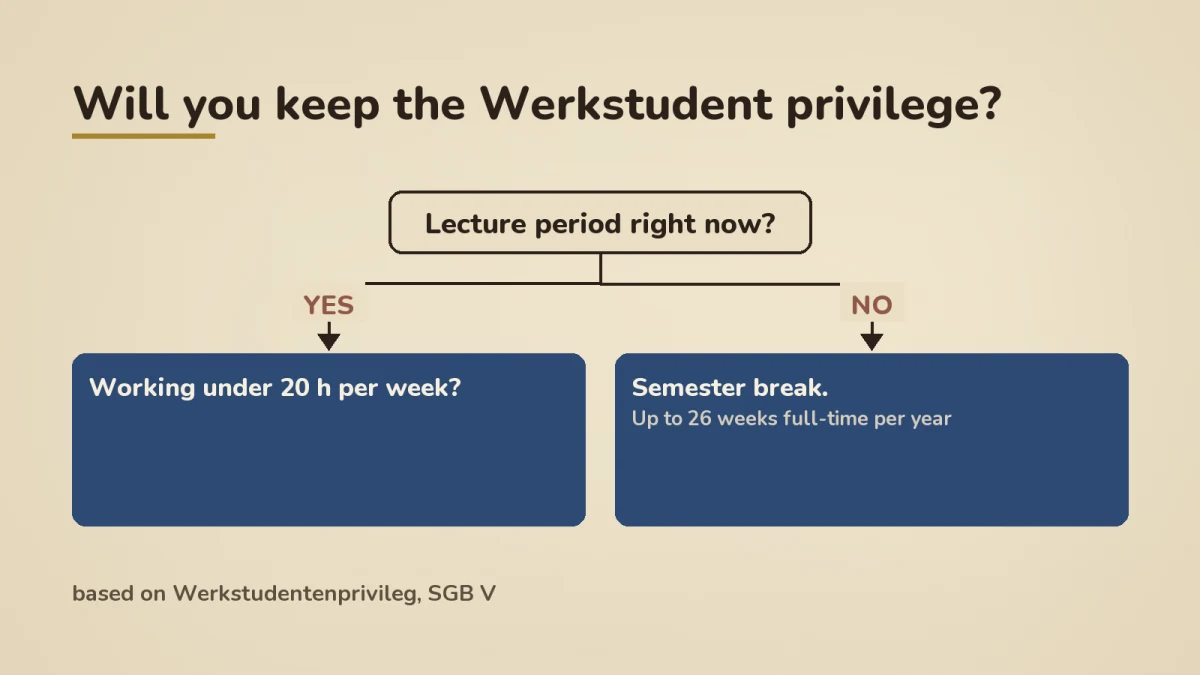
Two limits apply at the same time, and confusing them is the most common mistake.
| Limit | Source | What it caps |
|---|---|---|
| 20 hours per week (lecture period) | German social-insurance law | Whether you keep the Werkstudentenprivileg |
| 140 full days or 280 half days per year | Residence permit (visa) rule | Whether you stay legal under your student visa |
During the lecture period (Vorlesungszeit), 20 hours per week is the social-insurance ceiling. Cross it for a single week and the privilege does not apply that month. You owe the full employee share of health, unemployment, and care insurance, the employer owes their share, and your net pay drops accordingly.
During the semester break (Vorlesungsfreie Zeit), you can work full-time without losing the privilege, but only for up to 26 weeks across the year. Many international students treat the winter and summer breaks as the productive earning windows for exactly this reason.
The 140-day visa rule is separate. It counts any day you worked more than four hours as a "full day" and any day you worked four hours or less as a "half day". Werkstudent hours, mini-job hours, and internship days all count toward this annual budget. A regular Werkstudent contract at 20 hours per week across the academic year roughly uses your full 140-day budget on its own.
What does a Werkstudent earn at the 2026 minimum wage?
At €13.90 gross per hour and 20 hours per week, the math is:
- Gross monthly: €13.90 × 20 hours × 4.33 weeks = roughly €1,206 per month
- Pension contribution (employee share, 9.3 percent): roughly €112 per month
- Net cash to you: roughly €1,094 per month
That is before tax. In most cases there is no income tax to pay because the 2026 Grundfreibetrag (tax-free allowance) is €12,348 for the year. A Werkstudent on €1,206 gross times 12 months earns €14,472 gross, only the portion above the allowance is taxable, and the actual tax burden after standard deductions is small or zero. Filing an annual return usually returns whatever was withheld via Steuerklasse 1.
If your employer pays above the minimum wage, the privilege still applies as long as you stay under 20 hours per week during the lecture period. There is no salary cap on a Werkstudent. Engineering, IT, and consulting Werkstudent roles in Munich, Stuttgart, and Frankfurt routinely pay €18 to €25 per hour, which lifts the monthly gross to €1,560 to €2,165 without breaking the privilege.
The insurance traps every international student needs to know
These are the recurring mistakes we see every semester. Each one is preventable if you know about it before signing the contract.
Trap 1:
Crossing 20 hours for "just one week"
The 20-hour rule is not an average. It is a hard weekly ceiling during the lecture period. If you work 25 hours in one week to cover a project deadline, the privilege fails for the entire month, full social insurance kicks in, and you owe roughly 13 percent of your gross to your share of health, unemployment, and care insurance. The employer also owes their share, which is why most German employers will refuse to schedule you over 20 hours during lectures even when you offer.
Trap 2:
The pension contribution surprise
The 3.6 percent employee pension share you sometimes see online applies in specific opt-down scenarios that international students rarely qualify for. The default rate in 2026 is 9.3 percent of gross. On €1,206 gross that is €112 per month, every month. Plan for it. It is not optional, and it is not refundable when you leave Germany unless you formally apply through the Deutsche Rentenversicherung 24 months after your last contribution.
Trap 3:
Mini-job plus Werkstudent counts as one job
If you take a Werkstudent role and a mini-job at the same time, the social-insurance authorities aggregate the hours. Cross 20 hours combined, and the privilege fails the same way it would on a single contract. International students routinely sign a Werkstudent contract for 18 hours a week and add a 6-hour mini-job, then lose the entire privilege.
Trap 4:
Multiple Werkstudent contracts add up
Two Werkstudent contracts with different employers do not give you 40 hours per week. The 20-hour ceiling applies across all employment combined. Tell each new employer about your existing contract and ask them to verify with their payroll provider before you sign.
Trap 5:
Public holidays and paid sick days count toward the 20 hours
If your work week contains a public holiday for which you receive paid leave, those hours count toward the 20-hour weekly ceiling. The same is true for paid sick days. A 22-hour scheduled week that includes a paid public holiday will trigger a privilege review by the health insurer (Krankenkasse). The check is automated and triggered by the employer's monthly payroll filing.
Werkstudent vs Mini-Job vs Internship in 2026
These three contracts are often presented as alternatives, but they serve different goals. The choice depends on whether you want hours, money, or a CV line.
| Dimension | Werkstudent | Mini-Job | Paid internship (Praktikum) |
|---|---|---|---|
| Max gross per month | No cap (limited by 20h rule) | €603 (2026 limit) | No cap |
| Hours during lectures | 20 hours/week max | Flexible, capped by earnings | 20 hours/week max if voluntary |
| Social insurance | Pension only (Werkstudentenprivileg) | Employer pays flat 13% pension and 13% health (Pauschalabgabe) | Full insurance once you exceed minimum-wage thresholds |
| Tax | Steuerklasse 1, refundable | Tax-free up to limit | Steuerklasse 1, refundable |
| Career value | High : directly relevant industry experience | Low : service / retail roles | Highest : counts as real work experience |
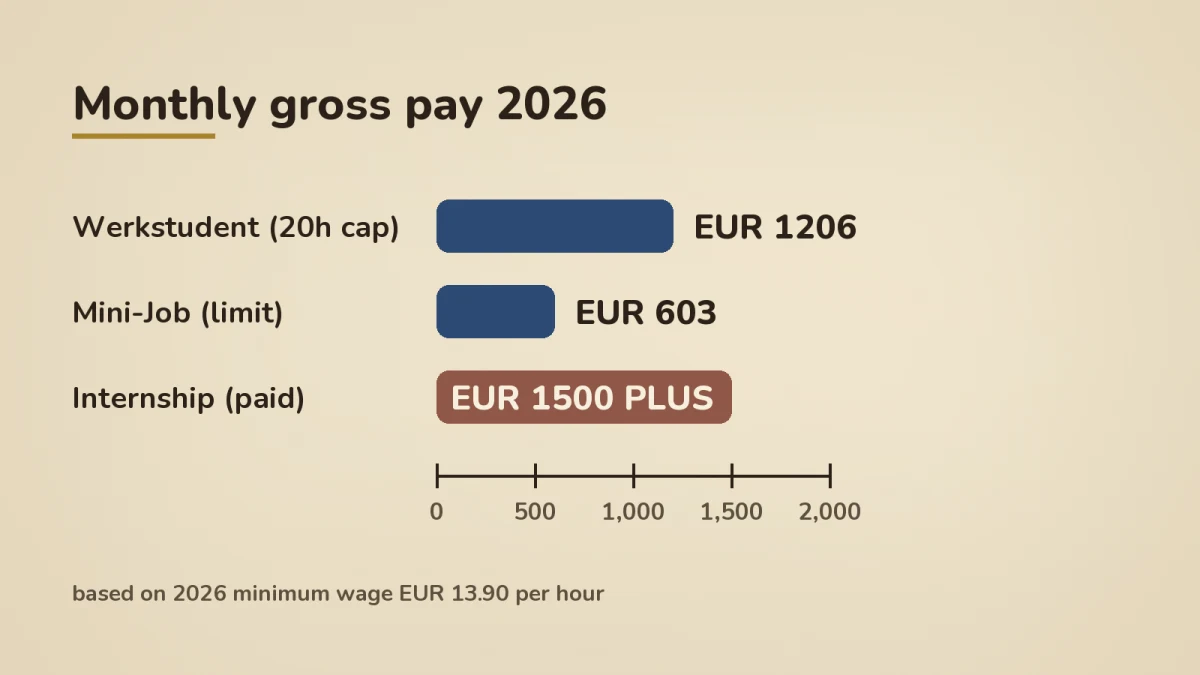
The right combination for most international students: a Werkstudent contract in your study field for industry experience plus a small mini-job over the summer break for cash. That keeps you under both the hour ceiling and the social-insurance threshold while building a CV you can use after graduation, when you transition to the post-study work visa and eventually to an EU Blue Card.
Common mistakes to avoid
- Signing a contract without reading the hours clause. Ask for it in writing in English or have a German-speaking friend read it before you sign.
- Believing the recruiter who says you can "do extra hours unofficially". Werkstudent payroll filings are automated. Krankenkasse and pension audits are routine. The privilege is not enforced on the employer's honour.
- Working through the semester break at full-time and forgetting it counts toward the 26-week annual full-time cap. Track it.
- Treating the 140-day visa rule and the 20-hour insurance rule as the same. They are not. You can break one without breaking the other, but it is easy to break both at once.
- Skipping the annual tax return. Most Werkstudent students earn under the Grundfreibetrag and get back whatever was withheld. The return takes 30 minutes via WISO or Smartsteuer and pays for itself.
FAQ
How is a Werkstudent different from a regular part-time job?
A regular part-time job (Teilzeit) is taxed and insured exactly like full-time employment, just for fewer hours. A Werkstudent contract is exempt from health, unemployment, and care insurance during the lecture period under the Werkstudentenprivileg. Same hours, same wage, very different net pay.
Do I need German language skills for a Werkstudent role?
Not always. IT, engineering, data, and research Werkstudent roles in larger companies often run in English. Customer-facing or admin roles usually require B2 German. Check the job ad. The most common pattern: technical Werkstudent contracts in Berlin, Munich, and Hamburg are English-speaking; everything else is German.
Can I do a Werkstudent role remotely from outside Germany?
No. The Werkstudentenprivileg requires the work to be performed in Germany. If you are physically outside Germany during the working hours, the privilege does not apply and the role becomes a regular employment contract under whichever country's labour law applies.
What happens if my Werkstudent role ends and I want to switch employers mid-semester?
You can switch freely. The 20-hour weekly limit and the 140-day annual visa limit are unaffected. Notify the Auslaenderbehoerde only if your residence permit lists a specific employer (rare for student permits). Update your Krankenkasse if your insurance arrangement changes.
Does my Werkstudent income affect my BAfoeG or scholarship?
If you receive BAfoeG (most international students do not), the income above an allowance reduces your monthly grant. For DAAD and most private scholarships, declare the work in your annual reporting. Some scholarship rules forbid paid work over 20 hours per week or 10 hours per week : read the contract.
Is Werkstudent income deducted from my visa proof of funds?
Indirectly. If you renew your residence permit, the Auslaenderbehoerde will look at your bank statements and your Werkstudent payslips together. Earnings reduce the amount you need to top up the blocked account by, since they prove ongoing financial means. Read our guide on the cost of living for international students for the broader picture.
What about taxes : will I owe anything?
Probably not. The 2026 Grundfreibetrag is €12,348 per year. A Werkstudent on €1,206 gross times 12 months earns €14,472 gross before pension contribution; the taxable portion after deductions is small. Most students get back whatever was withheld via the annual return. We have a deeper post on paying taxes as an international student.
Where to next
- Jobs in Germany for international students: part-time, mini-job, working student : broader category overview
- Internship opportunities for international students : when a Praktikum beats a Werkstudent
- Cost of living in Germany for international students : what your Werkstudent income needs to cover
- Paying taxes in Germany as an international student : annual return walkthrough
Continue reading
Career & Jobs·14 min read
Why Germany has 1M jobs and zero callbacks (and how to fix your application)
Germany has over 1 million open jobs but most foreign applicants get silence. Here is why your applications fail and how to fix the stack.
Read articleCareer & Jobs·15 min read
Chancenkarte Germany: Point system explained, real one-year results, who actually got in
Germany's Chancenkarte point system explained with a 6-point matrix, worked examples, and real one-year results from 2024 to 2025.
Read articleCareer & Jobs·13 min read
Universities in Berlin Offering Career Services: A Complete List
Looking for universities in Berlin offering career services? Explore our complete list of institutions providing career guidance, internships, and job placement support to help you succeed.
Read articleReady to plan your Germany journey?
Explore our tools and resources to find the perfect university and program for your academic goals.