Skilled Immigration Act 2.0: What changed for non-EU workers
Germany's Skilled Immigration Act 2.0 lowered Blue Card thresholds, launched Chancenkarte, and cut the PR wait. Here is what stands in 2026.

Table of contents
Last updated: May 2026
TL;DR: Germany's Skilled Immigration Act 2.0 (Fachkräfteeinwanderungsgesetz, in force since November 2023) lowered EU Blue Card salary thresholds, opened a route for IT specialists without a degree, launched the Chancenkarte points-based job-seeker card, and cut the wait for permanent residency. The 3-year citizenship fast-track was scrapped in October 2025; the rest of the package is still active in 2026.
If you are a non-EU professional planning a move to Germany, the Skilled Immigration Act 2.0 is the law you actually care about. It sets your salary floor for the EU Blue Card, it created the Opportunity Card (Chancenkarte), and it changed how fast you can apply for permanent residency. The official route into all of this is the /work pillar on msingermany.com, which routes by visa type.
This post covers what changed, what it means in 2026 numbers, and where the rules have already been rewritten since the original rollout.
What is the Skilled Immigration Act 2.0
The Fachkräfteeinwanderungsgesetz (FEG) was first passed in 2020. The 2.0 update was approved by the Bundestag in July 2023 and came into force in three stages: November 2023, March 2024, and June 2024. The core idea is to make it easier for non-EU skilled workers to move to Germany without losing the formal qualification standards.
Three pillars sit underneath the reform:
- The qualifications pillar, which broadens the EU Blue Card to more occupations and lowers the salary bar.
- The experience pillar, which lets people without German-recognised degrees come on the strength of work experience, especially in IT.
- The potential pillar, which uses the Opportunity Card to let job-seekers enter Germany on a points-based assessment, no job offer required upfront.
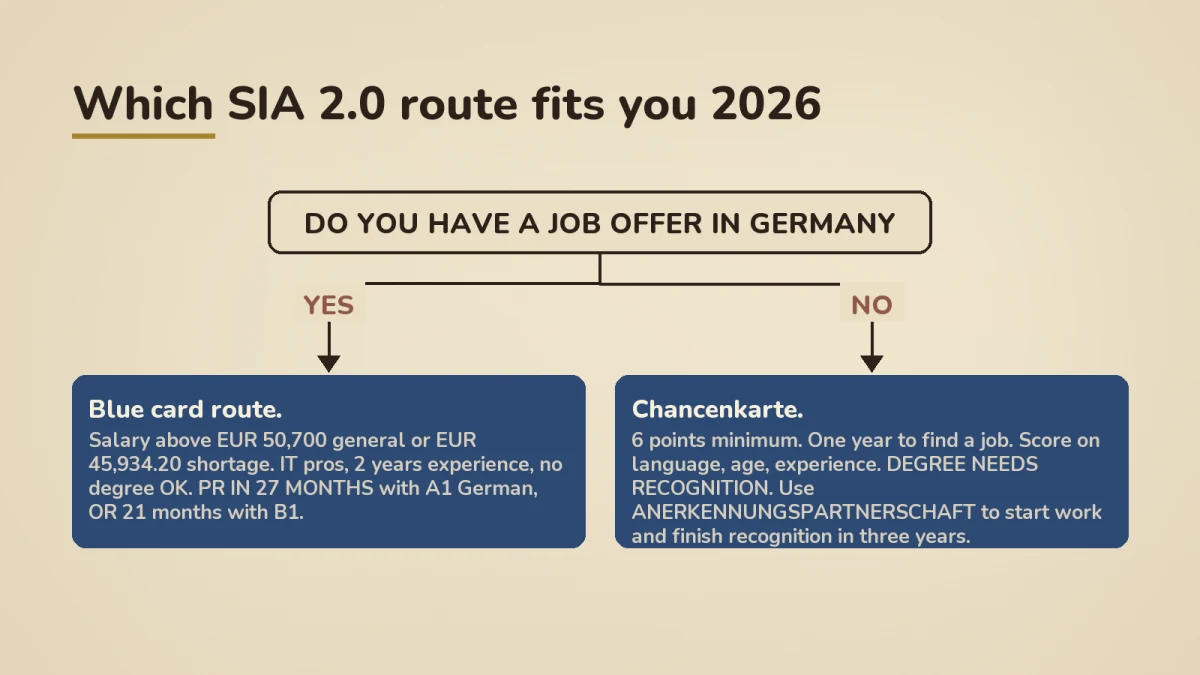
Blue Card thresholds in 2026: lower bar, more occupations
The Blue Card is the workhorse of skilled immigration into Germany. SIA 2.0 cut both salary thresholds and widened the list of professions that count as shortage occupations.
| Pre-reform (until Nov 2023) | 2026 (annually indexed) | |
|---|---|---|
| General threshold | EUR 58,400 | EUR 50,700 |
| Shortage occupation / recent graduate / IT-without-degree | Approx EUR 45,500 | EUR 45,934.20 |
The shortage occupation list now includes IT, MINT (math, IT, natural sciences, tech), engineering, healthcare, education, manufacturing, construction, and pharmacy. Recent graduates, defined as anyone whose foreign or German degree was awarded within the last three years, get the lower threshold automatically.
Numbers are republished by the Federal Employment Agency every January. Always check the current year before signing a contract: under-shooting by a few hundred euros means the application gets rejected.
IT specialists without a degree
This is the most underused route in SIA 2.0. If you have three years of relevant IT work experience within the last seven years and your German employer pays you above the shortage-occupation threshold, you qualify for a Blue Card with no formal degree at all.
Documentation needs to be tight: employment certificates with role, duration, and a clear technology stack. Letters of recommendation from previous employers help. The Auslandsportal at digital.diplo.de now accepts these uploads end-to-end in over 130 missions including New Delhi, Mumbai, Lagos, Manila, and Istanbul.
Chancenkarte: the points-based job-seeker card
Launched on 1 June 2024, the Opportunity Card lets you enter Germany for up to one year to look for work, on a points-based score. You need at least 6 points from a defined matrix that rewards qualification recognition, German or English language level, age, work experience, prior ties to Germany, and accompanying-spouse skills.
Real numbers from the IW Köln report: roughly 550 cards issued per month in the first year, against a government estimate of 25,000 per year. Roughly 27 percent of holders convert to a residence permit while in Germany. India, China, Turkey, Russia, and Pakistan are the top sending countries.
If you cannot meet Blue Card salary on day one, the Opportunity Card is the realistic route. Score your points before you apply: if you are short, the most movable variables are German language level (A2 to B1 is one extra point) and a job placement letter (one more point).
Recognition reform:
Anerkennungspartnerschaft
The biggest practical win for non-EU professionals whose qualifications need German recognition. Before SIA 2.0, you had to complete the ZAB recognition process in your home country before applying for a work visa. That cycle could take 12 to 18 months.
Anerkennungspartnerschaft, in force since March 2024, lets you and a German employer apply for recognition AND a residence permit at the same time. You enter Germany on the work permit, finish the recognition while employed, and your residence is conditional on completing it within three years.
This unblocks healthcare professionals, engineers, technicians, and teachers whose home-country credentials previously stalled the visa.
Faster permanent residency
SIA 2.0 cut the wait for the Niederlassungserlaubnis, Germany's permanent residence permit.
| Route | Pre-reform | After SIA 2.0 |
|---|---|---|
| Blue Card holder, A1 German | 33 months | 27 months |
| Blue Card holder, B1 German | 21 months | 21 months (unchanged) |
| Other skilled-worker visa | 4 years | 3 years |
For a Blue Card holder with A1 German, that is six fewer months waiting. For non-Blue-Card skilled workers, that is one fewer year. Read the /blog/fast-track-pr-germany breakdown for the document checklist and the order of operations.
What did NOT survive: the citizenship fast-track
The 2024 citizenship reform initially included a 3-year fast-track for "specially integrated" applicants on top of the standard 5-year path. That 3-year route was scrapped on 30 October 2025 by a coalition Bundestag vote. It is gone.
What remains in 2026:
- 5 years standard naturalisation residency.
- No separate 8-year route in the current §10 of the Nationality Act (StAG).
- Dual citizenship still allowed by default, with no renunciation requirement for non-EU citizens.
If you had been counting on the 3-year route, recalculate from the 5-year line. Time spent in Germany before SIA 2.0 still counts.
Common mistakes
- Using last year's threshold. Salary numbers are indexed every January. A contract signed in January 2026 needs the 2026 figure, not the 2025 one.
- Skipping the IT-without-degree route. Many applicants assume a degree is mandatory and apply for the Opportunity Card instead. If you have three years of IT experience and a job offer, the Blue Card is faster.
- Confusing Anerkennungspartnerschaft with full recognition. You still need to finish the recognition within three years of entry. The partnership just lets you start working sooner.
- Banking on the 3-year citizenship. It is gone. Plan for 5 years minimum.
- Bringing family without A1. Spouses still need A1 German. The 2024 pass rate for the A1 test for family reunion was 62 percent. Start the language prep early.
FAQ
Is the Skilled Immigration Act 2.0 still in force in 2026?
Yes. All three pillars are active: the lowered Blue Card thresholds, the IT-without-degree route, and the Chancenkarte. Only the 3-year citizenship fast-track was rolled back, in October 2025. The rest is intact.
What is the 2026 Blue Card salary threshold?
EUR 50,700 for general professions, EUR 45,934.20 for shortage occupations and recent graduates. These are gross annual figures and they are indexed by the Federal Employment Agency every January.
Can I get a Blue Card without a degree in 2026?
Yes, if you are an IT specialist with at least three years of relevant work experience in the last seven years and your German employer pays you above the shortage-occupation threshold. You do NOT need to convert your experience into a recognised qualification.
What is the difference between the Chancenkarte and the EU Blue Card?
The Chancenkarte is a one-year job-seeker card based on a points score. You enter Germany without a job and look for one. The Blue Card is a work residence permit that requires a confirmed job offer above the salary threshold. Most applicants who can clear Blue Card salary should aim for the Blue Card directly.
How long until I get permanent residency in Germany?
Blue Card holders: 21 months with B1 German, 27 months with A1. Other skilled-worker visa holders: 3 years. The clock starts when you register your residence in Germany after entry.
Can my spouse come with me on a Blue Card?
Yes. Blue Card and most skilled-worker visas allow spouse and minor children. The spouse can work in Germany without restriction. A1 German is still required for spouses, with a few exemptions.
Has the Opportunity Card replaced the Job Seeker Visa?
Mostly, for skilled workers. The classic 6-month Job Seeker Visa still exists for some profiles but the Chancenkarte is the default route for most non-EU applicants in 2026.
Where to next
- EU Blue Card complete guide for the visa-by-visa walkthrough.
- What is the Opportunity Card for the points matrix and worked examples.
- Fast-track pathways to permanent residency for the document checklist.
- What is ZAB in Germany for credential recognition steps.
- For consultation on the right route, the /work pillar has the live visa-routing tool.
Continue reading
Visa & Immigration·15 min read
How to Ace Your Student Visa Interview for Bachelor’s in Germany
Get expert tips on how to successfully navigate your student visa interview for Bachelor's in Germany. Learn what to expect, how to prepare, and what to say to impress the interviewer.
Read articleVisa & Immigration·20 min read
German Student Visa for Bachelor’s in Germany
This guide provides a step-by-step process for obtaining a German student visa for bachelor's aspirants. From eligibility criteria to document requirements, visa application submission, and interview preparation, this comprehensive guide covers everything you need to know to navigate the visa application journey with confidence and secure your place in a German university.
Read articleVisa & Immigration·7 min read
Residence Permit in Germany for International Students
Discover a complete guide on residence permit in Germany for international students. Learn the importance, steps, and required documents for a hassle-free registration process.
Read articleReady to plan your Germany journey?
Explore our tools and resources to find the perfect university and program for your academic goals.