Germany Job Seeker Visa 2026: Who qualifies after the Chancenkarte launch and real timelines
Germany's Job Seeker Visa still exists alongside the Chancenkarte and the post-study work permit. Who qualifies for each in 2026, real timelines, and costs.

Table of contents
Last updated: May 2026
TL;DR: The traditional Germany Job Seeker Visa still exists in 2026, but it now sits alongside two newer pathways: the Chancenkarte (Opportunity Card) introduced June 2024, and the 18-month post-study work permit for graduates of German universities. The right one depends on whether you have a recognized qualification, where you are studying or working, and how strong your German is. None of these are guaranteed; all of them depend on your Anabin recognition and the embassy your file lands in.
If you are a non-EU professional planning to move to Germany to find work, the Job Seeker Visa pillar page is the umbrella term most search engines still use. The actual law has fragmented since the Skilled Immigration Act 2.0 overhaul. There are now three separate residence permits that all let you enter Germany without a job offer in hand, and the rules for each are different.
This guide explains who qualifies for each pathway in 2026, what timelines to expect from filing to flight to first paycheck, and the mistakes that cause six-month embassy queues to end with a refusal letter.
The three pathways in 2026 and which one applies to you
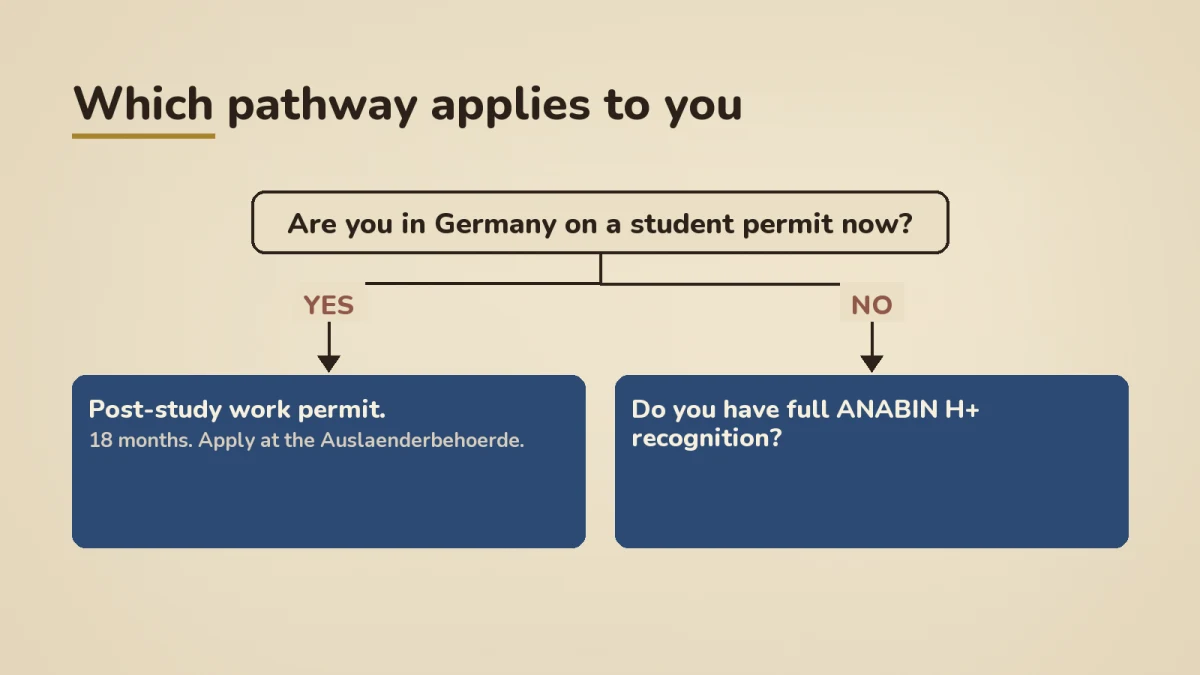
After June 2024, three German residence permits let you enter the country without an existing employment contract:
- Traditional Job Seeker Visa, §20 AufenthG. Six months. For skilled workers from third countries with a recognized vocational or academic qualification.
- Chancenkarte (Opportunity Card), §20a AufenthG. Twelve months. Points-based. Allows part-time work up to 20 hours per week and trial employment up to two weeks per employer during the search.
- Post-study work permit, §20.3 AufenthG. Eighteen months. Issued inside Germany to graduates of German universities; not a visa you apply for from abroad.
The post-study permit is structurally different. You are already in Germany on a student permit when you apply, so your Ausländerbehörde issues it without an embassy step. The other two are visas you apply for at the German embassy in your home country before flying, with the online filing now routed through the digital.diplo.de portal before the in-person biometrics appointment.
If you finish your degree at a German university, you go to the post-study permit. If you have a recognized qualification but you are based outside Germany, you choose between the traditional JSV and the Chancenkarte. The traditional JSV is shorter but lighter on paperwork; the Chancenkarte is longer but you must score 6 points on a fixed matrix.
Who qualifies for the traditional Job Seeker Visa
The §20 visa is the original "fly to Germany, find a job, switch to a work permit" route, and it is still active in 2026. The Federal Ministry of the Interior (BMI) confirms that the job-search visa enables interested skilled workers from third countries to come to Germany for six months in order to look for a job.
Eligibility:
- Recognized vocational training (at least two years) OR a foreign university degree comparable to a German qualification. Comparability is checked against the Anabin database (
anabin.kmk.org). - Proof of livelihood for the full six months. In practice this is either a Sperrkonto (blocked account) or a notarised sponsorship letter (Verpflichtungserklärung) from a host in Germany.
- Health insurance covering the entire stay.
- Proof of accommodation for the first weeks.
The visa is non-renewable. You cannot extend it inside Germany. If you do not find a qualifying job within six months, you must leave and re-apply from outside if you want another shot.
The financial proof for 2026 mirrors the student blocked account amount, with monthly minimums set by the Auswärtiges Amt and the BAMF. Most embassies expect roughly €1,000 to €1,100 per month, though the exact figure is published per embassy and changes annually.
Who qualifies for the Chancenkarte and how the points work
The Chancenkarte is the §20a Aufenthaltsgesetz residence permit launched on 1 June 2024. It runs for twelve months and explicitly allows you to work part-time during the job search, which the older JSV does not.
There are two ways to qualify:
Track A: recognized qualification. If your foreign degree is fully recognized in Germany (Anabin H+ status with full equivalence), you skip the points test and qualify automatically. You still need to prove livelihood and health insurance.
Track B: points-based. If you have a foreign qualification that is recognized in your country of training but not yet fully equivalent in Germany, you can still qualify by scoring at least 6 points on this matrix.
| Category | Criterion | Points |
|---|---|---|
| Qualification recognition (partial) | Foreign qualification recognized in country of training | Required baseline |
| German language | A1 | 1 |
| German language | A2 | 2 |
| German language | B1 | 3 |
| German language | B2 or higher | 4 |
| English language | C1 (or English as native language) | 1 |
| Professional experience | At least 2 years in the last 5 | 2 |
| Professional experience | At least 5 years in the last 7 | 3 |
| Age | 35 or under at application | 2 |
| Age | 35 to 40 | 1 |
| Shortage occupation | Profession listed as shortage occupation | 1 |
| Prior stay in Germany | At least 6 months legal stay in last 5 years (not tourism) | 1 |
| Spouse or partner | Spouse or registered partner also meets Chancenkarte criteria and applies jointly | 1 |
Note: a recognized qualification is the baseline; without it, the points alone will not get you the permit. You need at least 6 points across the optional categories on top of that baseline. The Federal Foreign Office page for Chancenkarte at the embassy in Phnom Penh lists the exact wording most consulates apply.
Financial proof for the Chancenkarte in 2026 sits at roughly €1,091 per month, which translates to a blocked account of around €13,000 for the full year. The figure is reset by the BAMF each January and individual embassies publish their own minimum.
Two things make the Chancenkarte materially better than the traditional JSV:
- You can work up to 20 hours per week during the job search. That income covers groceries and rent in mid-cost cities like Leipzig or Bremen and means the year is not pure burn rate.
- You can do trial employment up to two weeks per employer. This is a legal "Probearbeit" window built into §20a; you cannot do this on the traditional JSV.
Real timelines from filing to first paycheck
The honest answer is that "six months" or "twelve months" measures the wrong thing. The clock that matters is filing → embassy slot → entry → first qualifying job offer → switch to work permit. Here is what each stage actually takes in 2026:
| Stage | Traditional JSV | Chancenkarte | Post-study permit |
|---|---|---|---|
| Document prep including Anabin | 2 to 4 months | 2 to 4 months | None, already in Germany |
| Embassy appointment wait | 4 to 12 weeks | 6 to 16 weeks | None |
| Visa decision after appointment | 4 to 8 weeks | 6 to 12 weeks | 4 to 8 weeks at the Ausländerbehörde |
| Stay window once issued | 6 months | 12 months | 18 months |
| Typical time to first qualifying offer | 3 to 5 months | 4 to 8 months | 4 to 9 months |
| Switch to Blue Card or work permit | 6 to 10 weeks | 6 to 10 weeks | 6 to 10 weeks |
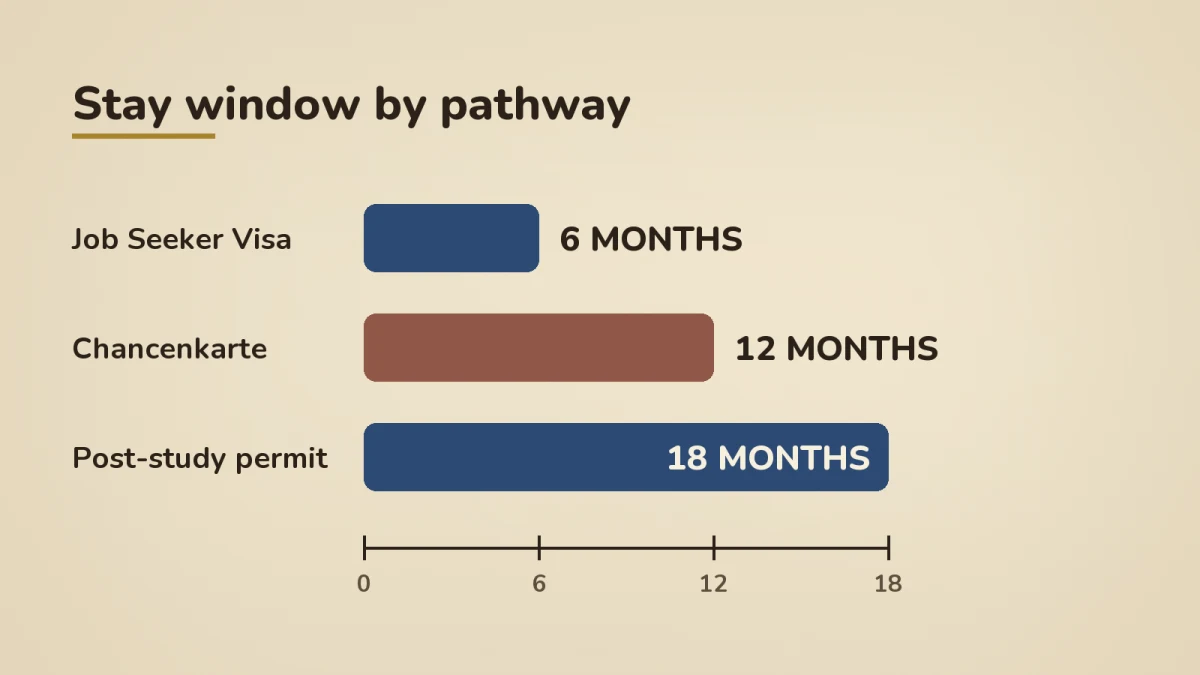
Two patterns dominate. First, the Chancenkarte's longer window is real, but it does not buy you twice as much job-search runway. It buys you a calmer process, the right to work 20 hours a week, and the right to do trial work that often becomes the offer. Second, the embassy backlog is the largest variable: New Delhi, Mumbai, Lagos and Manila are all at the upper end of the appointment-wait range in 2026, while embassies in smaller mission countries are notably faster.
If you find a qualifying job during the search window, you switch to either the EU Blue Card (if salary clears the 2026 threshold and your degree is academic) or a Skilled Worker Visa under §18a or §18b. Both are issued by the Ausländerbehörde, not the embassy. The Blue Card route is typically faster because the salary threshold acts as a built-in test and the case officer has fewer judgement calls to make.
What it actually costs
Pre-departure, the realistic 2026 budget is:
- Embassy fee: €75
- Document translation and notarisation: €150 to €400
- Apostille and document logistics: €100 to €250
- Anabin certificate of comparability (Zeugnisbewertung), if you go that route: €200
- Health insurance for the search window: €70 to €110 per month
- Blocked account: €13,000 (Chancenkarte) or roughly €6,500 (traditional six-month JSV)
- Flight, deposit, first month rent: €2,000 to €3,500
Most candidates spend €700 to €1,200 on the application stack itself, and the largest line item by far is the blocked account cash. Sperrkonto money is not lost; you draw it down month by month after entry. But it must sit in a recognised provider's account before the embassy will approve you. See our blocked account providers comparison if that is your bottleneck.
Common mistakes that get applications refused
- Submitting a degree that is not in Anabin. If your university or programme is not in the database, the embassy cannot verify equivalence inside the appointment slot. File a Zeugnisbewertung with the ZAB three months before booking.
- Confusing Chancenkarte and Job Seeker Visa. They share the same intent but they are different legal permits with different documents. Embassy systems will reject a Chancenkarte file submitted on the traditional JSV cover sheet and vice versa.
- Underfunding the blocked account. The 2026 number is not the 2024 number. Embassies refuse files missing even one month of the current per-month minimum.
- Treating the JSV as a tourist trip. The visa carries an obligation to actively job-search. Long unexplained gaps in registration history can be cited at extension or switch time.
- Filing the post-study permit too late. German graduates have a window starting the day they pass their final exam, but the Ausländerbehörde wants the file before the student permit expires. File at least 8 weeks before the student-permit end date.
- Skipping German. B1 alone earns you 3 points on the Chancenkarte and roughly doubles interview callbacks for non-English-language roles. The cheapest single lever in the entire process.
FAQ
Can I apply for both the traditional Job Seeker Visa and the Chancenkarte?
No. They are mutually exclusive permits issued under different sections of the Aufenthaltsgesetz. You file for one or the other. Most embassies will reject duplicate applications and you may bias the case officer against you. Pick the route that matches your strongest profile and prepare it well.
Does the Chancenkarte replace the Job Seeker Visa?
No, not yet. The Skilled Immigration Act 2.0 introduced the Chancenkarte alongside the traditional JSV without abolishing the older permit. As of 2026, both are in force. The Chancenkarte is the better default for most applicants because of the longer window and the right to work part-time, but the traditional JSV remains valid for skilled workers who already have a clean Anabin H+ recognition and prefer the lighter paperwork.
Can I bring my spouse on a Job Seeker Visa or Chancenkarte?
Family reunification is not automatic during the search window. Spouses and dependent children typically join only after you switch to a work permit such as the Blue Card. The Chancenkarte rules allow spouses to apply jointly under the points system, which is a softer path if your partner also has a recognized qualification.
What happens if I do not find a job within the search window?
You must leave Germany. The traditional JSV is non-renewable. The Chancenkarte can in some cases be extended by up to 24 months total if you have a concrete employment contract awaiting, but this is at the discretion of the Ausländerbehörde and not guaranteed. After leaving, you can re-apply from abroad after a cooling-off period, often around six months. See our fast-track to permanent residency guide for what comes after a successful switch.
Do I need a job offer to apply for either visa?
No. Both the Job Seeker Visa and the Chancenkarte are designed for applicants without an existing offer. That is the entire point: you fly into Germany, attend interviews in person, and switch to a work-permit category once you have signed a contract.
How does the post-study work permit differ if I am already studying in Germany?
The 18-month post-study permit is issued by your local Ausländerbehörde, not by an embassy abroad. You do not need a blocked account, you do not need a points test, and you can work without restriction during the 18 months. The catch is that you must apply before your student permit expires, with proof of graduation and continuing health insurance. See our Chancenkarte explainer for how the points system compares to the Anabin route.
Which embassies are fastest in 2026?
Booking-wait times in 2026 vary widely. Indian missions (New Delhi, Mumbai, Bengaluru, Chennai, Kolkata) are running at the upper end of the published wait times. Manila, Lagos and Tehran are also slow. Smaller posts in Eastern Europe and Latin America tend to clear within four to six weeks. Whichever post you use, book the appointment first; documents can be polished while you wait.
Where to next
Continue reading
Career & Jobs·10 min read
Payscale in Germany: Average Gross Remuneration by Profession and Region
Discover the average gross remuneration in Germany by profession and region. Learn how much you can earn as a student or professional and work out your ROI. Explore the payscale in Germany and make an informed decision for your higher studies.
Read articleCareer & Jobs·15 min read
Chancenkarte Germany: Point system explained, real one-year results, who actually got in
Germany's Chancenkarte point system explained with a 6-point matrix, worked examples, and real one-year results from 2024 to 2025.
Read articleCareer & Jobs·14 min read
Why Germany has 1M jobs and zero callbacks (and how to fix your application)
Germany has over 1 million open jobs but most foreign applicants get silence. Here is why your applications fail and how to fix the stack.
Read articleReady to plan your Germany journey?
Explore our tools and resources to find the perfect university and program for your academic goals.