Apply for a German visa online: Step-by-step on the digital.diplo.de portal (2026)
Germany's digital.diplo.de portal is the official online channel for national visas in 2026. Three steps, one applicant per file: how it works.

Table of contents
Last updated: May 2026
TL;DR: Germany's official online visa portal is digital.diplo.de, run by the Federal Foreign Office. In 2026 it is the default channel for national visas (study, work, training, family) at most German missions worldwide, including the German missions in India. You still book one in-person appointment at the mission for biometrics; everything before that happens online.
For most readers in 2026, applying for a German national visa starts on a single web page: digital.diplo.de. The Federal Foreign Office calls it the "Consular Services Portal" in English and "Auslandsportal" in German. It replaces the legacy Videx PDF form that students and skilled workers used to print, sign, and bring to the consulate. If you are heading to Germany for study, an Ausbildung, a job, the Opportunity Card, or to join family, the portal is where your application now begins. See the broader visa-types overview for which residence path matches your situation.
This is a how-to, not a sales page. The portal itself is free. There is no agent step you must pay for to access it.
What digital.diplo.de actually does
The portal is the front door for national visas, the long-stay category 1 you need for any stay over 90 days or for any purpose tied to a residence title (study, work, family reunion, training). Schengen short-stay visas (under 90 days, tourism or short business) are not handled here; those go through the responsible mission's local channel.
What the portal does:
- Hosts the application form for each visa category, in English and German.
- Lets you upload supporting documents directly, instead of bringing photocopies on the day.
- Routes the file to your responsible German mission, which runs a preliminary review and asks for missing documents through a chat-style thread inside the portal.
- Confirms when the file is complete and tells you what to bring to your in-person biometrics appointment.
Currently the portal handles one applicant per application. If you are travelling as a family, each adult files separately; minor children's applications are usually still submitted on paper at the mission.
Which visas you can apply for online
The portal lists every long-stay category the Foreign Office issues. The most common ones for our readers:
| Category | Use this for |
|---|---|
| Study purposes and seeking a university place | Master's, Bachelor's, Studienkolleg, university applicant visa |
| Basic or advanced training and search for a training place | Ausbildung, vocational upgrades, training-place search |
| Blue Card (EU) | Skilled workers with a recognised degree and a qualifying job offer |
| Opportunity Card (Chancenkarte) | Job-seeker route based on points, no offer needed up front |
| Skilled worker with academic degree | Job offer plus recognised degree, non-Blue-Card route |
| Skilled worker with vocational training | Job offer plus recognised non-academic training |
| Work experience visa | Two years of relevant experience plus recognised qualification |
| Family reunion: spouse, child, parent | Joining a partner, child, or parent already in Germany |
If you are not sure which one fits, the portal has a Visa Navigator that asks five or six questions and points you at the right form. Use it before you start filling anything in; switching categories midway means restarting.
How the process works in 2026
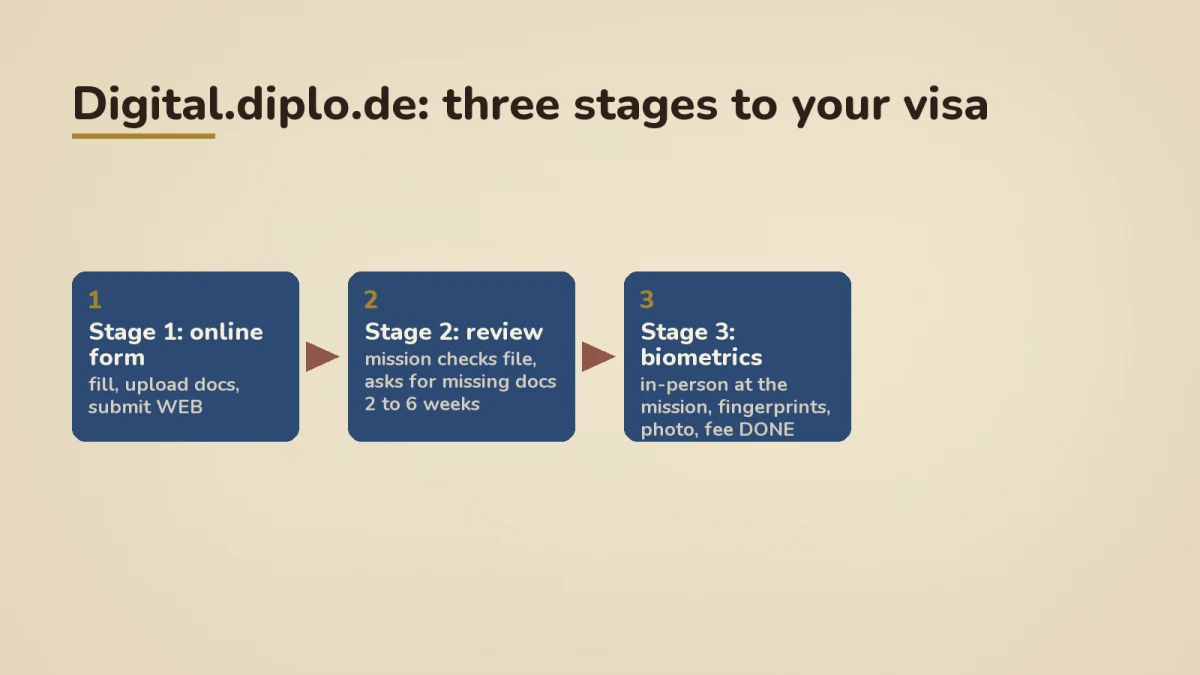
Every application moves through three stages, regardless of category.
1. Complete the application online
You create an account on the portal, pick your visa type and the mission responsible for your address, and fill in the form. The portal saves drafts so you can stop and come back. You upload supporting documents as PDFs or JPGs: passport copy, admission letter or job contract, proof of finances (a blocked account, sponsorship, salary slip, or scholarship letter), health insurance, biometric photo, and any category-specific extras. Once the file feels complete, you submit it for preliminary review.
2. Wait for the preliminary review
The German mission reads your file and decides whether anything is missing. Communication happens inside the portal in a thread linked to your application; the mission no longer sends emails for missing documents. Turnaround depends on the mission and the season. Reviewers usually ask for one or two clarifications before clearing the file.
3. Attend the in-person biometrics appointment
After the file passes review, the mission invites you to book a slot. At the appointment you confirm your identity, give fingerprints and a face photo, hand over the original documents the reviewer asked you to bring, and pay the fee. At the German missions in India the national visa fee is EUR 75 (INR 8,300) for adults and EUR 37.50 (INR 4,200) for applicants under 18. After the appointment, the mission sticks the visa label in your passport, and the German missions in India say processing can take several months depending on the visa category.
If you are anxious about the appointment, the appointment booking and cancellation guide is worth reading; the rules differ from mission to mission.
What you need before you start
The portal flags missing fields, but it cannot guess at documents you have not yet collected. Before opening the form, have these ready:
- Passport valid for at least one year past your planned arrival, with two blank pages.
- Proof of purpose: admission letter, signed job contract, training contract, or, for the Opportunity Card, your points score sheet.
- Financial proof matching the visa: a Sperrkonto certificate for student visas, a salary slip and contract for work visas, a sponsorship declaration (Verpflichtungserklärung) for some family cases.
- Health insurance covering Germany from day one. Travel insurance is acceptable only for the first 90 days; you will switch to statutory or private cover on arrival.
- One biometric photo in the current digital format (35 x 45 mm, neutral expression, plain background).
- All academic or professional certificates the category requires, plus their certified translations where the mission asks for them.
Common mistakes to avoid
A handful of patterns cause most preliminary-review rejections.
- Applying through the wrong domain. The portal is
digital.diplo.de. Anything else (an "official partner", a paid agent's form, a Videx PDF) is either obsolete or a third party. - Filing under the wrong mission. The mission responsible for you depends on your registered address, not your nationality. The Foreign Office's Consulate Finder returns the right one in two clicks.
- Trying to apply for a partner or child inside the same file. The portal accepts one applicant per application; a second person needs a second account.
- Uploading photos as Word or HEIC files. Stick to PDF and JPG; HEIC and DOCX often fail silently.
- Submitting before your admission letter or contract is signed. Reviewers will reject; you keep your slot in the queue but lose two to four weeks.
- Booking the biometric appointment before the preliminary review clears. Some missions allow it, most do not, and a wasted slot adds weeks.
- Skipping the motivation letter on student visa files. The portal does not always mark it as required, but reviewers expect one.
FAQ
Is digital.diplo.de free to use?
Yes. The portal is operated by the Federal Foreign Office and there is no fee to register, fill in, or submit an application. You only pay the visa fee in cash or card at the in-person biometrics appointment.
Do I still need to visit the consulate in person?
Yes. Biometric data (fingerprints and a face photograph) and identity verification still happen in person at the responsible German mission. Only the form, the documents, and the back-and-forth review move online.
Can my family apply together?
No. The portal currently supports one applicant per application. Each adult opens their own account. Minor children's applications are still typically submitted on paper at the mission.
Which missions accept online applications in 2026?
Over 130 missions worldwide are live, including the German missions in India (the Embassy in New Delhi and the consulates in Mumbai, Chennai, Kolkata and Bengaluru), Islamabad, Manila, Cairo, Tehran, and most posts in the Americas, Africa, and East Asia. The portal itself confirms availability when you select your country and visa type.
What is the difference between digital.diplo.de and Videx?
Videx is the legacy PDF form that you used to download, fill in, and bring printed to the consulate. It is being phased out for national visas. If a mission is on the new portal, you should not use Videx; if a mission is not yet on the portal, the consulate will tell you which form to use locally.
How long does the preliminary review take?
It varies by mission, season, and category. Skilled-worker and Blue Card files often clear faster than student visas because the document set is smaller. The German missions in India say processing can take several months, depending on the category of your national visa. Apply early.
Can I track my application status?
The German missions in India say there is no way to track your application online, and they do not answer status inquiries within the first three months after you file your application.
What if my visa is rejected?
You receive a reasoned decision and a window to appeal (Remonstration) or re-apply. Most rejections are document-based, not character-based; fix the gap and try again. Read the rejection prevention guide before you appeal.
Where to next
- The visa-types overview maps each digital.diplo.de category to the residence permit you receive on arrival.
- If you are filing a Master's student visa, the student visa guide walks through the document set in detail.
- If your mission still uses the Videx form, the VIDEX walkthrough covers every field.
- Once your file is in, the appointment booking guide explains how to lock a biometric slot.
Continue reading
Visa & Immigration·7 min read
Residence Permit in Germany for International Students
Discover a complete guide on residence permit in Germany for international students. Learn the importance, steps, and required documents for a hassle-free registration process.
Read articleVisa & Immigration·15 min read
How to Ace Your Student Visa Interview for Bachelor’s in Germany
Get expert tips on how to successfully navigate your student visa interview for Bachelor's in Germany. Learn what to expect, how to prepare, and what to say to impress the interviewer.
Read articleVisa & Immigration·20 min read
German Student Visa for Bachelor’s in Germany
This guide provides a step-by-step process for obtaining a German student visa for bachelor's aspirants. From eligibility criteria to document requirements, visa application submission, and interview preparation, this comprehensive guide covers everything you need to know to navigate the visa application journey with confidence and secure your place in a German university.
Read articleReady to plan your Germany journey?
Explore our tools and resources to find the perfect university and program for your academic goals.